

The cup on the box has been polite fiction for decades. A 15 cup coffee maker holds seventy-five fluid ounces, measured in the five-ounce serving the industry adopted back when diners poured demitasses, and no household since has drunk from one at breakfast. Translated into modern mugs, that is nine full eight-ounce pours with a splash left over, or barely five rounds from the fourteen-ounce travel tumbler a teenager guards like property. Whether the surplus earns its counter space depends less on the number stamped on the box than on how your particular crowd moves between six and nine in the morning.
This guide follows four households that genuinely use the volume: a six-person family sprinting through one shared forty-minute exit, a host feeding a brunch table, a three-desk shop where the machine barely cools between cycles, and a summer batch-cooler who brews hot purely to pour it cold. It keeps score in ounces, grams, and minutes throughout, because capacity succeeds or fails on arithmetic long before taste joins the conversation.
When a Twelve-Cup Pot Dies Mid-Family
Take six people with alarms staggered between 6:20 and 7:00 and a front door that closes behind the last of them at 7:35. Two fill insulated travel mugs at fourteen ounces each; four pour ceramic mugs of eight. Together they draw exactly sixty ounces, which is precisely the entire output of a standard twelve-cup machine. There is no margin in that equation. One overnight guest, one refill request, one commuter wanting a half-cup for the road, and somebody downstairs is staring into an empty carafe with keys already in hand.
Fifteen cups restores the margin: seventy-five ounces absorbs that same morning and leaves fifteen more standing for whoever circles back before lunch. The catch sits in the chassis. Machines in this class commonly measure twelve to fourteen inches wide and deep, stand fifteen to seventeen inches tall, and weigh more than ten pounds before any water goes in. Measure the gap between countertop and cabinet before ordering; if that clearance runs under eighteen inches, a tall unit either wedges beneath with no room to lift the carafe free or lives shoved forward into your cutting-board territory every single day.
Brunch Refills Are the Second Reason
Weekend hosting kills smaller pots in a different way. Put six guests around a Sunday table and the mugs get topped off rather than emptied, so consumption outruns anyone’s mental tally. Run dry mid-meal and the choices turn ugly: abandon the eggs, load fresh grounds, and wait out another eight-to-ten-minute cycle while the pan smokes, or make the apology. A fifteen-cup reservoir brews once at 8:45 and carries the table through to the last pancake.
Dosing trips up hosts more often than hardware does. A full pot asks for about 120 grams of ground coffee, call it two dozen level tablespoons, which is enough that scooping by feel reliably lands weak. Weigh the portion into a jar the night before and the morning reduces itself to one button press. Carafe construction then decides how the meal unfolds: a sealed stainless carafe can leave the machine entirely, sit on the table for an hour, and stay honestly hot, while a glass carafe parked on a hotplate begins tipping toward scorched after thirty to forty minutes of neglect.
One Machine, Four Heavy Drinkers, All Morning
A two-room office or home business compresses the same problem into ordinary weekdays. Count a heavy drinker at three eight-ounce cups before noon, twenty-four ounces apiece, and four such drinkers push demand past ninety-six ounces by eleven, already beyond one full fifteen-cup pot. Expect two complete cycles before lunch in that setting and plan around them: first brew at opening, immediate rinse and reset, second pot while the room is fullest. Machines asked to pull double duty daily earn their keep or expose their weaknesses fast, which is why shared spaces chew through cheap brewers so quickly.
Nobody babysits a carafe at work, so the warmer’s shut-off behavior outweighs nearly every other feature. A fixed two-hour plate will happily cook the last inch into syrup; better machines let you shorten the hold to thirty minutes or stretch it toward four, matching the day’s actual pace. Replacement parts deserve a check too. A model whose carafes remain purchasable for twenty dollars survives office life; a discontinued orphan turns the whole appliance into landfill the first time someone chips a handle.
Brewing Hot to Pour Cold
The least obvious power user treats the machine as an iced-coffee plant. Brew all seventy-five ounces at 6:30, refrigerate what the family doesn’t drink hot, and the fridge covers four to six tall iced coffees through the rest of the morning. Melting ice claims roughly a quarter of a finished glass, so brewing toward the strong edge of the ratio pays off double here; the dilution that ruins a mild pot merely corrects this one.
Hot glass imposes rules. A carafe lifted straight off the burner can crack against cold refrigerator shelves, so give it twenty minutes to settle or decant into a pitcher first. Stainless thermal vessels shrug off the transition but hide the fill level, which matters once you are rationing a batch across a Saturday afternoon. Notice what this scenario never required: no cold-brew tower, no second appliance crowding the outlet. The same machine that handles the school year handles July, assuming its lid seals well enough for a shelf.
What Fifteen Cups Costs You the Other Five Days
Honesty requires the debit column. A full pot finishes in seven to ten minutes, noticeably longer than a twelve-cup cycle, because comparable heaters push proportionally more water through a deeper bed. The footprint claims a serious share of an average counter, and the loaded glass carafe approaches seven pounds, nearly five of them liquid, which matters for anyone with grip complaints. An unadjusted hotplate will quietly spoil the final third of every leisurely pot.
The quieter truth is that most owners of a 15 cup coffee maker hit the full fifteen cups once or twice a week. Tuesday wants six mugs; Thursday wants four. That gap is why the small-batch features deserve closer inspection than the maximum does. A dedicated 1-4 cup mode slows the water dispersal so a shallow grounds bed extracts at the pace a full one would; omit it and weekday coffee from a big machine tends to taste faintly of nothing. Legible low-volume graduations on the carafe help for the same reason, since eyeballing forty ounces against walls marked for seventy-five is precisely how weak pots happen.
The Hardware That Decides Whether Big Batches Taste Right
Volume amplifies whatever the machine does badly. Begin with the showerhead, the perforated arm that spreads water across the grounds. A wide, even spray soaks the entire basket; a narrow spout drenches the center and abandons the edges, and in a basket sized for 120 grams of coffee that unevenness shows up plainly in the cup. Extraction temperature belongs in the same conversation: flavor dissolves best between 195 and 205 degrees Fahrenheit, and long draws punish heaters that sag late in the cycle.
Carafe style then splits along familiar lines. Glass over a hotplate shows the level, costs less, and punishes inattention; sealed stainless holds heat for two to three hours untended and forgives a distracted household, at the price of pouring blind until you peek. While comparing, weigh the small logistics: a basket deep enough to hold the full dose without lifting the lid, a spout that pours without dribbling down the flank, pause-and-pour for rescuing a cup around minute four. None of these sell the capacity story on the box. All of them decide whether the fifteenth cup ever gets finished.
How much ground coffee goes into a full 15-cup pot?
Plan on about 120 grams, which follows the Specialty Coffee Association’s golden ratio of roughly 55 grams per liter across the pot’s 2.2 liters of water. Scoop-only kitchens can read that as two dozen level tablespoons, though a tablespoon’s weight swings with grind size, so a small scale removes the guesswork for about the cost of lunch. Treat 120 grams as a starting point rather than scripture. Nudging the dose ten percent in either direction tunes strength without touching anything else, and pre-weighed jars make the whole question disappear on busy weekends.
Is a 15-cup coffee maker overkill for a two-person household?
Usually, unless one of the honest exceptions applies. Two drinkers finishing three eight-ounce cups each draw only forty-eight ounces, comfortably inside what a twelve-cup machine provides, so the extra capacity mostly buys leftover coffee aging on a warmer. The case flips when guests visit often, when summers run on chilled batches, or when one member of the pair drinks like the office crew described earlier. If weekdays stay quiet, spend your scrutiny on the small-batch mode instead of the size. A big machine that brews six cups well beats a correctly sized one that cannot.
Do 15-cup machines take longer to brew than 12-cup models?
A full pot generally lands between seven and ten minutes, somewhat slower than a twelve-cup cycle because the heater pushes proportionally more water through a larger bed. Per ounce the pace is nearly identical, so the delay is the volume talking rather than sluggish engineering. Pause-and-pour shapes the perceived wait more than raw speed does: pulling the carafe around minute four yields a serviceable first cup while the remainder finishes behind it. If mornings are timed to the minute, start the brew before the shower and let the machine race you instead.

MUELLER HOME
Large-Batch Coffee Brewing with the Mueller 12-Cup Drip Coffee Maker
The Mueller 12-Cup Drip Coffee Maker brews up to 60 ounces, with a reusable filter that reduces ongoing waste and filter costs. It suits households, offices, and frequent coffee drinkers who want large or smaller 2-cup and 4-cup batches with simple cleanup.
Pros and Cons
Pros
- The 60-ounce carafe offers enough capacity for up to 12 cups while supporting smaller batches.
- The reusable filter can lower recurring paper-filter costs, although paper filters remain compatible.
- Borosilicate glass provides heat resistance and does not absorb coffee odors.
- Non-slip feet, a non-drip carafe, and two-hour automatic shutoff improve everyday convenience and safety.
Cons
- The permanent filter needs to be removed and cleaned regularly unless disposable paper filters are used.
- The warming plate turns off after two hours, so coffee will not remain heated beyond that period.
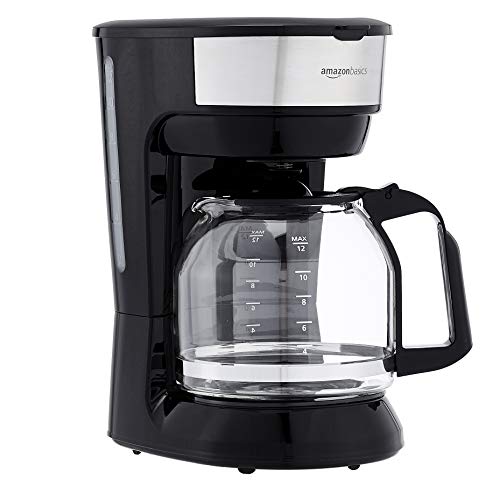
Amazon Basics
12-Cup Drip Coffee Maker for Home, Apartment, or Office | Amazon Basics
The Amazon Basics 12-cup coffee maker brews drip coffee with a reusable filter and warming plate, making it easy to keep a full pot hot. It suits homes, apartments, and offices that need straightforward brewing in a compact design.
Pros and Cons
Pros
- The 12-cup capacity supports multiple servings from one brew cycle.
- The reusable filter basket reduces ongoing disposable filter use and simplifies cleanup.
- The warming plate keeps coffee hot without scorching while the machine remains on.
- The indicator light makes it clear when the coffee maker is active.
Cons
- The basic ON/OFF design does not provide programmable start scheduling.
- The product data does not specify its weight, which may matter when moving it in a compact kitchen.
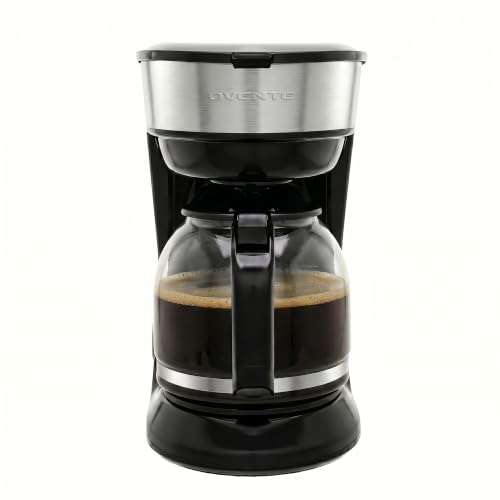
OVENTE
Brew 12 Cups at Once with the OVENTE CM412B Drip Coffee Maker
The OVENTE CM412B brews up to 12 cups in its 1.8-liter glass carafe, reducing the need for multiple batches when serving several people. It suits households, offices, and frequent hosts who value simple one-touch brewing and a reusable filter.
Pros and Cons
Pros
- Its 12-cup capacity is useful for families, office kitchens, brunches, and other multi-person servings.
- The dishwasher-safe borosilicate glass carafe simplifies cleanup after brewing.
- The included reusable filter supports flavor extraction while reducing disposable-filter waste.
- Simple on/off operation makes the machine accessible for buyers who do not need complex settings.
Cons
- The listed controls are limited to a basic on/off switch, so it may not suit buyers seeking programmable brewing options.
- The reusable filter must be removed and cleaned, although paper filters can be used instead.

Hamilton Beach
Under-Cabinet Coffee Brewing Made Easy: Hamilton Beach FrontFill 12-Cup Programmable Coffee Maker
The Hamilton Beach FrontFill 12 Cup Programmable Drip Coffee Maker simplifies under-cabinet brewing with a front-access reservoir and swing-open basket. It suits households that want scheduled coffee, adjustable brew strength, and the option to pour before brewing finishes.
Pros and Cons
Pros
- The FrontFill reservoir and front-opening brew basket improve access in tight countertop spaces.
- Programmable brewing supports wake-up-ready coffee without manual start-up each morning.
- The brew strength selector provides regular, bold, and 1–4 cup options.
- Auto Pause & Pour allows serving during the brewing process.
Cons
- The product data does not specify materials, dimensions, or weight, so countertop fit and portability are harder to assess.
- Its cleaning reminder indicates that owners need to run the self-cleaning cycle periodically.
MUELLER HOME Large-Batch Coffee Brewing with the Mueller 12-Cup Drip Coffee Maker
MUELLER HOME
Large-Batch Coffee Brewing with the Mueller 12-Cup Drip Coffee Maker
The Mueller 12-Cup Drip Coffee Maker brews up to 60 ounces, with a reusable filter that reduces ongoing waste and filter costs. It suits households, offices, and frequent coffee drinkers who want large or smaller 2-cup and 4-cup batches with simple cleanup.
$27.97 at AmazonEditors' Favorite
Color: Black Size: 12 Cup Dimensions: 10.55 x 7.68 x 12.52 Inches Weight: 3.75 pounds Product Group: Kitchen Binding: Kitchen
Shop NowGourmia Drip Coffee Maker - 12-Cup Capacity, Glass Carafe, Black

Great Value
Color: Black, Stainless Steel Size: 12 Cup Dimensions: 10 x 7.5 x 12 inches Weight: 3 pounds Product Group: Kitchen Binding: Kitchen
Shop NowAmazon Basics 12-Cup Drip Coffee Maker for Home, Apartment, or Office | Amazon Basics
Amazon Basics
12-Cup Drip Coffee Maker for Home, Apartment, or Office | Amazon Basics
The Amazon Basics 12-cup coffee maker brews drip coffee with a reusable filter and warming plate, making it easy to keep a full pot hot. It suits homes, apartments, and offices that need straightforward brewing in a compact design.
Check PriceColor: Black & Stainless Steel Size: 12-Cup Dimensions: 11.81 x 7.09 x 12.13 inches Weight: 2.91 pounds Product Group: Kitchen Binding: Kitchen
Shop NowOVENTE Brew 12 Cups at Once with the OVENTE CM412B Drip Coffee Maker
OVENTE
Brew 12 Cups at Once with the OVENTE CM412B Drip Coffee Maker
The OVENTE CM412B brews up to 12 cups in its 1.8-liter glass carafe, reducing the need for multiple batches when serving several people. It suits households, offices, and frequent hosts who value simple one-touch brewing and a reusable filter.
$21.99 at AmazonColor: Black Size: 1.8 L Dimensions: 0 x 0 x 0 inches Product Group: Kitchen Binding: Kitchen
Shop NowHamilton Beach Under-Cabinet Coffee Brewing Made Easy: Hamilton Beach FrontFill 12-Cup Programmable Coffee Maker
Hamilton Beach
Under-Cabinet Coffee Brewing Made Easy: Hamilton Beach FrontFill 12-Cup Programmable Coffee Maker
The Hamilton Beach FrontFill 12 Cup Programmable Drip Coffee Maker simplifies under-cabinet brewing with a front-access reservoir and swing-open basket. It suits households that want scheduled coffee, adjustable brew strength, and the option to pour before brewing finishes.
$49.99 at AmazonColor: Black Size: 3 Brewing Options Dimensions: 12.9 x 7.95 x 13.9 Inches Weight: 5 pounds Product Group: Kitchen Binding: Kitchen
Shop Now




Write Your Review
No reviews yet. Be the first to share your experience!