

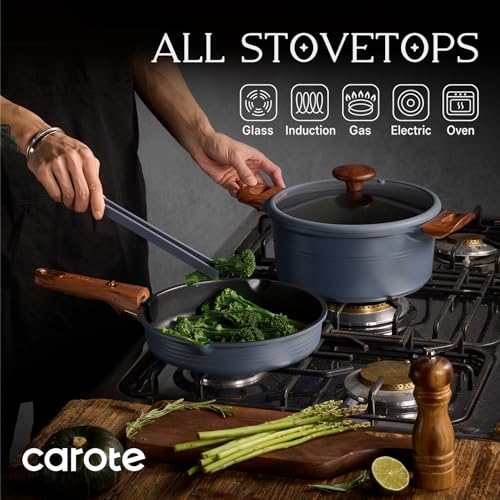
TL;DR — To use a cookware set well, match each pan’s material to the job: stainless steel for searing and pan sauces, nonstick for eggs and delicate foods, and heavy pots for stews and boiling. The trick to stainless steel not sticking is heat and patience — preheat the empty pan until a drop of water beads and skates across it (the Leidenfrost effect), then add oil, then the food, and let it release on its own. Use low-to-medium heat for nonstick, never preheat it empty, and hand-wash both to protect them. For picks, see our best cookware sets guide.
The HomeWhisk editorial team researches cookware by analyzing material construction, heat behavior, and aggregated owner feedback from communities like Reddit r/Cooking and major retailers. A cookware set gives you a range of pans, but most people use only two or three because no one explained what each is for or how to keep food from sticking. This guide fixes that — it covers what’s in a set, which pan to reach for, and the specific techniques (especially for stainless steel) that separate frustration from clean, professional results. For choosing a set, see our best cookware sets guide.

What’s in a Cookware Set and What Each Piece Does
A typical 10- to 12-piece set counts lids as pieces and usually includes:
- Frying/sauté pans (8″ and 10-12″): Wide, flat, low sides for searing, sautéing, and frying. The workhorses.
- Saucepans (1.5-3 qt): Tall, narrow, for sauces, grains, reheating, and small-batch boiling.
- Stockpot / Dutch oven (5-8 qt): For soups, stews, pasta water, and braises. A heavy one retains heat for slow cooking.
- Sometimes a sauté pan with straight sides for shallow frying and braising larger amounts.
The pieces you’ll actually use every day are the two frying pans and one saucepan. The rest fill in as your cooking grows. If you cook stovetop espresso or one-pot meals, a moka pot and a pressure cooker complement a set well — see our best moka pot and best instant pot guides.
Know Your Materials (This Determines Everything)
Cookware sets come in different materials, and each behaves differently on the stove:
- Stainless steel (usually with an aluminum or copper core, called “clad” or “tri-ply”): Doesn’t react with acidic food, browns beautifully, oven- and dishwasher-safe, and nearly indestructible. It sticks unless you use the right technique — covered below. Best all-around for searing and pan sauces.
- Nonstick (PTFE/ceramic coating): Food releases with little oil, ideal for eggs, pancakes, and fish. But the coating wears out in a few years, hates high heat, and can’t take metal utensils. A support player, not a do-everything set.
- Cast iron / enameled cast iron: Massive heat retention for searing and braising; holds temperature when food hits the pan. Heavy and slow to heat.
- Copper: The fastest, most responsive heat control, prized for delicate sauces and candy work, but expensive and high-maintenance. See our best copper cookware guide.
- Anodized aluminum: Light, fast-heating, durable — often the base for nonstick sets.
Most home cooks are best served by a stainless steel core set plus one or two nonstick pans for eggs. Match the material to the task rather than forcing one pan to do everything. Compare full-material sets in our best cookware sets and best nonstick cookware guides.
The Big One: How to Stop Stainless Steel From Sticking
Sticking is the number-one complaint about stainless steel, and it’s almost always a heat-and-timing problem, not a defect. Here’s the technique that fixes it:
1. Preheat the empty pan on medium for a couple of minutes. Stainless steel needs to be hot before anything goes in — this is the step most people skip. 2. Run the water test (Leidenfrost effect). Flick a few drops of water into the pan. If they sizzle and evaporate immediately, it’s not hot enough yet. When the drops form beads that skate and roll across the surface like mercury, the pan is at the right temperature. This happens because the pan is hot enough to instantly vaporize the bottom of the droplet, which lifts it on a cushion of steam. 3. Add oil now, not before. Cold oil in a cold pan seeps into the metal’s microscopic pores and bonds food to it. Hot pan first, then oil, and swirl to coat. 4. Add the food and leave it alone. Protein sticks when it first hits the pan, then releases itself once a seared crust forms. If it’s stuck, it’s not ready to flip — wait, and it will lift cleanly.
Get the temperature right and stainless steel becomes nearly nonstick for searing. For eggs and delicate fish, still reach for a nonstick pan — it’s the right tool for those.
Using Each Pan for the Right Job
- Searing steak or chicken: Stainless steel or cast iron, preheated hot, food left undisturbed to crust.
- Eggs, omelets, pancakes, delicate fish: Nonstick on low-to-medium heat.
- Pan sauces: Stainless steel — the browned bits (fond) that stick to the bottom deglaze into sauce, which nonstick can’t produce.
- Simmering sauces, grains, reheating: Saucepan on low.
- Soups, stock, pasta, braises: Stockpot or Dutch ovens; a heavy one for slow braises.
- Acidic foods (tomato, wine, citrus): Stainless steel or enamel, never bare cast iron or worn nonstick.
Matching heat level matters as much as the pan: nonstick should never go above medium (high heat degrades the coating and can scorch it), while stainless steel and cast iron thrive on higher heat for searing.
Cooktop Compatibility and Heat Management
- Induction needs magnetic cookware. Stainless steel and cast iron usually work; some aluminum and copper don’t unless they have a magnetic base. Check for an induction symbol.
- Gas works with everything; the flame responds instantly, so lower it before food scorches.
- Electric/ceramic glass wants flat-bottomed pans for good contact; avoid dragging heavy cast iron across glass tops.
A universal rule: preheat gradually and cook on lower heat than you think. Clad stainless and aluminum spread heat well, so medium usually does what beginners try to do with high — and high heat is what warps thin pans and burns food.
Cleaning and Maintenance
- Stainless steel: Dishwasher-safe, but hand-washing keeps it shiny. For stuck-on fond or rainbow “heat tint,” a paste of baking soda or a stainless cleaner like Bar Keepers Friend restores it. Deglaze with water while the pan is warm to lift residue easily.
- Nonstick: Hand-wash only, soft sponge, no abrasives or metal tools. Never use cooking spray (it builds a sticky residue that ruins the coating) and never heat it empty.
- Cast iron: Never soak; dry immediately and re-oil to maintain seasoning.
- All pans: Let a hot pan cool before plunging it into cold water — thermal shock warps metal and cracks nonstick.
Treated right, a good stainless set lasts decades while nonstick is a consumable you’ll replace. For sets built to last, see our best cookware sets guide; for travel and outdoor kits, our best camping cookware guide.
Frequently Asked Questions
How do you use a stainless steel pan without sticking?
Heat the empty pan first, then test it with water: when a few drops form beads that glide across the surface like mercury (the Leidenfrost effect), it’s at the right temperature. Add oil at that point — not to a cold pan — swirl to coat, then add your food and leave it undisturbed. Protein sticks on contact but releases itself once a seared crust forms, so if it won’t budge, it isn’t ready to flip. Cold pan or cold oil is what causes sticking, not the steel.
What temperature should a stainless steel pan be before adding oil?
Hot enough to pass the water test. Preheat on medium for a couple of minutes, then flick in a few drops of water. If they sizzle and vanish instantly, keep waiting; when they bead up and skate across the pan, it’s ready — that’s roughly 300-350°F at the surface. Add oil then, let it shimmer, and add food. Adding oil to a cold pan lets it seep into the metal’s pores and bond food to the surface, which is the usual cause of sticking.
What oil should I use in a stainless steel pan?
Use an oil with a smoke point above your cooking temperature. For high-heat searing, choose refined oils like avocado, grapeseed, canola, or light/refined olive oil, which handle 400°F+ without breaking down and smoking. Save extra-virgin olive oil and butter for lower-heat cooking or finishing, since they smoke and burn sooner. Add the oil only after the pan is preheated and passes the water test, so it stays fluid and coats the surface rather than soaking into the metal.
Which cookware works on an induction cooktop?
Induction only heats magnetic cookware, so the pan’s base must be ferromagnetic. Most stainless steel and all cast iron work; test by seeing if a magnet sticks firmly to the bottom. Plain aluminum and copper don’t work unless the maker added a magnetic base layer, and many induction-ready sets are labeled with a coil symbol. If you have or plan to get an induction stove, confirm compatibility before buying, since a beautiful copper or aluminum set may not heat at all on it.
What are the must-have pieces in a cookware set?
Three pieces cover most cooking: a 10-12 inch frying or sauté pan for searing and sautéing, a 2-3 quart saucepan for sauces and grains, and a large stockpot or Dutch oven for soups, pasta, and braises. Add a small nonstick skillet for eggs and delicate foods. Everything else in a big set is a bonus you may rarely touch. Buying a smaller set of quality pieces you’ll actually use beats a huge boxed set of thin ones. See our best cookware sets guide for balanced options.
How do I clean stuck-on food and heat stains from stainless steel?
For stuck-on food, deglaze the warm pan with a splash of water to loosen the residue, then wash normally. For burnt-on spots, simmer water with a little baking soda, then scrub. The rainbow or bluish “heat tint” that appears on stainless is harmless and comes from overheating; remove it with a stainless cleaner like Bar Keepers Friend or a baking-soda paste, rubbing in the direction of the grain. Avoid steel wool, which scratches. Let the pan cool before washing to prevent warping.
The Bottom Line
Using a cookware set well is mostly about matching the pan to the task and managing heat. Reach for stainless steel or cast iron when you want a seared crust and a pan sauce, nonstick when you want eggs and fish to slide free, and a heavy pot for anything slow and wet. The stainless-steel sticking problem that frustrates so many cooks disappears once you preheat the empty pan, use the water-bead test, add oil to the hot pan, and let food release itself. Keep nonstick on low-to-medium heat, hand-wash it, and let hot pans cool before washing. Do that and a good set will cook better and last far longer. For choosing your set and adding specialty pieces, see our best cookware sets, best nonstick cookware, and best copper cookware guides.


Write Your Review
No reviews yet. Be the first to share your experience!