

A combo drip and espresso machine promises to end a very common kitchen argument: one person wants a big mug of plain coffee first thing, the other wants a latte, and nobody wants two separate machines eating up the counter. These hybrids put a drip carafe on one side and an espresso group with a steam wand on the other, in a single housing. That sounds tidy, and sometimes it is exactly right. But whether one earns its place depends far more on how your household actually drinks coffee than on the spec sheet. Below are the scenarios I see most often, and how a combo fits each one.
The couple where one drinks drip and one drinks lattes
This is the scenario combos were built for. Picture a weekday morning: one person pours a full 10-cup carafe of regular coffee to get through the day, while the other pulls a shot, steams a little milk, and makes a flat white. With a combo, both happen from one appliance sharing one water reservoir and one power cord. Nobody is waiting for a second machine to warm up.
The catch is timing. Many combos use a single heating system, or a boiler and a heating element that don’t love running at the same moment. If the drip side is mid-brew, the espresso side may pause until it finishes, or the steam wand may run weak. For most couples that’s a non-issue, because you’re making the shot while the carafe drips and the two finish within a couple of minutes of each other. It only bites if both of you are rushing out the door at the exact same second every day. If that’s you, look specifically for a model with independent heating for each side, and expect to pay more for it.
One honest note: the espresso from a combo is usually good, not exceptional. The steam wands tend to be shorter and less powerful than what you’d get on a dedicated espresso machine at the same price. If the latte drinker is happy with a solid morning cup and isn’t chasing café-grade microfoam, a combo keeps everyone satisfied. If they’ve started watching latte-art videos, that’s a sign the household may eventually want a standalone espresso setup.
The small kitchen with no counter space
Here the appeal is obvious and the reality is more mixed. A combo replaces two machines with one, which frees up a slot on a crowded counter. That’s real. But combos are wide. Because they sit two brewing systems side by side, a lot of them run 15 to 17 inches across and need clearance above for a hinged lid and behind for a removable reservoir. Before you buy, measure the actual footprint, not just the width in the headline, and check the height under your upper cabinets.
There’s a second small-kitchen trap: the water tank. Some combos share one reservoir between both sides, which is convenient, but a shared 60-ounce tank drains fast if you’re running a full carafe plus a few shots, meaning more trips to the sink. Others split the tank, which is nice for control but adds bulk. For a genuinely tight kitchen, a shared-reservoir model with a front-facing tank you can refill without pulling the machine off the wall is the sweet spot. If your counter is so small that even a combo won’t fit comfortably, a pod machine with a milk frother sold separately may serve you better than forcing a wide hybrid into the space.
The weekend entertainer
Say you host brunch a couple of times a month. Six people show up, half want regular coffee and half want cappuccinos, and you’d rather be cooking than playing barista for an hour. This is where a combo can shine in a way a single espresso machine can’t. You start a full carafe for the drip crowd, then work through espresso drinks one at a time while the carafe holds the plain coffee warm on its plate. One machine, two streams of drinks, and you’re not pulling twelve separate shots.
The limitation shows up on the espresso side under load. Combos generally have a smaller portafilter and a modest steam boiler, so making eight milk drinks back to back means you’ll be re-steaming and waiting between each one. It’s fine for a relaxed morning; it’s slow if you’re trying to serve a crowd fast. My advice for the entertainer: lean on the drip carafe for volume, treat the espresso side as a nice extra for the two or three guests who really want it, and don’t promise the whole table lattes. If espresso for a crowd is your main event, a machine with a larger boiler and a dual-spout portafilter matters more than the combo convenience.
What actually matters when you’re choosing one
Ignore the long feature lists and focus on a handful of things that change daily use. First, the heating setup: single-boiler models are cheaper but make you wait between drip and steam, while dual-heating models let both sides work closer to together. Second, the steam wand. A proper articulating wand that you control manually will make far better milk than a fixed automatic frother, which tends to produce thin, bubbly foam. Third, the grinder question. Most combos take pre-ground coffee on both sides, so a good separate grinder does more for your cup quality than almost any built-in feature.
Also weigh the boring stuff, because it decides whether you keep using the machine. Combos have more parts to clean: a carafe, a portafilter, a drip tray, a steam wand, and sometimes two water tanks. Look for removable, dishwasher-safe pieces and a wand that wipes clean easily. Check that the carafe pours without dribbling and that the controls are separate for each side rather than crammed into one confusing panel. A machine you clean in two minutes gets used every day; one that takes fifteen ends up unplugged in a cabinet.
When a combo is the wrong call
Be honest about your own habits. If everyone in the house drinks the same thing, you don’t need a hybrid, you need the best single machine for that one drink. A household of straight-drip drinkers is better served by a good standalone drip brewer with a thermal carafe. A household of committed espresso people should put their money into a dedicated machine and grinder, where the same budget buys noticeably better shots and steam. Combos also tend to be the first appliance to break in a way that’s hard to fix, since two systems in one box means twice the parts that can fail, so a household that runs equipment hard should weigh long-term reliability against the space savings.
The combo makes the most sense in the genuinely split household: mixed drinkers, limited space, and a willingness to accept espresso that’s good rather than perfect in exchange for one machine doing both jobs. If that describes your kitchen, a combo is a smart, practical buy. If it doesn’t, one of the specialized paths above will make you happier.
Frequently asked questions
Can a combo machine make drip coffee and espresso at the same time?
It depends on the heating design. Models with a single boiler usually make you finish one process before starting the other, so you’ll brew the carafe and then pull shots, or the reverse. Models with independent heating for each side let you run both close to simultaneously, which is worth paying for if two people leave the house at the same minute every morning. For most homes the small wait between drip and espresso is unnoticeable, because you naturally stagger the two drinks.
Is the espresso from a combo machine as good as a dedicated espresso machine?
Generally no, and it helps to expect that going in. At a given price, a combo splits its budget across two brewing systems, so the espresso side gets a smaller boiler and a less powerful steam wand than a standalone would. The result is solid, enjoyable espresso and decent milk foam, but not café-level shots or fine microfoam. If good-enough espresso alongside real drip coffee suits your household, the tradeoff is fair. If espresso quality is your priority, buy a dedicated machine instead.
How much counter space do I really need for one?
More than you’d guess. Because they place two systems side by side, most combos run 15 to 17 inches wide and need extra room above for a lid that lifts and behind for a reservoir you slide out to refill. Measure the full footprint plus the height under your cabinets before buying, not just the width listed in the title. If clearance is tight, choose a model with a front-loading water tank so you can top it up without dragging the machine forward every time.

De'Longhi
Home Espresso, Cold Brew, and Latte Drinks with the De'Longhi La Specialista Arte Evo
The De'Longhi La Specialista Arte Evo grinds, brews espresso, steams milk, and makes cold brew in under five minutes, with its biggest advantage being four built-in drink presets. It suits home baristas who want fresh-ground coffee and hands-on control without buying a separate grinder.
Pros and Cons
Pros
- Four presets cover Espresso, Americano, Cold Brew, and Hot Water without requiring separate brewing equipment.
- The 15 bar Italian pump manages low-pressure pre-infusion and reaches the optimal 9 bar extraction pressure.
- Eight grinder settings provide useful control when adjusting beans for extraction.
- The compact design and dishwasher-safe removable parts suit kitchens with limited space and busy routines.
Cons
- The semi-automatic design requires hands-on grinding, tamping, extraction, and milk steaming.
- The product data does not specify materials or weight, so buyers cannot assess those build details before purchase.

Cuisinart
Coffee Center Barista Bar 4-in-1 Coffee Maker for Coffee, Espresso, Lattes and Cappuccinos
The Cuisinart Coffee Center Barista Bar makes up to 12 five-ounce cups of coffee plus single-serve coffee, espresso, lattes, and cappuccinos, with its biggest advantage being four brewing options in one machine. It suits households with varied coffee preferences because it supports drip coffee, K-Cup-style pods, and Nespresso OriginalLine-style capsules.
Pros and Cons
Pros
- Four brewing functions cover drip coffee, K-Cup-style pods, espresso capsules, and milk-based coffee drinks.
- Three single-serve sizes make it easier to control serving volume.
- Programmable brewing, brew strength control, Brew Pause, and extended keep-warm settings add daily convenience.
- The permanent gold-tone filter and charcoal water filter reduce reliance on disposable coffee filters.
Cons
- The product data does not specify the machine's dimensions, weight, or construction materials.
- Single-serve pods and Nespresso OriginalLine-style capsules are separate compatibility formats, so buyers should confirm their preferred capsules before purchasing.

Grindora
Home Espresso, Latte and Cold Brew Station: Grindora Espresso Machine with Grinder and PID Control
The Grindora espresso machine grinds, doses, brews, and froths coffee, with 44 grind settings providing precise control over extraction. It suits home baristas who want to prepare espresso, Americano, latte, cappuccino, and cold brew without buying separate appliances.
Pros and Cons
Pros
- Forty-four grind settings provide more adjustment range than basic built-in grinders.
- PID control offers selectable brewing temperatures of 194°F, 198°F, and 205°F.
- Pre-infusion can reduce channeling by wetting the coffee bed before full-pressure extraction.
- The stainless steel construction and integrated grinder create a durable-looking, space-conscious home coffee station.
Cons
- The included 51mm portafilter has a smaller accessory ecosystem than the widely used 58mm professional format.
- Temperature adjustment is limited to three preset levels rather than continuous degree-by-degree control.

Gevi
Make Lattes and Cappuccinos at Home: Gevi 20 Bar Espresso Machine with Grinder
The Gevi espresso machine grinds beans, pulls single or double shots, and steams milk, with its 30-setting conical burr grinder providing the biggest advantage for dialing in fresh espresso. It suits home coffee drinkers who want customizable café-style drinks without buying a separate grinder.
Pros and Cons
Pros
- A built-in conical burr grinder with 30 settings supports freshly ground espresso without a separate appliance.
- The 20 bar Italian pump is designed to produce rich, full-bodied extraction.
- PID and NTC controls regulate temperatures for both espresso brewing and milk frothing.
- The steam wand handles microfoam, hot water dispensing, and flushing for routine cleaning.
Cons
- The listing does not provide dimensions, weight, or material details, so buyers cannot easily confirm countertop fit or exterior durability.
- The adjustable grinder, dosing, temperature, and steam controls may require experimentation before producing consistent drinks.
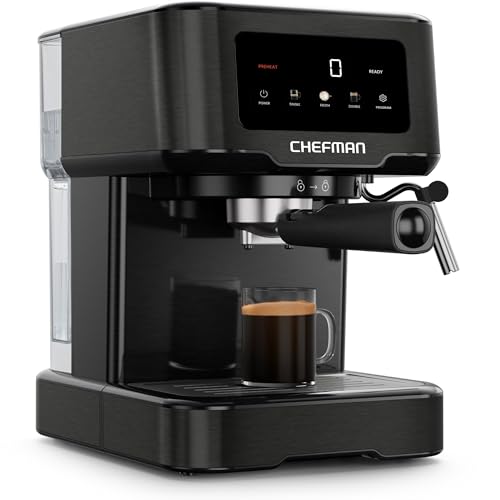
Chefman
Home Lattes and Cappuccinos: Chefman CraftBrew 15-Bar Digital Espresso Machine
The Chefman CraftBrew prepares single or double espresso shots and steamed-milk drinks, with programmable shot volume providing useful control over strength. It suits home coffee drinkers who want lattes, cappuccinos, lungos, and ristrettos from one compact machine.
Pros and Cons
Pros
- The 1350-watt machine combines espresso brewing and manual milk steaming in a compact countertop design.
- Programmable shot volume offers more flexibility than machines limited to fixed single and double pours.
- The large removable water tank reduces refilling when preparing drinks for several people.
- cETL approval and Chefman's one-year assurance provide documented safety and warranty coverage.
Cons
- The manual steam wand requires practice to achieve consistent milk texture.
- No built-in coffee grinder is listed, so buyers may need pre-ground espresso or a separate grinder.
The Best Deals This Week*
-
Home Espresso, Latte and Cold Brew Station
$249
($299.99)Save $50.99 -
Make Lattes and Cappuccinos at Home
$289.99
($359.99)Save $70.00 -
Home Lattes and Cappuccinos
$84.99
($129.99)Save $45.00
*Deals are selected by our commerce team
Ninja Luxe Café Premier Espresso & Rapid Cold Brew, Black, ES601BK

Editors' Favorite
Color: Black Size: 12.99" L x 13.39" W x 14.57" H Dimensions: 12.99 x 13.39 x 14.57 inches Product Group: Kitchen Binding: Kitchen
Shop NowDe'Longhi Home Espresso, Cold Brew, and Latte Drinks with the De'Longhi La Specialista Arte Evo
De'Longhi
Home Espresso, Cold Brew, and Latte Drinks with the De'Longhi La Specialista Arte Evo
The De'Longhi La Specialista Arte Evo grinds, brews espresso, steams milk, and makes cold brew in under five minutes, with its biggest advantage being four built-in drink presets. It suits home baristas who want fresh-ground coffee and hands-on control without buying a separate grinder.
$699.95 at AmazonGreat Value
Color: Stainless Steel Size: 4 Drink Presets Dimensions: 14.37 x 11.22 x 15.87 inches Weight: 21.5 pounds Product Group: Kitchen Binding: Kitchen
Shop NowCuisinart Coffee Center Barista Bar 4-in-1 Coffee Maker for Coffee, Espresso, Lattes and Cappuccinos
Cuisinart
Coffee Center Barista Bar 4-in-1 Coffee Maker for Coffee, Espresso, Lattes and Cappuccinos
The Cuisinart Coffee Center Barista Bar makes up to 12 five-ounce cups of coffee plus single-serve coffee, espresso, lattes, and cappuccinos, with its biggest advantage being four brewing options in one machine. It suits households with varied coffee preferences because it supports drip coffee, K-Cup-style pods, and Nespresso OriginalLine-style capsules.
$339.80 at AmazonColor: Matte Black Size: 12-Cup Dimensions: 11.88 x 12.88 x 16.75 inches Weight: 14 pounds Product Group: Kitchen Binding: Kitchen
Shop NowGrindora Home Espresso, Latte and Cold Brew Station: Grindora Espresso Machine with Grinder and PID Control
Grindora
Home Espresso, Latte and Cold Brew Station: Grindora Espresso Machine with Grinder and PID Control
The Grindora espresso machine grinds, doses, brews, and froths coffee, with 44 grind settings providing precise control over extraction. It suits home baristas who want to prepare espresso, Americano, latte, cappuccino, and cold brew without buying separate appliances.
$249.00 at AmazonColor: Silver Size: 20bar Dimensions: 11.02 x 9.57 x 14.57 inches Weight: 12.6 Pounds Product Group: Kitchen
Shop NowGevi Make Lattes and Cappuccinos at Home: Gevi 20 Bar Espresso Machine with Grinder
Gevi
Make Lattes and Cappuccinos at Home: Gevi 20 Bar Espresso Machine with Grinder
The Gevi espresso machine grinds beans, pulls single or double shots, and steams milk, with its 30-setting conical burr grinder providing the biggest advantage for dialing in fresh espresso. It suits home coffee drinkers who want customizable café-style drinks without buying a separate grinder.
$289.99 at AmazonColor: Silver Size: 11.5"W*12.01"D*16.53"H Dimensions: 12.01 x 11.5 x 16.53 inches Product Group: Kitchen
Shop NowChefman Home Lattes and Cappuccinos: Chefman CraftBrew 15-Bar Digital Espresso Machine
Chefman
Home Lattes and Cappuccinos: Chefman CraftBrew 15-Bar Digital Espresso Machine
The Chefman CraftBrew prepares single or double espresso shots and steamed-milk drinks, with programmable shot volume providing useful control over strength. It suits home coffee drinkers who want lattes, cappuccinos, lungos, and ristrettos from one compact machine.
$84.99 at AmazonColor: Stainless Black Size: 1.5 Liter Dimensions: 10.79921258741 x 8.90157479407 x 11.90157479101 inches Product Group: Kitchen Binding: Kitchen
Shop Now


Write Your Review
No reviews yet. Be the first to share your experience!