

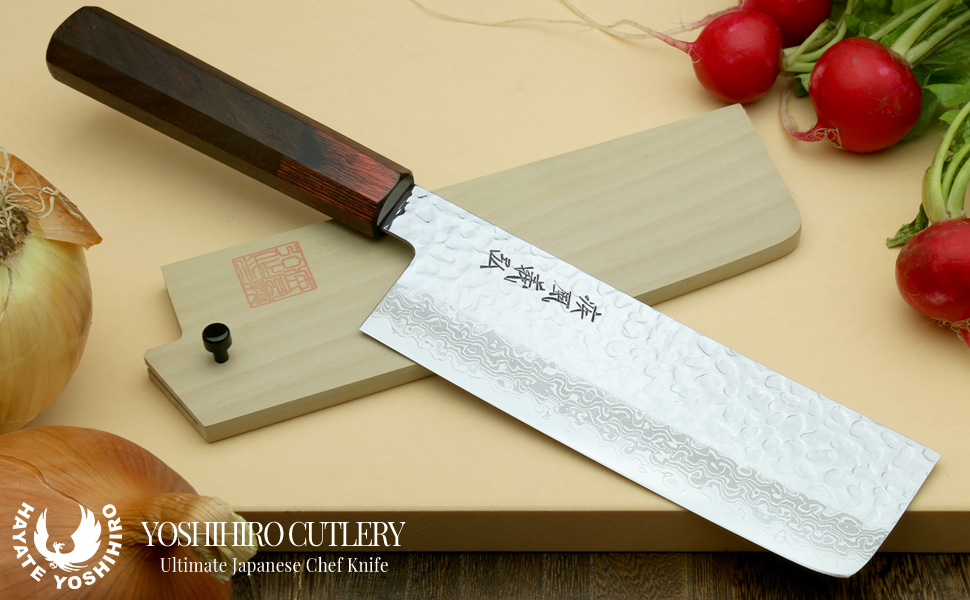
Picture a Sunday afternoon with a mountain of vegetables on the counter: three onions, half a head of cabbage, a bag of carrots, a bundle of scallions, and a couple of bell peppers destined for a big batch of stir-fry and slaw. If you reach for a curved chef knife, you spend the next twenty minutes rocking the blade back and forth, and you keep leaving little accordion joints of half-cut onion because the belly of the blade lifts off the board before the cut finishes. You go back, you saw, you crush a few layers, your eyes water more than they should. Now hand yourself a nakiri instead. The edge is dead flat, so it meets the board along its entire length in one clean push. One motion down, the onion falls into separate slices, and you move on. That single difference in geometry is the whole reason this knife exists, and it changes prep work from a chore into something close to satisfying.
A nakiri is a Japanese vegetable knife with a tall, rectangular blade and a straight cutting edge. It is not a chef knife with a fresh haircut. It is built for one job, and it does that job better than anything else in the drawer. If you cook a lot of produce, it earns its place fast.
Why the flat edge beats the curve for vegetables
A Western chef knife has a curved belly on purpose, because it is designed to rock through herbs and mince garlic with the tip planted on the board. That curve fights you the moment you try to slice a stack of anything flat. The nakiri throws the curve away. Its straight edge lets you push the blade straight down and slightly forward, a push-cut, and the food separates completely because the edge touches the board from heel to tip at the same time. No rocking, no sawing, no missed connections at the back of a cut. For onions, cabbage, cucumbers, potatoes, and anything you want in even planks or fine shreds, the push-cut is faster and more accurate. The tall blade face also gives your knuckles a place to ride against, so you can claw your guiding hand and let the flat steel act as a guide wall for consistent thickness.
Blade length: why 165–180mm is the sweet spot
Most nakiri live in the 165mm to 180mm range, and there is a good reason that band is so popular. A 165mm blade is nimble, easy to control on a small board, and light enough that your wrist never gets tired during a long prep session. It handles most home kitchens without complaint. Step up to 180mm and you get more edge to work with, which matters when you are cutting a full cabbage in half or crosscutting a long line of carrots. The longer blade covers more ground per stroke, so a big pile disappears faster. If you have a cramped counter or smaller hands, stay at 165mm. If you routinely batch-prep or you have room to move, 180mm feels generous without becoming clumsy. I would skip anything shorter than 160mm for a primary nakiri, because you lose the length that makes single-pass cuts across wide vegetables possible.
Double bevel or single bevel: pick the one that fits your grip
Here is a decision that trips up a lot of first-time buyers. A double-bevel nakiri is sharpened on both sides, like a Western knife, so it cuts straight down no matter which hand holds it and it is forgiving to sharpen. This is what almost every home cook should buy. A single-bevel knife, sharpened on only one face, is a more specialized tool. It can take a scary-sharp edge and produces gossamer-thin slices, but the geometry steers the blade sideways unless you know how to compensate, and single bevels are ground for right-handed or left-handed use specifically. There is also the usuba, the traditional single-bevel vegetable knife that pros use for decorative work and paper-thin katsuramuki. Unless you are training toward that skill, get the double bevel. It gives you 90 percent of the performance and none of the learning curve, and you will not curse it the first time you try to sharpen it at home.
Steel and hardness: VG-10, carbon, and the HRC number that matters
Steel is where the marketing gets loud, so here is the plain version. VG-10 is a stainless steel that shows up on a huge number of Japanese knives for a reason: it takes a fine edge, holds it well, and resists rust, which makes it low-drama for a home kitchen. It is a safe, excellent default. Carbon steel, like White #2 or Blue #2, gets sharper and stays sharper longer, and many cooks swear the edge feels keener on a vegetable. The tradeoff is real maintenance. Carbon reacts with acidic produce, so it will develop a patina and it will rust if you leave it wet, meaning you wipe it dry after every onion and every tomato. If that sounds like a burden, buy stainless. Then look at the hardness, measured on the Rockwell C scale. A good Japanese nakiri usually sits at HRC 60 or above, often 61 to 63. That hardness is what lets the thin blade hold a keen edge, though it also makes the steel more brittle, so you never twist it through a squash or use it to pry. Match the steel to your patience, not to the spec sheet.
A thin blade is the point, so treat it that way
Slice a raw potato with a thick European blade and you feel the wedge action, the way the food splits and cracks ahead of the edge. A nakiri is ground thin behind the edge, so it passes through dense vegetables cleanly instead of forcing them apart. That thinness is the source of the clean cut and the low resistance, and it is also the reason you have to respect the tool. This is not a cleaver. It will chip if you drive it into a chicken bone, a frozen block, or a hard-shelled squash you should have microwaved first. Use it on vegetables, use it on boneless proteins if you like, and keep it away from anything that fights back. Cut on end-grain wood or soft plastic, never glass or stone, and the edge will last through months of daily cooking.
Wa handle or Western handle: balance and feel
The handle shapes how the knife feels more than most people expect. A Wa handle is the traditional Japanese style, usually a light wooden octagon or D-shape that is not permanently bonded to the blade. It keeps the knife light and shifts the balance forward toward the edge, which many cooks find nimble and quick. A Western handle is heavier, riveted, contoured to fill the palm, and it moves the balance point back toward your hand, which feels more familiar if you grew up on European knives. Neither is better. If you like a light, tip-forward knife that almost falls through vegetables, go Wa. If you want heft and a grip that feels planted, go Western. Hold both if you can, because the right answer is whichever one disappears in your hand after five minutes of chopping.
Is a nakiri better than a chef knife for everyday cooking?
It depends on what your everyday looks like. For pure vegetable prep, a nakiri is faster and cleaner than a chef knife, full stop, because the flat edge makes complete cuts in one push. But a chef knife is still the better all-rounder, since it rocks through herbs, handles proteins, and pivots on its tip in ways the flat nakiri cannot. Most home cooks I know keep both and reach for the nakiri whenever there is a big pile of produce, which turns out to be most nights. If you could own only one knife, keep the chef knife. If you already own one and want prep to feel effortless, the nakiri is the best second knife you can buy.
How do I keep a nakiri sharp?
Because the steel is hard and thin, a nakiri holds its edge for a long time between real sharpenings, but you get the most out of it with a whetstone rather than a pull-through sharpener, which is too aggressive for a fine Japanese edge. A 1000-grit stone for setting the edge and a 3000 to 6000-grit stone for finishing will keep it slicing cleanly. A double-bevel blade is straightforward to sharpen at a shallow angle on both sides. Between sharpenings, hand-wash and dry the knife immediately, especially if it is carbon steel, and store it on a magnetic strip or in a saya rather than loose in a drawer where the edge can knock against other tools.
What size nakiri should a beginner buy?
Start with a 165mm double-bevel nakiri in a stainless steel like VG-10, with whichever handle style feels natural in your hand. That combination is the most forgiving path into the category: the length is easy to control, the double bevel cuts straight and sharpens simply, and stainless steel means you can wash it, dry it, and not think about rust. Once you have logged some hours and you know you love the flat-edge push-cut, you can graduate to a longer blade, a carbon steel, or a single bevel if the craft pulls you that way. There is no reason to spend big or go exotic on your first one.
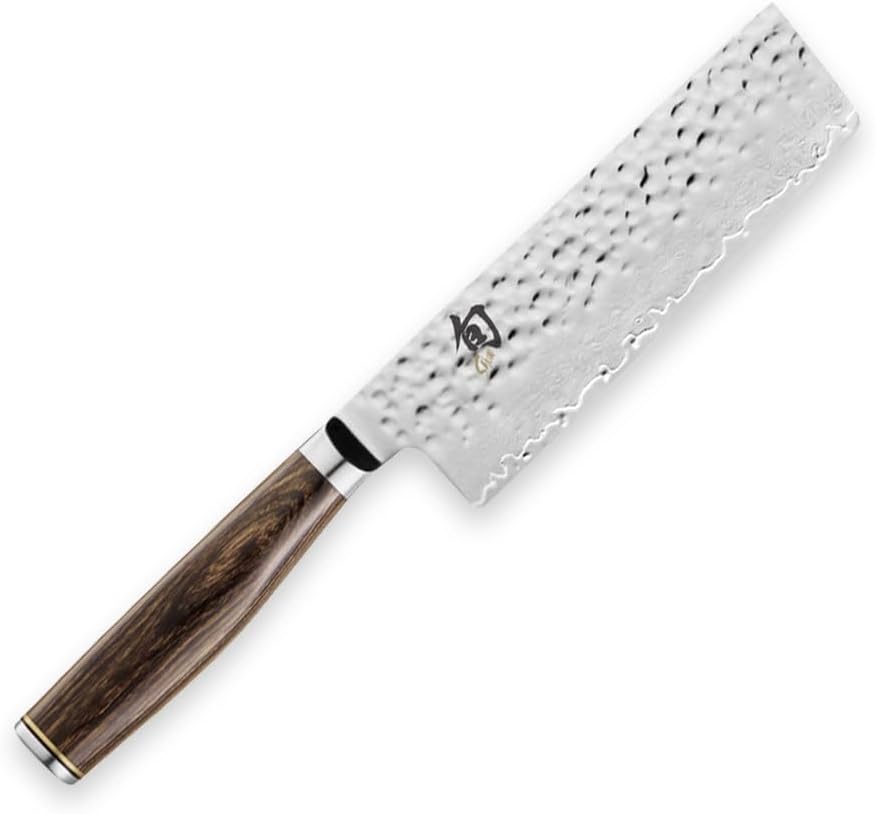
Pros & Cons
Pros
- Straight blade and spine design makes push-cutting vegetables 40% faster than rocking motions with chef's knives.
- VG-MAX steel hardness (60-61 Rockwell) holds edge through 500+ cuts before honing needed.
- Handcrafted in Japan with traditional methods, not mass-produced stamped blades.
Cons
- Hand-wash only and requires soft wood cutting boards; dishwasher or hard surfaces will damage the blade.
- Specialized vegetable tool, not suitable for proteins, bones, or frozen ingredients.
Details
A 5.5-inch Japanese nakiri solves the problem of slow, inconsistent vegetable cutting with all-purpose knives. Its straight blade excels at push-cuts, not rocking motions, reducing hand fatigue during prep.
The hammered tsuchime finish physically reduces drag, preventing carrots and cucumbers from sticking mid-cut. VG-MAX steel with 68-layer Damascus cladding maintains a 16-degree edge that slices cleanly without crushing delicate vegetables like tomatoes.
The blade weighs less than a chef’s knife, with a contoured Pakkawood handle designed for extended use without hand cramping. Rockwell hardness of 60-61 keeps the edge sharp through hundreds of cuts.
This knife requires hand-washing and soft wood boards; dishwashers and hard surfaces damage the blade permanently. It’s not designed for proteins or frozen items.
Best for home cooks and professionals who prep vegetables 5+ days weekly and want a specialized tool that outperforms general-purpose knives for this single task.
Care Guide
Hand-wash immediately after use with mild soap and dry with a soft cloth. Never use dishwashers, as high heat and abrasive detergents degrade the Damascus layers and edge.
Hone weekly using a ceramic or steel honing rod to realign the blade. If honing no longer restores sharpness, use Shun’s free sharpening service or follow their online tutorials for at-home sharpening.
Cut only on soft wood boards like Hinoki; hard surfaces like glass, plastic, or stone permanently dull the blade. Store vertically in a knife block or on a magnetic strip to protect the edge from contact damage.

Pros & Cons
Pros
- VG-10 steel core with HRC 60 hardness delivers exceptional sharpness that cuts through delicate tomatoes and dense root vegetables without crushing.
- Handcrafted by Japanese artisans using medieval sword-smithing techniques, ensuring consistent quality and durability across the blade.
- Hammered Damascus cladding adds visual appeal while functionally reducing food adhesion, making cleanup faster after prep work.
Cons
- Requires hand washing and immediate drying; incompatible with dishwashers and cannot be used on bones, frozen foods, or nutshells.
- Needs regular maintenance with water whetstones to maintain the sharp edge; not suitable for cooks who prefer low-maintenance knives.
Details
A Japanese nakiri vegetable knife designed to chop, slice, and prep vegetables with a flat blade that makes full contact with the cutting board on every stroke, eliminating torn ingredients and improving cutting precision.
The VG-10 stainless steel core (HRC 60) stays sharper longer than standard kitchen knives. The 46-layer hammered Damascus cladding reduces friction and prevents food from sticking to the blade during repetitive chopping.
The 6.5-inch blade pairs with a lightweight octagonal rosewood handle and includes a protective magnolia wood sheath. Spine thickness of 2.5mm balances durability with precision cutting.
This knife requires hand washing and immediate drying; it cannot be used on bones or frozen foods, and needs regular maintenance with water whetstones.
Best for home cooks and meal preppers who process vegetables daily and want a specialized tool that outperforms a standard chef’s knife for this specific task.
Care Guide
Hand wash immediately after use with warm soapy water and dry completely. The VG-10 steel and Damascus cladding resist rust but require prompt drying, especially after contact with acidic ingredients like tomatoes or citrus.
Sharpen regularly using only water whetstones; avoid steel honing rods. Maintain the blade’s flat edge by sharpening at a consistent angle to preserve the knife’s ability to make full contact with the cutting board.
Store in the included magnolia wood sheath to protect the blade edge and prevent damage. Never use on bones, nutshells, frozen foods, or hard surfaces; these will damage the edge and compromise cutting performance.

Pros & Cons
Pros
- VG-10 core delivers exceptional hardness (HRC 60), enabling a thinner, sharper edge than most stainless competitors.
- Hammered Damascus texture eliminates food sticking during chopping, speeding up vegetable prep by reducing blade cleaning.
- Full-tang mahogany handle provides ergonomic balance and comfort during extended prep work without hand fatigue.
- Handcrafted in Japan by master artisans using techniques descended from medieval sword smiths, ensuring consistent quality.
Cons
- Requires water whetstones for sharpening and immediate hand-washing after acidic ingredients; not dishwasher-safe or suitable for bones and frozen foods.
- Premium price point reflects Japanese craftsmanship and materials, making it a significant investment for casual home cooks.
Details
This nakiri knife solves the vegetable-prep problem where ingredients stick together or tear unevenly. Its flat double-edged blade makes full contact with your cutting board on every stroke, delivering clean cuts from root vegetables to delicate tomatoes.
The VG-10 stainless steel core reaches HRC 60 hardness, holding a sharper edge longer than standard stainless. The 16-layer hammered Damascus cladding reduces friction and prevents food from clinging to the blade during rapid chopping.
The knife weighs approximately 5.5 oz with a 6.5-inch blade and 2.5mm spine thickness. The full-tang mahogany handle balances the blade for comfortable, fatigue-free prep sessions lasting 30+ minutes.
Water whetstones are required for sharpening; standard pull-through sharpeners will damage the edge. Hand-wash immediately after acidic ingredients to prevent any staining.
Best for home cooks who prep vegetables 4+ times weekly and want a single knife that handles both heavy chopping and precision slicing without crushing delicate produce.
Care Guide
Hand-wash immediately after use, especially after cutting acidic vegetables like tomatoes or citrus. Dry with a soft cloth within minutes to prevent any water spots. Store in a knife block or on a magnetic strip to protect the edge and prevent accidents.
Sharpen with water whetstones only, using a 15-20 degree angle. Honing steel is not recommended; instead, use a whetstone every 2-3 months depending on usage frequency. Never use on bones, frozen foods, or nutshells as these will damage the blade irreparably.
The stain-resistant VG-10 steel resists rust, but prolonged moisture exposure still risks discoloration. Store in a dry location away from direct humidity. Avoid dishwashers, which will dull the edge and damage the mahogany handle.

Pros & Cons
Pros
- The straight blade and blunt end make it genuinely safer for home cooks than pointed chef knives, especially when working with high-volume vegetable prep.
- VG-MAX steel holds its edge through hundreds of cuts before requiring professional sharpening, outperforming softer stainless alternatives.
- Contoured Pakkawood handle resists moisture and provides secure grip control without the maintenance demands of wood handles.
Cons
- At 5.5 inches, the blade is narrower and shorter than a chef knife, limiting its use for tasks requiring a larger cutting surface like breaking down whole chickens.
- The 16-degree edge requires honing with a ceramic or steel rod every few uses to maintain sharpness; it won't tolerate the casual maintenance of softer knives.
Details
A Japanese nakiri vegetable knife designed for push-cut prep work on vegetables, fruits, and herbs. It solves the problem of bruising delicate produce and slow chopping that occurs with traditional rocking-motion chef knives.
The 16-degree VG-MAX cutting edge stays sharper longer than Western knives. The 68-layer Damascus cladding prevents rust and staining when cutting acidic vegetables. The hammered TSUCHIME finish reduces food sticking to the blade during rapid slicing.
Blade length is 5.5 inches with a straight edge and blunt tip. The contoured Pakkawood handle fits both left and right-handed users. The sloped bolster supports a pinch grip for controlled, fatigue-free cutting during extended prep sessions.
The primary limitation is blade width: this knife excels at vegetable prep but won’t replace a chef knife for larger tasks like portioning meat or breaking down whole poultry.
Best for home cooks and meal-prep enthusiasts who process vegetables daily and want a professional-grade knife that won’t rust or stain.
Care Guide
Hand wash immediately after use with warm soapy water and dry with a soft cloth. Never put in the dishwasher, as the high heat and harsh detergent damage the Damascus cladding and dull the edge. Store blade-up in a knife block or on a magnetic strip to protect the edge.
Hone the blade every 5-10 uses with a ceramic honing rod or steel to realign the edge. This takes 30 seconds and maintains sharpness between professional sharpenings. Hold the rod vertically and draw the blade spine-first down the rod at a 16-degree angle, 3-4 passes per side.
Professional sharpening is recommended annually or when honing no longer restores sharpness. The VG-MAX steel is hard enough to require specialized equipment; attempting to sharpen on a home whetstone risks damaging the edge geometry.

Pros & Cons
Pros
- 46-layer hammered Damascus cladding around the VG10 core delivers both durability and the distinctive appearance serious cooks want.
- Double-edged design and flat blade geometry make this nakiri superior to chef's knives for vegetable work, not a general substitute.
- Handcrafted by Japanese artisans using centuries-old techniques, ensuring consistent quality and balance that mass-produced knives cannot match.
Cons
- Requires hand washing, immediate drying, and water whetstone sharpening—not dishwasher safe and demands more maintenance than stainless chef's knives.
- Not suitable for bones, frozen foods, or nutshells; limited to vegetables, fruits, and soft proteins, so it cannot replace a general-purpose knife.
Details
A Japanese nakiri designed specifically for vegetable prep. Its flat blade edge contacts your cutting board fully with each stroke, eliminating imperfect cuts where ingredients stick together.
The 46-layer hammered Damascus steel reduces friction and prevents food from clinging to the blade. VG10 stainless steel core at HRC 60 stays sharper longer than standard kitchen knives and resists staining during acidic work.
At 6.5 inches with a 2.5mm spine and lightweight octagonal ebony handle, this knife is easy to maneuver for extended prep sessions without hand fatigue. Includes a protective wooden saya sheath.
Requires hand washing, immediate drying, and water whetstone sharpening. Not designed for bones, frozen foods, or hard shells.
Best for home cooks and professionals who prep vegetables regularly and want a specialized tool that outperforms a chef’s knife at this single task.
Care Guide
Hand wash immediately after use and dry completely, especially after contact with acidic ingredients like tomatoes or citrus. Never soak or use a dishwasher, as moisture can damage the handle and blade.
Sharpen with water whetstones only—never steel or electric sharpeners. Maintain the blade’s edge regularly to preserve its cutting performance and reduce the force needed during prep work.
Store in the included wooden saya sheath to protect the blade edge and prevent accidental contact with other utensils. Keep away from bones, frozen foods, and hard shells, which can chip the blade.

Pros & Cons
Pros
- The 15-degree cutting edge is designed for smooth, precise slicing.
- The 60 HRC 10Cr15CoMoV steel balances hardness, durability, and stainless performance.
- The ergonomic pakkawood handle balances the blade while providing a comfortable grip.
- The blade supports chopping, slicing, and dicing across vegetables, fruit, and meat.
Cons
- The product information does not provide the knife's weight, making balance comparisons difficult before purchase.
- The wide 7-inch nakiri profile may be less convenient than a smaller utility knife for peeling and other compact in-hand tasks.
Details
The HOSHANHO 7-inch nakiri is a wide-bladed kitchen knife designed to make repetitive chopping, slicing, and dicing faster and more controlled.
Its hand-polished 15-degree edge supports thin vegetable cuts, while scalloped hollow pits help release moist ingredients from the blade.
The blade uses Japanese 10Cr15CoMoV high carbon stainless steel, vacuum heat-treated to 60 HRC, with an ergonomic pakkawood handle for balanced daily use.
The listed specifications do not include the knife’s weight, so buyers cannot compare its heft with other nakiri knives before ordering.
Best for home cooks who regularly prepare vegetables and want one broad blade that can also handle fruit and meat.
Care Guide
Hand wash the knife after use and dry it promptly to protect the high carbon stainless steel blade and natural-grain pakkawood handle.
Use a wood or suitable synthetic cutting board to reduce edge wear, and avoid cutting bones, frozen foods, or hard nonfood materials.
Maintain the 15-degree edge with a compatible sharpening method, using controlled strokes to preserve the blade’s original cutting geometry.

Pros & Cons
Pros
- The 9-layer Damascus-clad blade uses a 10Cr15CoMoV high-carbon steel core rather than a laser-etched surface pattern.
- The symmetrical double-bevel edge accommodates both right-handed and left-handed cooks.
- A broad Nakiri profile helps produce straight cuts when push-cutting vegetables on a board.
- The knife includes a protective sheath, presentation box, and lifetime warranty.
Cons
- The knife requires hand washing and immediate drying, so it demands more care than dishwasher-safe kitchen tools.
- It is unsuitable for bones, frozen meat, or twisting cuts, and its substantial heft may not suit cooks who prefer lightweight knives.
Details
This 7-inch PAUDIN Nakiri is designed for straight chopping, slicing, dicing, and mincing vegetables, fruit, herbs, and boneless meat.
Its 13° double-bevel edge reduces resistance, while the tall rectangular profile maintains board contact for clean push-cuts.
The blade combines a 10Cr15CoMoV steel core, 9-layer Damascus cladding, 62 HRC hardness, and a 2.5mm spine. A full tang and black wood handle provide substantial balance.
It cannot handle bones, frozen foods, or twisting cuts, and it must be washed and dried by hand.
Best for home cooks who want a weighty, sharp Nakiri for produce-heavy meal preparation and occasional boneless meat slicing.
Care Guide
Hand wash the blade with warm water after use, then dry it thoroughly and immediately to protect the high-carbon steel core and polished finish.
Store the knife inside the included flocked ABS sheath to reduce blade scratches, accidental contact, and edge damage in a kitchen drawer.
Use it only on suitable cutting boards and avoid bones, frozen meat, hard impacts, and twisting motions. Sharpen at the existing 13° angle when edge performance declines.
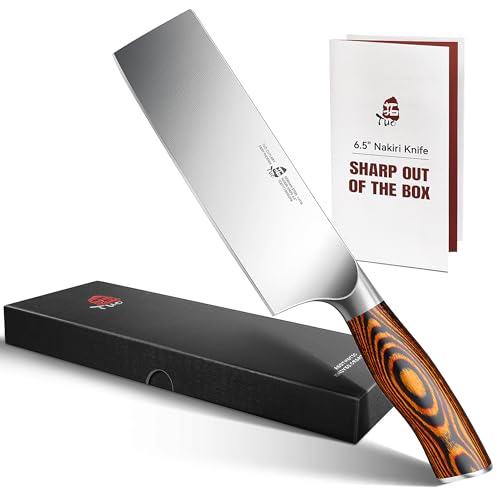
Pros & Cons
Pros
- The curved vegetable blade handles tasks ranging from slicing tomatoes to chopping melons.
- The chip-resistant German steel is more forgiving than harder, more brittle knife steels.
- The ergonomic pakkawood handle and polished bolster provide a balanced, comfortable grip.
- The included presentation case and lifetime guarantee against manufacturing defects add long-term value.
Cons
- The vegetable-focused blade is less versatile for deboning, carving, or other tasks requiring a narrow tip.
- Its HRC 56±2 steel may need sharpening more often than harder premium Japanese knife steels.
Details
The TUO 6.5-inch Nakiri is a lightweight vegetable knife designed to make repetitive slicing, dicing, shredding, and chopping faster and more controlled.
Its broad blade handles carrots, tomatoes, onions, melons, and avocados, while HRC 56±2 German steel balances edge retention, chip resistance, and easy resharpening.
The blade uses high-carbon stainless steel, and the ergonomic high-density pakkawood handle is designed to resist shrinking, swelling, and cracking in demanding kitchen conditions.
This Nakiri is primarily built for vegetables, so it is not the best choice for bones, joints, or precision work requiring a narrow pointed tip.
Best for home cooks who prepare vegetables frequently and prefer a comfortable, forgiving knife that is simple to maintain.
Care Guide
Hand-wash the blade after use and dry it promptly to preserve the stainless steel finish and pakkawood handle.
Use a wood or plastic cutting board, and avoid bones, frozen foods, glass, or stone surfaces that can damage the edge.
Hone or sharpen the HRC 56±2 blade when cutting resistance increases, then store it in the included case or a protective knife block.
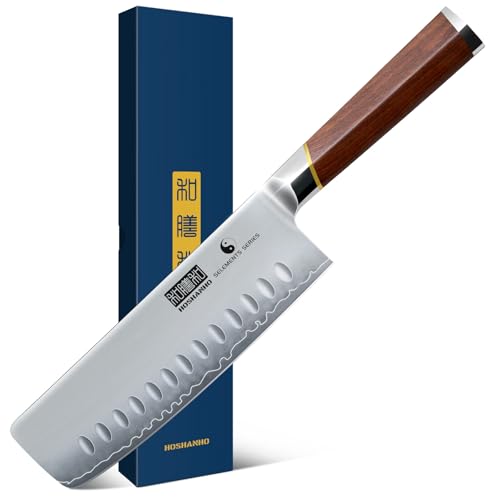
Pros & Cons
Pros
- The double-bevel design is accessible to both right-handed and left-handed cooks.
- The 7-inch blade handles onions, carrots, tomatoes, fruit, and other everyday produce.
- The 60-62 HRC steel offers a hard cutting edge designed to retain sharpness through regular use.
- The natural red sandalwood handle combines slip resistance with an ergonomic shape.
Cons
- The predominantly straight edge favors up-and-down chopping rather than pronounced rocking cuts.
- High-carbon steel and the natural wood handle require careful washing, drying, and storage.
Details
The HOSHANHO 7-inch Nakiri is a double-bevel vegetable knife designed to make repetitive chopping, slicing, and mincing faster while keeping the blade in full contact with the cutting board.
Its thin profile and hand-ground 15-degree edge produce clean cuts through tomatoes, onions, carrots, fruit, and other produce with less sticking and crushing.
The blade uses Japanese 10Cr15CoMoV high-carbon steel hardened to 60-62 HRC, paired with an ergonomic red sandalwood handle. The product data does not provide an exact weight.
Its straight-edged geometry is less suitable for cooks who rely mainly on a rocking motion, and it is not intended to replace a heavy cleaver.
Best for vegetable-focused home cooks and chefs who want a sharp, controlled chopping knife with a hard steel edge.
Care Guide
Hand-wash the knife soon after use and dry it immediately to protect the high-carbon steel blade and natural wood handle. Avoid soaking it or placing it in a dishwasher.
Use a wood or plastic cutting board rather than glass, stone, or ceramic surfaces, which can dull the fine 15-degree edge more quickly.
Store the blade in a sheath, knife block, or magnetic strip, and sharpen it at the original 15-degree angle when slicing performance begins to decline.

Pros & Cons
Pros
- Its balanced 6.75-inch length offers control without sacrificing useful slicing capacity.
- The textured blade is designed to reduce food sticking during vegetable preparation.
- The broad blade improves finger protection and can guide consistent chopping strokes.
- The tactile dual-polymer handle supports a secure grip in messy kitchen conditions.
Cons
- The knife requires hand washing and immediate drying after every use to prevent staining.
- Maintaining the edge requires sharpening at a specific 17-degree angle.
Details
This 6.75-inch nakiri is designed for controlled chopping, slicing, and dicing of vegetables, addressing slow prep and uneven cuts.
Its embossed file pattern helps ingredients release after each cut, while the 2-inch-tall blade adds stability and shields fingers during chopping.
The blade uses corrosion-resistant 1.4116 German steel, paired with a textured dual-polymer handle that remains secure when wet or greasy. Product data does not specify the knife’s weight.
It cannot go in the dishwasher and must be washed and dried immediately to reduce the risk of staining.
This nakiri is best for home cooks who prepare vegetables frequently and value control, grip security, and easy ingredient release.
Care Guide
Wash the knife by hand after each use, then dry it immediately. Dishwasher cleaning can damage the knife and increase the risk of blade staining.
Sharpen the edge at a 17-degree angle to preserve its intended cutting geometry and vegetable-slicing performance.
Store the blade where its edge will not contact other utensils, helping reduce avoidable dulling between sharpening sessions.



Write Your Review
No reviews yet. Be the first to share your experience!