

TL;DR — The best sourdough bread knife for most home kitchens is the option that balances reliable construction, realistic capacity, easy cleanup, and a price that matches how often you will use it. HomeWhisk prioritizes documented specifications, material choices, and repeated owner-review patterns rather than marketing claims. If you are still comparing nearby categories, start with best bread knife and best bread knife for sourdough before narrowing your final pick.
The HomeWhisk editorial team researches kitchen equipment by comparing manufacturer specifications, material details, dimensions, warranty language, retailer listings, and aggregated owner reviews. For best sourdough bread knife, we looked for patterns that matter after the return window closes: repeated complaints, praised design details, compatibility limits, and maintenance habits that determine whether a product stays useful.
This is a commercial buying guide, so the goal is practical selection rather than a broad encyclopedia entry. Use this page alongside best chef knife and best chef knife budget if your purchase overlaps adjacent tools or a larger kitchen setup.
Pros & Cons
Pros
- Japanese steel holds its edge through hundreds of slices, making it a one-time investment for serious home bakers.
- Wavy blade design eliminates the crushing problem that frustrates users with straight-edge bread knives on soft or delicate foods.
- Textured grip stays secure even with wet hands or when cutting oily ingredients like avocados and tomatoes.
Cons
- Requires hand-washing and immediate drying after each use; no dishwasher convenience means extra cleanup steps.
- At 10 inches, it may feel oversized for smaller hands or compact cutting boards, limiting its versatility in tight kitchens.
Details
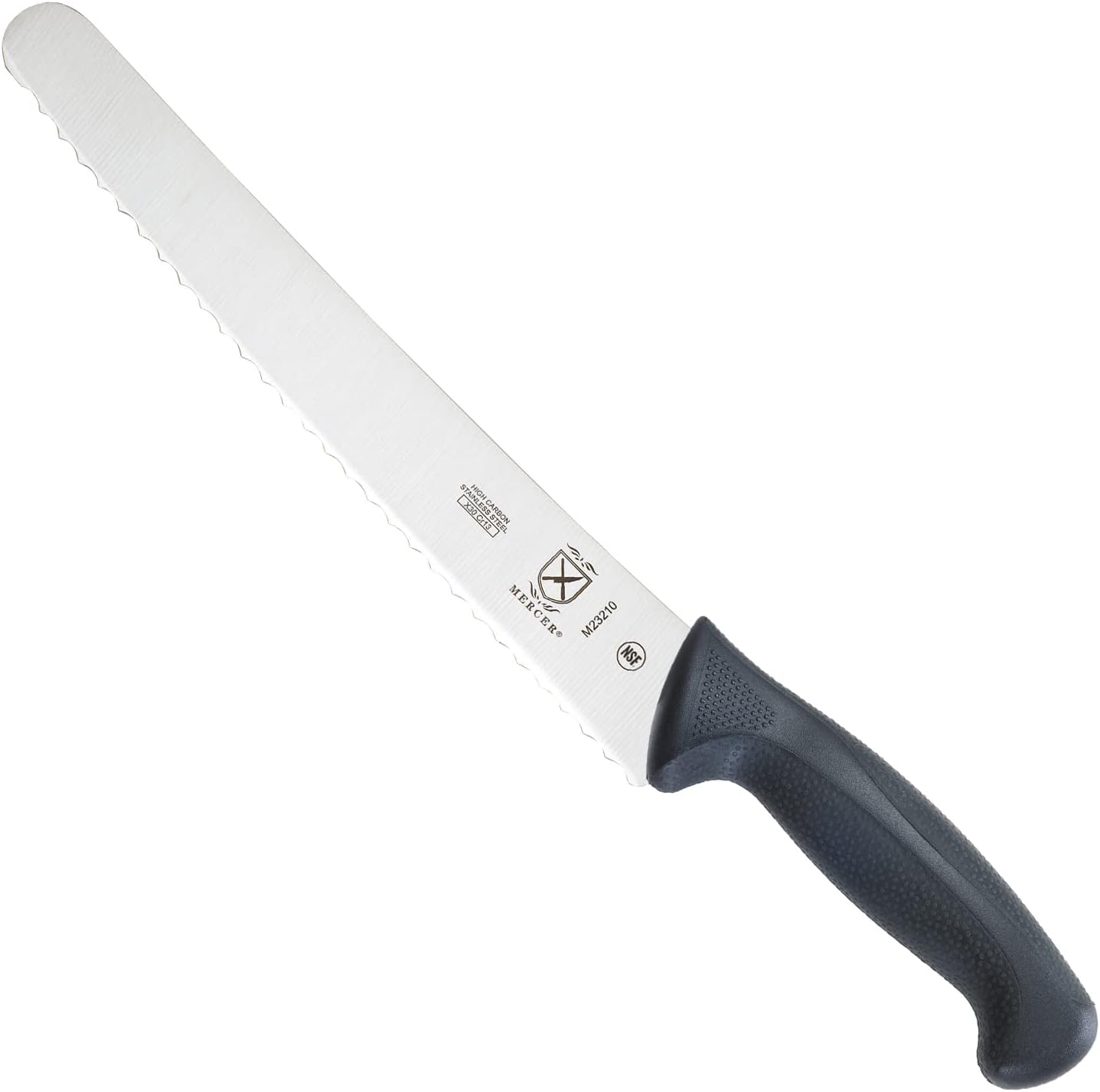
A 10-inch serrated bread knife designed to slice through crusty exteriors without compressing soft interiors, solving the common problem of mangled bread and cake.
The wavy edge blade and one-piece Japanese high-carbon steel combine to maintain sharpness through hundreds of cuts. The textured ergonomic handle with finger points prevents slipping during wet or repetitive tasks.
One-piece construction provides excellent balance and durability. The black handle is dishwasher-unsafe but color-coded for professional food safety protocols.
Requires hand-washing and immediate drying to preserve edge integrity; submerging or machine washing will degrade performance.
Best for home bakers, pastry enthusiasts, and cooks who regularly slice bread, cakes, tomatoes, and fruits and prioritize edge retention over convenience.
Care Guide
Hand-wash immediately after use with warm water and mild soap. Dry completely with a soft towel before storing. Never submerge for extended periods or place in the dishwasher, as moisture and heat damage the steel and handle bond.
Store blade-down in a knife block or with a blade guard to protect the edge and prevent accidents. Avoid cutting on glass or marble surfaces; use wooden or plastic cutting boards only.
The wavy edge does not require honing like straight blades. If edge dulls after years of use, professional sharpening restores performance; home sharpening is not recommended for serrated blades.

Pros & Cons
Pros
- The serrated 10-inch blade handles baguettes, toast, homemade cakes, pastries, and bagels.
- A 15-degree sharpened edge is designed to cut cleanly without flattening softer bread.
- The Japanese 10Cr15CoMoV stainless steel blade offers durability, corrosion resistance, and edge retention.
- The ergonomic handle provides stability while reducing the effort needed for slicing.
Cons
- The 10-inch blade may require more storage space and feel cumbersome on compact cutting boards.
- As a specialized serrated knife, it is less versatile for general chopping and precision vegetable prep than a chef's knife.
Details
The HOSHANHO bread knife is a 10-inch serrated slicer designed to portion crusty loaves, soft toast, cakes, pastries, and bagels without excessive crushing or scattered crumbs.
Its precision-sharpened 15-degree edge penetrates firm crusts while reducing pulling through delicate interiors, helping produce cleaner and more even slices.
The blade uses vacuum heat-treated Japanese 10Cr15CoMoV high-carbon stainless steel for edge retention, durability, and corrosion resistance. The knife weighs 0.5 pounds and has an ergonomically shaped handle.
The long serrated blade needs suitable drawer or block space and is not intended to replace a general-purpose chef’s knife.
Best for home bakers and bread-focused households that regularly slice large loaves, cakes, or pastries.
Care Guide
Hand-wash the blade after use and dry it promptly to help preserve the edge and corrosion-resistant finish. Avoid leaving food residue or moisture on the high-carbon stainless steel.
Use a wood or plastic cutting board rather than hard glass or stone surfaces, which can shorten the working life of the sharpened serrations.
Store the 10-inch blade in a suitable knife block, sheath, or protected drawer slot. Serrated edges require an appropriate sharpening tool or professional service when performance eventually declines.

Save $4.00
Pros & Cons
Pros
- The 420J2 stainless steel blade combines sharp cutting performance with straightforward resharpening.
- Engineered serrations are designed to work with standard household sharpening rods.
- The food-grade stainless steel frame avoids the chipping risk associated with painted wooden frames.
- Built-in thickness scales reduce guesswork when preparing toast, sandwiches, or evenly portioned servings.
Cons
- The knife is optimized for right-handed use, so left-handed bakers may find the bow design awkward.
- The tensioned blade should not be disassembled, which may make cleaning around the frame more involved.
Details
This bow-design bread knife slices crusty sourdough and baguettes without pressing heavily enough to crush their soft interiors.
Its tensioned serrated blade extends slightly below the frame, helping finish cuts cleanly through the bottom crust.
Four scale marks guide slices from 1/4 inch to 1 inch, making portions more consistent for toast, sandwiches, and serving.
The 10.7-inch knife weighs about 0.88 pounds and uses a 420J2 stainless steel blade with a durable food-grade stainless steel frame.
Its right-handed design is the main limitation; it is best for home bakers who regularly slice crusty artisan loaves.
Care Guide
Keep the blade tensioned as supplied, and do not remove the securing screws because they maintain slicing stability.
When the edge begins to lose performance, use a standard household sharpening rod that fits the blade’s engineered serrations.
Clean and dry the stainless steel surfaces after use, then install the protective cover and hang or store the knife away from exposed hands.

Save $6.20
Pros & Cons
Pros
- The resharpenable edge actually works: hone each serration with a standard rod, then the flat side, and you restore cutting performance without buying a new knife.
- Offset handle design genuinely reduces knuckle contact with the board and makes long slicing sessions more comfortable than standard bread knives.
- Cuts through both crusty sourdough and soft sandwich bread cleanly with minimal crumbing, thanks to the precise serration angle and hollow grooves.
Cons
- Resharpening requires learning the two-step process and having a honing rod on hand; it's not as simple as a standard knife.
- At 10 inches, it's longer than some home kitchen bread knives, so it needs adequate cutting board space and storage room.
Details
A resharpenable serrated bread knife that solves the problem of dull blades turning crusty bread into crumbs and torn slices. Unlike disposable bread knives, this one restores its edge with a regular honing rod, saving money and waste over years of daily use.
The 13–15° edge angle and double-sided hollow grooves work together: the precise angle cuts through firm crusts without slipping, while the grooves release moist interior and sticky fruit without sticking. The offset handle keeps your knuckles safely above the board during repetitive slicing.
Made from quality stainless steel with an ABS handle and protective finger bolster. The 10-inch blade requires adequate board space but handles everything from sourdough to tomatoes in one knife.
Resharpening takes practice; you need a honing rod and willingness to learn the two-step process. Not ideal if you want zero maintenance.
Best for home bakers and daily bread slicers who want a knife that stays sharp and lasts years instead of months.
Care Guide
Resharpen every 2–4 weeks with regular use. Step 1: Draw a honing rod along each serration at a slight angle, repeating 1–3 times per serration. Step 2: Lightly hone the flat blade side 1–3 times. This takes under 2 minutes and restores the edge fully.
Hand wash immediately after use; serrated blades trap bread particles that dull the edge if left wet. Dry thoroughly and store in a knife block or sheath to protect the serrations from damage.
Never use a pull-through sharpener or electric honer; these destroy the serration geometry. Stick to a manual honing rod for best results and blade longevity.
Pros & Cons
Pros
- Wavy edge technology maintains sharpness longer than traditional serrated blades, reducing the need for frequent replacement.
- One continuous piece of steel with no plastic or wood components means the knife won't develop loose joints or wobble over time.
- Cuts through bagels and artisan bread cleanly without crushing the interior, preserving texture and presentation.
Cons
- At 8 inches, the blade may feel slightly short for very large loaves or thick cakes compared to 10-inch professional bread knives.
- Serrated edges cannot be easily resharpened at home, so eventual replacement is necessary when the blade dulls after years of use.
Details
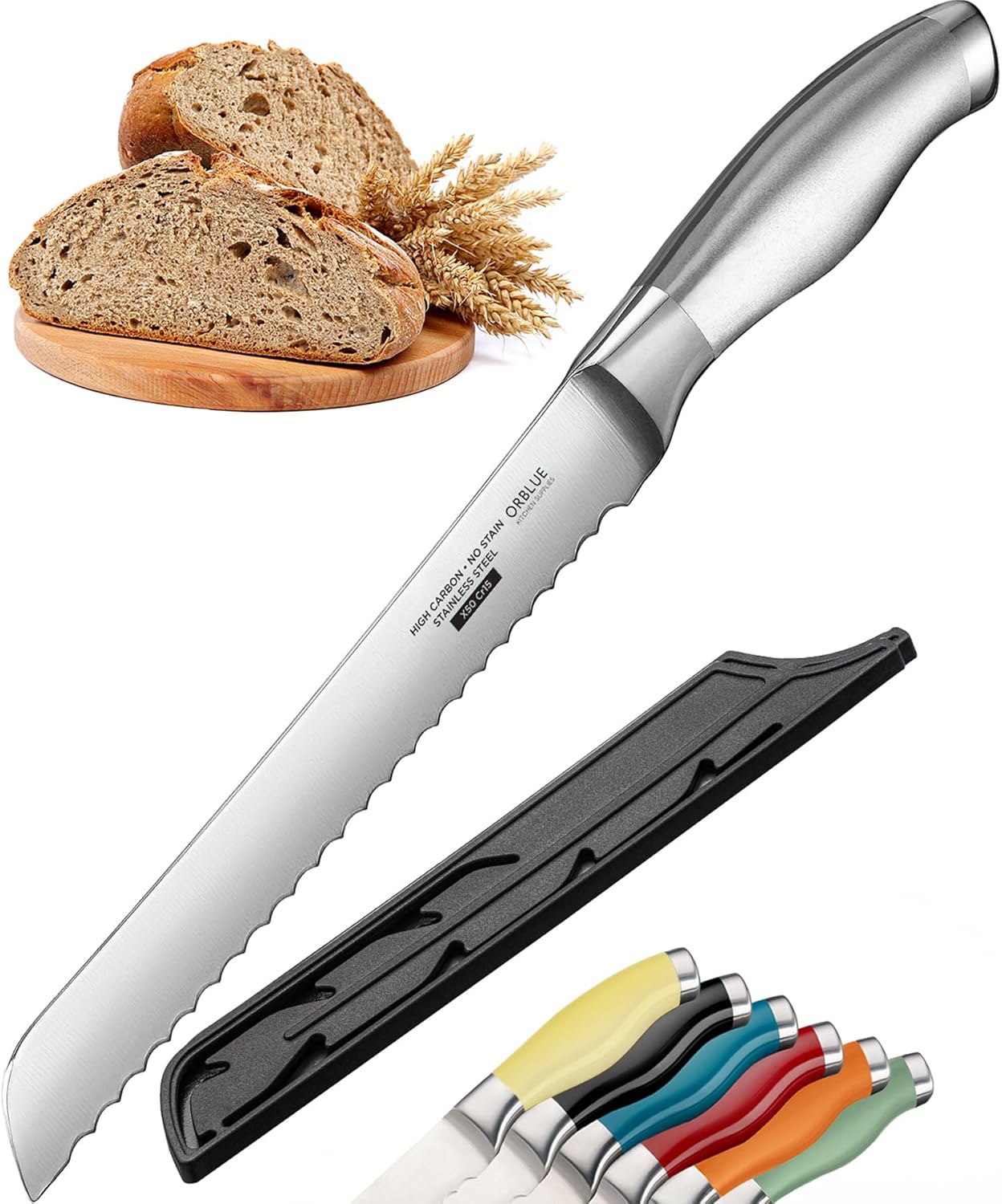
This is a dedicated serrated bread knife designed to slice through crusty loaves, bagels, cakes, and pastries without crushing the interior crumb. The wavy edge grips tough surfaces and cuts cleanly in a single downward stroke.
The knife features an 8-inch blade made from high-quality 5Cr15Mov stainless steel at 2.2mm thickness, paired with a 5-inch ergonomic handle. The entire knife is one continuous piece of steel with no plastic, wood, or screws that loosen over time.
Built from rust-resistant stainless steel and dishwasher-safe, this knife requires minimal maintenance and resists corrosion from daily kitchen use and moisture exposure.
The serrated edge cannot be resharpened at home, so replacement becomes necessary after years of heavy use as the blade gradually dulls.
Best for home bakers and anyone who regularly slices artisan bread, bagels, or delicate cakes and wants a durable, no-fuss cutting tool.
Care Guide
Hand wash immediately after use under warm running water with a soft sponge and mild dish soap. Dry with a clean cloth to prevent water spots. The knife is also dishwasher-safe, though hand washing extends blade life.
Store the knife in a knife block, on a magnetic strip, or with the included rubber safety guard covering the tip. Never store loose in a drawer where the blade can contact other utensils and dull prematurely.
The stainless steel resists rust naturally, but avoid prolonged contact with acidic foods like tomatoes or citrus. Wipe the blade immediately after cutting acidic items to maintain the finish.
Editor’s Picks
| Category | Pick Type | Why It Makes Sense |
|---|---|---|
| Best Overall | Balanced sourdough bread knife | Strongest mix of construction, usability, cleanup, and owner satisfaction |
| Best Value | Practical sourdough bread knife | Keeps the core performance features while avoiding unnecessary upgrades |
| Best for Most Home Kitchens | Use-case focused option | Prioritizes the size, controls, material, or workflow that matters most for this search |
At a Glance: Comparison Table
| Pick Type | Steel / Edge | Handle Feel | Best For | Trade-Off |
|---|---|---|---|---|
| Best Overall | Forgiving stainless or semi-stainless | Neutral balance | Daily prep | Not the cheapest |
| Best Value | Durable stamped or simpler forged steel | Practical grip | Newer cooks | Less refined finish |
| Best Upgrade | Harder steel with cleaner edge retention | More precise balance | Frequent prep | Needs better care |
| Best Small Kitchen | Versatile mid-length profile | Easy control | Tight counters | Less reach |
| Best Specialty | Task-specific blade geometry | Purpose-built | Specific foods | Less universal |
How We Evaluated These Products
We evaluated sourdough bread knife options by starting with the product job: what the item must do well for most home kitchens, what trade-offs buyers usually accept, and which features are often overstated. From there, we compared visible specifications such as materials, dimensions, capacity, heat or power ratings where relevant, included accessories, warranty terms, and care instructions.
Aggregated owner feedback was used to identify repeated patterns rather than isolated anecdotes. A single dramatic review can be misleading, but repeated comments about dull factory edges, slippery handles, chipping, rust spots, awkward balance, unsafe storage, or difficult sharpening are useful signals. We gave more weight to recent reviews because product lines, coatings, accessories, and manufacturing details can change over time.
We also considered how the product fits into a full kitchen workflow. A Sourdough Bread Knife can look excellent on a spec sheet and still be frustrating if it is too large to store, too slow to clean, incompatible with common accessories, or poorly matched to the buyer’s cooking habits. That is why this guide connects the main recommendation to related guides like best bread knife, best bread knife for sourdough, and best chef knife.
What Actually Matters:
Steel, hardness, and edge geometry
The steel and its heat treatment decide almost everything about how a sourdough bread knife performs over years of use. Softer stainless in the mid-50s HRC range is forgiving and quick to touch up, while harder Japanese-style steel holds a keener edge but chips more easily and wants careful boards. Look at the grind and blade profile too — a thin, well-tapered edge slices cleanly, whereas a thick shoulder wedges through food. For a related option, compare best bread knife before you commit.
Handle comfort and balance
Handle comfort is where a knife either disappears in your hand or fights you. Check how the handle fills a pinch grip, whether the spine and choil are eased instead of squared, and where the balance point sits relative to the bolster. A blade that balances near the finger guard feels nimble for detail work; a handle-heavy one feels planted for power cuts. Grip material matters for wet hands, so weigh textured composite against smooth polished wood. For a related option, compare best bread knife for sourdough before you commit.
Blade length and task fit
Blade length should follow the tasks you actually repeat, not the biggest option on the shelf. A longer blade covers more food per stroke and suits big-board prep, but it turns clumsy in a small kitchen or on a crowded counter. For most home kitchens, a mid-length profile usually handles the widest range of jobs before you reach for a specialist shape. For a related option, compare best chef knife before you commit.
Sharpening, storage, and upkeep
Upkeep is the hidden cost of any blade, so judge storage and sharpening before you buy. A knife stored loose in a drawer dulls and chips faster than one on a magnetic strip, in a block, or in an edge guard. Ask whether you will realistically hone it, send it out, or run it on a pull-through — the honest answer should steer you toward steel that matches your habits. For a related option, compare best chef knife budget before you commit.
Price tiers and long-term value
Price tiers for a sourdough bread knife rise fast, and past a point you pay for finish rather than cutting. The jump from a basic to a mid-tier blade usually buys better steel and fit; the jump to premium often buys hand-finishing and brand. For most home kitchens, spend where it changes daily use — edge retention and comfort — and skip cosmetic upgrades that never touch the food. For a related option, compare best chef knife for beginners before you commit.
Frequently Asked Questions
What should I look for in the best sourdough bread knife?
Start with fit for your routine: capacity, materials, cleaning, storage, and compatibility. Then compare owner-review patterns for repeated praise or complaints. For best sourdough bread knife, avoid buying only by star rating; the right sourdough bread knife should match most home kitchens and the way you actually cook.
Is a more expensive sourdough bread knife worth it?
It can be, but only when the upgrade improves something you will notice often: durability, control, cleaning, capacity, or comfort. If the higher price only adds accessories or cosmetic finish, a value pick may be smarter. Spend more when the category is used weekly or daily.
What size sourdough bread knife is best for most home kitchens?
The best size is the one that handles your normal use without making storage and cleanup annoying. Product photos can hide scale, so check exterior dimensions as well as usable capacity. For small kitchens or occasional use, a slightly smaller sourdough bread knife is often the better long-term choice.
How long should a good sourdough bread knife last?
A good sourdough bread knife should last long enough to justify its price when cared for according to the manufacturer instructions. Lifespan depends on materials, heat exposure, cleaning habits, moving parts, coatings, and storage. Repeated owner complaints about early failure are more important than one isolated review.
What mistakes should I avoid when buying sourdough bread knife?
The biggest mistake is buying the most feature-heavy option without checking whether those features solve your actual problem. Also avoid ignoring dimensions, care requirements, replacement parts, and compatibility. If maintenance sounds unrealistic for your household, choose a simpler product.
How does best sourdough bread knife compare with nearby options?
Nearby options can overlap, so use intent to decide. If your need is broad, start with the main sourdough bread knife category. If your need is specific, compare related guides such as best chef knife for cutting vegetables and best bread knife to avoid buying a product that is good generally but wrong for your setup.
Our Top Pick
For most shoppers, the best sourdough bread knife is the balanced option that gets the fundamentals right before adding extras. Prioritize the product with clear specifications, enough capacity for your normal routine, materials that match your maintenance habits, and repeated owner feedback showing reliable everyday use. The shortcode above contains the product set for this page; use the decision tree below to choose the right type within that set.
- Choose the Best Overall type if you want one safe sourdough bread knife for regular use.
- Choose the Best Value type if price matters more than premium finish.
- Choose the Best for Most Home Kitchens type if your use case is specific and frequent.
- Choose an upgrade only if better materials, controls, capacity, or durability will matter every week.

Write Your Review
No reviews yet. Be the first to share your experience!