

TL;DR — The best quality knives for most home kitchens is the option that balances reliable construction, realistic capacity, easy cleanup, and a price that matches how often you will use it. HomeWhisk prioritizes documented specifications, material choices, and repeated owner-review patterns rather than marketing claims. If you are still comparing nearby categories, start with best bread knife and best bread knife for sourdough before narrowing your final pick.
The HomeWhisk editorial team researches kitchen equipment by comparing manufacturer specifications, material details, dimensions, warranty language, retailer listings, and aggregated owner reviews. For best quality knives, we looked for patterns that matter after the return window closes: repeated complaints, praised design details, compatibility limits, and maintenance habits that determine whether a product stays useful.
This is a commercial buying guide, so the goal is practical selection rather than a broad encyclopedia entry. Use this page alongside best chef knife and best chef knife budget if your purchase overlaps adjacent tools or a larger kitchen setup.
Save $30.00
Pros & Cons
Pros
- The 2.5mm blade thickness paired with the hollow edge design handles both delicate julienne cuts and heavier chopping without flexing or wedging.
- Pakkawood handle construction offers a more sanitary and dimensionally stable grip than standard composite or natural wood handles.
- The 15-18 degree edge angle matches professional Japanese knife geometry, giving it a noticeably sharper out-of-box performance than German-style knives at this price.
- Versatile enough for meat, vegetables, fruit, and bread, making it a practical single-knife solution for small kitchens with limited storage.
Cons
- With zero verified reviews available, long-term edge retention and handle durability under daily use remain unconfirmed by real buyers.
- The 3-month refund window is shorter than the lifetime guarantees offered by competing brands at the same price point.
Details
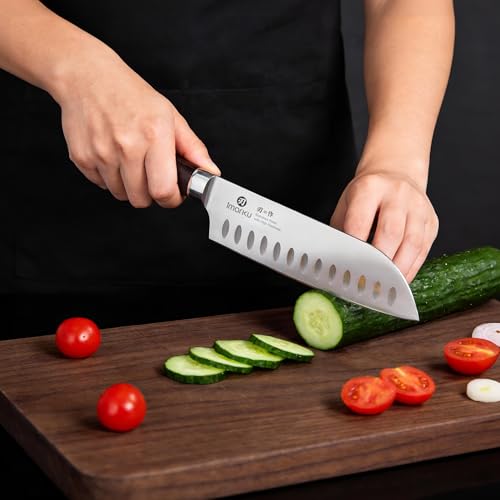
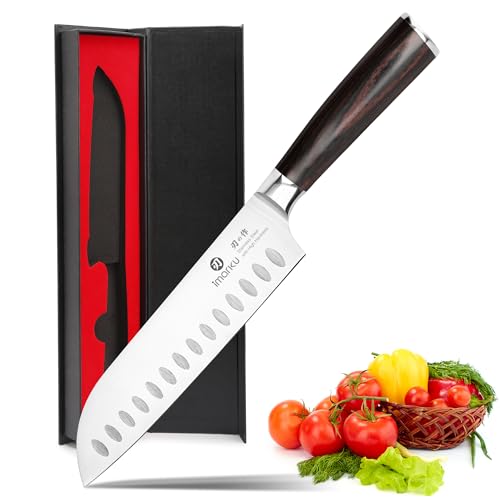
The imarku Santoku solves the sticking problem common with flat-edge knives by using a hollow scalloped blade that keeps sliced food from clinging during fast prep.
Its 15-18 degree hand-polished edge cuts with less force than wider-angle Western knives, which matters most when processing large volumes of vegetables or thin-sliced proteins.
Built from high carbon stainless steel at 2.5mm thickness with a Pakkawood handle, it balances rigidity and grip comfort across different hand sizes.
The brand upgrade notice means packaging and minor cosmetics may vary from product photos, though materials and construction are stated to be unchanged.
Best for home cooks who want one capable, low-maintenance knife that handles daily prep without occupying much counter or drawer space.
Care Guide
Hand-wash with warm soapy water immediately after use and dry thoroughly before storage. Dishwasher cycles degrade the Pakkawood handle and accelerate edge micro-chipping on high carbon steel.
Hone the blade on a ceramic rod every 3-4 uses to maintain the 15-18 degree edge angle. Sharpen on a whetstone at the same angle when honing no longer restores bite.
Store on a magnetic strip or in a knife block. Loose drawer storage causes edge-on-edge contact that dulls the blade faster than actual cooking use.
Save $100.00
Pros & Cons
Pros
- The set covers most everyday cutting tasks with chef's, bread, slicing, Santoku, utility, paring, and steak knives.
- A 57-58 Rockwell hardness gives the 7Cr17 steel a useful balance of edge retention and everyday durability.
- Sloped bolsters provide full access to the blade edge while encouraging a controlled pinch grip.
- The Acacia wood block combines protected storage with non-slip countertop stability.
Cons
- The set does not include a honing rod or knife sharpener, so edge maintenance requires a separate tool.
- The 15-piece block setup occupies countertop space and may be excessive for kitchens that need only a few essential knives.
Details
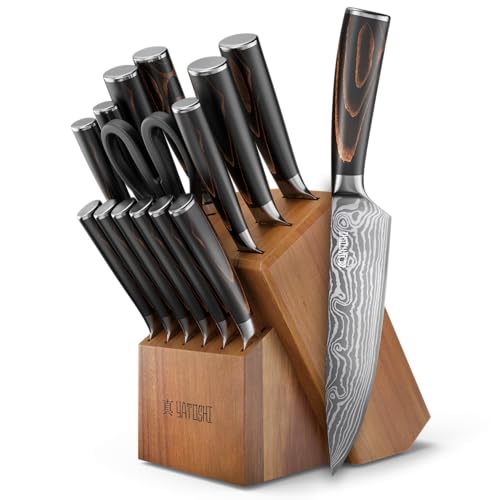
This 15-piece set replaces mismatched kitchen knives with dedicated blades for chopping, slicing, bread, small prep tasks, and serving steak.
Its 7Cr17 high-carbon stainless steel reaches 57-58 Rockwell hardness, while the sloped bolster supports a controlled pinch grip and lets you use the full cutting edge.
The set includes blades from 3.5 to 8 inches, ergonomic Pakkawood handles, pull-apart scissors, and an Acacia wood block with non-slip rubber feet.
No honing rod or sharpener is included, so buyers need a separate maintenance tool to preserve cutting performance.
Best for home cooks who want one coordinated block set for everyday meal preparation and six-person steak service.
Care Guide
Wash and dry each knife promptly after use to protect the high-carbon stainless steel blades and Pakkawood handles from prolonged moisture exposure.
Use wood or plastic cutting boards rather than glass or stone surfaces, which can dull the 57-58 Rockwell edges more quickly.
Store every blade in its assigned Acacia wood block slot, and use a compatible honing or sharpening tool when cutting performance begins to decline.
Pros & Cons
Pros
- 32,768-layer blade construction from 108 traditional forging steps delivers exceptional durability and edge retention compared to mass-produced knives.
- At 8 inches, the blade length balances control for detail work with enough surface area for efficient slicing of larger cuts.
- FSC-certified African Pakka wood handle provides comfortable grip without slipping, even when wet or during repetitive cutting motions.
Cons
- Requires hand-washing and immediate drying to prevent water spots and maintain the stainless steel finish; dishwasher use will damage the blade.
- The high-carbon content means the blade can chip if used on hard surfaces like bone or frozen foods without proper technique.
Details
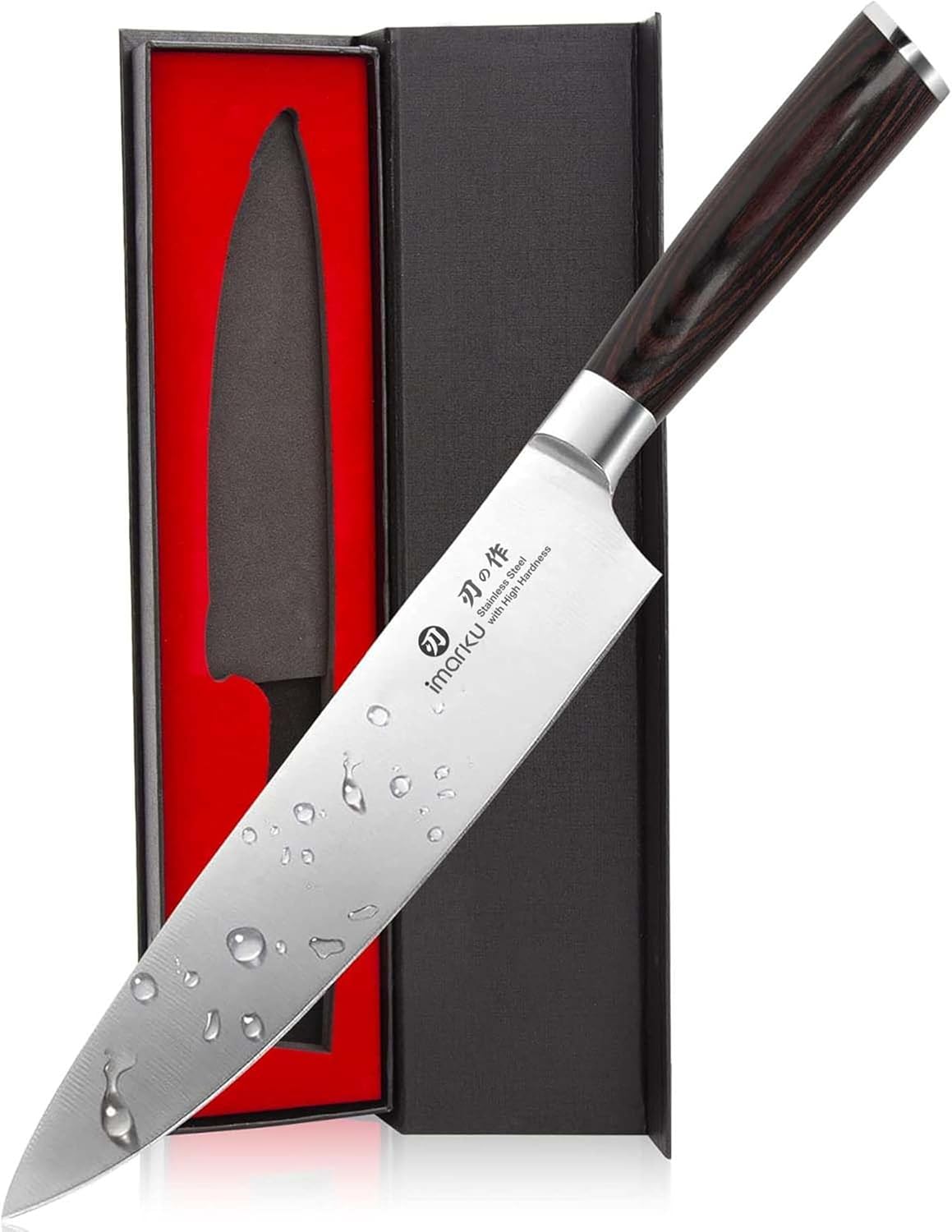
This is an 8-inch gyutou knife designed to replace multiple knives in your kitchen. It slices proteins, dices vegetables, and chops herbs with a single blade, solving the problem of owning too many single-purpose knives.
The 56-58 HRC hardness rating makes it twice as hard as standard kitchen knives, staying sharp through hundreds of cuts. The high-carbon stainless steel (16-18% chrome) resists rust and maintains its glossy finish for years.
The blade weighs approximately 6-7 ounces with an 8-inch cutting edge. The Pakka wood handle is textured for grip control and designed to reduce hand fatigue during extended prep work.
The main limitation is maintenance: it requires hand-washing and immediate drying to prevent water spots and corrosion. Dishwasher use will dull and damage the blade.
Best for home cooks and meal-prep enthusiasts who want a single, reliable knife that handles 80% of daily kitchen tasks without constant sharpening.
Care Guide
Hand-wash immediately after use with warm soapy water and a soft cloth. Dry the blade completely with a kitchen towel to prevent water spots and mineral buildup on the stainless steel surface.
Store the knife in a knife block or on a magnetic strip to protect the edge and prevent accidental dulling. Never store loose in a drawer where it contacts other utensils.
Hone the blade monthly with a honing steel to realign the edge. Professional sharpening every 1-2 years will restore the blade if it loses sharpness despite proper care and use.

Pros & Cons
Pros
- Single-piece stamped blade construction balances durability with lightweight maneuverability, reducing fatigue during extended prep work.
- Satin-finished blades hold their edge longer than cheaper alternatives, staying sharp enough for clean cuts on soft and hard foods.
- Triple-rivet handles with curved design and stainless-steel endcap provide secure grip and professional appearance on countertops.
Cons
- Stamped blades cannot be resharpened as aggressively as forged knives, so eventual replacement may be necessary after years of heavy use.
- Hardwood block requires occasional oiling to prevent drying and cracking in low-humidity kitchens.
Details
A complete knife system designed to eliminate the need for multiple purchases. Solves the common problem of owning mismatched knives that don’t perform consistently across different cutting tasks.
The 8-inch chef’s knife handles 80% of daily prep work, while the hollow-edge santoku’s grantons prevent herb and vegetable slipping. The 8-inch bread knife cuts through crusty loaves without crushing the interior.
High-carbon stainless steel blades resist staining and rust. Full-tang construction distributes weight evenly. Includes 3-inch paring, 5-inch serrated utility, two santoku options, 8-inch chef’s knife, 8-inch bread knife, six 4.5-inch steak knives, honing steel, kitchen shears, and hardwood block.
Stamped blades are thinner than forged alternatives, making them lighter but slightly less durable under extreme pressure or chopping on hard surfaces.
Best for home cooks who want professional-grade performance without forged-knife weight or specialty maintenance routines.
Care Guide
Hand wash immediately after use under warm running water with mild soap. Dry blades with a soft cloth before storing to prevent water spots. Never leave knives soaking or in the dishwasher overnight, as prolonged moisture exposure can dull edges.
Use the included honing steel weekly by drawing each blade spine-down along the steel at a 15-degree angle. This realigns the blade edge without removing metal, keeping knives sharp for months between professional sharpening.
Oil the hardwood block quarterly with food-grade mineral oil to prevent cracking and drying. Store knives blade-up in the block away from direct sunlight and heat sources to preserve both blade sharpness and wood finish.

Pros & Cons
Pros
- Built-in sharpener works effectively with one hand, eliminating the learning curve of manual sharpening methods.
- Complete 15-piece set covers every cutting task from delicate paring to heavy-duty bread slicing without gaps.
- German stainless steel resists staining and rust even in dishwashers, maintaining appearance and edge retention.
Cons
- Hand-washing is recommended despite dishwasher-safe rating to maximize blade longevity and sharpness retention.
- Built-in sharpener works best for maintenance honing; heavily dulled blades may require professional resharpening.
Details
A 15-piece kitchen knife system designed to eliminate multiple tool purchases and constant sharpening hassles. The integrated sharpener solves the problem of dull blades interrupting meal prep without requiring separate equipment.
The built-in hand-operated sharpener maintains edges between uses, and the tapered edge grinding provides precise cuts through proteins, vegetables, and bread. German 1.4116 stainless steel resists staining and rust through repeated washing.
The set includes an 8-inch chef knife, 7-inch Santoku, 8-inch slicing knife, serrated bread knife, utility knife, paring knife, six steak knives, kitchen shears, and a hard wood block. Total footprint is compact enough for standard counters.
The built-in sharpener works best for routine maintenance; heavily dulled blades benefit from professional sharpening services.
Best for home cooks who meal prep multiple times weekly and want a complete knife collection without buying pieces individually.
Care Guide
Hand-wash blades immediately after use with warm soapy water and dry thoroughly. Dishwasher use is safe but accelerates edge wear; reserve it for occasional deep cleaning. Never soak blades for extended periods as moisture can affect the handle.
Use the built-in sharpener weekly during regular cooking to maintain optimal edge. Stroke each blade 3-5 times through the sharpening slot at a consistent angle. This quick maintenance prevents the need for professional resharpening.
Store blades in the wood block immediately after drying to prevent accidental damage and protect your hands. Avoid cutting on glass, marble, or ceramic surfaces; use wood or plastic cutting boards to preserve the edge.
Editor’s Picks
| Category | Pick Type | Why It Makes Sense |
|---|---|---|
| Best Overall | Balanced quality knives | Strongest mix of construction, usability, cleanup, and owner satisfaction |
| Best Value | Practical quality knives | Keeps the core performance features while avoiding unnecessary upgrades |
| Best for Most Home Kitchens | Use-case focused option | Prioritizes the size, controls, material, or workflow that matters most for this search |
At a Glance: Comparison Table
| Pick Type | Steel / Edge | Handle Feel | Best For | Trade-Off |
|---|---|---|---|---|
| Best Overall | Forgiving stainless or semi-stainless | Neutral balance | Daily prep | Not the cheapest |
| Best Value | Durable stamped or simpler forged steel | Practical grip | Newer cooks | Less refined finish |
| Best Upgrade | Harder steel with cleaner edge retention | More precise balance | Frequent prep | Needs better care |
| Best Small Kitchen | Versatile mid-length profile | Easy control | Tight counters | Less reach |
| Best Specialty | Task-specific blade geometry | Purpose-built | Specific foods | Less universal |
How We Evaluated These Products
We evaluated quality knives options by starting with the product job: what the item must do well for most home kitchens, what trade-offs buyers usually accept, and which features are often overstated. From there, we compared visible specifications such as materials, dimensions, capacity, heat or power ratings where relevant, included accessories, warranty terms, and care instructions.
Aggregated owner feedback was used to identify repeated patterns rather than isolated anecdotes. A single dramatic review can be misleading, but repeated comments about dull factory edges, slippery handles, chipping, rust spots, awkward balance, unsafe storage, or difficult sharpening are useful signals. We gave more weight to recent reviews because product lines, coatings, accessories, and manufacturing details can change over time.
We also considered how the product fits into a full kitchen workflow. A Quality Knives can look excellent on a spec sheet and still be frustrating if it is too large to store, too slow to clean, incompatible with common accessories, or poorly matched to the buyer’s cooking habits. That is why this guide connects the main recommendation to related guides like best bread knife, best bread knife for sourdough, and best chef knife.
What Actually Matters:
Steel, hardness, and edge geometry
The steel and its heat treatment decide almost everything about how a quality knives performs over years of use. Softer stainless in the mid-50s HRC range is forgiving and quick to touch up, while harder Japanese-style steel holds a keener edge but chips more easily and wants careful boards. Look at the grind and blade profile too — a thin, well-tapered edge slices cleanly, whereas a thick shoulder wedges through food. For a related option, compare best bread knife before you commit.
Handle comfort and balance
Handle comfort is where a knife either disappears in your hand or fights you. Check how the handle fills a pinch grip, whether the spine and choil are eased instead of squared, and where the balance point sits relative to the bolster. A blade that balances near the finger guard feels nimble for detail work; a handle-heavy one feels planted for power cuts. Grip material matters for wet hands, so weigh textured composite against smooth polished wood. For a related option, compare best bread knife for sourdough before you commit.
Blade length and task fit
Blade length should follow the tasks you actually repeat, not the biggest option on the shelf. A longer blade covers more food per stroke and suits big-board prep, but it turns clumsy in a small kitchen or on a crowded counter. For most home kitchens, a mid-length profile usually handles the widest range of jobs before you reach for a specialist shape. For a related option, compare best chef knife before you commit.
Sharpening, storage, and upkeep
Upkeep is the hidden cost of any blade, so judge storage and sharpening before you buy. A knife stored loose in a drawer dulls and chips faster than one on a magnetic strip, in a block, or in an edge guard. Ask whether you will realistically hone it, send it out, or run it on a pull-through — the honest answer should steer you toward steel that matches your habits. For a related option, compare best chef knife budget before you commit.
Price tiers and long-term value
Price tiers for a quality knives rise fast, and past a point you pay for finish rather than cutting. The jump from a basic to a mid-tier blade usually buys better steel and fit; the jump to premium often buys hand-finishing and brand. For most home kitchens, spend where it changes daily use — edge retention and comfort — and skip cosmetic upgrades that never touch the food. For a related option, compare best chef knife for beginners before you commit.
Frequently Asked Questions
What should I look for in the best quality knives?
Start with fit for your routine: capacity, materials, cleaning, storage, and compatibility. Then compare owner-review patterns for repeated praise or complaints. For best quality knives, avoid buying only by star rating; the right quality knives should match most home kitchens and the way you actually cook.
Is a more expensive quality knives worth it?
It can be, but only when the upgrade improves something you will notice often: durability, control, cleaning, capacity, or comfort. If the higher price only adds accessories or cosmetic finish, a value pick may be smarter. Spend more when the category is used weekly or daily.
What size quality knives is best for most home kitchens?
The best size is the one that handles your normal use without making storage and cleanup annoying. Product photos can hide scale, so check exterior dimensions as well as usable capacity. For small kitchens or occasional use, a slightly smaller quality knives is often the better long-term choice.
How long should a good quality knives last?
A good quality knives should last long enough to justify its price when cared for according to the manufacturer instructions. Lifespan depends on materials, heat exposure, cleaning habits, moving parts, coatings, and storage. Repeated owner complaints about early failure are more important than one isolated review.
What mistakes should I avoid when buying quality knives?
The biggest mistake is buying the most feature-heavy option without checking whether those features solve your actual problem. Also avoid ignoring dimensions, care requirements, replacement parts, and compatibility. If maintenance sounds unrealistic for your household, choose a simpler product.
How does best quality knives compare with nearby options?
Nearby options can overlap, so use intent to decide. If your need is broad, start with the main quality knives category. If your need is specific, compare related guides such as best chef knife for cutting vegetables and best bread knife to avoid buying a product that is good generally but wrong for your setup.
Our Top Pick
For most shoppers, the best quality knives is the balanced option that gets the fundamentals right before adding extras. Prioritize the product with clear specifications, enough capacity for your normal routine, materials that match your maintenance habits, and repeated owner feedback showing reliable everyday use. The shortcode above contains the product set for this page; use the decision tree below to choose the right type within that set.
- Choose the Best Overall type if you want one safe quality knives for regular use.
- Choose the Best Value type if price matters more than premium finish.
- Choose the Best for Most Home Kitchens type if your use case is specific and frequent.
- Choose an upgrade only if better materials, controls, capacity, or durability will matter every week.


Write Your Review
No reviews yet. Be the first to share your experience!