

TL;DR — The best mixer for baking is the option that balances reliable construction, realistic capacity, easy cleanup, and a price that matches how often you will use it. HomeWhisk prioritizes documented specifications, material choices, and repeated owner-review patterns rather than marketing claims. If you are still comparing nearby categories, start with best air fryer and best air fryer budget before narrowing your final pick.
The HomeWhisk editorial team researches kitchen equipment by comparing manufacturer specifications, material details, dimensions, warranty language, retailer listings, and aggregated owner reviews. For best mixer for baking, we looked for patterns that matter after the return window closes: repeated complaints, praised design details, compatibility limits, and maintenance habits that determine whether a product stays useful.
This is a commercial buying guide, so the goal is practical selection rather than a broad encyclopedia entry. We also considered closely related searches such as best mixer for home baking, best home mixer for baking so the recommendations match how shoppers describe the category. Use this page alongside best air fryer for beginners and best air fryer for family if your purchase overlaps adjacent tools or a larger kitchen setup.

Pros & Cons
Pros
- The polished 5.3-quart stainless steel bowl supports large recipes and offers a durable mixing surface.
- Twelve speeds give bakers more control when moving from gentle folding to dense dough preparation.
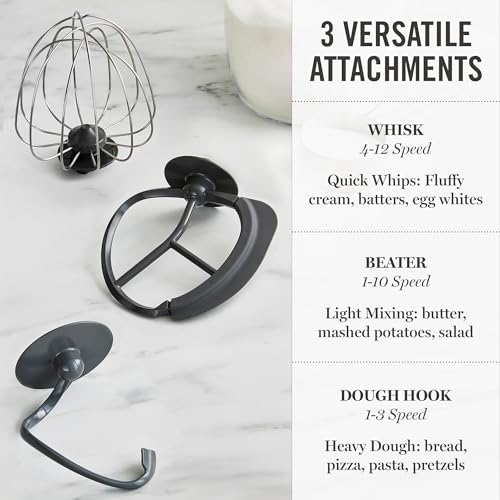
- Three included attachments handle common whipping, beating, and kneading tasks.
- The tilt head and removable splash shield improve bowl access while helping contain messy ingredients.
Cons
- The supplied product information does not list motor wattage, so direct power comparisons with other stand mixers are difficult.
- Dimensions and weight are not provided, leaving buyers unable to confirm countertop clearance or storage needs from the listing data.
Details
This tilt-head stand mixer combines a large bowl and multiple attachments to reduce manual work when mixing batter, whipping ingredients, or kneading dough.
Its 12 speeds support gentle folding through thick-dough mixing, while the 5.3-quart bowl accommodates large recipes, including batches of up to nine dozen cookies.
The polished stainless steel bowl, stainless steel whisk, dough hook, and silicone-edged flat beater provide the core tools needed for frequent home baking.
Motor wattage, dimensions, and weight are not listed, so buyers should verify power expectations and available counter space before ordering.
Best for frequent home bakers who want large-batch capacity, broad speed control, and included attachments in one mixer.
How to Use
Lock the stainless steel bowl in place, choose the whisk, dough hook, or flat beater for the recipe, then lower the tilt head before starting.
Begin at a low speed to reduce splatter, then increase gradually based on whether you are folding, mixing batter, whipping, or kneading thick dough.
Use the splash shield and pour chute for cleaner ingredient additions, then remove the shield and tilt the head back for easier scraping and attachment changes.

Pros & Cons
Pros
- Strong enough for bread dough and pizza dough without straining the motor, based on verified buyer use.
- The silicone-edge beater scrapes bowl sides during mixing, reducing the need to stop and manually scrape.
- Caviar gray finish resists fingerprints and matches modern kitchen aesthetics better than glossy plastic models.
Cons
- The 5.3-quart capacity is too small for double or triple batches of bread dough if you bake in bulk.
- Some buyers report the mixer walking slightly on counters during heavy dough mixing despite the weighted base.
Details
This is a tilt-head stand mixer built for home bakers who need reliable mixing power without spending $300-plus on commercial-grade models.
The 12-speed dial ranges from gentle folding (speed 1-2) to high-speed whipping (speed 10-12), and the planetary mixing action rotates attachments in one direction while spinning the bowl content in the other for thorough coverage. The dough hook handles up to 4 cups of flour for bread recipes.
The 5.3-quart stainless steel bowl includes an ergonomic handle for stable pouring. The base weighs enough to reduce vibration during medium-speed mixing. The motor housing is plastic with metal internal gears.
The bowl capacity limits you to single-batch baking, and the motor may slow slightly under very stiff dough loads, though it recovers without overheating.
Best for weekly bakers in smaller kitchens who want stand mixer convenience at under $150.
How to Use
Start on speed 1 or 2 when combining dry ingredients to prevent flour clouds, then increase speed gradually as the batter or dough comes together. Use the splash guard during the first 30 seconds of mixing.
For bread dough, run the dough hook on speed 2 for 8-10 minutes until the dough pulls away from bowl sides and becomes elastic. For whipped cream or meringue, start the whisk on speed 6 and increase to speed 10-12 once soft peaks begin forming.
Tilt the head back before scraping bowl sides or adding ingredients mid-mix. Let the mixer rest for 10 minutes between heavy dough batches to prevent motor overheating.

Save $17.96
Pros & Cons
Pros
- The 5.3-quart bowl can accommodate enough dough or batter for up to nine dozen cookies.
- Twelve speeds offer more precise control across delicate folding, routine mixing, and thick dough preparation.
- Three included stainless steel attachments support common baking tasks from whipping to kneading.
- The removable splash shield and tilt-head design simplify access while helping contain messy ingredients.
Cons
- The supplied product information does not list motor wattage, making direct power comparisons with other stand mixers difficult.
- Only three attachments are specified, so buyers seeking specialty functions may need to check accessory compatibility separately.
Details
This tilt-head stand mixer combines ingredients, whips mixtures, and kneads dough, reducing the manual work required for frequent baking and large batches.
Its 12 speeds support gentle folding through thick-dough mixing, while the 5.3-quart bowl can handle batches of up to nine dozen cookies.
The polished stainless steel bowl and stainless steel whisk, dough hook, and beater provide durable food-contact surfaces. Product weight is not supplied, so portability cannot be assessed.
Motor wattage and specialty attachment compatibility are not specified, which limits direct comparison for buyers focused on maximum power or expansion options.
Best for home bakers who regularly make cakes, cookies, bread dough, or other recipes in medium to large batches.
How to Use
Select the whisk for aerating mixtures, the dough hook for kneading, or the silicone-edged flat beater for cake batter, cookie dough, and general mixing.
Begin at a lower speed to combine ingredients with less splatter, then increase through the 12 settings as the recipe requires. Use the splash shield pour chute for controlled additions.
Stop mixing before tilting the head to scrape the bowl, inspect consistency, or change attachments, then secure the head before restarting.
Save $30.00
Pros & Cons
Pros
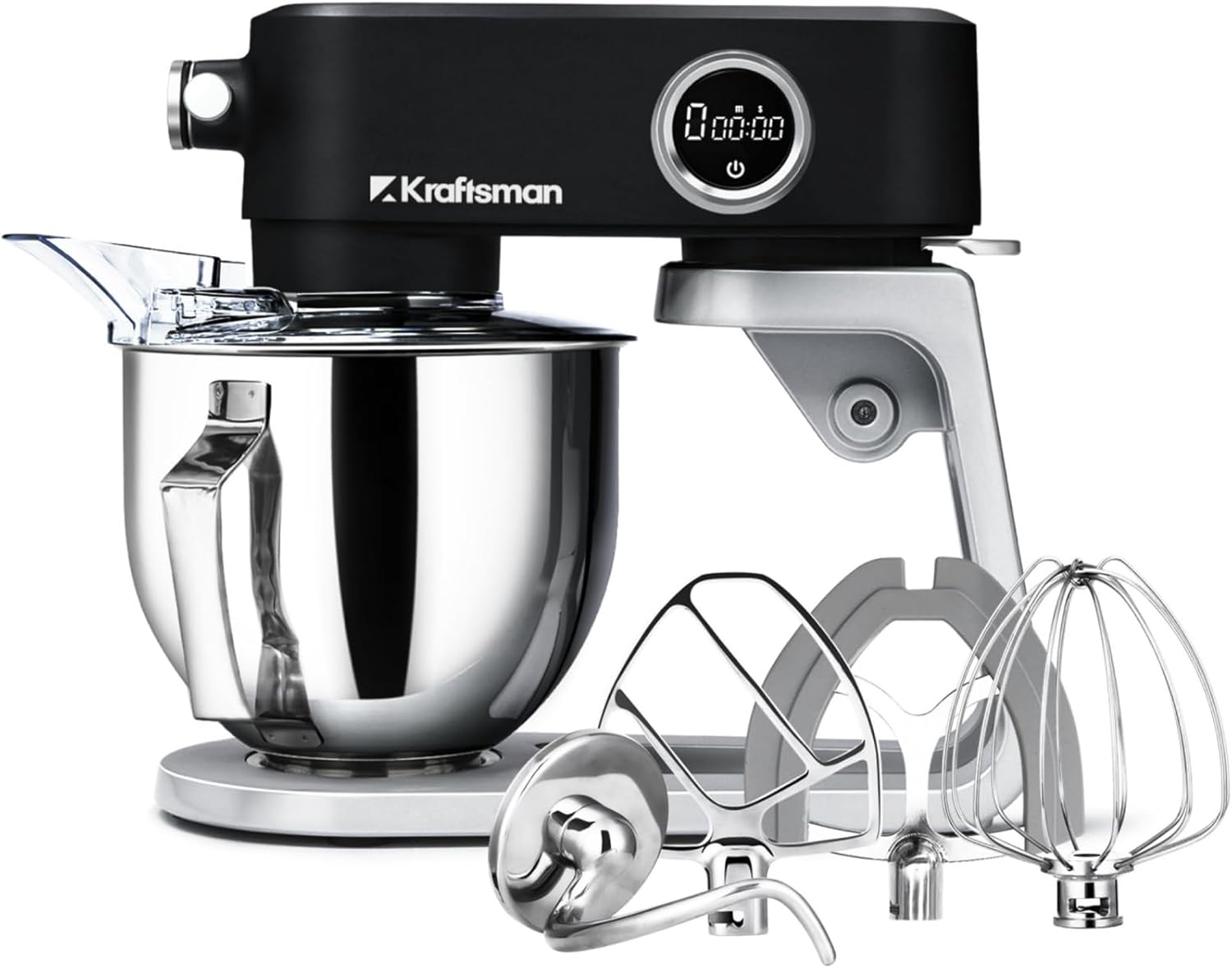
- DC motor provides noticeably stronger torque for dense dough while consuming less energy than traditional AC motors.
- Heavy metal construction prevents vibration and movement even when mixing stiff bread dough at high speeds.
- Four stainless steel attachments included in the box cover most common baking tasks without additional purchases.
Cons
- At nearly 25 pounds, this mixer requires permanent counter space and is not practical to move in and out of storage.
- Price point sits higher than entry-level mixers, making it a bigger commitment for occasional bakers.
Details
This is a 5.3-quart stand mixer built for bakers who regularly work with heavy dough and need a machine that can handle sustained kneading without overheating or walking across the counter.
The DC motor delivers 30% better efficiency than AC motors, translating to stronger torque for dense bread and pizza dough while running under 68 decibels. The built-in timer provides second-level precision for consistent results across multiple batches.
The body is die-cast aluminum weighing 24.9 pounds, which anchors it firmly during operation. All four attachments are stainless steel, including a flexible edge beater that auto-scrapes the bowl during mixing. The tilt-head mechanism includes a removable splash guard with pour chute.
The weight makes this unsuitable for moving in and out of cabinets, and the power hub compatibility depends on purchasing additional attachments separately.
Best for home bakers who knead dough weekly and value a stable, quiet machine over portability.
How to Use
Lock the bowl into the base by twisting until it clicks, then tilt the head back and attach your chosen tool by pushing up and turning clockwise. Start on low speed for dry ingredients to prevent flour clouds, then increase gradually as ingredients combine.
For bread dough, use the dough hook on speed 2-4 and knead for 8-10 minutes, using the built-in timer to track. The flexible edge beater works best for cake batters and cookie dough on speeds 4-6, reducing the need to stop and scrape manually.
Always turn off and unplug before changing attachments or removing the bowl. Clean attachments immediately after use to prevent dried-on dough, and wipe the motor housing with a damp cloth rather than submerging.

Pros & Cons
Pros
- Kneading times adjust from 1 to 40 minutes, providing more control than a fixed-cycle machine.
- Proofing can be set to 98°F or 102°F for faster rising in cooler kitchens.
- The stainless steel bowl is removable for easier serving and washing.
- Suction cups stabilize the compact machine and help reduce movement during kneading.
Cons
- The listed 98°F and 102°F proofing settings may be warmer than recipes that call for a slower, cooler rise.
- Long-term durability and performance consistency cannot be assessed from the supplied product information.
Details
This countertop appliance kneads and proofs yeast dough, reducing the repetitive handwork involved in making bread, pizza, buns, noodles and dumplings.
Two kneading modes support softer bread-style dough and firmer noodle-style dough, while adjustable cycle times let users adapt operation to different recipes.
Proofing settings of 98°F and 102°F provide a controlled warm environment, which is especially useful when room temperature is too low for a reliable rise.
The removable 6.34-quart 304 stainless steel bowl supports larger batches and easier cleaning. The housing is described as compact, but product weight is not provided.
The warm proofing range offers limited control for recipes needing slow fermentation, making this machine best for home bakers prioritizing speed and convenience.
How to Use
Add measured ingredients to the stainless steel bowl, install the kneading blade and choose speed 1 for noodles or dumplings, or speed 2 for bread, pizza and toast dough.
Adjust kneading between 1 and 40 minutes, then select 98°F or 102°F proofing for 5 to 120 minutes according to the recipe and room temperature.
Use the delay timer only with ingredients that can remain safely at room temperature, then remove the bowl, blade and lids for cleaning after the cycle.
Editor’s Picks
| Category | Pick Type | Why It Makes Sense |
|---|---|---|
| Best Overall | Balanced mixer | Strongest mix of construction, usability, cleanup, and owner satisfaction |
| Best Value | Practical mixer | Keeps the core performance features while avoiding unnecessary upgrades |
| Best for Baking | Use-case focused option | Prioritizes the size, controls, material, or workflow that matters most for this search |
At a Glance: Comparison Table
| Pick Type | Capacity | Controls | Best For | Trade-Off |
|---|---|---|---|---|
| Best Overall | Balanced build | Everyday size | Most homes | Not the lowest price |
| Best Value | Core materials | Practical capacity | Budget buyers | Fewer premium details |
| Best Upgrade | Heavier construction | Frequent use | Serious cooks | Higher cost |
| Best Compact | Space-saving design | Smaller batches | Small kitchens | Less capacity |
| Best Specialty | Focused feature set | Niche use | Specific needs | Less universal |
How We Evaluated These Products
We evaluated mixer options by starting with the product job: what the item must do well for baking, what trade-offs buyers usually accept, and which features are often overstated. From there, we compared visible specifications such as materials, dimensions, capacity, heat or power ratings where relevant, included accessories, warranty terms, and care instructions.
Aggregated owner feedback was used to identify repeated patterns rather than isolated anecdotes. A single dramatic review can be misleading, but repeated comments about weak motors, noisy operation, cracked plastic, confusing controls, awkward cleaning, overheating, or capacity claims that feel inflated are useful signals. We gave more weight to recent reviews because product lines, coatings, accessories, and manufacturing details can change over time.
We also considered how the product fits into a full kitchen workflow. A Mixer can look excellent on a spec sheet and still be frustrating if it is too large to store, too slow to clean, incompatible with common accessories, or poorly matched to the buyer’s cooking habits. That is why this guide connects the main recommendation to related guides like best air fryer, best air fryer budget, and best air fryer for beginners.
What Actually Matters:
Capacity, wattage, and real counter footprint
Usable capacity and footprint rarely match the marketing number, so read the real dimensions. A model rated for a large batch can still cook unevenly if the basket or bowl is cramped, and a “compact” unit can still hog the counter once you account for lid clearance and cord. For baking, compare interior usable space and the space it claims when open, not just the headline quarts or watts. For a related option, compare best air fryer before you commit.
Controls, presets, and repeatability
Controls and repeatability separate an appliance you trust from one you fight. Check whether presets map to things you actually cook, whether the dial or panel gives fine control, and whether it remembers or resets between uses. A machine that hits the same result every time is worth more than one with a long feature list you set once and never touch again. For a related option, compare best air fryer budget before you commit.
Cleaning design and removable parts
Cleaning design makes or breaks how often the mixer earns its counter space. Look for removable, dishwasher-safe parts, smooth interiors without food traps, and a lid or basket that rinses without disassembly gymnastics. A powerful appliance that is a chore to wash gets used less, so treat easy teardown as a core spec rather than a bonus. For a related option, compare best air fryer for beginners before you commit.
Noise, heat, and everyday usability
Noise, heat, and everyday usability are the frictions you only notice after purchase. A loud motor or a unit that vents heat across the counter changes when and where you are willing to run it. Check cord length, how far controls sit from a wall, and whether the exterior stays touch-safe — small ergonomics decide whether a mixer lives on the counter or in a cupboard. For a related option, compare best air fryer for family before you commit.
Durability, warranty, and value
Durability and value show up in the parts you cannot see on the box. Weigh the warranty length, the reputation of the motor or heating element, and whether replacement baskets and seals are sold at all. For baking, the better buy is often the model with a proven track record and available parts over a cheaper one that fails just past the return window. For a related option, compare best air fryer for family of 4 before you commit.
Frequently Asked Questions
What should I look for in the best mixer?
Start with fit for your routine: capacity, materials, cleaning, storage, and compatibility. Then compare owner-review patterns for repeated praise or complaints. For best mixer for baking, avoid buying only by star rating; the right mixer should match baking and the way you actually cook.
Is a more expensive mixer worth it?
It can be, but only when the upgrade improves something you will notice often: durability, control, cleaning, capacity, or comfort. If the higher price only adds accessories or cosmetic finish, a value pick may be smarter. Spend more when the category is used weekly or daily.
What size mixer is best for baking?
The best size is the one that handles your normal use without making storage and cleanup annoying. Product photos can hide scale, so check exterior dimensions as well as usable capacity. For small kitchens or occasional use, a slightly smaller mixer is often the better long-term choice.
How long should a good mixer last?
A good mixer should last long enough to justify its price when cared for according to the manufacturer instructions. Lifespan depends on materials, heat exposure, cleaning habits, moving parts, coatings, and storage. Repeated owner complaints about early failure are more important than one isolated review.
What mistakes should I avoid when buying mixer?
The biggest mistake is buying the most feature-heavy option without checking whether those features solve your actual problem. Also avoid ignoring dimensions, care requirements, replacement parts, and compatibility. If maintenance sounds unrealistic for your household, choose a simpler product.
How does best mixer for baking compare with nearby options?
Nearby options can overlap, so use intent to decide. If your need is broad, start with the main mixer category. If your need is specific, compare related guides such as best air fryer for large family and best air fryer to avoid buying a product that is good generally but wrong for your setup.
Our Top Pick
For most shoppers, the best mixer is the balanced option that gets the fundamentals right before adding extras. Prioritize the product with clear specifications, enough capacity for your normal routine, materials that match your maintenance habits, and repeated owner feedback showing reliable everyday use. The shortcode above contains the product set for this page; use the decision tree below to choose the right type within that set.
- Choose the Best Overall type if you want one safe mixer for regular use.
- Choose the Best Value type if price matters more than premium finish.
- Choose the Best for Baking type if your use case is specific and frequent.
- Choose an upgrade only if better materials, controls, capacity, or durability will matter every week.


Write Your Review
No reviews yet. Be the first to share your experience!