

I have packed a hot lunch almost every school morning for six years, and I have heard every confident claim about insulated food jars from other parents at drop-off. Most of them are wrong. The thermos food container is a genuinely useful piece of gear, but it is surrounded by folklore that either sets people up for a lukewarm noon disappointment or scares them off buying one at all. So before you spend money or give up on hot lunches, let me knock down the myths that come up most often and tell you what actually happens in the physics and in the kitchen.
Myth: Any insulated jar keeps food hot all day
This is the big one, and it is only half true. A cheap double-wall jar that relies on trapped air will lose heat steadily, and by noon your chili is closer to room temperature than to hot. What actually holds heat for five to seven hours is vacuum insulation, where the space between the two stainless steel walls has had the air pumped out. No air means almost no conduction, so the heat you seal in has nowhere to go. If the product listing does not say vacuum insulated, assume it is a glorified soup cup. I learned this the hard way with a bargain jar that promised “all-day warmth” and delivered a sad, cool mac and cheese by 11:30.
The other half of the truth is that even a good vacuum jar will not perform if you skip the prep. A jar starts at room temperature, and cold steel will steal heat from your food the second you pour it in. That leads directly to the next myth.
Myth: You just fill it and go
If you take one habit away from this article, make it preheating. Before you add food, fill the empty jar with boiling water, screw the lid on loosely, and let it sit for five to ten minutes while you finish making lunch. Then dump the water, add your piping hot food, and seal it immediately. That single step warms the steel so it stops acting like a heat sink, and it is the difference between food that is genuinely hot at noon and food that is merely warm.
The food itself needs to go in hot too, not warm. Reheat soup until it is steaming, not just heated through. A thermos holds temperature; it does not add heat. Think of it as a bank account. You can only withdraw what you deposit, and preheating just reduces the fees. The same logic works in reverse for cold food: pre-chill the jar with ice water and pack cold yogurt or fruit if you want it cool at lunch.
Myth: Bigger is always better
People assume a larger jar keeps food hotter, and there is a grain of physics behind it, since a bigger thermal mass cools a little slower. But in real life the opposite problem bites you. A 24oz jar that is only half full has a big pocket of air above the food, and that air pulls heat out of the meal. For a young kid, a 12oz jar filled to the top will hold heat better than a 24oz jar filled halfway, and the child will actually finish it.
Match the size to the eater. I use 10 to 12oz jars for my younger one, 16oz for my older kid and for my own desk lunches, and I only reach for the 24oz size when I am packing a hearty stew for a long day outdoors. The trick is to fill whatever jar you choose close to the brim. Less headroom means less air, and less air means hotter food for longer.
Myth: They all leak in a backpack
A good food jar does not leak, but plenty of people have been burned by a bad one or by a user error. Two things cause most leaks. First is a worn or missing silicone gasket. That little rubber ring inside the lid does all the sealing, and if it dries out, tears, or gets left in the dishwasher rack, the seal fails. Keep a spare, and reseat the gasket every so often. Second is overfilling with liquid and then sealing while it is scalding, which builds pressure as it cools and can push liquid past the threads.
There is also a real distinction to know. Many food jars are leak resistant, not fully leakproof, because a wide-mouth lid with a broad gasket is harder to seal perfectly than a narrow water-bottle cap. That is a fair trade. In practice, if you tighten the lid firmly and do not lay a jar of brothy soup on its side for hours, you will be fine. I pack soup upright in a lunch bag and have not had a spill in years.
Myth: You can never put them in the dishwasher
This rule is outdated. A lot of newer stainless food jars are labeled dishwasher safe for both the body and the lid, and the manufacturers mean it. What you should not do is assume every jar is, or toss the silicone gasket loose into the machine where it can vanish. Check your specific model. Older jars and some with printed graphics do better with a hand wash to protect the vacuum seal and the finish.
Regardless of the dishwasher question, the smart move is to disassemble the lid, pull out the gasket, and wash the parts separately now and then. Food particles and oils hide in the threads and under the seal, and that is where funky smells start. A bottle brush and a thin brush for the lid channels take two minutes and keep the jar from developing a permanent tomato-soup aroma.
Myth: A wide mouth is just a marketing gimmick
Wide-mouth is the single feature I care about most, and it is not a gimmick. A narrow opening makes it miserable to pour in chunky chili, to eat pasta with a fork, or to scrub the inside clean. A wide mouth lets a kid get a spoon all the way to the bottom, which matters when the last few bites are the ones they skip in a narrow jar. It also makes filling easier, so you spill less on the counter at 7am.
The lids on wide-mouth jars often double as a bowl or cup, which is handy for hot noodles or for portioning something out. If you eat anything with texture, rice bowls, stew, dumplings, chunky soup, the wide mouth earns its keep every single day. The narrow versions are really only comfortable for smooth liquids.
How long will a good vacuum food jar really keep food hot?
A quality vacuum-insulated jar that you have preheated with boiling water and filled to the top with steaming food will keep that food safely and pleasantly hot for roughly five to seven hours. That is comfortably enough to cover a morning fill and a noon lunch. If you skip the preheat or leave a lot of empty space, expect to lose a couple of those hours and end up with warm rather than hot food. Cold retention runs even longer, often eight hours or more, since the jar only has to fight the ambient warmth of a lunch bag.
What size thermos should I pack for a child versus an adult?
For a preschooler or younger elementary kid, a 10 to 12oz jar is the sweet spot, because it fills to the top with a kid-sized portion and holds heat well without being heavy. Older kids and most adults do well with a 16oz jar, which handles a real meal of soup and bread or a rice bowl. Save the 20 to 24oz jars for big appetites or long outdoor days. Remember to fill whatever you pick close to the brim, since a half-empty large jar loses heat faster than a full smaller one.
Can I put soup with dairy or eggs in a thermos safely?
Yes, as long as you keep it hot. The safety rule is to hold hot food above 140 degrees Fahrenheit, and a preheated vacuum jar packed with steaming food does exactly that for the length of a school or work day. Reheat creamy soups, egg dishes, or meat until they are truly hot before packing, seal them right away, and eat within that five to seven hour window. What you should avoid is packing lukewarm dairy and letting it coast in the danger zone all morning, which is where bacteria grow. Hot in, sealed fast, eaten by lunch is the whole formula.
The Best Deals This Week*
-
Large Bento Lunch Box Set for Adults Kids Women
$27.99
($29.99)Save $2.00 -
Pawtong Bento Lunch Box with 8oz Soup Thermo
$26.98
($32.99)Save $6.01
*Deals are selected by our commerce team
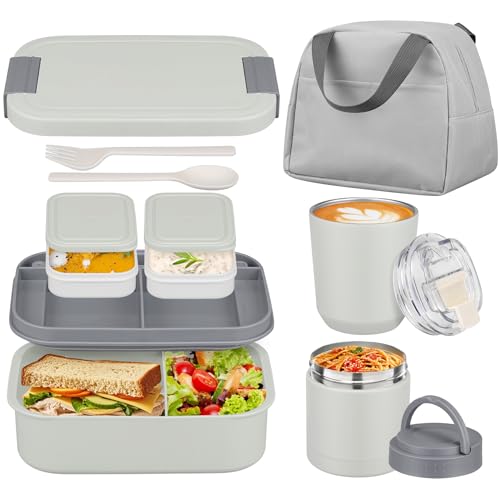
HWONMTE Large Bento Lunch Box Set for Adults Kids Women with 10.5oz Soup Thermo,Coffee Tumblers Men Girls Boys Teenagers Leak-Proof Lunch Food Containers with Lunch Bag
HWONMTE
Large Bento Lunch Box Set for Adults Kids Women with 10.5oz Soup Thermo,Coffee Tumblers Men Girls Boys Teenagers Leak-Proof Lunch Food Containers with Lunch Bag
$27.99 at AmazonEditors' Favorite
Color: Gray Size: 1 Weight: 2.59925006898 pounds Product Group: Kitchen Binding: Kitchen
Shop NowPawtong 10oz Soup Thermo for Hot Food Kids Insulated Food Jar,Thermo Hot Food Lunch Container, Width Mouth Stainless Steel Lunch Box for Kids with Spoon (Black-Gamepad)

Pawtong
10oz Soup Thermo for Hot Food Kids Insulated Food Jar,Thermo Hot Food Lunch Container, Width Mouth Stainless Steel Lunch Box for Kids with Spoon (Black-Gamepad)
$9.99 at AmazonGreat Value
Color: Black-Gamepad Size: 10 oz Dimensions: 5 x 4 x 3 inches Weight: 0.5952481074 pounds Product Group: Kitchen Binding: Kitchen
Shop NowPawtong Bento Lunch Box with 8oz Soup Thermo, Kids Leakproof Lunch Food Containers with 4 Compartment, Kids Thermo Insulated Hot Food Jar for School, Trvael - (Pink)

Pawtong
Bento Lunch Box with 8oz Soup Thermo, Kids Leakproof Lunch Food Containers with 4 Compartment, Kids Thermo Insulated Hot Food Jar for School, Trvael - (Pink)
$26.98 at AmazonColor: Pink Size: middle Dimensions: 7.99 x 7.28 x 3.15 inches Weight: 1 Pounds Product Group: Kitchen Binding: Kitchen
Shop Nowwiwens Thermo Food Jar for Hot Food 32OZ Soup Thermo Lunch Containers Wide Mouth Vacuum Insulated Stainless Steel Leakproof Bento Box with Spoon (Black)

wiwens
Thermo Food Jar for Hot Food 32OZ Soup Thermo Lunch Containers Wide Mouth Vacuum Insulated Stainless Steel Leakproof Bento Box with Spoon (Black)
$32.99 at AmazonColor: Black Dimensions: 4.72047243613 x 4.72047243613 x 5.11023621526 inches Product Group: Kitchen Binding: Kitchen
Shop NowTHERMOS FUNTAINER Kids Food Jar with Spoon, 10oz, Navy

Color: Navy Size: 10 Ounce Dimensions: 9.44 x 8.8 x 13.55 inches Weight: 0.25 Pounds Product Group: Kitchen Binding: Kitchen
Shop Now



Write Your Review
No reviews yet. Be the first to share your experience!