

When a Ninja blender 1200 watts listing catches your eye, the number means the motor can draw up to 1200 watts of power from the wall. That’s plenty for smoothies, frozen drinks and crushed ice. But the number alone doesn’t tell you how well a blender actually blends. Blade design, jar shape and the way a brand states its wattage matter just as much.
This guide explains what a 1200-watt rating really means, how wattage claims differ from brand to brand, and how to choose the right power level for the way you cook. One catch up front: none of the Ninja titles we pulled for this article state 1200 watts, so we won’t pretend they do. We’ll use them as honest reference points instead.
What 1200 watts means on a Ninja blender
Watts measure how much electrical power a motor pulls. On a standard 120-volt US outlet, a 1200-watt motor draws about 10 amps (1200 divided by 120). That’s comfortably inside a typical 15-amp kitchen circuit, though you shouldn’t run it at the same time as a kettle or toaster oven on the same circuit.
More watts generally means more torque for thick, frozen or fibrous loads. A 1200-watt motor has about 33 percent more power than a 900-watt one, so it should keep its speed through a jar of frozen fruit and ice that would bog down a smaller motor. Still, read the label carefully. Some brands quote steady running watts. Others quote peak watts, a short burst figure that looks bigger on the box. Compare like with like, or the comparison means nothing.
That’s where the Ninja Nutri-Plus Personal Blender is a useful yardstick. Its title lists 900PW and three 20oz cups, which is roughly 590 mL each. The PW in a Ninja title typically points to a peak watts figure, so treat 900 as a ceiling rather than a constant draw. It’s a single-serve blender aimed at smoothies and shakes to go, and shoppers who land on it while searching for a best nutri blender will see where the lower end of Ninja’s power range sits.

Ninja
Single-Serve Smoothies and Frozen Drinks with Ninja Nutri-Plus BN301 900-Watt Personal Blender
The Ninja Nutri-Plus BN301 blends smoothies, frozen drinks, and nutrient extractions directly in 20-ounce cups, with a 900-peak-watt motor that crushes ice and frozen ingredients. It suits busy individuals or small households seeking quick portions, portable lids, and dishwasher-safe cleanup.
Pros and Cons
Pros
- The Pro Extractor Blades Assembly crushes ice and breaks down whole fruits and vegetables.
- Three 20-ounce cups support multiple servings or back-to-back drink preparation.
- Included spout and storage lids provide options for drinking immediately or storing a blend.
- Dishwasher-safe removable parts simplify cleanup.
Cons
- Push-to-blend operation requires manual pressure rather than offering automatic blending programs.
- The 20-ounce cups are designed for personal portions, not large family-size batches.
Ninja Single-Serve Smoothies and Frozen Drinks with Ninja Nutri-Plus BN301 900-Watt Personal Blender
Ninja
Single-Serve Smoothies and Frozen Drinks with Ninja Nutri-Plus BN301 900-Watt Personal Blender
The Ninja Nutri-Plus BN301 blends smoothies, frozen drinks, and nutrient extractions directly in 20-ounce cups, with a 900-peak-watt motor that crushes ice and frozen ingredients. It suits busy individuals or small households seeking quick portions, portable lids, and dishwasher-safe cleanup.
$69.98 at AmazonEditors' Favorite
Color: Silver Size: 900-Peak-Watts Dimensions: 4.7 x 4.7 x 13.8 inches Weight: 5.34 Pounds Product Group: Kitchen Binding: Kitchen
Shop NowDoes more wattage blend better?
Up to a point, yes. Past that point, design does more of the work. Two blenders with the same wattage can give very different results, and a smaller motor with a smart blade layout can beat a bigger one with a poor layout. Here’s what to weigh besides the number on the box.
Blade design and jar shape
Power only matters if it reaches the food. Blade height, jar taper and how you load ingredients decide whether the blades keep pulling food downward or just spin in an air pocket. A narrow single-serve cup funnels everything onto the blades, which is why a 900-watt personal blender can turn a banana, berries and milk into a smooth drink. A big pitcher has to move far more volume, so it leans harder on motor power. If you mostly make one or two servings, a best mini blender may be all you need.
Noise, heat and run time
A stronger motor is usually a louder one. It also makes more heat when you push it through dense loads like frozen fruit or nut butter. Keep to the run times in the manual, give the motor a rest between long batches, and stop if you smell hot plastic. Wattage buys headroom. It doesn’t buy immunity from overheating.
When a Ninja Foodi system makes more sense
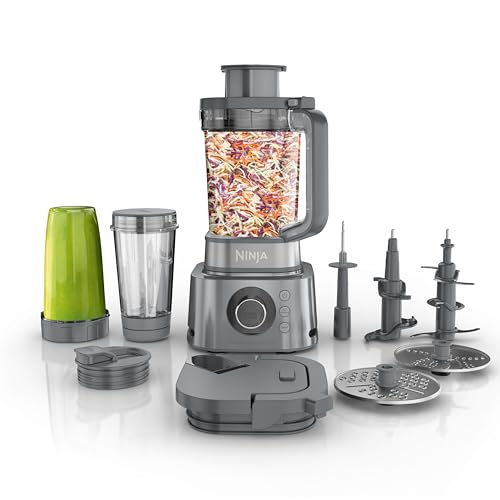
If you want more than smoothies, the Foodi line is the better fit. The Ninja Foodi Power Blender & Processor System, 7 Functions, Silver, SS401 pairs a blender with a food processor in one system, according to its title. Seven functions means you’re not stuck with a single blend setting, so you can match the program to the job. The exact function list sits on the product listing.
We can’t confirm the wattage from the title, so check the specs section on the listing if 1200 watts is a hard requirement for you. If you’d like to see how Ninja’s full range stacks up, our best ninja blender roundup covers it. For this question, the Foodi system is the model to look at when you want a pitcher-style blender plus processing in one box.
Ninja
Smoothies, Food Prep and Nut Butter with Ninja Foodi SS401 Power Blender and Processor
The Ninja Foodi SS401 blends drinks, makes thick smoothie bowls, and slices, shreds, or grates food, with a 1600-peak-watt smartTORQUE motor as its biggest advantage. It suits cooks who want one countertop system for both high-power blending and precise food processing.
Pros and Cons
Pros
- Its seven functions cover both blending and food-processing tasks in one countertop system.
- The smartTORQUE motor is designed to maintain power when handling thick or frozen mixtures.
- Select-cut processing discs provide more precise results when slicing, shredding, or grating ingredients.
- The built-in tamper helps create thick smoothie bowls and nut butters without requiring excess liquid.
Cons
- The product data does not provide dimensions or weight, so buyers should verify available counter and storage space.
- Using its full range of functions requires switching among the processing lid, discs, smoothie bowl maker, and extraction cup.
Ninja Smoothies, Food Prep and Nut Butter with Ninja Foodi SS401 Power Blender and Processor
Ninja
Smoothies, Food Prep and Nut Butter with Ninja Foodi SS401 Power Blender and Processor
The Ninja Foodi SS401 blends drinks, makes thick smoothie bowls, and slices, shreds, or grates food, with a 1600-peak-watt smartTORQUE motor as its biggest advantage. It suits cooks who want one countertop system for both high-power blending and precise food processing.
$183.83 at AmazonEditors' Favorite
Color: ['Platinum'] Size: 1600 Peak Watts Dimensions: 8.7 x 8.3 x 16.14 inches Weight: 12.1 pounds Product Group: Kitchen Binding: Kitchen
Shop NowHow to read a wattage label before you buy
Start with the product title, then move to the spec section and the manual if the listing links one. Look for the words “peak” or “PW” next to the number. If you see them, the figure describes a burst, not steady output. No label at all? Then you can’t compare it fairly with a blender that does state its power.
Next, check the cup or pitcher size. A 20oz cup and a 64oz pitcher ask very different things of the same motor. Then look at the function count. A system with 6 or 7 functions is built for more than drinks, so its motor and blades serve several jobs. Simple, right? Not always, because brands present numbers differently. Take your time with the fine print.
Common mistakes with high-wattage blenders
Buying on watts alone is the big one. A number on the box feels objective, but it ignores jar size, blade design and how the brand counts watts. Read the full title and the spec section before you compare two blenders.
Overfilling is the next. Every jar has a max fill line for a reason. Past it, food can’t circulate, the motor works harder and the lid can pop. Fill to the line, not above it.
Loading in the wrong order also hurts. Put liquid in first, then soft ingredients, then frozen fruit and ice on top. Pulse a few times before you run it continuously. Short bursts help the blades grab a stuck mass.
Blending hot liquids in a sealed jar is a safety problem. Steam expands fast and can push the lid off. Let soups and hot sauces cool first, or follow the manual’s guidance for hot blending. And don’t skip the basics: unplug the base before you handle the blades, since they’re sharp.
Last, don’t ignore the budget. A strong motor isn’t always worth a higher price if you only make one smoothie a day. Our best blender value guide is a good place to see what the middle of the market looks like.
Choosing between 900 watts, 1200 watts and a Foodi system
Think about what ends up in the jar. For one-serve smoothies, protein shakes and a bit of frozen fruit, a 900PW personal blender like the Nutri-Plus does the job. For family-size batches, ice-heavy drinks or thicker blends, a 1200-watt class motor gives you more headroom. And if you also chop, shred or knead, a system with processing attachments saves you buying a second appliance.
The Ninja Foodi Power Blender & Food Processor, 6 Functions, Silver, SS351 sits right next to the SS401 in Ninja’s lineup. By the titles, the difference is one function: 6 versus 7. Both pair a blender with a food processor, so the choice comes down to which function set you want and what price you’re comfortable with. Compare the two listings side by side before you decide. Shoppers still weighing size can browse our best blender for guide for use-case picks.
Ninja Foodi Power Blender & Food Processor, 6 Functions, Silver, SS351

Editors' Favorite
Color: Silver Size: 1600 Peak Watts Dimensions: 8.19 x 8.43 x 14.17 Inches Weight: 8.2 Pounds Product Group: Kitchen Binding: Kitchen
Shop NowFAQ
How many watts is a Ninja blender?
It varies by model. Ninja sells personal cups, full-size pitchers and Foodi systems across a wide range of power. The Ninja Nutri-Plus title lists 900PW, while the two Foodi titles in this guide don’t state a wattage. Check the spec section of the exact model you’re considering.
Is 1200 watts enough to crush ice?
In general, yes. A motor in that class has the torque to break up ice when you load it correctly. Add liquid first, put the ice on top, and pulse before running continuously. Technique and blade design count as much as the wattage figure.
Is 1200 peak watts the same as 1200 running watts?
No. Peak watts describe a brief burst, often at start-up, while running watts describe what the motor draws under steady load. A blender labeled 1200 peak watts may draw noticeably less once it’s spinning. When you compare models, make sure both numbers use the same measure.
Will a 1200-watt blender trip my breaker?
Unlikely on its own. At about 10 amps, it fits within a standard 15-amp kitchen circuit. Trouble starts when you run it alongside another high-draw appliance on the same circuit, like a toaster oven or electric kettle. If a breaker does trip, move one appliance to a different outlet circuit.
Do I need 1200 watts for smoothies?
Not for a single serving. A personal blender in the 900-watt class can handle a smoothie cup. A bigger motor pays off when you blend large batches, lots of ice or thick frozen mixes. Match the power to your most demanding recipe, not your average one.

Write Your Review
No reviews yet. Be the first to share your experience!