

A Ninja blender and smoothie maker is the same machine: any Ninja blender with a sharp blade assembly and enough power can turn fruit, greens, yogurt and ice into a drinkable smoothie. What changes from model to model is the container. Some Ninja models give you single-serve cups you can drink from, and others give you a full-size pitcher for the whole family.
This guide helps you decide which kind of Ninja suits the way you make smoothies, how to load and run it so the texture comes out smooth instead of gritty, and which mistakes cause most of the bad batches. We’ve kept the product talk to three Ninja models, and every spec we mention comes from the product titles on Amazon.
Can a Ninja blender really double as a smoothie maker?
Yes. A smoothie is just fruit, liquid and something creamy or icy, broken down until it pours. Any blender with a strong motor and a blade stack that reaches the bottom of the container can do that. Ninja’s lineup leans on exactly that design, with tall blade assemblies that pull ingredients down into the cutting zone instead of leaving them stuck on top.
The real decision is cup versus pitcher. A personal blender gives you one or two servings in a cup you can twist off the base and carry out the door. A pitcher system makes four or more servings at once and handles bigger jobs like crushed ice or a batch of soup. If you make one smoothie before work, the cup is easier. If you’re feeding a household on Saturday morning, the pitcher saves you from blending three rounds.
For a solo smoothie routine, the Ninja Nutri-Plus is a natural fit. The title describes a 900PW personal blender that comes with three 20oz cups. That’s a handy setup because you can prep a cup the night before, leave it in the fridge, and snap it onto the base in the morning. If this is the size you’re leaning toward, our roundup of the best nutri blender options shows how it stacks up against similar single-serve designs.

Ninja
Single-Serve Smoothies and Frozen Drinks with Ninja Nutri-Plus BN301 900-Watt Personal Blender
The Ninja Nutri-Plus BN301 blends smoothies, frozen drinks, and nutrient extractions directly in 20-ounce cups, with a 900-peak-watt motor that crushes ice and frozen ingredients. It suits busy individuals or small households seeking quick portions, portable lids, and dishwasher-safe cleanup.
Pros and Cons
Pros
- The Pro Extractor Blades Assembly crushes ice and breaks down whole fruits and vegetables.
- Three 20-ounce cups support multiple servings or back-to-back drink preparation.
- Included spout and storage lids provide options for drinking immediately or storing a blend.
- Dishwasher-safe removable parts simplify cleanup.
Cons
- Push-to-blend operation requires manual pressure rather than offering automatic blending programs.
- The 20-ounce cups are designed for personal portions, not large family-size batches.
Ninja Single-Serve Smoothies and Frozen Drinks with Ninja Nutri-Plus BN301 900-Watt Personal Blender
Ninja
Single-Serve Smoothies and Frozen Drinks with Ninja Nutri-Plus BN301 900-Watt Personal Blender
The Ninja Nutri-Plus BN301 blends smoothies, frozen drinks, and nutrient extractions directly in 20-ounce cups, with a 900-peak-watt motor that crushes ice and frozen ingredients. It suits busy individuals or small households seeking quick portions, portable lids, and dishwasher-safe cleanup.
$69.98 at AmazonEditors' Favorite
Color: Silver Size: 900-Peak-Watts Dimensions: 4.7 x 4.7 x 13.8 inches Weight: 5.34 Pounds Product Group: Kitchen Binding: Kitchen
Shop NowHow to make a smoothie in a Ninja blender
The method barely changes between a personal cup and a full pitcher. The order you load things in matters more than the model name on the base. Get that right and even a modest motor will give you a smooth drink.
Load the container in the right order
Start with liquid. Pour in milk, juice, water or a plant milk until it covers the bottom of the cup. Add soft ingredients next: yogurt, nut butter, bananas, fresh berries. Put leafy greens on top of those, then finish with the hard, frozen items such as frozen fruit and ice. The frozen pieces sit near the top where gravity pushes them down into the blades as the liquid begins to move.
Flip that order and you’ll get a pocket of dry powder or a block of ice stuck above the blades. The motor spins, nothing gets pulled down, and you end up shaking the cup and starting again. It’s the most common reason people think their blender is weak when it’s really just loaded upside down.
Blend in bursts, then run it steady
Start with a few short pulses to break up the big pieces, then let it run continuously until the sound evens out. On a personal cup, that usually takes under a minute. A full pitcher with more volume may need a little longer. Stop and check the texture before you pour. If you see flecks of kale or chunks of fruit skin, run it another 15 to 20 seconds.
Don’t overfill. Every cup has a max line for a reason, and a cup packed to the brim won’t circulate. Fill to the line, not past it. If the mix is too thick to move, add a splash of liquid and try again.
Personal cups versus a full pitcher
Single-serve cups win on convenience. You blend straight into the cup you’ll drink from, so there’s one less thing to wash. Because the blade assembly screws onto the cup, a personal blender also takes up very little counter space. The tradeoff is capacity. A 20oz cup doesn’t leave much room once you add ice, so you’ll often be making one drink at a time.
A pitcher system gives you more volume and more versatility. If you want a bigger blender that also handles food prep, the Ninja Foodi Power Blender & Processor System, listed as a 7 function model in silver, is aimed at that job. The title calls it a blender and processor system, which means it’s meant to chop and process food as well as blend drinks. That extra range is useful if you want one machine for smoothies on Monday and a chopped salsa or dough on Friday.
The bigger footprint is the downside. Pitcher systems take more cabinet space and more cleanup, and they’re overkill if all you ever make is a single banana-and-berry drink. If you aren’t sure how much blender you need, our guide to the best blender for different kitchen jobs walks through the common use cases, and the best small blender picks cover the compact end of the market.
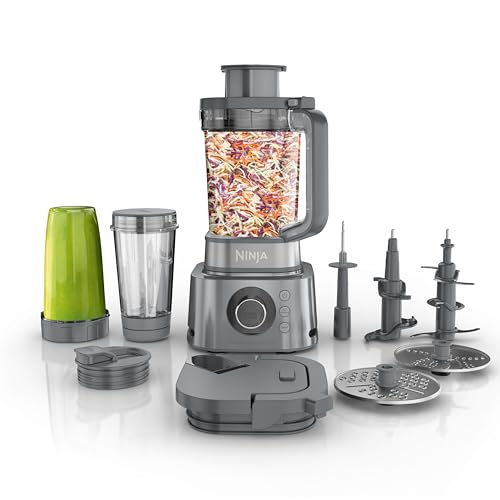
Ninja
Smoothies, Food Prep and Nut Butter with Ninja Foodi SS401 Power Blender and Processor
The Ninja Foodi SS401 blends drinks, makes thick smoothie bowls, and slices, shreds, or grates food, with a 1600-peak-watt smartTORQUE motor as its biggest advantage. It suits cooks who want one countertop system for both high-power blending and precise food processing.
Pros and Cons
Pros
- Its seven functions cover both blending and food-processing tasks in one countertop system.
- The smartTORQUE motor is designed to maintain power when handling thick or frozen mixtures.
- Select-cut processing discs provide more precise results when slicing, shredding, or grating ingredients.
- The built-in tamper helps create thick smoothie bowls and nut butters without requiring excess liquid.
Cons
- The product data does not provide dimensions or weight, so buyers should verify available counter and storage space.
- Using its full range of functions requires switching among the processing lid, discs, smoothie bowl maker, and extraction cup.
Ninja Smoothies, Food Prep and Nut Butter with Ninja Foodi SS401 Power Blender and Processor
Ninja
Smoothies, Food Prep and Nut Butter with Ninja Foodi SS401 Power Blender and Processor
The Ninja Foodi SS401 blends drinks, makes thick smoothie bowls, and slices, shreds, or grates food, with a 1600-peak-watt smartTORQUE motor as its biggest advantage. It suits cooks who want one countertop system for both high-power blending and precise food processing.
$183.83 at AmazonEditors' Favorite
Color: ['Platinum'] Size: 1600 Peak Watts Dimensions: 8.7 x 8.3 x 16.14 inches Weight: 12.1 pounds Product Group: Kitchen Binding: Kitchen
Shop NowCommon smoothie mistakes to avoid
Most bad smoothies come down to a handful of habits. Fixing them costs nothing.
First, too little liquid. A smoothie that’s all frozen fruit and a tablespoon of milk will stall the blades. Start with more liquid than you think you need and thicken it afterward with extra frozen fruit or a spoonful of yogurt. Thinning a thick smoothie is easy, but rescuing a stalled one means taking the cup apart.
Second, tossing in whole ice with no liquid. Ice needs something to move it around. Add it last, on top of the liquid and soft ingredients, and let the blender work through it in steps.
Third, ignoring the greens. Spinach blends easily, but tougher greens like kale need extra time, and stems can leave a stringy texture. Strip the thick stems and blend the greens with the liquid first, before you add the frozen items. A short head start makes a visible difference.
Fourth, skipping the rinse. A smoothie dries fast, and dried fruit sugar clings to blades. Rinse the cup right after you pour, or fill it with warm water and a drop of dish soap, blend for a few seconds, and rinse again. Plain and quick.
Finally, running the motor too long. Blenders generate heat, and a continuous run of several minutes can warm up your drink and strain the motor. If the smoothie isn’t done in about a minute, stop, scrape or shake, and go again in short rounds.
When it makes sense to step up to a bigger Ninja
A personal cup covers most smoothie routines, but there are clear signs you’ve outgrown it. You’re making two or three batches back to back. You want to crush ice for cocktails or frozen drinks. You’d like to chop vegetables or mix dough without hauling out another appliance. In those cases a processor-style system earns its counter space.
The Ninja Foodi Power Blender & Food Processor, SS351, is another option in that category. Its title lists 6 functions, one fewer than the 7 listed for the SS401 system above, and both are described as a blender and processor in one. We can’t tell you from the titles exactly which functions differ, so check the product page for the full list of presets and included attachments before you decide between the two. If budget matters, the tiers between a basic personal cup and a full system are covered in our look at the best cheap blender options.
It’s also worth comparing Ninja’s own range before you buy. Our best Ninja blender roundup lays out how the personal, pitcher and processor styles differ, and the best mini blender guide is a useful reference if portability is your main concern.
Ninja Foodi Power Blender & Food Processor, 6 Functions, Silver, SS351

Editors' Favorite
Color: Silver Size: 1600 Peak Watts Dimensions: 8.19 x 8.43 x 14.17 Inches Weight: 8.2 Pounds Product Group: Kitchen Binding: Kitchen
Shop NowFAQ
Is a Ninja blender good for smoothies?
Yes. Ninja blenders are built around tall blade assemblies and strong motors, which suit frozen fruit and ice. The key is matching the size to your habits. A personal cup works well for one or two drinks, while a pitcher system suits families and bigger batches.
What’s the best order to add smoothie ingredients to a Ninja?
Liquid first, then soft ingredients like yogurt and fresh fruit, then leafy greens, then frozen fruit and ice on top. That order lets the blades pull the heavier frozen pieces down into the liquid. Loading it the other way around often leaves dry pockets near the blades.
How long should I blend a smoothie in a Ninja?
Plan on roughly 30 to 60 seconds for a single cup, starting with a few quick pulses. Larger pitchers may take a bit longer. Stop when the sound evens out and the texture looks uniform. If you see flecks of greens or fruit skin, run it again for 15 to 20 seconds.
Can a Ninja blender crush ice for smoothies?
Ninja markets its blenders around ice crushing, but results depend on the model and on how you load it. Always add ice on top of the liquid and soft ingredients, and never fill past the max line. If your blender struggles, add a little more liquid and pulse in short rounds.
Should I get a personal Ninja or a full-size system for smoothies?
If you drink one smoothie a day and want easy cleanup, a personal blender like the Nutri-Plus with its three 20oz cups is simpler. If you cook with your blender too, or you often make several servings at once, a Foodi blender and processor system gives you more room and more functions.
Write Your Review
No reviews yet. Be the first to share your experience!