

A mixer food processor is a countertop machine that handles the chopping, shredding and pureeing a food processor does, and some shoppers also expect it to mix batter like a stand mixer. Most of the time those are two different machines, and knowing which job you need done is the fastest way to pick the right one.
This guide explains what people mean by the term, where a mixer and a food processor overlap, and how to choose a size so the machine you buy actually gets used. It also covers a compact chopper and two baby food makers that work as small processors.
What a “mixer food processor” really means
When shoppers type this phrase, they usually mean one of three things. Some want a stand mixer that comes with a food processor attachment. Some want a food processor that can also whip and blend. And some just want one small appliance that does the prep work so they can stop chopping by hand.
A true stand mixer turns a beater, whisk or dough hook through a bowl of ingredients. A food processor spins a sharp blade or a shredding disc through food packed into a work bowl. The motion is different, so the results are different. A mixer builds structure in dough and traps air in cream and egg whites. A processor cuts, grates and purees.
Combination machines exist, but they usually trade depth for range. If you bake bread every week, you’ll want a dedicated mixer. If you spend most of your prep time on onions, cabbage, cheese and nuts, a processor saves far more time. For a lot of home cooks, the honest answer is a compact processor first and a mixer later.
A good starting point is a small, easy-to-store model like the Cuisinart 5-Cup Chop & Shred Food Processor (FP-5). The title tells you what it is built for: chopping and shredding in a compact body with an easy-store design. It comes in silver and holds 5 cups, which is enough for a salad’s worth of vegetables or a batch of salsa.

Cuisinart
5-Cup Chop & Shred Food Processor FP-5 for Fast Vegetable Prep
The Cuisinart FP-5 chops and shreds ingredients in a 5-cup bowl, with its biggest advantage being compact storage that keeps removable parts nested inside. It suits cooks who want quick food prep without dedicating much counter or cabinet space to an appliance.
Pros and Cons
Pros
- The compact base and integrated cord storage make this processor easier to keep in small kitchens.
- The reversible shredding disc offers both fine and medium shredding options.
- The ergonomic handle gives the 5-cup bowl a more comfortable grip during food preparation.
- The nesting storage design keeps removable components together inside the work bowl.
Cons
- The 5-cup work bowl may require multiple batches for large meal preparation.
- The product data does not specify its materials or total weight, which may matter to buyers comparing construction and portability.
Cuisinart 5-Cup Chop & Shred Food Processor FP-5 for Fast Vegetable Prep
Cuisinart
5-Cup Chop & Shred Food Processor FP-5 for Fast Vegetable Prep
The Cuisinart FP-5 chops and shreds ingredients in a 5-cup bowl, with its biggest advantage being compact storage that keeps removable parts nested inside. It suits cooks who want quick food prep without dedicating much counter or cabinet space to an appliance.
$69.95 at AmazonEditors' Favorite
Color: Silver Size: 7.9"(L) x 5.91"(W) x 13.31"(H) Dimensions: 7.9 x 5.91 x 13.31 inches Product Group: Kitchen Binding: Kitchen
Shop NowMixer vs food processor: what each one does best
Before you spend money, match the machine to the tasks on your weekly list. Here’s how the two split the work.
Where a mixer wins
Anything that needs air or gluten development belongs in a mixer. That includes whipped cream, meringue, buttercream, cake batter, cookie dough and bread dough. A mixer holds a steady speed for minutes at a time, and its bowl is shaped so the beater reaches the whole mixture. A processor blade can cut through dough, but it tends to overwork it, and the result can turn dense.
A mixer also handles large batches. Many stand mixer bowls hold 4 to 7 quarts, which is much more room than a compact processor offers.
Where a food processor wins
Anything that needs to be cut, grated or ground is faster in a processor. Think shredded cheese, coleslaw, diced onions, breadcrumbs, pesto, hummus and pie crust. The work bowl keeps the food moving toward the blade, so pieces come out fairly even when you pulse in short bursts.
Speed matters here. A carrot you would grate by hand in five minutes can go through a shredding disc in seconds. That’s the real appeal of a processor. Fast prep, less mess. It’s why a chopper-style model earns its counter space even in a small kitchen.
If you’re still comparing models, our best food processor roundup lays out the main options side by side.
How to choose a size and style
Capacity is the first decision. Compact processors in the 3 to 5 cup range suit one or two people and small prep jobs. Mid-size models in the 9 to 11 cup range are better for families who batch-cook. Large 12 to 14 cup models are for heavy use, but they take up real storage space and take longer to wash.
If counter and cabinet room is tight, start small. A 5-cup bowl can still handle most weeknight recipes, as long as you work in two rounds when a recipe is large. Our best compact food processor page covers the small-footprint choices in more detail.
Attachments and blades
Look at what comes in the box. A standard S-blade handles chopping and pureeing. A shredding disc handles cheese and vegetables. A slicing disc gives you even cuts for potatoes and cucumbers. The Cuisinart FP-5 is listed as a chop and shred model, so those are the two jobs it’s aimed at. If you need a dough blade or a dicing kit, check the product page before you buy rather than assuming it’s included.
Ease of cleaning and storage
The fewer the parts, the more likely you are to reach for the machine on a busy night. Check whether the bowl and blade are dishwasher safe, and look at how the lid locks. Machines that store in a compact stack are easy to keep in a cabinet, which is why the “easy-store” wording on a title is worth noticing.
Budget
You don’t need to spend a lot to get a useful machine. A basic chopper does most of what a beginner needs. If money is tight, browse the best budget food processor list and focus on motor reliability and bowl size before extra features.
Small processors for baby food and purees
Some of the products that show up under this search aren’t full-size kitchen machines. They’re baby food makers that combine a steamer and a blender or processor in one unit. They solve a narrower problem: cooking soft vegetables and fruit, then pureeing them into small portions.
The SosekiBaby Solo Baby Food Maker is described as a glass puree blender and mini food processor. The glass part of that title is useful to know if you’d rather avoid plastic touching hot food. Because it’s a mini unit, it suits tiny batches, and it won’t replace a full processor for shredding a block of cheese or chopping a head of cabbage.

soseki
Homemade Baby Food Purees: SosekiBaby Solo Glass Blender and Mini Food Processor
The SosekiBaby Solo turns fruits, vegetables, and lean proteins into smooth baby-food purees, with its quiet 35,000 RPM motor as the biggest advantage. It suits parents preparing homemade meals during naps or nighttime because the dual-speed controls support both silky and ultra-fine textures.
Pros and Cons
Pros
- The high-speed motor is designed to create lump-free purees for easier swallowing.
- Two modes provide more texture control than a single-speed baby food maker.
- The removable bowl, blade, and splash cover are dishwasher safe.
- The glass and stainless steel construction avoids relying solely on plastic components.
Cons
- The listing does not specify bowl capacity, dimensions, or weight, making storage and batch planning harder to judge.
- The glass bowl may require more careful handling than a plastic alternative.
soseki Homemade Baby Food Purees: SosekiBaby Solo Glass Blender and Mini Food Processor
soseki
Homemade Baby Food Purees: SosekiBaby Solo Glass Blender and Mini Food Processor
The SosekiBaby Solo turns fruits, vegetables, and lean proteins into smooth baby-food purees, with its quiet 35,000 RPM motor as the biggest advantage. It suits parents preparing homemade meals during naps or nighttime because the dual-speed controls support both silky and ultra-fine textures.
$49.00 at AmazonEditors' Favorite
Color: Mint Size: 4.2*7.44*6.1Inches Dimensions: 4.2 x 6.1 x 7.44 inches Weight: 2.4 Pounds Product Group: Kitchen
Shop NowCommon mistakes when buying or using one
A few errors come up again and again. Avoiding them saves money and frustration.
Buying a processor to do a mixer’s job
If your main goal is baking cakes, cookies or bread, a processor will disappoint you. It can cut butter into flour for pastry, which is a real strength, but it won’t whip egg whites or knead dough with the control of a mixer. Decide first which job matters most.
Overfilling the bowl
Every bowl has a max fill line for a reason. Too much food stops the blade from pulling everything down, and you end up with a mix of mush and big chunks. Work in batches. Fragments of unprocessed food at the top mean the bowl is too full.
Holding the pulse button too long
Short pulses give you control. Running the motor nonstop turns onions into paste and nuts into butter. Pulse, check, pulse again. Short bursts, even pieces. That habit is the single best way to get even results.
Skipping the manual
Run times, liquid limits and cleaning rules differ between models. Hot liquids in particular need care, because steam can build up under a locked lid. Read the manufacturer’s guidance before the first use.
If you often work with frozen fruit or crushed ice, check out the best food processor for ice and best food processor for frozen food guides first. Not every motor and blade is built for hard, cold ingredients.
When a baby food maker makes sense over a standard processor
A standard processor is the better all-around tool. But a dedicated baby food maker can make sense if you’re making fresh purees every few days and want steaming and blending in one place, so there’s one less pot and one less transfer step.
The Grownsy Baby Food Maker is listed as a steamer and blender baby food processor in dark grey. That combo means you steam produce, then blend it in the same unit. It’s a convenience play, so think about how often you’ll really use it. Once a child moves on to table food, a general-purpose processor gets more years of use.
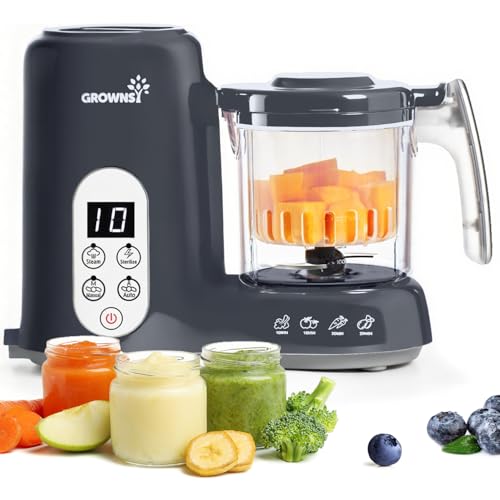
GROWNSY
Baby Food Steamer and Blender for One-Step Meal Prep, GROWNSY Baby Food Maker
The GROWNSY Baby Food Maker steams and blends in one appliance, reducing the tools and steps needed for homemade baby meals. It suits parents introducing purees who want adjustable textures, a sterilizer mode, and a recipe book in one countertop device.
Pros and Cons
Pros
- Combines steaming and blending without requiring separate kitchen tools.
- Offers both automatic and manual mixing for adjustable food texture.
- Uses heat-resistant Tritan for a durable, food-safe bowl.
- Includes a one-year warranty, 24/7 customer service, and lifetime technical support.
Cons
- The product data does not specify the bowl capacity, dimensions, or weight, so countertop fit and batch size are difficult to assess.
- Cleaning requirements and whether components are dishwasher-safe are not provided.
GROWNSY Baby Food Steamer and Blender for One-Step Meal Prep, GROWNSY Baby Food Maker
GROWNSY
Baby Food Steamer and Blender for One-Step Meal Prep, GROWNSY Baby Food Maker
The GROWNSY Baby Food Maker steams and blends in one appliance, reducing the tools and steps needed for homemade baby meals. It suits parents introducing purees who want adjustable textures, a sterilizer mode, and a recipe book in one countertop device.
$89.99 at AmazonEditors' Favorite
Color: Dark Gray Size: XXL Dimensions: 11.9 x 9 x 5.8 inches Product Group: Baby Product
Shop NowFor a deeper look at this niche, see the best food processor for baby food guide, which compares options built around smaller batches.
Which one should you buy?
Match the machine to your habits. If you chop and shred most nights and want something that stores easily, a compact processor like the Cuisinart FP-5 fits. If you bake often, put your money toward a stand mixer and add a processor later. If you’re feeding an infant, a steamer-and-blender unit can save time during the puree stage, but treat it as a short-term helper.
Whichever way you go, read the capacity and included parts on the product page, and compare the size against your cabinet space. That five-minute check prevents most returns.
FAQ
Can a food processor replace a mixer?
Not fully. A food processor chops, shreds and purees very well, and it can bring together pastry dough. But it can’t whip cream or egg whites the way a mixer can, and it doesn’t knead bread dough with the same control. If you bake a lot, you’ll want both over time.
Can I use a food processor to mix batter?
You can for simple, thin batters such as pancake or muffin batter, using short pulses. Don’t overmix, since that makes baked goods tough. For cake batters that rely on creamed butter and sugar, a mixer gives a lighter result.
What size food processor is best for a small kitchen?
A 3 to 5 cup model is usually enough for one or two people and fits in a cabinet more easily. You’ll process in smaller batches, but cleanup is quick. The Cuisinart FP-5 sits at the 5-cup end of that range.
Is a baby food maker the same as a food processor?
Not exactly. Baby food makers are smaller and often add a steaming function, so they’re built for soft fruit and vegetables in small amounts. A regular food processor has a larger bowl and more blade options, which makes it better for general cooking.
How do I keep food processor blades sharp?
Wash them by hand with a soft brush instead of tossing them loose in a dishwasher, and dry them right away. Avoid processing very hard items the manufacturer doesn’t recommend, such as large bones or whole frozen blocks. Handle blades carefully, because they stay sharp even when they look clean.

Write Your Review
No reviews yet. Be the first to share your experience!