

A mini tailgate grill is a compact, portable grill, usually propane, charcoal or electric, small enough to fit in a trunk and cook for roughly 2 to 6 people in a parking lot. The right pick depends less on raw power and more on your venue’s fuel rules, how far you have to carry it and how quickly it cools down for the drive home.
This guide covers how to size a mini grill, how to choose a fuel, what to pack, and the mistakes that wreck game-day cooking. It also explains when a small grill stops making sense. Along the way you’ll find two products from our research that fit different parts of the plan.
What to look for in a mini tailgate grill
Four things decide whether a small grill works at a tailgate: weight, cooking surface, fuel and cleanup. Weight comes first. If you can’t carry the grill with one hand while the other holds a cooler handle, it’s too heavy for a long walk across a stadium lot. Aim for something you can lift without a second thought, because you’ll be loading and unloading it twice in one day.
Cooking surface is next. A burger patty needs roughly 15 to 20 square inches of grate once you leave space for heat to circulate, so a 150 square inch surface holds about eight patties at a time. That’s plenty for a small group if you cook in two rounds. Bigger crowds mean longer lines at the grill, and nobody wants to watch kickoff from behind a hot grate.
Fuel and cleanup round out the list. Some lots ban charcoal. Others limit propane. A few allow neither, and then your options shrink to electric or a pre-cooked spread. Cleanup matters because you’re packing up in a parking lot, not standing over a kitchen sink. A drip tray, a removable grate or a grill that cools quickly saves real time at the end of the day.
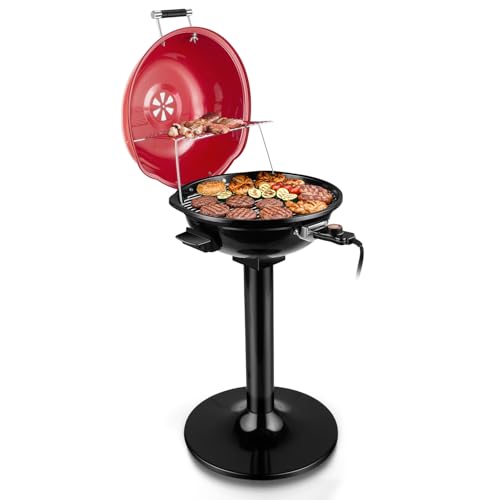
If your tailgate has power nearby, or you plan to use the same grill at home on a patio, the Techwood Electric Grill is worth a look. Its listing describes a 1600W indoor/outdoor electric BBQ grill with adjustable heat, a drip tray and a removable stand, in a double layer design aimed at parties, patios and backyards. That makes it a flexible tabletop cooker rather than a flame-and-smoke setup. The catch is simple: it needs an outlet or a power source that can handle the load.
Techwood
Portable Indoor-Outdoor Grilling for Parties and Patios: Techwood 1600W Electric Grill
The Techwood electric grill provides adjustable, flare-up-free cooking with a 240-square-inch surface, making group meals easier without charcoal or propane. Buy it for balconies, patios, camping, RVs, or tailgating when you need portable capacity and five heat settings.
Pros and Cons
Pros
- Adjustable temperature control gives you five heat levels for different foods.
- The spacious cooking rack supports group meals with more than 15 servings.
- A fully electric system works without charcoal or propane and avoids flare-ups.
- The portable design suits compact cars, small balconies, RVs, patios, and camping.
Cons
- It requires access to an electrical outlet, so it cannot be used where power is unavailable.
- The 240-square-inch cooking surface may require substantial storage space despite the portable design.
Techwood Portable Indoor-Outdoor Grilling for Parties and Patios: Techwood 1600W Electric Grill
Techwood
Portable Indoor-Outdoor Grilling for Parties and Patios: Techwood 1600W Electric Grill
The Techwood electric grill provides adjustable, flare-up-free cooking with a 240-square-inch surface, making group meals easier without charcoal or propane. Buy it for balconies, patios, camping, RVs, or tailgating when you need portable capacity and five heat settings.
$98.79 at AmazonEditors' Favorite
Color: Red Size: Large Dimensions: 8 x 16 x 18 inches Product Group: Kitchen
Shop NowChoosing a fuel: propane, charcoal or electric
Fuel is the biggest decision you’ll make. Each type has a clear strength and a clear headache, and the right one usually comes down to where you’re parking and who’s cooking.
Propane
Small tabletop gas grills typically run on 1 lb disposable canisters. They light fast, heat up in minutes and shut off with a turn of the knob, which makes pack-up easy. The downside is fuel supply. A single small canister won’t last all day, so bring a spare. Also check your venue’s rules, since some lots limit cylinder sizes or ban gas entirely. For a wider look at compact options, our best portable grill roundup is a good starting point.
Charcoal
Charcoal gives you the classic smoky flavor and costs little to run. It also asks the most from you. Coals take time to light, time to cook on and a long time to cool. Never dump hot coals in a trash bin or on the pavement. Bring a metal bucket with a lid, let the coals die down fully, and follow your venue’s disposal rules. Fire departments often advise leaving ash in a covered metal container for around 48 hours before it goes in the trash. If flavor is your priority, see our best charcoal grill picks.
Electric
Electric grills skip flames and smoke, so they’re allowed in more places, including some balconies and patios where gas and charcoal are banned. Always check your building or venue rules first. The trade-off is power. At 1,600 watts, a grill pulls roughly 13 amps at 120 volts, which is most of a standard household circuit. A generator or portable power station has to be sized for that load with headroom to spare. Without it, an electric grill is just a heavy table decoration. Our best electric grill guide goes deeper on the category.
What to pack and how to set up at the lot
Set up on flat, level ground, well away from your vehicle, canopy tents and anyone’s folding chairs. Wind is the quiet troublemaker. A steady breeze can blow a gas flame sideways or scatter charcoal ash into the next group’s spread, so park the grill with a windbreak on at least one side. Keep a fire extinguisher or a bucket of water within arm’s reach. Not optional.
Your toolkit can stay short. You need long tongs, a spatula, heat-resistant gloves, an instant-read thermometer, a foil pan for resting cooked food and a lighter or matches if you’re using fuel. A grill mat helps if your grate is wide and small foods tend to slip through, and our best grill mats list covers the options. Bring more paper towels and trash bags than you think you’ll need.
Food safety deserves its own paragraph. Keep raw meat in a cooler at 40°F or below, and keep it separate from ready-to-eat food like buns and salads. The USDA advises that perishable food shouldn’t sit out for more than 2 hours, or 1 hour if the air temperature is above 90°F. Cook burgers to an internal temperature of 160°F and chicken to 165°F, and check with a thermometer instead of guessing by color. Game day is long. Plan your cooking window so nothing lingers.
Prep at home to keep the lot simple. Form patties ahead of time, marinate chicken in a sealed bag inside the cooler, and slice toppings the night before. The less you chop on a folding table, the faster everyone eats. If you’re feeding a larger group than one small grill can handle, stagger your menu. Hot dogs and sausages cook quickly, while thicker cuts need more time and more attention.
Common mistakes with a mini tailgate grill
The most frequent error is overloading the grate. A small surface packed edge to edge blocks airflow, drops the temperature and leaves you with food that’s burned outside and raw in the middle. Cook in batches and keep finished food warm in a foil pan. It’s slower, but it’s safer and tastes better.
Second is skipping the thermometer. Parking-lot grilling means wind, shifting heat and a lot of distractions, so judging doneness by eye gets unreliable fast. A basic instant-read thermometer costs little and removes the guesswork. Third is cooking meat straight from an icy cooler. Let thicker cuts sit out briefly, within the 2-hour limit, so the outside doesn’t char before the center warms up.
Other mistakes are easy to avoid once you know them. Don’t forget spare fuel. Don’t pack a grill that’s still hot. Don’t set up under a tent canopy, where trapped heat and smoke become a hazard. And don’t assume every lot has the same rules, because many don’t. Check the venue’s tailgating policy a few days ahead, so you’re not unloading a grill you can’t use. Frustrating, and avoidable.
If you’re still deciding between a cheap compact grill and something sturdier, our best grill under $200 roundup shows what a smaller budget can realistically buy.
When a mini grill isn’t enough
A mini grill is a great fit for a small group, a quick pre-game meal or a trunk full of gear. It’s a poor fit for a crowd of 20, a full-day cookout or a season-long setup at home. If you find yourself cooking in round after round, or you want a single grill that can handle every holiday, it’s time to look at a full-size model.
To be clear, the Royal Gourmet 8-Burner Gas Grill is not a mini grill and not a tailgate grill. Its title lists 8 burners and 104,000 BTUs on liquid propane, which puts it firmly in backyard-party territory. We’re including it as the other end of the scale: the grill you’d keep at home while the mini rides in the trunk. If a grill like that is on your list, our best grill for $500 page compares more options at that price.

Royal Gourmet
Large-Batch Outdoor Grilling with Royal Gourmet 8-Burner Gas Grill
The Royal Gourmet 8-Burner Gas Grill handles large outdoor meals with 993 square inches of cooking space and 104,000 BTUs across eight independently controlled burners. It suits households that regularly grill for groups and need multiple heat zones, folding prep space, and substantial accessory storage.
Pros and Cons
Pros
- The 993-square-inch cooking surface supports large-batch grilling.
- Eight stainless steel burners provide individually controlled grilling zones.
- Two electronic ignition systems offer spark ignition at every push.
- Folding side tables and two-level storage improve outdoor cooking organization.
Cons
- The 993-square-inch cooking area may be more grill capacity than smaller households need.
- The supplied specifications do not list the grill's weight, which makes placement planning harder.
Royal Gourmet Large-Batch Outdoor Grilling with Royal Gourmet 8-Burner Gas Grill
Royal Gourmet
Large-Batch Outdoor Grilling with Royal Gourmet 8-Burner Gas Grill
The Royal Gourmet 8-Burner Gas Grill handles large outdoor meals with 993 square inches of cooking space and 104,000 BTUs across eight independently controlled burners. It suits households that regularly grill for groups and need multiple heat zones, folding prep space, and substantial accessory storage.
$497.99 at AmazonEditors' Favorite
Color: Black & Silver Size: Grill Dimensions: 90.31 x 90.31 x 38.19 Inches Weight: 119 pounds Product Group: Lawn & Patio Binding: Tools & Home Improvement
Shop NowFAQ
What size is a mini tailgate grill?
There’s no strict standard, but most mini tailgate grills have a cooking surface of roughly 100 to 200 square inches and are light enough to carry with one hand. That’s enough for about 5 to 10 burgers at a time. Pick the size based on how many people you usually feed and how far you’ll carry it.
Can you use a mini grill in a stadium parking lot?
It depends on the venue. Many lots allow propane or charcoal grills, while some ban open flames or limit cylinder sizes. Others restrict grilling to certain areas. Check the team or venue’s tailgating policy before you pack, since the rules often appear on the official website.
How many people can a mini tailgate grill feed?
A typical mini grill comfortably feeds 2 to 6 people if you cook in batches. It can stretch further with quick foods like hot dogs and sausages. For a bigger group, bring a second grill or prep part of the menu ahead of time.
Is an electric grill okay for tailgating?
Only if you have a reliable power source. A 1,600-watt grill draws roughly 13 amps at 120 volts, so you’d need a generator or portable power station sized for that load. If your lot has no hookups and no generator, propane or charcoal is the more practical choice.
How do you pack up a hot mini grill safely?
Turn off the fuel or let the charcoal burn down, then wait until the grill is completely cool to the touch before you move it. Dispose of ash in a covered metal container, never a trash bin. Wipe the grate while it’s still warm, not hot, so the residue comes off easily.









Write Your Review
No reviews yet. Be the first to share your experience!