

Lunch box divided containers keep each food in its own space, so crackers stay crisp, fruit doesn’t pick up the smell of last night’s curry, and sauce stays where you put it. If you want one box that holds a full meal without everything blending together, a box with built-in compartments or removable dividers is the simplest fix.
This guide explains how the different divider styles work, how to pick between plastic and stainless steel, how to pack a compartment box so it stays tidy, and when it’s time to replace one. Three real products from our research are woven in so you can see what each style looks like in practice.
What divided lunch containers actually do
A divided container is a single box split into zones. The zones might be molded into the body, or they might be inserts you can lift out. Either way, the job is the same: keep wet foods away from dry ones, strong flavors away from mild ones, and small snacks from rolling around.
That matters more than it sounds. A sandwich sitting against cut grapes gets soggy by noon. Cheese cubes tossed in with chopped raw onion take on the onion. A compartment fixes both problems without needing three separate containers and a bag to carry them.
Divided boxes also help with portion control. When the main dish, a side, and a snack each get a defined space, it’s easy to see at a glance whether the meal is balanced. Parents like this for kids because a half-empty compartment tells you what got eaten and what didn’t. Adults use the same trick for meal prep, filling each zone on Sunday night and grabbing a finished box every morning.
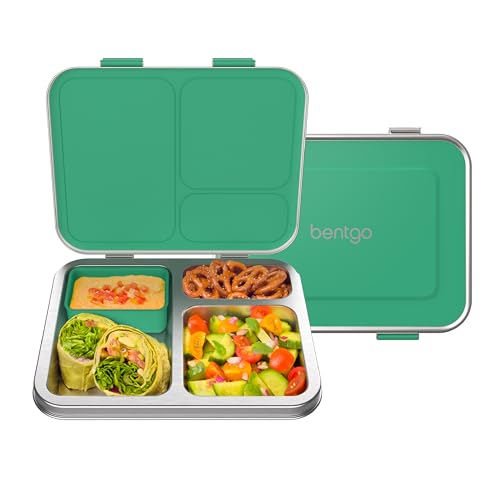
For a child, a three-compartment stainless steel design is a common starting point. The Bentgo Kids Stainless Steel Leak-Resistant Lunch Box has 3 compartments built into a stainless steel body, which gives younger eaters a clear layout for a main, a side, and a snack. Note the wording in the title: leak-resistant, not leakproof. That’s an honest label, and we’ll come back to what it means for packing.
Bentgo Kids Stainless Steel Leak-Resistant Lunch Box, 3 Compartments
Editors' Favorite
Color: Green Size: 9.8 in x 7.6 in x 1.6 in Dimensions: 9.8 x 7.6 x 1.7 Inches Weight: 1.6 pounds Product Group: Kitchen Binding: Kitchen
Shop NowFixed compartments versus removable dividers
The biggest design choice is whether the dividers stay put. Each approach has a clear trade-off, and the right one depends on what you pack most often.
Fixed compartments
With fixed compartments, the walls are part of the box. There’s nothing to lose, nothing to lift out, and nothing to forget in the dishwasher. The walls also sit tight against the lid, which usually keeps foods more separated than a loose insert does. The downside is flexibility. If your lunch is one big salad or a large portion of pasta, you’re working around walls you can’t move.
Removable dividers
Removable dividers let one box act as several. Pull the insert out for a big grain bowl, or drop it in for a mix of snacks. They also make cleaning easier, since you can wash the box and the divider separately and reach every corner. The trade-off is a loose part that can slip out of place in a bag or go missing over time.
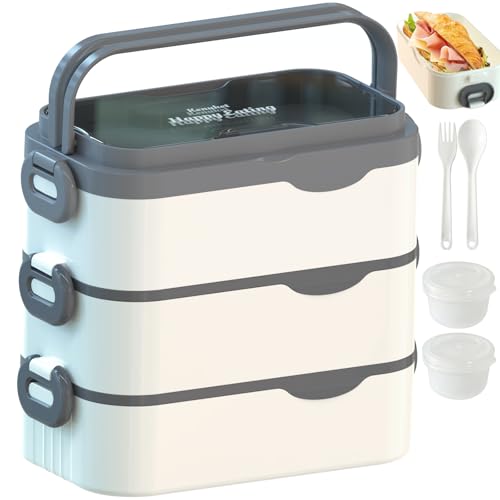
A good middle ground is a stackable box that comes with dividers and extras. The Kenuket Bento Box Adult Lunch Box has 3 stackable layers, large capacity, and comes with utensils, dividers, and sauce boxes. The title also lists it as microwave and dishwasher safe and made from food grade containers. That mix suits someone who wants to separate a main dish, sides, and dressings in one carry. At the time we pulled the listing it showed a price near $18.99, which is a fraction of the stainless options.
Kenuket
Pack Large Work and School Lunches with the Kenuket 3-Layer Bento Box
The Kenuket bento box organizes up to 3000 ml of meals across three stackable layers, with dividers and sauce boxes for varied portions. Adults, children over 7, and families should buy it for flexible meal packing with included utensils and easy cleaning.
Pros and Cons
Pros
- Food-grade BPA-free PP provides a non-toxic container material for everyday meal storage.
- The stackable design supports different meal sizes without requiring multiple separate lunch boxes.
- Included fork, spoon, dividers, and sauce boxes reduce the need for extra accessories.
- Freezer-safe containers help keep prepared food fresh at temperatures down to -4°F.
Cons
- The covers must be removed before microwave use.
- Transparent covers should be washed by hand because the product instructions exclude them from dishwasher cleaning.
Kenuket Pack Large Work and School Lunches with the Kenuket 3-Layer Bento Box
Kenuket
Pack Large Work and School Lunches with the Kenuket 3-Layer Bento Box
The Kenuket bento box organizes up to 3000 ml of meals across three stackable layers, with dividers and sauce boxes for varied portions. Adults, children over 7, and families should buy it for flexible meal packing with included utensils and easy cleaning.
$18.99 at AmazonEditors' Favorite
Color: White-Black Size: L Dimensions: 7.76 x 4.57 x 7.64 inches Weight: 1.7 pounds Product Group: Kitchen Binding: Kitchen
Shop NowPlastic versus stainless steel
Material changes how a divided box behaves day to day. Neither one is better in every case. It comes down to how you heat, carry, and clean your lunch.
Plastic boxes are light and often microwave friendly, so you can reheat leftovers right in the container. Check the label every time, because not every plastic is rated for heat. The common drawbacks are staining from tomato sauce or turmeric and lingering smells that take a few washes to fade.
Stainless steel doesn’t stain or hold odors the same way, and it tends to feel sturdier in a backpack. It can’t go in the microwave, though. If you plan to reheat food, you’ll need to move it to a plate first or eat it cold. Steel also weighs more than plastic, which adds up for a small child carrying a full bag. Fair warning: that weight is worth thinking about before you buy.
If you like the idea of steel for an adult, the Reabulun Bento Box Adult Lunch Box is built from 304 stainless steel in a stackable 3 layer design. The title lists a 3L large capacity and comes with a soup bowl, a spoon, and a fork. Note this one separates food by layers rather than by molded compartments, so it works more like stacked tiers than a single tray. That suits a soup or a stew in one tier and a grain or protein in another.

Reabulun
Large-Capacity Meal Prep Lunch Box: Reabulun 3L Stackable Stainless Steel Bento Box
The Reabulun 3L bento box packs meals, soup, snacks, fruit, and utensils in stackable stainless steel layers, with its biggest advantage being flexible meal separation. It suits adults, children, office workers, and commuters who want to carry varied homemade meals in one portable container.
Pros and Cons
Pros
- Three independently stackable layers allow users to carry only the capacity they need.
- The included soup bowl, spoon, fork, and fruit compartment support a complete packed meal.
- The 304 stainless steel liner is easy to clean and designed for long-term daily use.
- The sealing system is designed to reduce leaks when the lunch box is carried in a moving vehicle.
Cons
- Its 3L capacity may be larger than necessary for small meals or compact bags.
- Microwave use is limited to 212°F for three minutes, and the box is not intended for ovens or light-wave ovens.
Reabulun Large-Capacity Meal Prep Lunch Box: Reabulun 3L Stackable Stainless Steel Bento Box
Reabulun
Large-Capacity Meal Prep Lunch Box: Reabulun 3L Stackable Stainless Steel Bento Box
The Reabulun 3L bento box packs meals, soup, snacks, fruit, and utensils in stackable stainless steel layers, with its biggest advantage being flexible meal separation. It suits adults, children, office workers, and commuters who want to carry varied homemade meals in one portable container.
$29.99 at AmazonEditors' Favorite
Color: Creamy white Size: 3 Layers Dimensions: 8.2 x 4.5 x 8.26 inches Product Group: Kitchen Binding: Tools & Home Improvement
Shop NowHow to pack a divided lunch box
A divided box won’t fix a badly packed lunch, but it makes a good one easy. A few habits go a long way.
Start with the heaviest, wettest item
Put the main dish in the biggest compartment first, then fit smaller items around it. Heavy foods at the bottom of a stack keep delicate ones from getting crushed. If your box has layers, the sturdiest food belongs in the bottom tier.
Keep wet and dry apart
Use one compartment for anything juicy, like sliced fruit or yogurt, and keep crackers, chips, and bread in another. Small silicone or paper cups can add a second barrier inside a compartment when a food is especially wet.
Fill every gap
Empty space lets food slide around and mix. Tuck in berries, nuts, or a few cheese cubes to fill the corners. A packed box travels better than a half-empty one.
Keep cold food cold
The USDA advises keeping perishable food at 40 degrees F or below and not leaving it out for more than 2 hours. A divided box on its own doesn’t keep food cold, so pair it with an insulated bag and a frozen ice pack on warm days.
Common mistakes with divided lunch boxes
Most problems come from asking the box to do something it wasn’t built for. Here are the ones that come up most.
First, trusting leak-resistant to mean leakproof. A box that resists leaks can still drip if you tip it with a loose sauce or soup inside. Pack liquids in a small sealed cup, and keep the box level in the bag.
Second, overfilling. If you press the lid down on a heaping compartment, the seal can lift and the lid can pop. Leave a little headroom. Easy fix.
Third, putting a steel box in the microwave. Stainless steel and microwaves don’t mix. If you need hot food, heat it in a microwave-safe dish first or choose a box that the maker lists as microwave safe.
Fourth, skipping a deep clean. Gaskets and divider grooves trap crumbs and moisture. Pull the seal if it comes out, wash it, and let every part dry fully before you close the lid. A damp, closed box is how odors start.
Fifth, picking the wrong size. A box that’s too big for a child won’t fit in a small bag, and one that’s too small leaves an adult hungry by two o’clock. Check the stated capacity and compare it with how much you usually eat.
Matching the box to the person
Different eaters need different layouts. A young child usually does best with a few clear compartments and a lid that’s easy to open. Our guide to the best lunch box for kindergarten goes deeper on easy-open lids and sizes for little hands. Older students tend to want something that fits a big appetite, which is where the best lunch box for high schoolers comes in.
Adults often care about capacity and reheating more than cute layouts. If you pack for a long workday, look at the best lunch box for a 12 hour shift for options that hold a full day of meals. Teachers face a similar challenge with short breaks and a lot of walking, so the best lunch box for teachers is worth a look as well.
If you aren’t sure which style fits, start with the broader best lunch box roundup, then narrow down with the best lunch container guide when you want to compare food storage styles side by side.
When to replace or upgrade your box
Even a good divided box wears out. Watch for a lid that no longer clicks shut, a cracked latch, a warped base, or a seal that has torn or gone stiff. Any of these can let liquid out and bacteria in.
Plastic that has turned cloudy, deeply scratched, or permanently stained is also a sign to move on, since scratches can hold residue that’s hard to wash out. For steel, look for dents that stop the lid from sitting flat, or rust spots on the seams.
It’s also worth upgrading when your needs change. A child who has outgrown three small compartments may be ready for a bigger box. An adult who moves from cold salads to hot meals may want a layered, microwave-friendly design. Matching the box to your real routine matters more than any feature list.
FAQ
Are divided lunch containers better than a regular lunch box?
For most people eating mixed foods, yes. Compartments keep flavors and textures separate and make portions easy to see. A regular single-space box works fine if you pack one dish, like a big salad or a pasta bowl.
Can divided lunch boxes go in the dishwasher?
It depends on the model. Some list themselves as dishwasher safe, such as the Kenuket box in this guide, while others call for hand washing. Always check the maker’s care notes, and keep seals and small dividers on the top rack if the box allows it.
How do I stop food from leaking between compartments?
Choose a box with a snug lid and fixed walls, and pack very wet foods in a small sealed cup. Leak-resistant boxes slow spills but don’t promise a perfect seal, so keep the box upright in your bag.
Can I microwave a stainless steel lunch box?
No. Metal containers shouldn’t go in a microwave. Move food to a microwave-safe dish for reheating, or pick a plastic box that the maker lists as microwave safe.
How many compartments should a lunch box have?
Three is a common choice because it fits a main, a side, and a snack. Kids often do well with three, while adults may prefer a larger stackable design or a box with removable dividers so the layout can change from day to day.






Write Your Review
No reviews yet. Be the first to share your experience!