

Most people shopping for a professional blender waste their money in the first ten minutes, before they have compared a single spec. They walk in fixated on one number, or they copy whatever a countertop looked like in a smoothie video, and they end up with a machine that either can’t handle what they actually cook or costs three times what their kitchen needs. The mistakes are predictable, and once you know them, the right choice gets a lot clearer.
Mistake One: Trusting the horsepower number on the box
Peak horsepower is the most abused figure in the blender aisle. A label might scream “3.5 peak HP,” but peak means the motor hit that output for a split second under lab conditions, usually at startup, not while it was grinding through frozen fruit. It tells you almost nothing about sustained performance. Two blenders with identical peak ratings can behave completely differently once you load them with ice and nut butter.
Look at continuous power instead, measured in watts, and look at how the motor is built. A well-cooled motor that runs at 1,400 watts all day will outlast and outwork a cheaper unit that briefly spikes higher and then bogs down. If a listing hides the sustained wattage and only shouts about peak horsepower, treat that as a warning sign about the whole product.
Mistake Two: Buying the biggest jar you can find
A 64-ounce container looks impressive and feels like value, but a large jar has a wide base. Blades sit far apart, and small batches spin around the edges without ever getting pulled into the vortex. If you mostly make one or two servings, a single smoothie or a cup of sauce, an oversized container will leave chunks near the walls and force you to stop and scrape.
Match the jar to your real habits. A household that batches soup and family-size smoothies genuinely benefits from a tall 64-ounce container. A single person or a couple is usually better served by a 32- or 48-ounce jar, or by a system that offers both a large pitcher and a personal cup that screws onto the same blade assembly. Storage matters too. A big square jar that won’t fit under your cabinets ends up living on the counter whether you like it or not.
Mistake Three: Paying for presets you’ll never touch
Marketing loves a control panel crowded with icons: soup, dip, frozen dessert, self-clean. It photographs well and justifies a higher price. In practice, most cooks settle into two or three actions within a week, a variable speed dial and a pulse button, and never think about the smoothie preset again. Automatic programs also lock you into a fixed run time, which is frustrating when you want to stop the moment the texture looks right.
Prioritize a smooth variable-speed control and a responsive pulse over a wall of one-touch buttons. Manual control is what lets you feather a delicate purée or crush ice in short bursts. Presets are a convenience, not a capability, and they should never be the reason a blender jumps a hundred dollars in price.
What actually separates a professional blender
Strip away the marketing and three things define a genuinely capable machine. First is a hardened stainless-steel blade assembly paired with a jar shaped to create a strong downward pull, so ingredients circulate instead of hovering above the blades. Blunt blades that rely on speed alone tear food rather than cut it, which heats your ingredients and leaves grit behind.
Second is thermal management. Professional units use larger motors with better airflow and thermal cutoffs that protect the machine during long runs. That is why a true workhorse can turn hot soup by friction alone or churn stiff nut butter without shutting off. Third is build integrity: metal drive couplings instead of plastic, a jar that seats firmly, and a base heavy enough to stay planted when the contents are thick. These are the parts you can’t see in a photo and won’t notice until a cheaper blender fails at them.
Test it against your hardest recipe, not your easiest
People judge a blender by how it handles a banana and some milk. Everything handles that. The honest test is the toughest thing you make. If you grind your own flour, blend fibrous kale and celery into juice, or process dates and almonds into a dense paste, buy for that job. A machine that clears your hardest recipe will breeze through the daily easy ones, but it never works the other way around.
A tamper is the underrated tool here. It lets you push thick mixtures down into the blades while the motor runs, which is the difference between a smooth frozen dessert and a machine that stalls with an air pocket in the middle. If you make anything dense, a blender that includes a tamper and a jar designed to use it safely is worth more than one with a longer preset list.
Don’t forget noise, cleanup, and the warranty
Powerful motors are loud. A high-end blender at full speed can be startling in an apartment or an open kitchen at six in the morning. Some models add insulated housings to soften the sound, and if early mornings or a sleeping household matter to you, that feature earns its keep. Cleanup is the other daily reality. A jar you can fill with warm water and a drop of soap, then run for thirty seconds, saves real time over one with tight corners and a removable blade you have to disassemble and rinse by hand.
Then there is the warranty, which quietly tells you how much the maker trusts their own build. Serious machines carry coverage of five, seven, or even ten years, and that length is a stronger quality signal than any horsepower claim. A two-year warranty on a blender that costs as much as a small appliance suite should make you pause. Read what the coverage includes, because some warranties protect the motor but not the jar or the blade.
Is a professional blender worth it for a home kitchen?
It depends on what you make and how often. If you blend daily and lean on tougher tasks like nut butters, frozen desserts, hot soups, or fibrous green juices, a professional machine pays for itself in durability and results a budget model can’t match. If you make the occasional smoothie from soft fruit, a mid-range blender will serve you fine and the extra spend is hard to justify. Buy for frequency and difficulty, not for the fantasy of what you might cook someday.
How many watts do I actually need?
For everyday smoothies, sauces, and light blending, roughly 1,000 to 1,200 watts of sustained power is plenty. Once you regularly crush ice, grind grains, or make thick, dense mixtures, aim for 1,400 watts or more of continuous output, and check that the figure is sustained rather than a peak spike. Beyond about 1,500 watts, the gains are marginal for most home cooks, so there is little reason to chase the highest number on the shelf.
What is the difference between peak and continuous horsepower?
Peak horsepower is the maximum output the motor reaches for a brief instant, typically at startup and under ideal lab conditions, so it overstates real-world capability. Continuous power is what the motor sustains while it actually works through a load, and it is the honest measure of what a blender can do over a full recipe. When a spec sheet features peak horsepower prominently while burying or omitting the continuous wattage, read that as a hint the sustained performance is not the selling point.

Reslee
Smoothies, Hot Soup, and Nut Milk Blender: Reslee BL126 40000 RPM Commercial Vacuum Blender
The Reslee BL126 makes smoothies, milkshakes, nut milk, hot soup, and purées, with 40000 RPM power and optional vacuum blending as its biggest advantage. Buy it for high-volume home kitchens, cafés, or juice bars that need one durable blender for tough ingredients and varied recipes.
Pros and Cons
Pros
- The 4HP Japanese Fuji Carbon pure copper motor is designed for continuous blending without overheating under heavy loads.
- The four-wall turbo vortex and laser-cut stainless steel blades help reduce gritty residue in smoothies, nut milk, and milkshakes.
- The lid safety lock prevents blade operation unless the lid is correctly aligned with the jar handle.
- The standard lid supports hot soup blending, while the vacuum lid provides a separate low-oxygen blending option.
Cons
- The blender can be too tall for standard kitchen cabinets when the quiet shield is raised.
- The supplied product data does not list the appliance's weight or exact dimensions, so countertop planning requires checking the manufacturer's specifications.

Vitamix
Best Blender for Smoothies & Soups: Vitamix Propel 750 Professional 64-Oz Review
The Vitamix Propel 750 runs four automatic blending programs and a 2.2 HP motor to take smoothies, hot soups, frozen desserts, and dips from raw ingredients to finished texture without manual guesswork. Home cooks who blend daily and want a machine that lasts years rather than seasons will get the most from its laser-cut blades, self-cleaning cycle, and 7-year warranty.
Pros and Cons
Pros
- Four one-touch blending programs deliver repeatable results for the most common kitchen tasks without requiring manual speed adjustments.
- The 60-second self-cleaning cycle means cleanup adds almost no time to the cooking routine, even after thick soups or nut butters.
- Laser-cut stainless-steel blades and a 2.2 HP motor handle ice crushing and fibrous produce that routinely stall lower-powered blenders.
- A 7-year warranty and Vitamix's track record for longevity make the investment case straightforward for anyone who blends several times a week.
Cons
- At $449.95, the Propel 750 sits at a price point that is harder to justify for anyone who blends only occasionally or sticks to simple tasks like protein shakes.
- The 64-ounce container is sized for volume, which makes it less practical when blending small single-serve portions where the vortex does not form efficiently.
The Best Deals This Week*
-
Smoothies, Hot Soup, and Nut Milk Blender
$249.99
($299.99)Save $50.00 -
Best Blender for Smoothies & Soups
$449.95
($629.95)Save $180.00 -
WantJoin Professional Commercial Blender
$199.99
($259.99)Save $60.00
*Deals are selected by our commerce team
Reslee Smoothies, Hot Soup, and Nut Milk Blender: Reslee BL126 40000 RPM Commercial Vacuum Blender
Reslee
Smoothies, Hot Soup, and Nut Milk Blender: Reslee BL126 40000 RPM Commercial Vacuum Blender
The Reslee BL126 makes smoothies, milkshakes, nut milk, hot soup, and purées, with 40000 RPM power and optional vacuum blending as its biggest advantage. Buy it for high-volume home kitchens, cafés, or juice bars that need one durable blender for tough ingredients and varied recipes.
$249.99 at AmazonEditors' Favorite
Color: Carbon Black Size: Large Dimensions: 10.51 x 7.83 x 20 inches Weight: 18.65 Pounds Product Group: Kitchen
Shop NowVitamix Best Blender for Smoothies & Soups: Vitamix Propel 750 Professional 64-Oz Review
Vitamix
Best Blender for Smoothies & Soups: Vitamix Propel 750 Professional 64-Oz Review
The Vitamix Propel 750 runs four automatic blending programs and a 2.2 HP motor to take smoothies, hot soups, frozen desserts, and dips from raw ingredients to finished texture without manual guesswork. Home cooks who blend daily and want a machine that lasts years rather than seasons will get the most from its laser-cut blades, self-cleaning cycle, and 7-year warranty.
$449.95 at AmazonGreat Value
Color: Black Size: 64 fl oz Dimensions: 9 x 7.5 x 18 inches Weight: 10 Pounds Product Group: Kitchen Binding: Kitchen
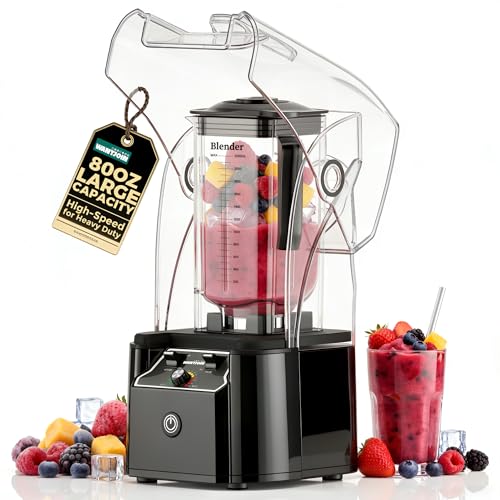
Shop NowWantJoin Professional Commercial Blender With Shield Quiet Sound Enclosure 2200W Industries Strong and Quiet Professional-Grade Power, Self-Cleaning, Black
WantJoin
Professional Commercial Blender With Shield Quiet Sound Enclosure 2200W Industries Strong and Quiet Professional-Grade Power, Self-Cleaning, Black
$199.99 at AmazonColor: Black Size: 9.84"D x 9.84"W x 21.65"H Dimensions: 9.842519675 x 9.842519675 x 21.653543285 inches Weight: 17 pounds Product Group: Kitchen Binding: Home
Shop Now

Write Your Review
No reviews yet. Be the first to share your experience!