

Espresso machines with K-cup compatibility solve a problem many households face: different coffee preferences under one roof. One person craves a morning espresso shot while another reaches for a quick pod brew. Traditional single-function machines force you to choose sides or clutter your counter with multiple appliances. Combo machines bridge this gap, though not all designs handle both tasks equally well.
These dual-function brewers appeal to specific situations. Mixed-preference households avoid appliance redundancy. Small offices serve varied tastes without installing separate stations. Occasional espresso drinkers who rely on pods daily gain flexibility without committing to a dedicated espresso setup. Understanding which scenario matches yours determines whether a combo machine makes sense or creates new frustrations.
Mixed-Preference Households: When Compromise Works
Households split between espresso enthusiasts and pod convenience seekers benefit most from combo machines. Picture a morning where one person pulls a double shot for a cappuccino while their partner brews a hazelnut K-cup in under a minute. Both get exactly what they want without negotiating counter space or budget for two machines.
The key is finding models where neither function feels like an afterthought. Some combo machines prioritize espresso quality with proper pressure systems and then tack on pod compatibility as a secondary feature. Others reverse this, building a pod brewer first and adding a steam wand that struggles to froth milk properly. The best options treat both brewing methods as equal priorities, using separate water reservoirs or clearly marked fill lines to prevent cross-contamination of flavors.
Temperature consistency matters here. Espresso demands water heated to 195-205°F, while pod brewing works at slightly lower temps. Machines that share a single heating element sometimes compromise on one side. Look for models with dual heating systems or fast recovery times between brew modes. A fifteen-minute cooldown between espresso and pod brewing defeats the purpose of having both functions.
Office and Breakroom Applications
Small offices face a coffee dilemma: stock a dozen pod flavors or invest in espresso equipment that requires training. Combo machines offer a middle path. The pod side handles the majority who want quick caffeine, while the espresso function serves the two or three people who know how to pull shots and prefer stronger drinks.
Capacity becomes critical in office settings. Residential combo machines with 40-ounce reservoirs won’t survive morning rush in a ten-person office. Commercial-grade or high-capacity models with 60+ ounce tanks reduce refill frequency. Removable water tanks simplify this further—someone can refill at the sink without moving the entire machine.
Durability also shifts in priority. Home users might pull three espresso shots and brew five pods weekly. Office machines face twenty or thirty brewing cycles daily. Plastic portafilter holders and lightweight construction fail under this load. Stainless steel components and metal brew heads withstand repeated use better. Check manufacturer specs for duty cycle ratings; some models explicitly state they’re designed for light residential use only.
Occasional Espresso Drinkers: Flexibility Without Full Commitment
Not everyone wants espresso daily. Maybe you crave a latte on Saturday mornings but drink regular coffee all week. Or you host brunch occasionally and want to offer espresso drinks without buying a dedicated machine that sits idle most days. Combo machines let you dabble in espresso without the counter space or learning curve of traditional equipment.
This scenario works best with machines that don’t require extensive maintenance between uses. Traditional espresso machines demand daily backflushing and regular descaling. Combo units simplify this—some use capsule-based espresso pods that eliminate grind consistency worries and reduce cleaning to rinsing the drip tray. You sacrifice some control over grind size and tamp pressure, but gain the ability to make espresso once a month without the machine clogging from disuse.
The tradeoff is espresso quality. Serious espresso drinkers notice the difference between 15-bar pump pressure and 19-bar systems, or between brass and aluminum boilers. Casual users often don’t. If you’re primarily a pod coffee drinker who occasionally wants espresso-based drinks, accepting slightly less authentic espresso is reasonable. If you’re an espresso purist who rarely uses pods, the reverse is true—buy an espresso machine and a separate pod brewer.
Space and Budget Constraints
Apartment kitchens and dorm rooms have limited counter real estate. Two separate machines claim 24-30 inches of space. A combo unit consolidates this to 12-15 inches. Vertical storage doesn’t help when both machines need to stay plugged in and ready to use. Combo machines address this physical constraint directly.
Budget math also favors combo units for some buyers. A decent pod brewer costs $80-150. Entry-level espresso machines start at $200-400. That’s $280-550 total for separate units. Combo machines range from $150-600 depending on features. The lower end of that spectrum delivers both functions for less than buying separate machines, though build quality suffers. Mid-range combo units around $300-400 often match the quality of buying two budget machines separately.
However, this equation changes at the high end. Serious espresso enthusiasts spending $800+ on a machine won’t find combo units that match dedicated espresso equipment at that price point. The engineering compromises required to incorporate both brewing methods limit maximum performance. If budget allows, separate machines deliver better results in each category.
Feature Priorities by Use Case
What matters most depends on your primary scenario. Mixed-preference households should prioritize machines with separate water paths to prevent flavor bleed between espresso and pods. Look for models where the pod holder lifts completely out of the way when pulling espresso shots, and vice versa. Shared drip trays are fine, but shared brew chambers create cleaning headaches.
Office users need capacity and speed above all. A 60-ounce reservoir, fast heat-up time under three minutes, and automatic shutoff after two hours of inactivity prevent waste. Programmable cup sizes for pods reduce user error—preset small, medium, and large options so people don’t accidentally brew 12 ounces into an 8-ounce cup. For espresso, automatic milk frothers beat manual steam wands in office settings since skill levels vary.
Occasional espresso drinkers benefit from machines that accept both ground coffee and espresso pods. This flexibility means you’re not locked into one ecosystem. You can use K-cups for daily coffee, Nespresso-compatible pods for quick espresso, and still have the option to use fresh grounds when you want maximum control. Multi-compatibility adds cost but maximizes the machine’s utility across different situations.
When Combo Machines Don’t Make Sense
Combo machines aren’t universal solutions. High-volume espresso households—those pulling five or more shots daily—will outgrow combo units quickly. The dual-function design compromises espresso performance through shared heating elements, smaller boilers, and lighter-duty pumps. A dedicated espresso machine with a proper PID temperature controller and volumetric dosing will produce more consistent results.
Similarly, if you never drink espresso and only want pod brewing, paying extra for espresso capability you won’t use wastes money. A dedicated pod brewer at the same price point will offer better build quality, larger water capacity, and more pod format compatibility. Combo machines make sense when you genuinely need both functions, not as insurance against hypothetical future espresso interest.
Maintenance complexity also increases with combo machines. You’re learning two sets of cleaning procedures, tracking two descaling schedules, and troubleshooting two potential failure points. If the espresso pump fails but the pod brewer works, you still need to repair or replace the entire unit. Separate machines isolate failures and often cost less to repair since parts are more standardized.
Do combo machines make weaker espresso than dedicated machines?
Combo machines typically produce adequate espresso for casual drinkers but fall short of dedicated equipment in consistency and extraction quality. The pressure systems in combo units often max out at 15 bars compared to 19 bars in purpose-built espresso machines, resulting in less crema and slightly under-extracted shots. Boiler size also matters—smaller boilers in combo machines recover heat more slowly between shots, so pulling multiple espressos back-to-back becomes problematic. If you’re comparing the result to coffee shop espresso or high-end home machines, you’ll notice the difference. For occasional lattes or americanos, most users find the quality acceptable.
Can you use any K-cup brand in espresso combo machines?
Compatibility varies by model, but most combo machines work with standard K-cup formats including original Keurig pods and generic alternatives. The pod holder dimensions determine fit—measure the diameter and depth if you use specialty or off-brand pods. Some machines specifically advertise compatibility with Keurig 1.0 or 2.0 systems, which affects whether you need licensed pods or can use any brand. A few combo units use proprietary pod formats that lock you into specific brands, so check compatibility before buying if you already have a preferred pod supplier. Reusable pod filters also work in most combo machines, letting you use your own ground coffee in the pod brewer side.
How much counter space do combo machines actually save?
A typical combo machine occupies 10-14 inches of width, 12-15 inches of depth, and 12-14 inches of height. Buying separate machines would require roughly 18-24 inches of width for side-by-side placement, or double the depth if you stack them front-to-back. The real savings come from eliminating the gap between machines—most people leave 2-4 inches of clearance between appliances, which adds up when you’re placing two devices. You’ll also free up one electrical outlet. However, combo machines often need more clearance above and behind them for steam vents and water reservoir access, so measure your available space in three dimensions rather than just width.

CAPXSNOB
5-in-1 Pod & Ground Coffee Maker for Small Kitchens: CAPXSNOB Magician2 Mini with 20-Bar Pump and LED Touch Control
The Magician2 brews K-Cup, Nespresso Original, Dolce Gusto, 44mm E.S.E. pods, and ground coffee from one 4.4-inch-wide machine that auto-detects each adapter and adjusts temperature and volume. Buy it if you keep multiple pod types on hand or have limited counter space and want one brewer instead of two or three.
Pros and Cons
Pros
- Handles four major capsule formats plus ground coffee, so household members can use different pods on one machine.
- 20-bar pump with pre-infusion wets the grounds at low pressure first, which improves crema and reduces bitterness.
- Two-tier adjustable drip tray clears tall glasses up to 5.9 inches, and the tray removes entirely for extra height.
- Backed by a 60-day return window and a 2-year limited warranty, extendable through product registration.
Cons
- Incompatible with Nespresso Vertuo, Tassimo, Senseo, illy Iperespresso, 38mm E.S.E., and reusable K-Carafe, K-Mug, Vue, or Rivo pods, so check your current stock before switching.
- Swapping adapters adds a step for households that brew several different capsule types back to back.
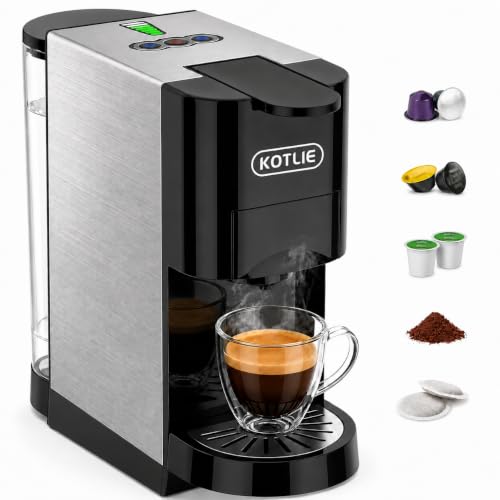
KOTLIE
Multi-Capsule Coffee Maker for Home and Office Kitchens: KOTLIE Classic 5-in-1 19-Bar Espresso Machine
The KOTLIE Classic brews coffee from five capsule and ground-coffee formats, with its biggest advantage being one machine for varied drink preferences. It suits households, shared kitchens and offices that want espresso, pod coffee or iced coffee from a single compact brewer.
Pros and Cons
Pros
- Its five-in-one compatibility supports multiple coffee systems and ground coffee in one appliance.
- The 19-bar extraction system and 1450W heating system are designed for quick brewing with rich aroma and crema.
- Seven volume settings and an Over Ice mode provide useful drink flexibility.
- Taller cup clearance makes it easier to brew directly into large mugs and travel cups.
Cons
- The listing gives a water-tank range of 800ml to 1L depending on the model, so buyers should confirm the exact configuration.
- Materials, dimensions and weight are not specified in the supplied product data, limiting advance planning for counter space and portability.

KitchenAid
One-Touch Hot and Iced Coffee at Home: KitchenAid KF2 KES8452 Fully Automatic Espresso Machine
The KitchenAid KF2 grinds beans and prepares six hot or iced recipes, with Intelligrind automatically adjusting the dose for consistent flavor. It suits coffee drinkers who want convenient espresso and iced coffee from a compact machine while retaining hands-on control over milk texture.
Pros and Cons
Pros
- The built-in burr grinder removes the need for a separate grinder and automatically fine-tunes each dose.
- Dedicated hot and iced settings provide more drink flexibility than an espresso-only machine.
- The 1.8L water tank supports multiple drinks before frequent refilling becomes necessary.
- A water filter and two cleaning tablets are included to help start routine maintenance.
Cons
- Milk preparation still requires hands-on use of the steam wand rather than fully automatic milk dispensing.
- The six-recipe menu may feel limited to buyers seeking a larger selection of specialty drinks.

Keurig
Smart WiFi Coffee Maker with Frother for Lattes and Cappuccinos — Keurig K-Café SMART Single Serve
The Keurig K-Café SMART brews coffee, lattes, and cappuccinos from any K-Cup pod using WiFi-enabled BrewID technology that auto-customizes settings for the specific pod you insert. Home baristas who want coffeehouse drinks without manual guesswork will appreciate the app-guided Barista Mode and built-in hot and cold frother.
Pros and Cons
Pros
- BrewID WiFi technology personalizes brew temperature and strength to each K-Cup pod, consistently producing better flavor than fixed-setting brewers.
- The hot and cold frother with three speed options gives you barista-style milk texture for lattes, cappuccinos, and cold foam drinks at home.
- Scheduling and remote brew via the Keurig app means your coffee is ready the moment you walk into the kitchen.
- MultiStream Technology saturates grounds more evenly than the K-Classic brewer, noticeably improving extraction and aroma in each cup.
Cons
- BrewID and Barista Mode features require a WiFi connection and active use of the Keurig app, adding setup steps that basic brewer buyers may find unnecessary.
- Brew options are locked to K-Cup pods, so buyers who prefer loose-leaf or ground coffee without a reusable pod adapter will find the system limiting.
The Best Deals This Week*
-
One-Touch Hot and Iced Coffee at Home
$599.99
($799.99)Save $200.00 -
Smart WiFi Coffee Maker with Frother for Lattes
$159.99
($199.99)Save $40.00
*Deals are selected by our commerce team
CAPXSNOB 5-in-1 Pod & Ground Coffee Maker for Small Kitchens: CAPXSNOB Magician2 Mini with 20-Bar Pump and LED Touch Control
CAPXSNOB
5-in-1 Pod & Ground Coffee Maker for Small Kitchens: CAPXSNOB Magician2 Mini with 20-Bar Pump and LED Touch Control
The Magician2 brews K-Cup, Nespresso Original, Dolce Gusto, 44mm E.S.E. pods, and ground coffee from one 4.4-inch-wide machine that auto-detects each adapter and adjusts temperature and volume. Buy it if you keep multiple pod types on hand or have limited counter space and want one brewer instead of two or three.
$159.99 at AmazonEditors' Favorite
Color: Black Size: Small Dimensions: 11 x 4.4 x 11 inches Weight: 8 pounds Product Group: Kitchen
Shop NowKOTLIE Multi-Capsule Coffee Maker for Home and Office Kitchens: KOTLIE Classic 5-in-1 19-Bar Espresso Machine
KOTLIE
Multi-Capsule Coffee Maker for Home and Office Kitchens: KOTLIE Classic 5-in-1 19-Bar Espresso Machine
The KOTLIE Classic brews coffee from five capsule and ground-coffee formats, with its biggest advantage being one machine for varied drink preferences. It suits households, shared kitchens and offices that want espresso, pod coffee or iced coffee from a single compact brewer.
$139.99 at AmazonGreat Value
Color: Black Size: Ordinary Dimensions: 12.5 x 5 x 11 inches Weight: 8.18 pounds Product Group: Kitchen
Shop NowKitchenAid One-Touch Hot and Iced Coffee at Home: KitchenAid KF2 KES8452 Fully Automatic Espresso Machine
KitchenAid
One-Touch Hot and Iced Coffee at Home: KitchenAid KF2 KES8452 Fully Automatic Espresso Machine
The KitchenAid KF2 grinds beans and prepares six hot or iced recipes, with Intelligrind automatically adjusting the dose for consistent flavor. It suits coffee drinkers who want convenient espresso and iced coffee from a compact machine while retaining hands-on control over milk texture.
$599.99 at AmazonColor: Black Matte Size: 1.8 L Dimensions: 18.5 x 7.7 x 14.2 inches Weight: 22.3 pounds Product Group: Kitchen Binding: Kitchen
Shop NowKeurig Smart WiFi Coffee Maker with Frother for Lattes and Cappuccinos — Keurig K-Café SMART Single Serve
Keurig
Smart WiFi Coffee Maker with Frother for Lattes and Cappuccinos — Keurig K-Café SMART Single Serve
The Keurig K-Café SMART brews coffee, lattes, and cappuccinos from any K-Cup pod using WiFi-enabled BrewID technology that auto-customizes settings for the specific pod you insert. Home baristas who want coffeehouse drinks without manual guesswork will appreciate the app-guided Barista Mode and built-in hot and cold frother.
$159.99 at AmazonColor: Black Size: 32 K-Cup Pods Dimensions: 12.1 x 11 x 17.2 Inches Weight: 1 pounds Product Group: Kitchen Binding: Kitchen
Shop Now


Write Your Review
No reviews yet. Be the first to share your experience!