

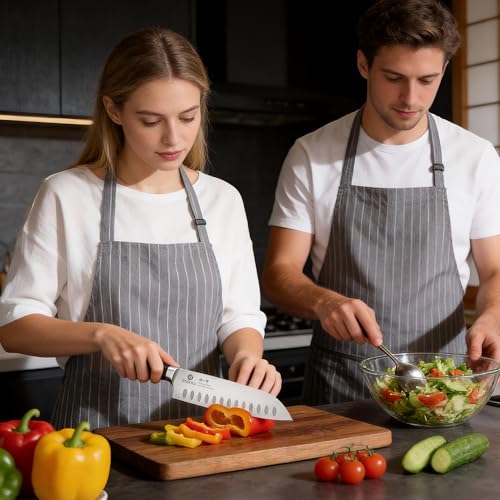
TL;DR — A high-carbon santoku is a Japanese general-purpose knife with a shorter, flatter blade (usually 5-7 inches) made from steel with an elevated carbon content, which lets it take and hold a much sharper edge than soft stainless. “Santoku” means “three virtues” — slicing, dicing, and mincing — and the blade’s flat profile and sheepsfoot tip favor an up-and-down chop over the rocking motion of a chef’s knife. “High carbon” may mean true carbon steel (extremely sharp but rust-prone) or high-carbon stainless (sharp and low-maintenance); knowing which you are buying matters. For picks, see our best santoku knife guide.
The HomeWhisk editorial team researches kitchen equipment by analyzing manufacturer specifications, steel metallurgy, blade geometry, and aggregated feedback from communities like Reddit r/chefknives and major retailers. This guide breaks down what a high-carbon santoku is, what the steel terms actually mean, how it differs from a chef’s knife, and how to sharpen and care for one.
What “Santoku” Means and What the Blade Does
Santoku (三徳) translates to “three virtues” or “three uses,” referring to its competence at slicing, dicing, and mincing. It is the Japanese home-kitchen equivalent of the Western chef’s knife.
The defining feature is the blade profile. A santoku has a flat cutting edge with very little belly (curve) and a sheepsfoot tip — the spine curves down sharply to meet the edge, giving a blunt, rounded front rather than a pointed tip. That flat edge is built for a push-cut or straight up-and-down chop, where the whole edge contacts the board at once, rather than the forward-and-back rocking motion a curved chef’s knife uses.
Santokus are also typically shorter (5-7 inches) and lighter than chef’s knives, with a thinner blade. Many have Granton edges — the row of oval dimples (hollows) along the blade — which create small air pockets that reduce suction, so thin slices of potato, cucumber, or fish release instead of sticking. The result is a nimble, precise knife well suited to smaller hands and detailed prep.
What “High Carbon” Actually Means
This is the term buyers most often misunderstand, because it is used two different ways.
Carbon content is what makes steel hardenable. More carbon lets the steel reach a higher hardness (measured on the Rockwell C scale, HRC), which lets it hold a finer, sharper edge for longer. Soft stainless kitchen steel sits around 52-56 HRC; a good high-carbon Japanese blade runs 58-63 HRC or more.
The confusion is between two categories:
- True carbon steel (also called high-carbon steel, e.g. Shirogami/white steel, Aogami/blue steel) contains little or no chromium. It takes a screaming-sharp edge and is easy to sharpen, but it rusts and stains readily and will develop a patina, so it demands careful drying and oiling.
- High-carbon stainless steel adds chromium (13%+) for corrosion resistance while keeping carbon high enough for a hard, sharp edge (steels like VG-10, AUS-10, or German X50CrMoV15). It is the practical choice for most home cooks — sharp, edge-holding, and low-maintenance.
When a product is labeled “high-carbon santoku,” check whether it means reactive carbon steel or high-carbon stainless; the care requirements are completely different.
Carbon Steel vs. Stainless: The Real Trade-Off
The choice between the two steel families is the biggest decision in buying a high-carbon santoku.
Carbon steel wins on ultimate sharpness and ease of sharpening — it takes a keener edge and hones back quickly on a stone. The costs are real: it oxidizes fast, so it must be wiped dry immediately, hand-washed, and occasionally oiled, and it reacts with acidic foods like onions and citrus (which can leave a metallic taste until a stable patina forms). It is favored by enthusiasts who enjoy maintenance.
High-carbon stainless gives up a little of that peak sharpness and stone feel in exchange for corrosion resistance and durability. For most people cooking daily, it is the smarter pick: still very sharp, holds an edge well, and forgives being left wet for a few minutes. If you want a knife you will love without a maintenance ritual, high-carbon stainless is usually the answer. Our best santoku knife and best chef knife guides note the steel type for each pick.
Santoku vs. Chef’s Knife: Which to Choose
These two knives overlap heavily, so the decision comes down to technique and hand size.
A chef’s knife has a longer (8-10 inch), curved blade with a pointed tip and pronounced belly, designed for rock-chopping — keeping the tip on the board and rocking through herbs and vegetables. It is more versatile for large items and long slicing strokes.
A santoku is shorter, flatter, and lighter, built for a straight chop and precise push-cutting; the blunt tip and reduced belly make rocking awkward. It shines at fine dicing, thin vegetable slices, and controlled work, and its lower weight suits smaller hands. Neither is objectively better — many cooks own both and reach for the santoku for precise vegetable prep and the chef’s knife for bigger jobs. If you are building a kitchen, a best knife sets purchase often includes both, alongside specialized blades like a best bread knife for crusty loaves and a best boning knife for breaking down poultry and meat.
How to Sharpen and Maintain a High-Carbon Santoku
A hard, high-carbon edge rewards proper sharpening and punishes bad habits.
Because santokus are hard, they hold an edge longer but are also more brittle than soft stainless — never use them to pry, hit bone, or cut frozen food, or the fine edge will chip. Hone regularly to realign the edge; note that traditional Japanese honing is best done on a fine ceramic rod or a stone rather than a coarse Western steel, which is too aggressive for hard steel. Sharpen on Japanese whetstones (a 1000-grit to set the edge, 3000-6000 to refine) at the knife’s factory angle — many Japanese santokus are ground to a keen 12-15° per side, versus a Western chef’s knife’s 20°.
Check whether your blade is double-bevel (sharpened both sides, most Western-style santokus) or single-bevel (one side only, some traditional Japanese knives), because it changes how you sharpen. Always hand-wash and dry immediately — never the dishwasher, whose heat, detergent, and jostling ruin both edge and handle. For carbon steel specifically, dry instantly and oil occasionally to prevent rust. Use a wood or soft poly cutting board, never glass or stone, which dull and chip the edge.
Frequently Asked Questions
What is a santoku knife best used for?
A santoku excels at precise, everyday prep: slicing vegetables and fruit, dicing onions, thin-cutting cucumbers or potatoes, mincing herbs and garlic, and portioning boneless meat and fish. Its flat edge and blunt tip favor a straight up-and-down chop and push-cut rather than rocking. The Granton (dimpled) edge helps thin slices release without sticking. It is less suited to jobs a chef’s knife handles better — carving large roasts, splitting winter squash, or long rock-chopping — and it should never be used on bone or frozen food, which can chip the hard edge.
Is a high-carbon santoku better than a stainless one?
It depends on what “high carbon” means and what you value. A true high-carbon (carbon steel) santoku takes a sharper edge and is easier to sharpen, but it rusts, stains, and needs immediate drying and occasional oiling. High-carbon stainless keeps a hard, sharp edge while resisting corrosion, making it far lower-maintenance. For most home cooks, high-carbon stainless is the better all-around choice; dedicated enthusiasts who enjoy upkeep and want maximum sharpness may prefer reactive carbon steel. Neither soft, low-carbon stainless holds an edge as well as either.
What is the difference between a santoku and a chef’s knife?
A chef’s knife is longer (8-10 inches) with a curved blade and pointed tip, designed for rock-chopping and versatile enough for large tasks. A santoku is shorter (5-7 inches), flatter, and lighter with a blunt sheepsfoot tip, designed for straight chopping and precise push-cutting. The santoku is nimbler for fine dicing and suits smaller hands; the chef’s knife handles bigger items and longer slicing strokes better. They overlap substantially, and many cooks keep both, using the santoku for detailed vegetable prep and the chef’s knife for heavier work.
How do I keep a high-carbon santoku from rusting?
If it is true carbon steel, rust prevention is routine: wipe it dry the moment you finish cutting, hand-wash only with mild soap, never leave it wet or soaking, and apply a thin coat of food-safe mineral or camellia oil before storage. Let it develop a stable gray patina over time, which actually protects the surface. High-carbon stainless santokus resist rust far better and only need normal hand-washing and drying. In both cases, never use the dishwasher, and store the knife in a block, on a magnetic strip, or in a sheath rather than loose in a drawer.
What angle should I sharpen a santoku knife at?
Check the manufacturer’s spec, but many Japanese and Japanese-style santokus are ground to a keen 12-15 degrees per side, sharper than the roughly 20 degrees typical of Western chef’s knives. Maintaining that factory angle preserves the knife’s sharpness. Use Japanese whetstones — around 1000 grit to establish the edge, then 3000-6000 to polish — and hone between sharpenings with a fine ceramic rod rather than a coarse steel, which is too aggressive for hard steel. Confirm whether the blade is double-bevel or single-bevel, as that determines whether you sharpen both sides.
Can a high-carbon santoku go in the dishwasher?
No. The dishwasher is the fastest way to ruin any quality knife. High heat can loosen or crack handles, harsh detergents corrode the steel (especially reactive carbon steel), and the blade knocking against racks and other items chips and dulls the fine edge. Always hand-wash a high-carbon santoku with mild soap and dry it immediately, and for carbon steel, dry it instantly to prevent rust. Proper hand-washing takes seconds and preserves both the edge and the knife’s appearance for many years.
The Bottom Line
A high-carbon santoku is a shorter, flatter, lighter Japanese general-purpose knife whose elevated-carbon steel takes and holds a sharper edge than ordinary soft stainless, making it excellent for precise slicing, dicing, and mincing with a straight chop. The key thing to clarify before buying is what “high carbon” means: true carbon steel is the sharpest and easiest to sharpen but rust-prone and high-maintenance, while high-carbon stainless is nearly as sharp, holds its edge well, and is the low-fuss choice most home cooks should pick. Whichever you choose, hand-wash and dry it, sharpen at the correct angle on whetstones, and keep it off bone and glass. For picks, see our best santoku knife, best chef knife, and best knife sets guides.
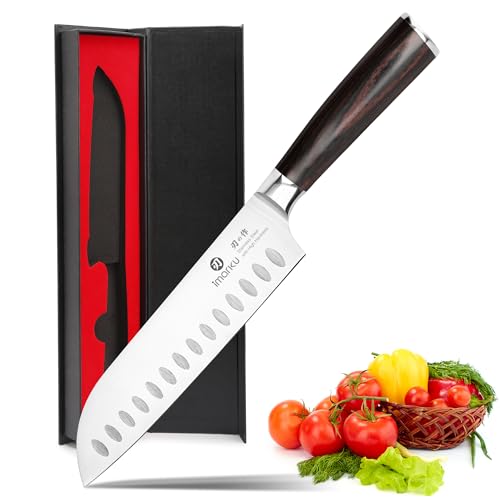
imarku
7-Inch Santoku Knife for Precision Slicing, Dicing & Mincing – High Carbon Japanese Steel with Pakkawood Handle
The imarku 7-inch Santoku knife combines a hollow scalloped edge and 15-18 degree hand-polished bevel to reduce drag and prevent food from sticking during high-volume prep work. Home cooks and apartment dwellers who want a restaurant-capable knife without the steep price will find it covers meat, vegetables, and bread with a single blade.
Pros and Cons
Pros
- The 2.5mm blade thickness paired with the hollow edge design handles both delicate julienne cuts and heavier chopping without flexing or wedging.
- Pakkawood handle construction offers a more sanitary and dimensionally stable grip than standard composite or natural wood handles.
- The 15-18 degree edge angle matches professional Japanese knife geometry, giving it a noticeably sharper out-of-box performance than German-style knives at this price.
- Versatile enough for meat, vegetables, fruit, and bread, making it a practical single-knife solution for small kitchens with limited storage.
Cons
- With zero verified reviews available, long-term edge retention and handle durability under daily use remain unconfirmed by real buyers.
- The 3-month refund window is shorter than the lifetime guarantees offered by competing brands at the same price point.

Zwilling
Henckels Santoku Knife 7-inch Hollow Edge German Stainless Steel
This 7-inch Santoku excels at mincing, slicing, and dicing with its hollow-edge blade that prevents food sticking during prep. Buy it if you want a durable, balanced Japanese-style knife that handles everyday vegetable work without the premium price tag.
Pros and Cons
Pros
- Hollow-edge grantons genuinely prevent cucumber and tomato slices from sticking to the blade mid-cut.
- German stainless steel holds its edge through repeated use on harder vegetables like carrots and beets.
- Fully forged construction creates noticeable weight and balance that makes repetitive dicing feel controlled and effortless.
Cons
- At 7 inches, it's smaller than Western chef's knives, requiring more frequent repositioning on larger vegetables.
- Dishwasher safe, but hand washing extends blade life and prevents potential handle loosening over time.

HOSHANHO
7-Inch Japanese Santoku Chef Knife | HOSHANHO High Carbon Stainless Steel
This 7-inch santoku slices vegetables, meat, and fish with a 15-degree blade angle that delivers thinner, more precise cuts than standard chef knives. Home cooks and professional chefs alike benefit from the triple-layer laminated steel construction that stays sharp longer and resists corrosion.
Pros and Cons
Pros
- The triple-layer laminated steel with 10Cr15CoMoV Japanese steel reaches 62HRC hardness, delivering edge retention that outlasts standard stainless blades.
- Ergonomic pakkawood handle provides secure grip and control without hand fatigue during extended prep sessions.
- 15-degree blade angle and hand-sharpened edge produce cleaner cuts through delicate vegetables and proteins compared to wider blade angles.
Cons
- Hand-washing required; dishwasher use will degrade the blade edge and handle finish over time.
- Requires regular honing to maintain the 15-degree angle; the initial sharpness will gradually diminish with normal kitchen use.

MercerCulinary
Mercer Genesis 7-Inch Santoku Knife: Professional Slicing & Mincing
This fully forged German steel santoku delivers razor-sharp precision for slicing vegetables and mincing herbs with its Granton edge that releases food cleanly. Buy it if you prep vegetables daily and want a professional-grade knife that won't require constant sharpening.
Pros and Cons
Pros
- Granton edge prevents food from sticking to the blade, making thin slicing of cucumbers, tomatoes, and fish noticeably faster than standard chef's knives.
- Ergonomic handle with substantial bolster reduces wrist strain during extended prep sessions and feels secure even when wet.
- Professional-grade construction at under $50 delivers the same German steel and forging process used in culinary schools.
Cons
- Requires hand-washing only; dishwasher use will damage the blade and handle, adding a maintenance step most busy cooks dislike.
- Santoku's shorter blade length and rectangular shape take practice if you're accustomed to Western chef's knives, requiring a learning curve.

Henckels Forged Accent 2-Piece Santoku Knife Set | German Stainless Steel
This 2-piece santoku set delivers razor-sharp German engineering for mincing, slicing, and dicing with effortless precision and lasting edge retention. Buy it if you prep vegetables daily and want knives that stay sharp without constant maintenance.
Pros and Cons
Pros
- Forged bolster transitions seamlessly from blade to handle, eliminating weak points that cause blade wobble during cutting.
- Satin-finished blade holds its edge noticeably longer than stamped knives, reducing the need for frequent sharpening.
- Two-knife set covers both precision work and larger prep tasks without requiring a full block of specialty knives.
Cons
- Santoku blade shape has a steeper learning curve than traditional chef's knives if you're accustomed to rocking motions.
- German stainless steel requires hand-washing to maintain edge longevity, despite being dishwasher-safe.
imarku 7-Inch Santoku Knife for Precision Slicing, Dicing & Mincing – High Carbon Japanese Steel with Pakkawood Handle
imarku
7-Inch Santoku Knife for Precision Slicing, Dicing & Mincing – High Carbon Japanese Steel with Pakkawood Handle
The imarku 7-inch Santoku knife combines a hollow scalloped edge and 15-18 degree hand-polished bevel to reduce drag and prevent food from sticking during high-volume prep work. Home cooks and apartment dwellers who want a restaurant-capable knife without the steep price will find it covers meat, vegetables, and bread with a single blade.
$39.99 at AmazonEditors' Favorite
Color: Brown and Silver Size: 7" Dimensions: 12 x 3 x 1 inches Weight: 0.43 pounds Product Group: Kitchen Binding: Kitchen
Shop NowZwilling Henckels Santoku Knife 7-inch Hollow Edge German Stainless Steel
Zwilling
Henckels Santoku Knife 7-inch Hollow Edge German Stainless Steel
This 7-inch Santoku excels at mincing, slicing, and dicing with its hollow-edge blade that prevents food sticking during prep. Buy it if you want a durable, balanced Japanese-style knife that handles everyday vegetable work without the premium price tag.
$79.95 at AmazonGreat Value
Brand Name: ZWILLING J.A. Henckels Manufacturer: ZWILLING UPC: 035886185930 Global Trade Identification Number: 00035886185930 Model Number: 31170-181 Manufacturer Part Number: 31170-181 -OPEN BOX Manufacturer Warranty Description: Lifetime Warranty Against Manufacturer'S Defects Item Type Name: Hollow Edge Santoku Knife Unit Count: 1.0 Count Included Components: Hollow Edge Santoku Knife Best Sellers Rank: #92,282 in Kitchen & Dining (See Top 100 in Kitchen & Dining) #244 in Bread Knives ASIN: B00068J2A0 Customer Reviews: 4.6 4.6 out of 5 stars (1,418) 4.6 out of 5 stars Blade Material Type: Stainless Steel Handle Material: Stainless Steel,Steel Is the item dishwasher safe?: No Material Type: ZWILLING Carbon No Stain Steel BladeLength: 7 Inches Item Weight: 6.4 ounces Item Length: 16 Inches Size: 7" Color: Stainless Steel Blade Color: Silver Blade Edge: Hollow Ground Construction Type: Forged Blade Material: Stainless Steel Brand: ZWILLING J.A. Henckels
Shop NowHOSHANHO 7-Inch Japanese Santoku Chef Knife | HOSHANHO High Carbon Stainless Steel
HOSHANHO
7-Inch Japanese Santoku Chef Knife | HOSHANHO High Carbon Stainless Steel
This 7-inch santoku slices vegetables, meat, and fish with a 15-degree blade angle that delivers thinner, more precise cuts than standard chef knives. Home cooks and professional chefs alike benefit from the triple-layer laminated steel construction that stays sharp longer and resists corrosion.
$52.99 at AmazonBrand Name: HOSHANHO Manufacturer: HOSHANHO UPC: 714757571477 Model Number: 7 inch Santoku Knife Manufacturer Part Number: HSHES-2022-002 Item Type Name: 7 inch Santoku Chef Knife Unit Count: 1.0 Count Included Components: 7 inch Santoku Knife Best Sellers Rank: #13,746 in Kitchen & Dining (See Top 100 in Kitchen & Dining) #29 in Chef's Knives ASIN: B0C1BQTQKL Customer Reviews: 4.7 4.7 out of 5 stars (1,742) 4.7 out of 5 stars Blade Edge: Plain Construction Type: Forged Blade Material Type: High Carbon Stainless Steel Handle Material: Pakkawood Is the item dishwasher safe?: No Material Type: High Carbon Stainless Steel BladeLength: 7 Inches Item Weight: 11.2 ounces Item Length: 7 Inches Size: 7" Color: Silver Blade Color: Silver Blade Material: High Carbon Stainless Steel Brand: HOSHANHO
Shop NowMercerCulinary Mercer Genesis 7-Inch Santoku Knife: Professional Slicing & Mincing
MercerCulinary
Mercer Genesis 7-Inch Santoku Knife: Professional Slicing & Mincing
This fully forged German steel santoku delivers razor-sharp precision for slicing vegetables and mincing herbs with its Granton edge that releases food cleanly. Buy it if you prep vegetables daily and want a professional-grade knife that won't require constant sharpening.
$39.95 at AmazonBrand Name: Mercer Culinary Manufacturer: Mercer Tool Corp. UPC: 749628445519 765301903244 Global Trade Identification Number: 00765301903244 Model Number: M20707 Manufacturer Part Number: M20707 Manufacturer Warranty Description: Lifetime limited manufacturer's warranty Item Type Name: Genesis Unit Count: 1.0 Count Included Components: Mercer Culinary Genesis 7-Inch Forged Santoku Knife Best Sellers Rank: #3,706 in Kitchen & Dining (See Top 100 in Kitchen & Dining) #15 in Santoku Knives ASIN: B000IBVD4I Customer Reviews: 4.8 4.8 out of 5 stars (1,577) 4.8 out of 5 stars Blade Material Type: High Carbon Steel Handle Material: Santoprene Is the item dishwasher safe?: No Material Type: Stainless steel and manmade BladeLength: 7 Inches Item Weight: 2.99 ounces Item Length: 14.05 Inches Size: 7" Color: Black Blade Color: Silver Blade Edge: Plain Construction Type: Forged Blade Material: High Carbon Steel Brand: Mercer Culinary
Shop NowHenckels Forged Accent 2-Piece Santoku Knife Set | German Stainless Steel
Henckels Forged Accent 2-Piece Santoku Knife Set | German Stainless Steel
This 2-piece santoku set delivers razor-sharp German engineering for mincing, slicing, and dicing with effortless precision and lasting edge retention. Buy it if you prep vegetables daily and want knives that stay sharp without constant maintenance.
$49.95 at AmazonBrand Name: HENCKELS Manufacturer: Henckels UPC: 035886649906 Model Number: 1021241 Manufacturer Part Number: 1021241 Item Type Name: Asian Knife Set Unit Count: 2.0 Count Included Components: 5" HE Santoku, 7" HE Santoku Best Sellers Rank: #41,522 in Kitchen & Dining (See Top 100 in Kitchen & Dining) #14 in Santoku Knives ASIN: B09RTDZ14W Customer Reviews: 4.6 4.6 out of 5 stars (284) 4.6 out of 5 stars Blade Edge: Plain Construction Type: Forged Blade Material Type: Stainless Steel Handle Material: Stainless Steel Is the item dishwasher safe?: Yes Material Type: Stainless Steel BladeLength: 5 Inches Item Weight: 9.07 g Item Length: 5 Inches Size: 2-pc Color: Black Blade Color: Silver Blade Material: Stainless Steel Brand: HENCKELS
Shop Now



Write Your Review
No reviews yet. Be the first to share your experience!