

Quarter sheet pans measure 9×13 inches, a compact size that transforms how home cooks approach baking and roasting. The construction of these pans determines whether your cookies bake evenly, your vegetables caramelize properly, or your investment warps into a useless piece of scrap metal after six months.
Most quarter sheets are stamped from aluminized steel—cold-rolled steel coated with an aluminum-silicon alloy through a hot-dip process. This fusion gives you steel’s structural rigidity with aluminum’s superior heat conductivity. The aluminum layer typically measures 10-20% of the total thickness, enough to distribute heat rapidly while the steel core prevents the pan from buckling under high temperatures. Cheaper pans skip the aluminized process entirely, using bare steel that conducts heat poorly and rusts within months.
Gauge matters more than most manufacturers admit. Professional half-sheet pans typically use 13-gauge steel (0.09 inches thick), but quarter sheets often drop to 16 or 18 gauge to cut costs. A 16-gauge quarter sheet offers adequate performance for home use—thick enough to resist warping at 450°F but light enough to handle comfortably. Anything thinner than 18 gauge will warp the first time you roast Brussels sprouts at 425°F, creating an uneven surface where oil pools and food cooks inconsistently.
Material Science: Why Aluminum Fails and Steel Survives
Pure aluminum sheet pans feel appealingly lightweight and conduct heat beautifully, but they lack structural memory. When aluminum expands under heat and contracts during cooling, it doesn’t return to its original shape—you get permanent ripples and bends. Restaurant kitchens replace aluminum pans every few months for this reason.
Aluminized steel solves this problem through differential expansion. The steel core expands minimally (coefficient of 12×10⁻⁶ per °C) while the aluminum coating expands faster (23×10⁻⁶ per °C). This mismatch creates compression in the aluminum layer that actually increases the pan’s resistance to warping. You can slide an aluminized pan from a 450°F oven directly onto a room-temperature counter without warping—try that with bare aluminum.
Stainless steel quarter sheets exist but serve a different purpose. Stainless conducts heat poorly compared to aluminum (16 W/m·K versus 205 W/m·K), creating hot spots unless the manufacturer bonds an aluminum or copper core between steel layers. Tri-ply construction adds cost that makes sense for sauté pans but offers little advantage for sheet pans where even heat distribution comes primarily from oven air circulation, not pan conduction.
Rim Construction and the Warping Problem
A rolled rim—where the edge curves back on itself through a wire—adds 30-40% more rigidity than a simple bent edge. The wire crimped inside creates a stress point that resists the torsional forces generated when the pan heats unevenly. Cheaper pans use a simple hemmed edge (folded once) that looks similar but provides half the structural support.
You can test rim quality before buying. Hold the pan by one corner and tap the opposite corner against a solid surface. A pan with proper wire reinforcement produces a clear ring. A hemmed-edge pan makes a dull thud and may visibly flex. This flex compounds over dozens of heat cycles until the pan develops a permanent bow.
Warping typically begins at the corners where thermal stress concentrates. A quarter sheet pulled from a 475°F oven experiences a 400°F temperature differential between the rim (which cools quickly in room air) and the center (which retains heat). This gradient creates shearing forces that weak corners can’t resist. Quality pans add extra material at the corners—you’ll see slightly deeper curves where the rim meets the flat cooking surface.
Surface Treatments: Bare Metal Versus Coatings
Bare aluminized steel develops a natural patina after several uses—a bronzed layer of polymerized oils and oxidation that actually improves performance. This seasoning provides light non-stick properties and promotes even browning. Scrubbing this layer away with abrasive cleaners returns the pan to its original sticky state.
Non-stick coatings on sheet pans solve a problem that doesn’t exist for most baking tasks. Cookies, vegetables, and bacon release naturally from bare metal once they develop sufficient crust. The coating restricts you to 450°F maximum—higher temperatures degrade PTFE, releasing fumes and reducing slickness. Restaurant kitchens avoid coated sheet pans entirely because the coating fails within months under commercial use.
Silicone coatings offer a middle path. These ceramic-reinforced silicone layers tolerate temperatures up to 500°F and wear better than PTFE. They don’t provide true non-stick performance—think of them as reducing stick by 60-70% rather than eliminating it. For tasks like roasting sticky marinades or baking cheesy items, a silicone coating saves cleanup time. For general baking, bare metal performs better.
Dark coatings absorb more infrared radiation than shiny metal, promoting faster browning. A dark-coated quarter sheet bakes cookies 15-20% faster than bare aluminum at the same oven temperature. This sounds beneficial until you realize most recipes are developed for light-colored pans. You’ll need to reduce temperature by 25°F or shorten baking time by 2-3 minutes to avoid burnt bottoms.
Practical Dimensions and Toaster Oven Fit
True quarter sheet pans measure 9×13 inches with a 1-inch rim height. Some manufacturers label 8×12 or 9.5×13 pans as “quarter sheet” to fit specific toaster oven models. This matters when you’re following recipes scaled for standard dimensions—a genuine 9×13 pan holds about 1.2 liters of volume with a 1-inch rim, enough for roasting two pounds of vegetables or baking 18-24 cookies with proper spacing.
Toaster oven compatibility requires checking interior dimensions, not the oven’s exterior size. A typical countertop oven labeled “extra large” has an interior width of 12-13 inches, but the heating elements and door hinge may intrude 0.5-1 inch on each side. A 9-inch pan width leaves 1.5-2 inches of clearance for air circulation—critical for convection performance. Squeezing a pan that’s too wide blocks airflow and creates hot spots.
Rim height affects capacity more than cooks expect. A 1-inch rim holds vegetables in a single layer while providing splash protection for fatty items like chicken thighs. Half-inch rims, common on budget pans, let oils run over the edge and smoke on the oven floor. The shallow rim also makes the pan harder to grip with oven mitts—you end up grasping only the thin rim rather than a proper handle-like edge.
What Actually Matters When Choosing
Weight tells you more than marketing claims. A quality 9×13 quarter sheet weighs 12-14 ounces. Anything under 10 ounces uses thin metal that will warp. Anything over 16 ounces is overbuilt for home use—you’re paying for thickness that matters in commercial ovens running 16 hours daily but provides marginal benefit for home baking twice a week.
The corner radius reveals manufacturing quality. Well-made pans have smooth, continuous curves where the rim meets the cooking surface. Cheap pans show visible creases or flat spots where the stamping die didn’t form the metal properly. These stress concentrators become failure points after 20-30 heat cycles.
American-made pans from commercial suppliers cost 40-60% more than imports but use heavier gauge steel and better rim construction. If you bake weekly and want a pan that lasts ten years, the premium pays off within two years compared to replacing cheap pans annually. Occasional bakers who use a quarter sheet monthly can succeed with mid-range options that balance cost and durability.
Avoid pans with printed measurements or decorative patterns. The inks used for these markings break down under heat, releasing compounds that affect food flavor. Worse, the printing process requires a clear coat that degrades into sticky residue after a dozen uses. Professional pans rely on embossed markings or no markings at all.
Maintenance That Extends Pan Life
Bar Keeper’s Friend removes baked-on residue without damaging aluminized steel. The oxalic acid formula cuts through carbonized sugars and fats while leaving the aluminum coating intact. Avoid alkaline cleaners like oven spray—they dissolve the aluminum layer, exposing bare steel that rusts within days.
Stack pans with paper towels between them to prevent edge damage. The rim of one pan scratches the cooking surface of another, creating gouges where food sticks. These scratches also become rust initiation points if they penetrate the aluminum coating.
Store pans flat rather than vertically. Leaning pans against each other for months creates stress on the rim that mimics warping forces. You’ll pull out a pan that’s developed a subtle bow despite never being used. The weight of stacked items above also matters—don’t store cast iron on top of your sheet pans.
Frequently Asked Questions
Can you use parchment paper on every bake to avoid cleaning?
Parchment insulates food from the pan surface, slowing heat transfer by 8-12%. Cookies take longer to brown on the bottom, and roasted vegetables steam rather than caramelize because moisture can’t escape as efficiently. For delicate items like macarons where you need controlled heat, parchment helps. For crispy outcomes, direct metal contact works better. Silicone baking mats create even more insulation—they’re useful for sticky candies but counterproductive for roasting.
Do I need different pans for sweet and savory cooking?
No, but dedicated pans prevent flavor transfer. A pan used repeatedly for roasting fish or garlic will retain those oils in its seasoned surface. Baking sugar cookies on that pan can pick up savory notes. If you bake and roast with equal frequency, two quarter sheets solve the problem—one develops a sweet patina, the other a savory one. The cost of a second pan is less than dealing with chocolate chip cookies that taste faintly of salmon.
Why do some pans develop dark spots that won’t clean off?
Those spots are polymerized oils—essentially the same seasoning that forms on cast iron. Oils heated above 500°F break down into polymers that bond to metal through a process called carbonization. This layer is inert and doesn’t affect food safety or flavor. Aggressive scrubbing removes it temporarily, but it returns with use. Embrace the patina rather than fighting it—those dark pans actually bake more evenly than shiny new ones because the seasoned surface has uniform thermal properties across the entire cooking area.

NordicWare
Nordic Ware Naturals Quarter Sheet Pan 2-Pack for Even Baking and Roasting Vegetables
This aluminum quarter sheet pan pair delivers uniform browning and heat distribution with a reinforced steel rim that prevents warping through years of daily use. Home bakers who want commercial-grade results and cooks who roast vegetables multiple times per week will appreciate the durability and consistent performance.
Pros and Cons
Pros
- Pure aluminum heats uniformly across the entire surface, producing evenly browned cookies and crispy roasted vegetables without rotating mid-bake.
- Steel-reinforced rim stays flat through thermal stress and daily handling, unlike thin pans that buckle after a few months.
- Natural finish performs like nonstick without coatings that chip or degrade, and it works seamlessly with parchment paper or silicone mats.
Cons
- Aluminum reacts with acidic foods like tomatoes and vinegar, causing darkening and potential pitting over time when used for acidic roasts.
- Hand washing is required because dishwasher detergents cause cosmetic discoloration that dulls the shiny finish.
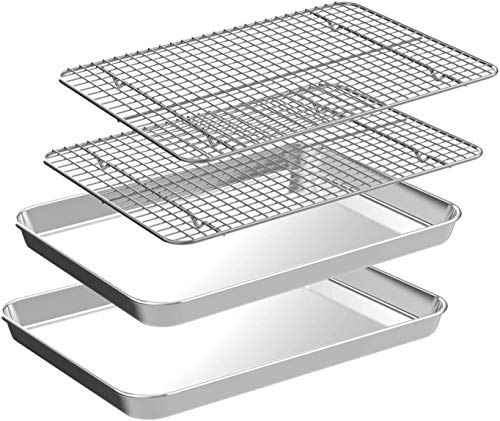
CEKEE
Quarter Sheet Baking Pan and Rack Set for Cookies, Roasting, and Meal Prep, CEKEE Stainless Steel
The CEKEE quarter sheet pan set combines two stainless steel baking pans with two wire racks, giving you a reusable setup for baking, roasting, cooling, and BBQ cooking. It suits home bakers and cooks who need compact, stackable bakeware with durable stainless steel construction and easy cleanup.
Pros and Cons
Pros
- The four-piece set provides two 12.59 x 9.84 x 1.18-inch pans and two 11.57 x 8.97-inch wire racks.
- Commercial-grade stainless steel contains no coating that could create chemicals at high baking temperatures.
- The pans support baking, BBQ cooking, picnic serving, jelly rolls, and cheesecake preparation.
- The lightweight design makes the set easier to handle and remove from the oven.
Cons
- The quarter-sheet size offers less cooking area than standard half-sheet pans.
- The stainless steel surfaces still require grease removal after each use to stay bright and clean.

USA Pan
Cookie Baking and Vegetable Roasting: USA Pan Nonstick Quarter Sheet Pan
This USA Pan quarter sheet delivers evenly baked cookies and roasted vegetables with a corrugated surface that promotes air circulation and easy release. It suits home bakers who need a durable, compact baking sheet with nonstick cleanup for everyday batches and reheating.
Pros and Cons
Pros
- The corrugated baking surface supports air circulation and even results.
- The proprietary silicone coating provides nonstick release and quicker cleanup.
- Heavy-gauge aluminized steel offers a sturdy commercial-grade construction.
- Its compact 13 x 9.5-inch outer size is useful for smaller batches and reheating.
Cons
- The quarter-sheet capacity is limited compared with larger baking sheets.
- The corrugated surface may be less suitable when a completely flat baking surface is needed.

CURTA
Small-Batch Baking and Roasting: CURTA 6 Pack Aluminum Quarter Sheet Pans
These six heavy-gauge aluminum quarter sheet pans distribute heat evenly for small-batch baking, roasting, reheating, and prep, while reinforced rims help resist warping. Buy them for home kitchens, toaster ovens, RV ovens, or commercial prep stations that need stackable trays for repeated use.
Pros and Cons
Pros
- Six pans provide useful capacity for meal prep, small-batch baking, and commercial food service.
- NSF listing supports use in commercial kitchen environments.
- Reinforced beaded rims help the trays retain their flat shape through repeated heating.
- Upturned lips contain cooking juices during roasting and reheating.
Cons
- High heat and commercial detergents may cause cosmetic discoloration or oxidation of the aluminum.
- The 1/4-size dimensions limit capacity compared with full-size sheet pans.

Made In
Quarter Sheet Pan for Roasting and Baking, Made In Commercial-Grade Aluminum
The Made In Quarter Sheet Pan handles baking, roasting, and freezing while its commercial-grade aluminum supports dependable daily cooking. It suits home cooks who need a compact, oven-safe pan for weeknight vegetables, salmon, and smaller batches.
Pros and Cons
Pros
- The compact quarter-sheet format fits smaller portions and everyday meals.
- Commercial-grade 3004 aluminum provides a durable baking surface.
- The 500F oven-safe rating covers common baking and roasting temperatures.
- Chef Matt Horn helped design it for use at Horn Barbecue.
Cons
- The quarter-sheet dimensions provide less cooking area than standard full-size sheet pans.
- The product data does not specify whether the pan is dishwasher safe or nonstick.
The Best Deals This Week*
-
Nordic Ware Naturals Quarter Sheet Pan 2-Pack
$20.53
($21.99)Save $1.46 -
Quarter Sheet Baking Pan and Rack Set for Cookies
$22.99
($24.98)Save $1.99 -
Cookie Baking and Vegetable Roasting
$19.95
($23.99)Save $4.04 -
Small-Batch Baking and Roasting
$41.39
($45.99)Save $4.60
*Deals are selected by our commerce team
NordicWare Nordic Ware Naturals Quarter Sheet Pan 2-Pack for Even Baking and Roasting Vegetables
NordicWare
Nordic Ware Naturals Quarter Sheet Pan 2-Pack for Even Baking and Roasting Vegetables
This aluminum quarter sheet pan pair delivers uniform browning and heat distribution with a reinforced steel rim that prevents warping through years of daily use. Home bakers who want commercial-grade results and cooks who roast vegetables multiple times per week will appreciate the durability and consistent performance.
$20.53 at AmazonEditors' Favorite
Brand Name: Nordic Ware Global Trade Identification Number: 00011172453068 Manufacturer Warranty Description: lifetime limited warranty UPC: 011172453068 Model Number: 45306AMZM Manufacturer Part Number: 45306AMZM Included Components: baking sheet^2 Unit Count: 2.0 Count Manufacturer: Nordic Ware Item Type Name: Naturals Best Sellers Rank: #1,002 in Kitchen & Dining (See Top 100 in Kitchen & Dining) #6 in Baking & Cookie Sheets ASIN: B078NJRJ7T Customer Reviews: 4.7 4.7 out of 5 stars (6,553) 4.7 out of 5 stars Material Type: Aluminum Is the item dishwasher safe?: No Size: Quarter Sheet (Pack of 2) Item Dimensions L x W x H: 12.9"L x 9.6"W x 1.1"H Item Weight: 2.1 Pounds Color: Natural Material: Aluminum Brand: Nordic Ware Product Dimensions: 12.9"L x 9.6"W x 1.1"H Is Dishwasher Safe: No
Shop NowCEKEE Quarter Sheet Baking Pan and Rack Set for Cookies, Roasting, and Meal Prep, CEKEE Stainless Steel
CEKEE
Quarter Sheet Baking Pan and Rack Set for Cookies, Roasting, and Meal Prep, CEKEE Stainless Steel
The CEKEE quarter sheet pan set combines two stainless steel baking pans with two wire racks, giving you a reusable setup for baking, roasting, cooling, and BBQ cooking. It suits home bakers and cooks who need compact, stackable bakeware with durable stainless steel construction and easy cleanup.
$22.99 at AmazonGreat Value
Color: Silver Size: 12*10*1Inch Dimensions: 12 x 8 x 1 inches Weight: 3 pounds Product Group: Kitchen Binding: Kitchen
Shop NowUSA Pan Cookie Baking and Vegetable Roasting: USA Pan Nonstick Quarter Sheet Pan
USA Pan
Cookie Baking and Vegetable Roasting: USA Pan Nonstick Quarter Sheet Pan
This USA Pan quarter sheet delivers evenly baked cookies and roasted vegetables with a corrugated surface that promotes air circulation and easy release. It suits home bakers who need a durable, compact baking sheet with nonstick cleanup for everyday batches and reheating.
$19.95 at AmazonColor: Aluminized Steel Size: Set of 1 Dimensions: 13 x 9 x 1 Inches Weight: 1 pounds Product Group: Kitchen Binding: Kitchen
Shop NowCURTA Small-Batch Baking and Roasting: CURTA 6 Pack Aluminum Quarter Sheet Pans
CURTA
Small-Batch Baking and Roasting: CURTA 6 Pack Aluminum Quarter Sheet Pans
These six heavy-gauge aluminum quarter sheet pans distribute heat evenly for small-batch baking, roasting, reheating, and prep, while reinforced rims help resist warping. Buy them for home kitchens, toaster ovens, RV ovens, or commercial prep stations that need stackable trays for repeated use.
$41.39 at AmazonColor: 13 x10 Inch (6-Pack) Size: 13 x10 Inch Dimensions: 13 x 10 x 1 inches Weight: 1.19 pounds Product Group: Kitchen Binding: Kitchen
Shop NowMade In Quarter Sheet Pan for Roasting and Baking, Made In Commercial-Grade Aluminum
Made In
Quarter Sheet Pan for Roasting and Baking, Made In Commercial-Grade Aluminum
The Made In Quarter Sheet Pan handles baking, roasting, and freezing while its commercial-grade aluminum supports dependable daily cooking. It suits home cooks who need a compact, oven-safe pan for weeknight vegetables, salmon, and smaller batches.
$19.00 at AmazonColor: Stainless Steel Size: Quarter Sheet Pan - Standard Dimensions: 9.5 x 13 x 1 Inches Weight: 0.98987555638 Pounds Product Group: Kitchen Binding: Kitchen
Shop Now




Write Your Review
No reviews yet. Be the first to share your experience!