

A braiser operates on a principle of contained evaporation: its wide, shallow basin exposes maximum surface area to heat while the tight-fitting lid traps moisture, creating a continuous condensation cycle that bastes food from above. Unlike tall Dutch ovens that rely on depth, a braiser’s geometry—typically 3 to 4 inches high with a 10- to 14-inch diameter—lets you sear proteins flat against the base before adding liquid, then maintains gentle heat distribution during the covered cooking phase. Cast iron and enameled cast iron models excel here because they absorb heat slowly and radiate it evenly, preventing hot spots that would scorch aromatics or cause uneven reduction. The lid’s dome or slight concavity becomes critical: as steam rises and condenses on the cooler inner surface, droplets fall back onto the ingredients rather than escaping, concentrating flavors without requiring constant attention or additional liquid.
This self-basting mechanism explains why braisers produce tender short ribs and caramelized root vegetables with less hands-on effort than stovetop-only methods. Once you add wine or broth and cover the pan, the circulating moisture breaks down collagen while the retained heat maintains a steady simmer without the temperature swings of thinner cookware. Understanding these mechanics clarifies what to prioritize when choosing one: material thermal mass, lid seal quality, handle durability under oven temperatures, and dimensional proportions that suit your typical batch sizes.
Material Composition and Heat Retention
Bare cast iron braisers weigh 12 to 16 pounds and require seasoning maintenance, but they tolerate stovetop temperatures exceeding 500°F and develop a natural nonstick patina over time. Enameled versions coat the iron interior with vitreous glass, eliminating seasoning chores and allowing acidic ingredients like tomatoes or vinegar without risk of metallic flavors. The enamel adds negligible weight while providing a smoother cooking surface that resists sticking during the initial sear. Both materials offer comparable heat retention—the iron core does the thermal work—but enameled models cost 30 to 50 percent more and chip if dropped onto hard floors. Stainless steel braisers with aluminum or copper cores heat faster and weigh less, making them easier to maneuver, yet they lack the sustained radiant warmth that keeps braises at a stable simmer once you reduce the burner. For recipes that transition from stovetop to a 350°F oven for two hours, cast iron variants hold temperature more reliably than tri-ply stainless.
Wall thickness matters as much as material choice. Premium models maintain 4- to 5-millimeter walls that moderate temperature changes, letting you sear over medium-high heat without burning fond. A 3.5-quart braiser should weigh at least 10 pounds if enameled, signaling adequate iron mass for sustained heat retention.
Lid Design and Seal Integrity
The lid must sit flush against the rim to trap steam effectively. Dome-shaped lids with a central knob create headroom for tall ingredients like whole artichokes or layered gratins, while flat lids with minimal clearance work well for thinner cuts like pork chops or fish fillets. Some premium braisers incorporate self-basting spikes or dimples on the underside of the lid, channeling condensation back toward the center of the pan for more uniform moisture distribution. Standard smooth lids perform adequately if the fit is tight; gaps wider than a millimeter allow steam to escape, forcing you to add extra liquid and extending cooking times. Test the seal by holding the braiser at eye level: the lid should rest evenly without tilting, and you should see consistent contact around the entire circumference.
Lid handles and knobs vary in oven-safe temperature ratings. Phenolic (plastic) knobs typically max out at 350°F to 375°F, adequate for most braises but limiting if you want to finish a dish under a 450°F broiler. Stainless steel or cast iron knobs tolerate 500°F and higher, though they conduct heat and require potholders for removal. A heavy lid compresses slightly against the rim as it heats, improving the seal, while lightweight lids can rattle during vigorous simmering, releasing puffs of steam that dry out the cooking environment.
Capacity and Dimensional Trade-Offs
Quart ratings for braisers can mislead because the wide, shallow shape means liquid depth stays low even at stated capacity. A 3.5-quart model might measure 12 inches across and 3 inches deep, holding enough liquid to partially submerge four chicken thighs but not to cover them entirely—by design, since braising relies on steam and radiant heat rather than full immersion. For two-person households, 2.5- to 3-quart braisers handle weeknight meals without excess bulk, fitting comfortably on standard 10-inch burners. Larger 5- to 6-quart versions suit batch cooking or entertaining but overhang smaller burners, causing uneven heating and potential handle scorching on adjacent burners. Measure your cooktop’s burner diameters before committing to a 14-inch braiser that extends beyond the flame or coil, wasting energy and creating hot spots at the pan’s center.
Depth influences cooking style. Shallower braisers (2.5 to 3 inches) encourage reduction and caramelization, ideal for dishes where you want concentrated sauces. Deeper models (4 inches or more) behave more like short Dutch ovens, suitable for recipes with higher liquid ratios. Interior color also affects cooking—light enamel makes it easier to monitor fond development and gauge reduction levels, while dark interiors hide browning, requiring more vigilant checking to avoid scorching.
Handle Configuration and Oven Safety
Most braisers feature two loop handles rather than a long single handle, distributing the pan’s weight across both hands for safer lifting. Loop handles should measure at least 2 inches wide to accommodate thick oven mitts, with enough clearance to slide fingers underneath without touching the hot pan body. Cast iron handles integrated into the mold offer maximum durability but conduct heat aggressively, requiring potholders even for stovetop-only use. Stainless steel handles bolted to the sides stay slightly cooler and provide grip texture.
Helper handles on opposite sides improve balance when transferring a full pan. Some designs omit handles entirely in favor of integral side grips molded into the pan walls, reducing snag points but making one-handed maneuvering difficult.
Maintenance Requirements and Longevity
Enameled braisers tolerate metal utensils and acidic ingredients without degradation, but the glass coating chips on impact, especially around the rim where the lid makes contact. Avoid thermal shock by letting the pan cool before washing, and never place a hot braiser directly onto cold granite or stone counters—use a trivet or folded towel to buffer temperature transitions. Minor chips on the exterior pose no functional issue, but interior chips expose raw iron that will rust if not dried immediately after washing. Some manufacturers offer limited lifetime warranties covering manufacturing defects but exclude damage from misuse like dropping or overheating empty pans.
Bare cast iron braisers demand regular seasoning to maintain their nonstick surface, requiring a thin oil coat and a 400°F oven session every few months depending on use frequency. They rust if stored damp but prove nearly indestructible otherwise. Stainless steel braisers with clad construction resist staining but show heat tinting over time, a cosmetic issue that does not affect performance. Dishwasher use voids most warranties for enameled and bare iron braisers due to harsh detergents and high heat. Hand washing with hot water and minimal soap preserves the surface and extends usable life beyond a decade for quality models.
Compatibility with Cooktop Types
Induction cooktops require magnetic bases, which cast iron and enameled cast iron inherently provide. Stainless braisers need a magnetic layer in the base—check specifications. Gas burners accommodate any braiser regardless of base material. Electric coil and smoothtop ranges work with all materials but heat slowly, and cast iron’s weight can scratch glass cooktops if slid rather than lifted.
Radiant and halogen smoothtops transfer heat efficiently to flat-bottomed pans, but any warping—common in lower-quality clad stainless—reduces contact and causes uneven cooking. Cast iron’s rigidity prevents warping, though rough or unfinished bases can scratch polished cooktop surfaces. For outdoor grilling, bare cast iron tolerates direct grate placement over charcoal or wood, while enameled versions risk thermal shock from flame contact and should sit over indirect heat zones only.
Can I use a braiser for baking bread or no-knead dough?
Yes, braisers function well for no-knead and artisan bread recipes that require covered baking to trap steam during oven spring. The wide, shallow shape produces flatter loaves compared to tall Dutch ovens, but crust development and crumb texture remain excellent. Preheat the empty pan in a 450°F to 500°F oven for 30 minutes before carefully transferring dough inside—use parchment paper as a sling to avoid burns. The key limitation is lid knob temperature rating: phenolic knobs fail at these temperatures, so bread baking requires stainless or cast iron knobs rated to 500°F minimum.
How do I prevent food from sticking during the searing phase?
Proper preheating is essential: heat the empty braiser over medium to medium-high for 3 to 4 minutes until a water droplet sizzles and evaporates within 2 seconds, then add oil and wait 30 seconds for it to shimmer before placing protein in the pan. Cold or insufficiently heated pans cause sticking because proteins bond to the metal before forming a seared crust. Pat ingredients dry with paper towels before searing, as surface moisture creates steam that prevents browning and encourages adhesion. Use enough fat—1 to 2 tablespoons of oil or butter—to coat the base lightly, and resist the urge to move or flip meat prematurely. Most proteins release naturally once a proper crust forms, typically after 3 to 5 minutes of undisturbed contact. For enameled surfaces, deglaze any stuck fond with liquid after searing rather than scraping aggressively, which can chip the enamel.
What size braiser works best for a family of four?
A 3.5- to 4-quart braiser handles most family meals for four, providing enough surface area to brown four to six chicken thighs or a 3-pound pork shoulder in a single layer without crowding. Crowding prevents proper browning and releases excess moisture. The 12- to 13-inch diameter typical of this capacity fits comfortably on standard burners and inside most ovens without requiring rack adjustments. Smaller 2.5-quart models suit two-person households but feel cramped for main courses serving four, while 5-quart and larger options offer batch-cooking capacity for entertaining but occupy significant storage space and weigh 15-plus pounds empty.

Komokeru
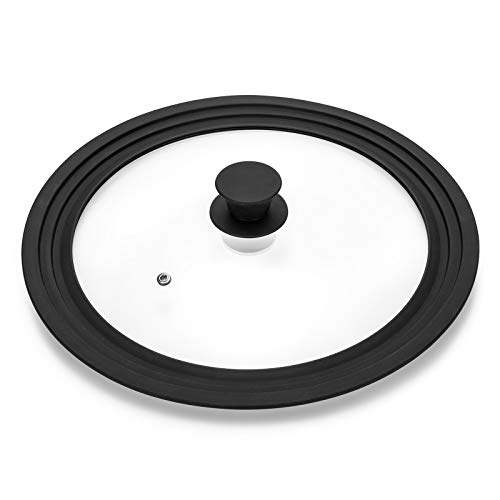
Universal Pan Lid Fits 7 to 12 Inch Cookware, Komokeru 2 Pack Tempered Glass Replacement Lids
This two-pack of tempered glass lids covers 7, 8, 9, 10, 11, and 12 inch pots, pans, and skillets, replacing a whole drawer of mismatched covers with two pieces. Worth buying if you own cast iron skillets or hand-me-down cookware that came without lids and you want one cover that moves between pans.
Pros and Cons
Pros
- Replaces multiple lost or broken lids with two universal covers, useful for cast iron and older cookware sold without lids.
- Tempered glass with a silicone rim is more forgiving of knocks than a plain glass lid.
- Vent hole and clear panel together let you manage a simmer without repeated lifting.
- Flat shape solves the storage problem that comes with owning several odd-sized lids.
Cons
- A universal lid rests on the rim rather than seating tightly, so it will not trap steam as well as a lid matched to your pan.
- The 450F silicone limit rules out oven finishing at higher temperatures and broiler use.
ELKKNOVE
Universal Pot Lid for 10.5, 11 and 12 Inch Pans - ELKKNOVE Tempered Glass Cover with Silicone Rim
This tempered glass lid covers 10.5", 11", and 12" pots, pans, and skillets with a single piece, replacing three separate lids in your cabinet. Buy it if your cookware came without lids or your cupboard is overflowing with mismatched covers you can never find.
Pros and Cons
Pros
- Replaces multiple lids for anyone with an odd-sized skillet or a lidless pan set.
- Glass top means you can check food without breaking the steam seal.
- Heat-resistant silicone rim protects the glass edge and grips the pan rim.
- Vent hole prevents spillover during pasta, rice, and heavy sauces.
Cons
- The 10.5" to 12" range excludes smaller saucepans and stockpots, so you may still need other lids.
- It rests on the rim rather than locking in, so it does not create a pressure-tight seal.
Komokeru Universal Pan Lid Fits 7 to 12 Inch Cookware, Komokeru 2 Pack Tempered Glass Replacement Lids
Komokeru
Universal Pan Lid Fits 7 to 12 Inch Cookware, Komokeru 2 Pack Tempered Glass Replacement Lids
This two-pack of tempered glass lids covers 7, 8, 9, 10, 11, and 12 inch pots, pans, and skillets, replacing a whole drawer of mismatched covers with two pieces. Worth buying if you own cast iron skillets or hand-me-down cookware that came without lids and you want one cover that moves between pans.
$23.99 at AmazonEditors' Favorite
Color: 7-8-9 inch & 10-11-12 inch Dimensions: 12 x 12 x 1.6 inches Weight: 2.78002912382 Pounds Product Group: Kitchen Binding: Tools & Home Improvement
Shop NowELKKNOVE Universal Pot Lid for 10.5, 11 and 12 Inch Pans - ELKKNOVE Tempered Glass Cover with Silicone Rim
ELKKNOVE
Universal Pot Lid for 10.5, 11 and 12 Inch Pans - ELKKNOVE Tempered Glass Cover with Silicone Rim
This tempered glass lid covers 10.5", 11", and 12" pots, pans, and skillets with a single piece, replacing three separate lids in your cabinet. Buy it if your cookware came without lids or your cupboard is overflowing with mismatched covers you can never find.
$14.99 at AmazonGreat Value
Color: black Size: 10.5",11",12" Dimensions: 12 x 12 x 0.0393700787 inches Weight: 1.6093745126 pounds Product Group: Kitchen Binding: Unknown Binding
Shop Now



Write Your Review
No reviews yet. Be the first to share your experience!