

Ask a room full of home cooks how they time things and most will point at their phones. Some own a battered wind-up dial inherited from a parent’s kitchen. Others insist the loudest alarm money can buy is the only safe choice. Nearly everyone assumes that juggling three simmering pots means juggling three separate devices. Every one of these assumptions sounds reasonable until you are standing in an actual kitchen with wet hands, a roaring extractor fan, and forty minutes left on the rice. A dedicated kitchen timer clock exists precisely because those moments break the phone-in-pocket habit, and the reasons why deserve a proper myth-by-myth walkthrough.
None of this means the gadgets you already own are useless. It means each was designed for a different job, and timing food is a specific job with specific demands: hands-free operation, an alarm audible over the hood fan, a display legible from the doorway, and a battery that outlives your attention span for charging cables. Here is where each popular assumption falls apart.
Your Phone Was Never Designed for This
Start with the most obvious failure. Four minutes into kneading enriched dough, both hands coated, you need the oven to drop twenty degrees at the twelve-minute mark. Pulling a phone from a back pocket with doughy fingers means smearing butter across the glass, typing a lock code one-handed, and hoping the timer app reopens where you left it. A countertop timer solves this with oversized physical buttons you can press with a knuckle, an elbow, or the heel of a floured palm. There is no passcode standing between you and the countdown.
The second problem is quieter. Phone alarms live inside a notification system built to prioritize messages, calls, and calendar pings, so a timer alert can arrive as a brief banner that vanishes if you glance away. Lay the phone face-down to keep flour off the screen and the sound muffles further. The phone also travels: carry it out to the mailbox mid-countdown and your bread’s fate walks out the door with you. A dedicated unit stays anchored to the counter, digits facing the room, doing exactly one job for as long as you leave it alone.
Battery economics tilt the same way. A timer running on a single AAA cell sips power for a year or more because a basic liquid-crystal display draws almost nothing. A phone burning its screen at full brightness to show a countdown eats noticeable charge, and screens auto-dim after fifteen or thirty seconds anyway, hiding the remaining time from anyone farther than arm’s length. The display that stays lit for the whole duration is the one you will actually glance at from across the kitchen.
The Wind-Up Dial Is Not a Museum Piece
Mechanical timers get written off as leftovers from a pre-digital age, which is strange, because their apparent weaknesses double as strengths. A spring-driven dial has no battery to die, no firmware, and no screen to crack. Rinse most of them under the tap after a flour spill, drop one on tile from counter height, hand it to a five-year-old who wants to twist something, and it keeps ticking. Attempt any of those tests with a phone costing several hundred dollars and see how far you get.
The honest limitations deserve stating too. A classic 60-minute dial cannot time an overnight cold proof or a three-hour braise, and the spring mechanism drifts, typically running a minute or two off as it ages. For steeping tea, blanching green beans for exactly two minutes, or holding a child to a ten-minute turn at the mixing bowl, that tolerance is beside the point. Precision baking is where digital units earn their keep; nearly everything else on a weeknight still belongs to the dial.
Maximum Volume Is a Feature You May Regret
Alarm loudness sounds like a simple case of more being better, right up until you live with other people. An 85-decibel shriek that punches through a range hood also punches through a nursery wall, a roommate’s video call, or the hush of a 6 a.m. kitchen before anyone else is awake, and even a friendly household turns hostile to noise once the dishwasher and the radio join in. What cooks actually need is range: a dial or switch that slides from a polite 60-decibel chime up to something assertive enough to beat exhaust-fan roar. Adjustable volume turns one device into a daytime tool and a naptime tool at once.
Two companion traits matter as much. An alarm that repeats until acknowledged beats one that beeps three times and surrenders, because a low volume setting only stays safe if the timer refuses to be missed. A flashing light indicator helps in kitchens where somebody is deaf or hard of hearing, converting the signal from audible to visible without touching the volume at all.
Five Dishes Do Not Need Five Devices
The one-timer-per-task instinct grew out of years of single-countdown gadgets, and multi-channel units have retired it. A four-channel timer lets you assign and label each countdown separately, so Thanksgiving runs the turkey at three hours, the dressing at forty-five minutes, the dinner rolls at twelve, and the potato casserole at thirty, all visible on one screen and all driven by the same pair of buttons. Home bakers stacking a preferment, a bulk ferment, and a final bake split the channels the same way. Line cooks have worked from channel-based timers for years for exactly this reason.
Check the ceiling before buying, though. Plenty of budget digital models stop dead at 99 minutes and 59 seconds, which quietly fails six-hour stocks, slow braises, and dough proofing overnight in the refrigerator. Better units count down a full 24 hours, and many double as a kitchen clock between uses, showing the time of day on that same large display. Some add a count-up stopwatch mode for recipes written in elapsed time rather than fixed durations. Of everything printed on the box, the maximum countdown is the specification most likely to matter months later.
What Separates a Good Kitchen Timer Clock From a Bad One
Readability leads the list. Digits an inch tall with strong contrast stay legible from the hallway; cramped, washed-out displays drag you across the room to squint. Backlighting costs a little more and repays it in dim early-morning kitchens. Mounting comes next, and magnet strength varies enormously: cheap ferrite magnets skid down a fridge door the moment it swings shut, while neodymium versions clamp on and stay. Because plenty of modern stainless fronts are not magnetic at all beneath the skin, a flip-out stand or a hanging hole covers the fridges where adhesion simply fails.
Power and controls deserve equal scrutiny. Models taking AAA or AA cells let you swap batteries in five seconds flat and keep spares in a drawer; coin-style LR44 cells die without warning and sometimes take their saved settings down with them. Physical buttons with real travel outperform touch surfaces whenever hands are wet, and a memory function that survives a battery change spares you from relearning the interface once a year. Add adjustable volume from the section above and the shortlist is complete: readable display, strong mount, swappable power, tactile buttons.
Common Questions About Kitchen Timer Clocks
How long can a kitchen timer clock count down?
It depends entirely on the model. Basic digital timers commonly top out at 99 minutes and 59 seconds, which covers most stovetop work but fails long braises and refrigerator proofs. Mid-range and higher units frequently extend to a 24-hour countdown, and nearly all of them double as a 12- or 24-hour clock when idle, displaying the time of day between tasks. Mechanical dials sit at the bottom of the range, usually 60 minutes maximum. If your cooking includes overnight rises, confirm the maximum on the spec sheet before purchasing, because this is the most common disappointment new owners report.
Will a magnetic timer stay put on a fridge door?
Sometimes, and the outcome depends on the magnet itself. Inexpensive ferrite magnets lose their grip on smooth doors and creep downward every time the door slams shut, eventually disappearing behind the kick plate. Neodymium magnets cost pennies more to include and hold firmly against bare steel. The complication is panel construction, since many newer refrigerators use stainless skins over non-magnetic layers, leaving nothing for any magnet to grab regardless of strength. Test the spot with a spare fridge magnet before trusting it, and favor timers that also ship with a kickstand or hanging hole as a backup mount.
How accurate is a wind-up timer compared with a digital one?
Expect a well-made mechanical dial to land within a couple of minutes over a full hour, with accuracy drifting as the spring ages. That margin makes no difference for eggs, tea, or traybake vegetables, where sixty seconds either way changes little. It begins to matter for sponge cakes, custards, and yeast schedules measured in tight intervals, which is where quartz-regulated digital timing, typically accurate to seconds per day, justifies its existence. Age tips the scales further: a dial timer used weekly for a decade can wander by several minutes. Treat mechanical units as sturdy generalists and reserve digital precision for baking days.
The Best Deals This Week*
-
TempPro TM02 24H Kitchen Timer with Clock Mode
$15.99
($19.99)Save $4.00 -
4-in-1 Digital Timer with Count Up/Down
$8.99
($9.99)Save $1.00
*Deals are selected by our commerce team
TempPro TM02 24H Kitchen Timer with Clock Mode & Dual Digital Timers

Editors' Favorite
Color: Silver Size: Digital Timer 1 Pack Dimensions: 4.5 x 4 x 1.5 inches Weight: 0.23368999772 pounds Product Group: Home Binding: Kitchen
Shop NowNUOSWEK 60 Minute Wind Up Timer, Visual Mechanical Timer with Loud Alarm, Manual Countdown Timers for Classroom, Home, Study and Cooking (White)

NUOSWEK
60 Minute Wind Up Timer, Visual Mechanical Timer with Loud Alarm, Manual Countdown Timers for Classroom, Home, Study and Cooking (White)
$8.99 at AmazonGreat Value
Color: White 1 Pack Dimensions: 1.2 x 3 x 3.4 Inches Weight: 0.24030386558 Pounds Product Group: Kitchen Binding: Kitchen
Shop NowAntonki 2 Pack Digital Timer for Kids Classroom Kitchen Timers for Cooking

Color: Classic White ( 2 Pcs ) Size: 2 Count (Pack of 1) Dimensions: 0.7 x 2.9 x 2.7 inches Weight: 0.10361726314 Pounds Product Group: Kitchen Binding: Kitchen
Shop NowALBAYRAK Kitchen Timers for Cooking, Chef Cooking Timer Clock with Loud Alarm - 100% Mechanical Desk Timer - No Batteries Required - Magnetic Backing, Exquisite Stainless Steel Body - Countdown Reminder

ALBAYRAK
Kitchen Timers for Cooking, Chef Cooking Timer Clock with Loud Alarm - 100% Mechanical Desk Timer - No Batteries Required - Magnetic Backing, Exquisite Stainless Steel Body - Countdown Reminder
$9.99 at AmazonColor: Black Dimensions: 1.7 x 2.7 x 2.7 Inches Weight: 0.28 pounds Product Group: Kitchen Binding: Kitchen
Shop NowKTKUDY 4-in-1 Digital Timer with Count Up/Down, Clock & Alarm, Ring & Silent Modes
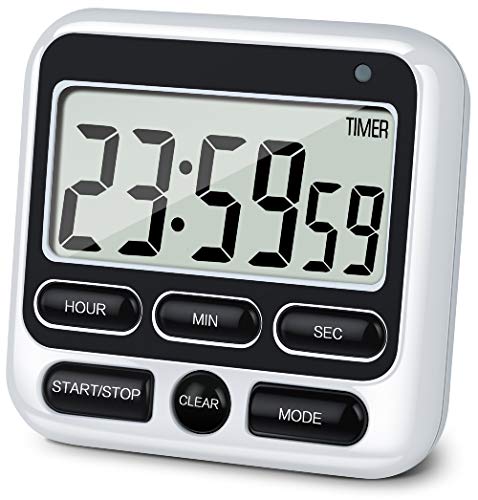
Color: Black Size: 3.15 x 3.15 x0.87 inch Dimensions: 3.15 x 0.87 x 3.15 inches Weight: 0.14 Pounds Product Group: Kitchen Binding: Kitchen
Shop Now








Write Your Review
No reviews yet. Be the first to share your experience!