

A stovetop kettle offers two temperatures: cold and boiling. That arrangement suits instant noodles and a mug of strong breakfast tea, and it quietly ruins almost everything else you might brew. Green tea poured at a full 100°C scalds its leaves and turns bitter within a minute of steeping, while pour-over coffee brewed straight off the boil extracts harsh and hollow. Temperature-controlled kettles exist to erase that gap — you pick a target anywhere from around 40°C to 100°C, and the machine puts the water there.
Marketing for these kettles dwells on presets and glowing displays. The real product sits underneath: a sensor, a control algorithm, and a heating element talking to each other several times a second. Follow that conversation and the spec sheet starts making sense — you can tell which numbers describe genuine capability and which are set dressing, and you can see why one model costs forty dollars and another costs a hundred fifty.
How a Temperature-Controlled Kettle Actually Works
Every electric kettle is a resistive coil sealed beneath a flat base plate. A plain kettle trips off mechanically: steam pushes up a tube to a bimetallic disc that snaps the circuit the instant the water boils. A temperature-controlled model swaps that tripwire for a probe — normally an NTC thermistor bonded into the base plate beside the element — whose electrical resistance shifts predictably with heat. A small control board translates resistance into a temperature reading, compares it against your setpoint, and decides second by second whether the element fires.
Where that probe sits matters more than any datasheet admits. Hot water convects upward, so during heating the coolest water in the jug rests against the floor — right where the sensor lives. The reading always lags the average, and manufacturers patch the gap in firmware with an offset that estimates what the whole volume is doing from what its floor reports. Fill below the minimum line and the estimate collapses: the probe now sits under a thin layer of water that races ahead of the model, and readings run hot. That printed minimum-fill warning is not legal boilerplate. It is the boundary of the kettle’s calibration.
Simple Cycling versus PID Control
Budget models steer the element the way a home thermostat steers a furnace: full power until the probe touches the setpoint, then nothing until the water drifts down a few degrees. Engineers call this bang-bang control, and physics sabotages it gently on every cycle. A 1,500-watt element carries a great deal of stored heat at cutoff, and that heat keeps soaking into the water after the switch opens. Aim a budget kettle at 80°C for green tea and it will commonly sail to 86 or 88°C, coast back down, fire again, and settle into a sawtooth that swings five degrees in either direction.
Costlier designs pulse the element instead of running it flat out. As the reading approaches the target, the controller shortens the power bursts — sustained output at 60°C, sputtering blips at 78°C — so the coil never banks enough heat to throw the water past the mark. The most refined versions run a full PID loop, weighing current error, accumulated error, and rate of change, and they hold within a degree or two indefinitely. Spec sheets seldom confess which scheme is inside, so read the accuracy claim as a confession: a promise of ±1°C implies real modulation, while vague wording attached to a kettle that visibly roils at low settings describes bang-bang hardware in a prettier case.
What the Glass Body Changes
Glass kettles use borosilicate, the laboratory formulation that survives direct flame without cracking. Its thermal expansion is roughly a third that of ordinary soda-lime glass, which is what lets a wall move from countertop-cool to near-boiling in about ninety seconds without shattering. Borosilicate also conducts heat poorly — around 1 watt per meter-kelvin against roughly 16 for stainless steel — so the wall drinks almost no energy from the water and returns none afterward. In control terms the glass body is a low-mass vessel: more of every watt reaches the water, warm-up edges slightly faster, and post-cutoff overshoot shrinks because no steel reservoir radiates heat back inward.
Transparency alters maintenance as much as physics. Hard water leaves calcium carbonate scale on every kettle interior above roughly 60°C, but only glass lets you watch the film form. That visibility carries weight, because scale is a ceramic insulator: a crust between water and thermistor slows the probe’s response, so the control board acts on increasingly stale information. A kettle that held 80°C honestly in March can run three or four degrees hot by summer if nobody descales. The glass turns that slow failure visible, and twenty minutes with a citric-acid solution restores both the clarity and the calibration.
Keep-Warm Plates and Hold Behavior
Holding water at temperature is cheap compared with reaching it. Parking a liter at 80°C demands something on the order of 50 to 100 watts; climbing there took fifteen hundred. Nearly every model therefore offers a keep-warm mode, and the implementations divide audibly. Basic designs re-fire the main element in short full-power bursts whenever the probe dips below setpoint, producing a click-and-surge rhythm you can hear from the next room. Finer designs trickle low-duty pulses and stay nearly silent. Rated hold times run from 30 minutes on entry-level units to 90 on better ones, and some add a reheat button that abandons your setpoint and drives the element to a full boil — handy when black tea follows a round of green.
What to Check Before Buying, According to the Engineering
Hold accuracy is the spec that separates real machines from dressed-up ones, so weigh it first: ±1 or ±2 degrees signals a modulating controller, while silence on the subject suggests simple cycling. Step size comes next. Panels on American models advance in 5°F increments on most units, which is tolerable for coffee but coarse for green tea, where the span between delicate and bitter covers barely ten degrees. One-degree steps give pour-over brewers the 93 to 96°C range and tea drinkers the 70 to 80°C green-tea band with genuine precision, and they matter most on the models that claim to serve both hobbies.
Match wattage to how you actually use the jug. Physics sets a floor: raising one liter from 20°C to 100°C requires about 335 kilojoules, so a 1,500-watt element needs at least four minutes and realistically closer to five once losses are counted, while 3,000-watt European models cut that to roughly two. Anyone brewing pour-over refills repeatedly and feels every one of those minutes. A parent preparing baby formula cares less about raw speed than about reliably reaching 70°C — the World Health Organization’s threshold for killing harmful bacteria in powdered formula — and then cooling fast to feeding temperature. Larger 1.7-liter jugs deserve 1,750 watts or more, or every refill becomes a wait.
The build details worth checking all trace back to the sensor story. A wide mouth means you can reach the base plate with a cloth once scale appears, protecting the probe you cannot see. A clearly marked minimum fill respects the calibration limit described earlier rather than treating it as a suggestion. Confirm that boil-dry protection exists — it is the same probe, watching for the temperature spike that means the water is gone — and favor a silicone lid seal if you object to plastic sitting over steam condensate. None of these features photograph well, and all of them decide how the kettle performs a year in.
Frequently Asked Questions
Does a glass kettle hold temperature as accurately as a stainless one?
At the moment water first reaches its setpoint, glass usually behaves a little better, because the wall stores almost no heat to dump into the water after cutoff. Stainless bodies preheat alongside the contents and typically add a degree or two of overshoot that glass avoids. Over a long keep-warm session the wall material stops mattering; hold accuracy comes from the control board pulsing the element, and a competent board will stay within ±2°C in either jug. Both materials share the same long-term enemy, limescale on the probe, and both lose calibration as it accumulates. Glass simply makes the problem visible weeks earlier, which in practice means glass owners descale on schedule and stainless owners forget.
Why does my kettle overshoot the temperature I selected?
The most common cause is bang-bang control: the element ran at full power right up to the cutoff point, and a 1,500-watt coil carries too much stored heat to stop instantly, so the water climbs past your target before drifting back down. Underfilling makes it worse, because a shallow layer of water heats faster than the firmware’s compensation expects. Scale on the sensor contributes too, since an insulated probe reacts late and invites the same overrun. Try filling to at least the minimum line and descaling thoroughly before assuming the unit is defective. If overshoot still exceeds three or four degrees on a fresh, full kettle, the model simply uses crude switching, and no setting change will correct it.
How often should I descale a glass temperature-control kettle?
Let the white film decide rather than the calendar. In hard-water regions the coating becomes noticeable within two to four weeks; in soft-water homes the same interval stretches to three months. Descale by filling halfway with a one-to-one mix of water and white vinegar, or a spoonful of citric acid dissolved in warm water, letting it sit for twenty minutes, then rinsing twice. The stakes run higher here than in a plain kettle, because the film insulates the thermistor and drags every reading out of calibration, so an unscaled temperature-control kettle gradually stops controlling temperature. Glass makes the judgment easy — if you can see the haze, your probe can feel it.

OVENTE
Loose-Leaf Tea and Pour-Over Coffee Brewing at Exact Temperatures: OVENTE KGD752S 1.8L Glass Electric Kettle with Infuser
This 1500W glass kettle boils 2 cups in about 3 minutes and holds seven preset temperatures from 100°F to 212°F, so green tea, oolong and pour-over coffee each get the water they actually need. Buy it if you brew loose-leaf tea or mix baby formula daily and want a removable infuser plus a 2-hour keep-warm instead of reboiling.
Pros and Cons
Pros
- Color-changing LED plus a digital readout shows the live water temperature from across the kitchen, so you know when to pour.
- 1.8L capacity fills several mugs or a French press in a single boil rather than back-to-back cycles.
- Auto shut-off and boil-dry protection cut power if the kettle runs empty, which matters on a busy counter.
- A removable filter in the spout keeps loose leaf and mineral flakes out of the cup.
Cons
- Glass walls show limescale and water spots quickly, so hard-water households will be descaling and wiping the exterior often.
- The base and cord footprint plus 1.8L height make it a tall unit that may not clear low upper cabinets.

OXO
Precision Temperature Control for Tea and Pour-Over Coffee: OXO Brew Adjustable Temperature Electric Kettle, 1.75L Glass
This 1.75L borosilicate glass kettle heats water anywhere from 104F to 212F and holds your chosen temperature for 30 minutes, so green tea never scalds and pour-over water stays in range through a full brew. Buy it if you make tea or manual coffee daily and want exact degrees instead of guesswork from a stovetop kettle.
Pros and Cons
Pros
- Exact degree selection beats preset-only kettles for anyone brewing multiple tea types.
- Cool-touch non-slip handle and slow-opening lid reduce steam burns and hot water splatter.
- Glass and stainless construction cleans easily and does not hold flavors between brews.
- 1.75L capacity fills a full teapot or several pour-over cups in one heating cycle.
Cons
- Glass exterior shows mineral scale and water spots quickly in hard-water areas, so it needs regular descaling to stay clear.
- Costs considerably more than a basic boil-only electric kettle, which is hard to justify if you only make black tea or instant coffee.

Hamilton Beach
Precision Tea and French Press Brewing at Home: Hamilton Beach 1.7 Liter Electric Glass Tea Kettle with 6 Temperature Presets
This 1500-watt cordless glass kettle boils 1.7 liters fast and holds water at one of six preset temperatures tuned for green, white, oolong, and black tea, French press coffee, and hot cocoa. Buy it if you brew loose-leaf tea or pour-over coffee and want the right water temperature without a separate thermometer.
Pros and Cons
Pros
- Six dedicated presets cover tea, French press coffee, and cocoa without a separate thermometer.
- Glass body lets you see water level and boil activity at a glance.
- Keep warm function makes it practical for refills during long work sessions or shared breakfasts.
- Boil-dry protection and auto shutoff add a safety margin for distracted mornings.
Cons
- Glass kettles show mineral scale and water spots more visibly than stainless steel, so hard-water households will descale and wipe it more often.
- The keep warm setting stops at 30 minutes, so it will not hold temperature through an all-day work session.

Hazel Quinn
Quiet 1.5L Glass Kettle with Precise Temperature Control: Hazel Quinn Glass & Stainless Steel Electric Kettle
This 1.5-liter borosilicate glass kettle boils at 1000 watts while running near 40 dB, with ±1°C temperature settings from 95°F to 194°F and a 24-hour keep-warm function. Buy it if you brew green tea, pour-over coffee, or mix baby formula and need exact water temperatures without plastic touching the water.
Pros and Cons
Pros
- STRIX base adds automatic shut-off, lift-off protection, and boil-dry protection for unattended heating.
- LED touch display shows temperature and keep-warm status clearly, including in a dark kitchen at night.
- Glass body lets you see water level and clarity, making descaling schedules easy to judge.
- Stainless steel spout and lid avoid the plastic taste common in cheaper glass kettles.
Cons
- At 1000 watts, it heats more slowly than 1500-watt kettles, so a full 1.5-liter boil takes noticeably longer.
- Temperature control tops out at 194°F, so reaching a rolling boil requires the standard boil setting rather than a custom high-temp preset.
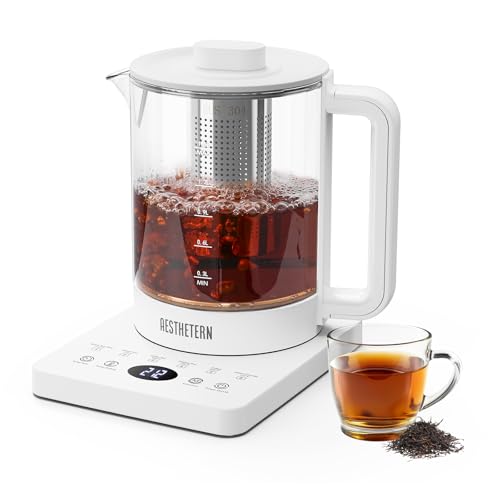
Aesthetern
Precision Tea Brewing at Home: Aesthetern 1.5L Glass Electric Kettle with Infuser, Temperature Control and 24H Keep Warm
This 1.5L borosilicate glass kettle heats water anywhere from 104°F to 212°F with six presets and ±1°F fine-tuning, so green tea never gets scorched and pour-over coffee hits the right window. Buy it if you brew multiple tea types or mix baby formula and want held-temperature water on demand rather than reboiling all day.
Pros and Cons
Pros
- ±1°F adjustment across the full 104°F to 212°F range covers delicate greens through rolling boil.
- Auto shut-off, boil-dry protection, and an anti-scald lid cover the main kettle safety risks.
- Glass body shows water level and infusion color at a glance during brewing.
- 1.5L capacity fills a teapot and a couple of mugs in one heat cycle.
Cons
- Glass exteriors show mineral scale and water spots quickly, so hard-water households will descale and wipe it often.
- Running keep warm for a full 24 hours draws power continuously and concentrates minerals in the leftover water.
OVENTE Loose-Leaf Tea and Pour-Over Coffee Brewing at Exact Temperatures: OVENTE KGD752S 1.8L Glass Electric Kettle with Infuser
OVENTE
Loose-Leaf Tea and Pour-Over Coffee Brewing at Exact Temperatures: OVENTE KGD752S 1.8L Glass Electric Kettle with Infuser
This 1500W glass kettle boils 2 cups in about 3 minutes and holds seven preset temperatures from 100°F to 212°F, so green tea, oolong and pour-over coffee each get the water they actually need. Buy it if you brew loose-leaf tea or mix baby formula daily and want a removable infuser plus a 2-hour keep-warm instead of reboiling.
$40.12 at AmazonEditors' Favorite
Color: Brushed Silver Size: 1.9 Quarts Dimensions: 8.5 x 5.9 x 8.9 inches Weight: 2.8 pounds Product Group: Kitchen Binding: Kitchen
Shop NowOXO Precision Temperature Control for Tea and Pour-Over Coffee: OXO Brew Adjustable Temperature Electric Kettle, 1.75L Glass
OXO
Precision Temperature Control for Tea and Pour-Over Coffee: OXO Brew Adjustable Temperature Electric Kettle, 1.75L Glass
This 1.75L borosilicate glass kettle heats water anywhere from 104F to 212F and holds your chosen temperature for 30 minutes, so green tea never scalds and pour-over water stays in range through a full brew. Buy it if you make tea or manual coffee daily and want exact degrees instead of guesswork from a stovetop kettle.
$112.52 at AmazonGreat Value
Color: Clear Size: 1.8 Quarts Dimensions: 8 x 8 x 12.5 inches Weight: 4 Pounds Product Group: Kitchen Binding: Kitchen
Shop NowHamilton Beach Precision Tea and French Press Brewing at Home: Hamilton Beach 1.7 Liter Electric Glass Tea Kettle with 6 Temperature Presets
Hamilton Beach
Precision Tea and French Press Brewing at Home: Hamilton Beach 1.7 Liter Electric Glass Tea Kettle with 6 Temperature Presets
This 1500-watt cordless glass kettle boils 1.7 liters fast and holds water at one of six preset temperatures tuned for green, white, oolong, and black tea, French press coffee, and hot cocoa. Buy it if you brew loose-leaf tea or pour-over coffee and want the right water temperature without a separate thermometer.
$65.95 at AmazonColor: Variable Temp, Clear Glass Size: 1.7 Liter Dimensions: 9.96 x 10.87 x 7.28 inches Weight: 3.17024732756 pounds Product Group: Kitchen Binding: Kitchen
Shop NowHazel Quinn Quiet 1.5L Glass Kettle with Precise Temperature Control: Hazel Quinn Glass & Stainless Steel Electric Kettle
Hazel Quinn
Quiet 1.5L Glass Kettle with Precise Temperature Control: Hazel Quinn Glass & Stainless Steel Electric Kettle
This 1.5-liter borosilicate glass kettle boils at 1000 watts while running near 40 dB, with ±1°C temperature settings from 95°F to 194°F and a 24-hour keep-warm function. Buy it if you brew green tea, pour-over coffee, or mix baby formula and need exact water temperatures without plastic touching the water.
$53.99 at AmazonColor: Black and silver Size: 1.6 Quarts Dimensions: 7.48 x 6.54 x 11.02 inches Weight: 2.42 pounds Product Group: Kitchen
Shop NowAesthetern Precision Tea Brewing at Home: Aesthetern 1.5L Glass Electric Kettle with Infuser, Temperature Control and 24H Keep Warm
Aesthetern
Precision Tea Brewing at Home: Aesthetern 1.5L Glass Electric Kettle with Infuser, Temperature Control and 24H Keep Warm
This 1.5L borosilicate glass kettle heats water anywhere from 104°F to 212°F with six presets and ±1°F fine-tuning, so green tea never gets scorched and pour-over coffee hits the right window. Buy it if you brew multiple tea types or mix baby formula and want held-temperature water on demand rather than reboiling all day.
$49.39 at AmazonColor: White Size: 1.6 Quarts Dimensions: 8.23 x 6.42 x 11.02 inches Product Group: Kitchen
Shop Now


Write Your Review
No reviews yet. Be the first to share your experience!