

It is 8:40 on a Saturday morning, the batter has been resting in the fridge overnight, and three kids are already at the counter arguing over who gets the first blueberry pancake. You ladle batter into your usual 10-inch frying pan, watch it spread into a lopsided oval, and begin the slow rotation: one pancake cooking while the last one sits under foil going soft, and the one before that already claimed by a toddler.
Twenty minutes in, the flaw in the setup is obvious. Every pancake browns in a ring that matches the gas burner beneath the pan — dark edges, pale middle — and the assembly line produces exactly one pancake every three minutes, which nobody at the table considers acceptable. This is the problem a proper pancake griddle pan was designed to solve, and choosing the right one depends less on brands than on where and how you cook: a family kitchen, a crepe habit, a campsite, or a glass induction hob each pulls the design in a different direction.
What a Griddle Does That a Frying Pan Can’t
A griddle trades depth for width. Instead of sloped walls and a curved floor, you get a flat slab — usually 2 to 5 millimeters thick — with sides low enough to slide a spatula under a pancake from any angle. That geometry puts the entire surface directly over the heat instead of concentrating it in the center, and it lets four or five pancakes cook at once rather than one lonely disc.
The catch is that a griddle is only as even as the burner underneath it. A flimsy pan stretched across a gas ring bakes a hot circle into its own middle while the outer third lags behind, which is why thickness and material matter more here than they ever did with your saucepans. Mass is what smooths the flame out: a heavy plate absorbs the burner’s hot spot and spreads it sideways, and it keeps the temperature from crashing every time a ladle of cold batter hits the metal.
Family Breakfasts: Cast Iron and the Long Preheat
For households that cook pancakes for a crowd most weekends, cast iron is still difficult to beat. A 16-to-20-inch cast iron griddle runs about 4 to 5 millimeters thick, weighs five to eight pounds, and works like a heat bank: give it eight to ten minutes over medium-low to reach roughly 375°F, and it will hold that temperature even when four ladles of cold batter land in a row. Its seasoned surface — layer upon layer of polymerized oil — releases pancakes cleanly and improves every month you keep using it.
The tradeoffs deserve honesty. Cast iron heats slowly and unevenly at first, so skipping the preheat guarantees pale centers; it takes two hands to wash; and a long pan fed by a single small burner will run cooler at the far end unless you rotate the pancakes or park the handle-side over a second burner. Big gas ranges shrug this off. Narrow stoves do not, so measure your grate spacing before ordering anything wider than 14 inches.
Crepes and Thin Batters: Carbon Steel or Nonstick Aluminum
Crepe makers need nearly opposite qualities. A crepe pours thin and finishes in ninety seconds, so the cooking surface must react within moments when you adjust the flame and stay glass-smooth so the batter sweeps to the edges without snagging. Carbon steel fits this brief well: at 2 to 3 millimeters thick it answers a knob turn almost immediately, it seasons much like cast iron, and dedicated crepe pans ship as shallow 9.5-to-11-inch discs sized for the wooden rake that spreads batter before it sets.
If seasoning sounds like homework, nonstick aluminum is the honest alternative. An aluminum plate 4 to 6 millimeters thick heats quickly and distributes warmth evenly, wipes clean with a sponge, and forgives beginners — a torn crepe peels away rather than welding itself to the metal. What you surrender is lifespan. Coatings fade within a few years under metal utensils and repeated high heat, so most nonstick griddles want medium heat at most and a silicone spatula alongside.
Campfire Cooking: Reversible Plates and Coal Management
Over a fire, the priorities shift again. A campsite griddle must survive direct flame, ignore wind, and cope with a heat source that has never held a steady temperature in its life. Thick cast iron wins for the same reasons it wins at home, with durability added: a reversible cast iron plate can sit straight on a grill grate or nestle into coals, offering a flat face for pancakes and eggs plus a ribbed face for bacon, with no coating to burn off and nothing to ruin.
Handles matter more outdoors than most people expect. Removable or folding handles let the plate sink deep into the coals, while a fixed grip wrapped in plastic or silicone suffers the moment a flame licks over the rim. Because fire heat arrives in unpredictable patches, the usual advice runs in reverse out there: rather than chasing hot spots with a spatula, slide the whole griddle off the fiercest coals when the center races ahead, then return the edges to live flame when they stall.
Induction and Glass-Top Stoves: Flatness Is Not Optional
Induction rewrites the rules. The hob does not radiate heat at all; it magnetizes the base of the pan so the pan generates its own heat, which means a pancake griddle pan for induction needs a ferromagnetic bottom sitting flush against the glass. All carbon steel qualifies and so does most cast iron. The hazard is scratching — bare iron dragged across ceramic glass leaves marks — so lift the pan instead of sliding it, and run a finger along the machined underside before buying to confirm it is smooth.
Zone size creates the second constraint. An induction coil is typically 6 to 8 inches across, and any griddle wider than that grows a dead band where the field fades and the batter refuses to brown. Manufacturers answer this with bridged zones — two coils driven together under one long plate — while smaller kitchens simply rotate pancakes between the lively center and the sleepy ends. Weight is the final concern on glass: an eight-pound iron slab slid daily wears the surface down, and a 3-millimeter carbon steel griddle delivers most of the performance at half the load.
Pancake Griddle Pan Questions, Answered
What size pancake griddle pan should I buy?
Match the pan to the burner, not the appetite. A griddle more than about three inches wider than its heating element wastes part of itself, because that outer band never reaches cooking temperature; over a standard 7-inch household burner, a 10-to-12-inch plate is the realistic ceiling, and bigger models only justify themselves on ranges with paired burners. Round shapes also suit round burners better than rectangles, which tend to overhang front and back. Storage deserves a thought, since a 20-inch double-burner slab wants a cupboard shelf to itself. Still, if you regularly feed more than four people, stepping up from 12 to 16 inches roughly doubles throughput and trims twenty minutes off the whole breakfast.
Do I really need to season a griddle?
Only if it is bare cast iron or carbon steel; nonstick models and most factory-pre-seasoned pans skip the ritual. Seasoning is nothing mystical: you wipe the metal with a thin film of neutral oil and hold it past its smoke point until the oil polymerizes into a hard, dark glaze that blocks rust and releases food. In practice, most of the work is maintenance — cook with a little fat, clean gently, and buff in a half-teaspoon of oil while the pan is still warm. Neglect it and the surface repays you with rust freckles and batter welded to the iron within weeks. Tend it casually and the pan simply gets better every month you own it.
Can I use a griddle on any type of stove?
Almost, with two checks. Gas burners and exposed electric coils accept nearly everything, including rectangular plates that straddle two burners. Smooth glass-ceramic tops tolerate griddles but punish dragging, and their weight limits rule out the heaviest double-burner irons. Induction insists on a magnetic base, which excludes aluminum and copper unless the maker has bonded a steel plate into the bottom. When in doubt, press a refrigerator magnet against the underside; if it grips firmly, the pan will couple with the coil and cook.
Back in that Saturday kitchen, the fix is unglamorous: one wide, heavy surface, given ten unhurried minutes to warm, turns a stressful relay into a single calm batch. Pick the material that matches your stove and your patience — iron for the long haul, steel for speed, nonstick for ease — and the last pancake reaches the table as warm as the first.

Blue Diamond
Square Griddle Pan for Spacious Stovetop Cooking, Blue Diamond 11-Inch Diamond Infused Ceramic Nonstick
This 11-inch square griddle pan provides a spacious cooking surface with diamond-infused ceramic nonstick designed for longer-lasting, easier cooking. It suits cooks who need one versatile pan for stovetop meals, oven finishing, and broiling, provided they do not use induction.
Pros and Cons
Pros
- PFAS-, PFOA-, lead-, and cadmium-free construction supports toxin-free cooking.
- The pan works on all stovetops except induction and is also oven and broiler safe up to 600°F.
- The diamond-infused ceramic nonstick surface is designed to be five times harder and ten times longer lasting than traditional coatings.
- The dishwasher-safe design reduces cleanup effort.
Cons
- It is not compatible with induction stovetops.
- The provided product data does not specify the pan's weight.

HUPECHAM
4-Cup Egg Pan for Faster Breakfasts: HUPECHAM Nonstick Granite Skillet
The HUPECHAM 4-cup egg pan cooks four eggs or other foods at once, with an extended base for faster, more even heating. It suits households with different breakfast preferences who want simultaneous cooking in a PFOS- and PFOA-free nonstick pan.
Pros and Cons
Pros
- The four-cup layout helps prepare multiple breakfast portions or ingredients at the same time.
- The extended base is designed to improve heating speed and uniformity.
- The granite coating is PFOS- and PFOA-free.
- Die-cast construction and a 5mm coating support durability.
Cons
- The listing does not specify dishwasher, oven, or utensil compatibility, so buyers should confirm care requirements.
- The divided four-cup layout may be less suitable for cooking large single items than a standard skillet.

GoodCook
Breakfast Griddle Pan for Eggs, Bacon and Hash Browns: GoodCook Everyday 11-Inch Ceramic Nonstick
The GoodCook Everyday 11-inch griddle provides a broad flat surface for eggs, bacon and hash browns, with ceramic nonstick coating for easy food release and cleanup. It suits cooks who want a non-toxic, even-heating stovetop pan for gas or electric cooking and do not need induction compatibility.
Pros and Cons
Pros
- The spacious 11-inch cooking area handles common breakfast foods on one flat surface.
- Ceramic nonstick coating supports easy release and cleanup.
- Aluminum construction is designed for even heating.
- The stay-cool handle improves handling during stovetop use.
Cons
- It is not compatible with induction stovetops.
- The product data does not specify the pan's weight.
Blue Diamond Square Griddle Pan for Spacious Stovetop Cooking, Blue Diamond 11-Inch Diamond Infused Ceramic Nonstick
Blue Diamond
Square Griddle Pan for Spacious Stovetop Cooking, Blue Diamond 11-Inch Diamond Infused Ceramic Nonstick
This 11-inch square griddle pan provides a spacious cooking surface with diamond-infused ceramic nonstick designed for longer-lasting, easier cooking. It suits cooks who need one versatile pan for stovetop meals, oven finishing, and broiling, provided they do not use induction.
$34.94 at AmazonEditors' Favorite
Color: Blue Size: 11" Griddle Pan Dimensions: 3.23 x 11.34 x 19.13 Inches Weight: 2.16 pounds Product Group: Kitchen Binding: Kitchen
Shop NowHUPECHAM 4-Cup Egg Pan for Faster Breakfasts: HUPECHAM Nonstick Granite Skillet
HUPECHAM
4-Cup Egg Pan for Faster Breakfasts: HUPECHAM Nonstick Granite Skillet
The HUPECHAM 4-cup egg pan cooks four eggs or other foods at once, with an extended base for faster, more even heating. It suits households with different breakfast preferences who want simultaneous cooking in a PFOS- and PFOA-free nonstick pan.
$13.96 at AmazonGreat Value
Color: Black Size: M Dimensions: 7.2 x 7.5 x 1 Inches Weight: 1 Pounds Product Group: Kitchen Binding: Kitchen
Shop NowFarberware Cookstart Aluminum DiamondMax Nonstick Square Griddle Pan, 11-Inch, Silver

Farberware
Cookstart Aluminum DiamondMax Nonstick Square Griddle Pan, 11-Inch, Silver
$21.99 at AmazonColor: Silver Size: 11 Inch Dimensions: 10.75 x 18.74 x 4.02 inches Weight: 1.46 pounds Product Group: Kitchen Binding: Kitchen
Shop NowGoodCook Breakfast Griddle Pan for Eggs, Bacon and Hash Browns: GoodCook Everyday 11-Inch Ceramic Nonstick
GoodCook
Breakfast Griddle Pan for Eggs, Bacon and Hash Browns: GoodCook Everyday 11-Inch Ceramic Nonstick
The GoodCook Everyday 11-inch griddle provides a broad flat surface for eggs, bacon and hash browns, with ceramic nonstick coating for easy food release and cleanup. It suits cooks who want a non-toxic, even-heating stovetop pan for gas or electric cooking and do not need induction compatibility.
$23.99 at AmazonColor: Black Size: Black Dimensions: 18.55 x 11.05 x 2.5 inches Product Group: Kitchen Binding: Kitchen
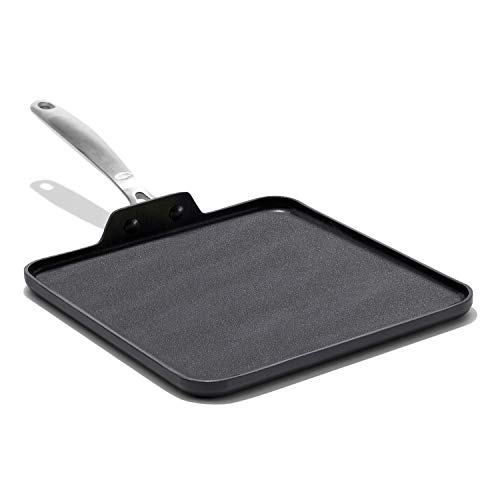
Shop NowOXO Enhanced 11" Griddle Pan, PFAS-Free Ceramic Nonstick, Durable Hard Anodized Cookware, Scratch Resistant, Stainless Steel Handle, Good Grips, Dishwasher Safe, Oven safe, Black
OXO
Enhanced 11" Griddle Pan, PFAS-Free Ceramic Nonstick, Durable Hard Anodized Cookware, Scratch Resistant, Stainless Steel Handle, Good Grips, Dishwasher Safe, Oven safe, Black
$65.04 at AmazonColor: Black Size: 11" Griddle Pan Dimensions: 19.29 x 11.33 x 3.14 inches Weight: 2.62 Pounds Product Group: Kitchen Binding: Kitchen
Shop Now




Write Your Review
No reviews yet. Be the first to share your experience!