

Cast iron pie plates sell for anywhere between fifteen dollars and well over a hundred, and very little of that spread shows up in the finished crust the way product listings imply. Iron holds and releases heat according to its mass, not its price tag, so a twenty-dollar pan and an eighty-dollar pan sitting side by side at 425°F behave far more alike than their marketing suggests. What money actually buys falls into three tiers: budget castings around fifteen to twenty-five dollars that demand seasoning patience, mid-range plates from thirty to fifty that trade machined smoothness for convenience, and premium territory above sixty where vintage polish, enameled coatings, and collector rarity enter the picture. Each band below covers exactly what you get, what tends to fail, and who should reach for it, because separating physical differences from cosmetic ones is the entire exercise before you spend a dime.
Budget New Cast Iron Pie Pans: $15 to $25
Lodge dominates this tier, and its nine-inch pie pan lists for roughly twenty dollars. The casting carries the sandy, pebbled texture typical of modern foundry work; drag a fingertip across the interior and you feel every grain. Factory seasoning arrives thin, so the first two or three pies tend to stick, especially juicy peach or cherry fillings whose bubbling sugar welds itself to an immature surface. Serious cooks run three or four extra rounds of oven seasoning before the inaugural bake, which costs nothing but an hour apiece and transforms how the plate behaves. Once cured, the pan works with real authority: dark iron drinks in radiant heat, and bottom crusts brown noticeably faster than the same dough in clear glass. The honest drawbacks are heft and friction. Walls run thick, the loop handle offers a nervous grip on a scorching plate, and the rough interior slows the growth of a slick patina, which complicates sliding a fragile savory galette off intact. An apple pie with a lattice top rides along happily once the seasoning settles. For someone who bakes a couple of fruit pies a year, none of that outweighs a twenty-dollar entry fee.
Mid-Range Plates: $30 to $50
Spend forty dollars or so and the character of the metal changes under your palm. Several smaller makers machine their cooking surfaces flat, milling away the sand grain and leaving a finish closer to a decades-old skillet than a fresh casting. That single change ripples outward. Filling releases cleanly early in the pan’s life, seasoning builds to a glossy black in weeks rather than months, and cleanup stops requiring strategy. Many machined plates pour thinner walls too, shaving most of a pound off the weight you lift in and out of a hot oven, a difference your wrists register by the fourth pie of a holiday marathon. Rims come ground true, handles arrive shaped for an actual hand, and blind-baked shells for cream pies pop out without torn edges. What stays stubbornly identical is the physics: a machined plate browns a crust at essentially the same rate as a rough one of equal mass. You are buying finish, balance, and reduced fuss, and for a monthly baker who wrestles butter-rich pastry, that purchase earns itself back quickly.
Premium and Vintage Territory: $60 and Up
Past sixty dollars, two unrelated animals share a shelf. The first is vintage bare iron: Griswold and Wagner plates poured in the early twentieth century, polished glassy-smooth and cast so thin that a century-old piece often weighs less than a modern budget pan. That low mass paired with the polished floor produces some of the cleanest releases in all of bakeware. Common sizes trade between fifty and ninety dollars while rare markings climb into the hundreds, and condition decides everything, because hidden pitting or a warped base wrecks both value and baking. The second animal is enameled cast iron in the French-cookware mold, where a porcelain glaze deletes seasoning chores entirely and shrugs off the acids that strip bare iron’s cure. Enamel carries its own compromises: it chips if knocked, it never develops the near-nonstick patina of maintained bare iron, and a healthy share of the price funds colorways and branding rather than metallurgy. Collectors should chase the vintage route with eyes open; bakers who run rhubarb, lemon curd, or tomato-based savory fillings through cast iron regularly are enamel’s natural audience.
Where Extra Money Changes the Bake, and Where It Doesn’t
Reduce the tiers to measurable outcomes and three things genuinely improve with price: surface smoothness, which accelerates both release and seasoning; total weight, which determines whether moving a loaded plate is a one-handed act or a two-towel ordeal; and fit and finish, from level rims to handles that fit gloved hands. Heat retention is absent from that list. A two-pound budget plate and a pound-and-a-half machined one hold temperature within a rounding error of each other, and both leave clear glass behind on bottom browning, because dark metal soaks up the oven’s radiant energy directly while Pyrex waits on slower conductive transfer.
Sizing deserves as much scrutiny as price. Most published recipes assume a nine-inch plate, yet many cast iron versions stretch to ten inches, adding roughly a quarter more volume, shallowing the fill, and extending the bake by five to ten minutes; that extra room and wall height is precisely why deep-dish recipes translate so happily to iron at any tier. Whichever band you pick, slide the empty plate into the oven for the last ten minutes of preheat. Every cast iron pie plate rewards a hot start with a crisper bottom, and every one punishes the bare forearm of a baker who forgets the handle has been sitting at 425 degrees.
Matching the Tier to the Baker
Buy by frequency and by filling, not by aspiration. A baker who unrolls dough twice a year for Thanksgiving apple and one summer berry pie gets indistinguishable results from a twenty-dollar Lodge given a weekend of seasoning prep, and the thirty dollars saved buys excellent fruit. Monthly bakers working laminated galette dough, free-form tarts, or anything that must leave the plate in one piece should step up to a machined surface, where the smooth finish repays its premium within a season. Rhubarb devotees and lemon-pie loyalists belong in enameled territory, since repeated acid exposure keeps scrubbing bare seasoning back to zero. Anyone drawn to vintage should buy in person, or from sellers who photograph the interior honestly, checking for hairline cracks near the rim and a base that rests flat on the counter. One caveat cuts across every tier: a cheap glass plate in weekly rotation outbakes an intimidating heirloom on a shelf, so purchase the least expensive option you will genuinely maintain.
Cast Iron Pie Plate Questions, Answered
Do I really need to season a pre-seasoned cast iron pie plate?
Yes, though the bar sits lower than with a raw pan. Factory seasoning is typically a single thin coat, enough to prevent rust in shipping but rarely enough to survive a syrupy fruit filling. Before the first pie, wipe the plate with a paper-thin film of neutral oil, bake it upside down at 450°F for an hour, and let it cool inside the oven; repeat that cycle two or three times. The extra afternoon of work closes most of the practical gap between budget and mid-range plates, which is why frugal bakers treat it as mandatory rather than optional.
Is a cast iron pie plate better than glass or ceramic for crust?
Better depends on the outcome you want. Cast iron delivers the darkest, crispest bottom crust because its dark surface soaks up radiant oven heat and drives it straight into the dough, which rescues soggy-prone fillings like deep-dish apple or wet-bottomed peach. Glass heats more gently, costs a fraction as much, and lets you watch the underside brown through the base, while ceramic browns evenly and looks handsome going to the table but lags both materials in speed. If shatteringly crisp pastry is the goal, iron takes it; if gentle, forgiving baking matters more, glass remains the smarter tool.
Can I bake an acidic pie, like rhubarb or lemon, in bare cast iron?
Occasionally, yes, but understand the cost. Acid attacks the polymerized oil layer that forms your seasoning, so a rhubarb or citrus filling can leave dull patches and pull faint metallic flavors into a pale sauce during long bakes. A plate with a year of established patina shrugs off one such pie far better than a freshly seasoned one. Wash promptly afterwards, dry thoroughly, and rub on fresh oil, expecting to touch up the finish where the filling sat. If rhubarb, lemon, or tomato-heavy savory pies are regular features in your kitchen, an enameled plate or plain glass spares you the endless reseasoning cycle.

Winco
9-Inch Aluminum Pie Plate for Everyday Baking: Winco Commercial Foodservice Pie Pan
This Winco aluminum pie plate bakes standard 9-inch pies, quiches, and tarts with the fast, even heat conduction aluminum is known for, producing browned bottom crusts instead of soggy ones. It suits home bakers and small kitchens that want commercial foodservice durability at a low cost per pan and plan to bake often enough to justify buying more than one.
Pros and Cons
Pros
- Made to commercial kitchen standards used across the foodservice and hospitality industry.
- Aluminum heats fast and evenly for reliable crust browning.
- Standard 9-inch medium size fits common recipes and pie carriers.
- Simple one-piece design with no coatings or seams to fail over time.
Cons
- Bare aluminum is not nonstick, so crusts need greasing or a parchment liner to release cleanly.
- Aluminum reacts with acidic fillings like lemon or cherry if left sitting in the pan, and it is not dishwasher safe without risk of discoloration.

STAUB
9-Inch Ceramic Pie Dish for Flaky Crusts and Oven-to-Table Serving: STAUB White Stoneware Baker
This 9-inch STAUB stoneware pie dish diffuses heat gently and retains it exceptionally well, so crusts brown evenly instead of scorching at the rim. Buy it if you bake pies and quiches regularly and want a dish that goes straight from oven to dinner table without a transfer.
Pros and Cons
Pros
- Exceptional heat retention keeps pies and quiches warm well past serving time.
- White enamel finish looks presentable enough to set directly on the table.
- Handles the full range from freezer to broiler, covering nearly every baking workflow.
- Scratch-resistant surface holds up to metal servers better than plain glazed ceramic.
Cons
- Designed in France but manufactured in China, which may disappoint buyers expecting French production at this tier.
- Ceramic is heavier and more breakable than metal or glass pie plates, so it needs careful handling when full and hot.
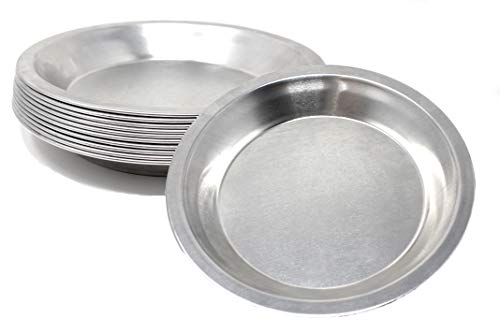
Chicago Metallic
8-Inch Aluminum Pie Pans for Everyday Baking: Chicago Metallic 10-Pack with Slanted Crust Edges
This 10-pack of 8-inch aluminum pie pans bakes fruit, cream, and savory pies with slanted raised edges that keep crimped crust edges from slumping during the bake. Buyers who bake in volume for holidays, bake sales, or gifting will get the most from a set this size, since finished pies can go out the door in the pan.
Pros and Cons
Pros
- Aluminum conducts heat fast, which helps set bottom crusts on juicy fruit pies.
- The 1 5/32-inch depth suits standard single-crust and double-crust recipes without overflow.
- Set of ten covers batch baking and gifting without buying pans one at a time.
- At 7 15/16 inches across the top, it matches most 8-inch pie recipes and store-bought crusts.
Cons
- Hand-wash only, so these cannot go in the dishwasher after a heavy baking session.
- Bare aluminum reacts with very acidic fillings like lemon or key lime if pies sit in the pan for days.
Winco 9-Inch Aluminum Pie Plate for Everyday Baking: Winco Commercial Foodservice Pie Pan
Winco
9-Inch Aluminum Pie Plate for Everyday Baking: Winco Commercial Foodservice Pie Pan
This Winco aluminum pie plate bakes standard 9-inch pies, quiches, and tarts with the fast, even heat conduction aluminum is known for, producing browned bottom crusts instead of soggy ones. It suits home bakers and small kitchens that want commercial foodservice durability at a low cost per pan and plan to bake often enough to justify buying more than one.
$12.58 at AmazonEditors' Favorite
Color: Aluminum Size: 9" Dimensions: 9.94 x 9.94 x 1.38 inches Weight: 0.1 Pounds Product Group: Kitchen Binding: Kitchen
Shop NowSTAUB 9-Inch Ceramic Pie Dish for Flaky Crusts and Oven-to-Table Serving: STAUB White Stoneware Baker
STAUB
9-Inch Ceramic Pie Dish for Flaky Crusts and Oven-to-Table Serving: STAUB White Stoneware Baker
This 9-inch STAUB stoneware pie dish diffuses heat gently and retains it exceptionally well, so crusts brown evenly instead of scorching at the rim. Buy it if you bake pies and quiches regularly and want a dish that goes straight from oven to dinner table without a transfer.
$49.95 at AmazonGreat Value
Color: White Size: 9-inch Dimensions: 12 x 9.3 x 1.9 inches Weight: 2 Pounds Product Group: Kitchen Binding: Kitchen
Shop NowChicago Metallic 8-Inch Aluminum Pie Pans for Everyday Baking: Chicago Metallic 10-Pack with Slanted Crust Edges
Chicago Metallic
8-Inch Aluminum Pie Pans for Everyday Baking: Chicago Metallic 10-Pack with Slanted Crust Edges
This 10-pack of 8-inch aluminum pie pans bakes fruit, cream, and savory pies with slanted raised edges that keep crimped crust edges from slumping during the bake. Buyers who bake in volume for holidays, bake sales, or gifting will get the most from a set this size, since finished pies can go out the door in the pan.
$25.28 at AmazonColor: Lime Size: 8 inches Dimensions: 1.4960629906 x 7.0078740086 x 1.4960629906 Inches Weight: 0.83996121822 Pounds Product Group: Kitchen Binding: Kitchen
Shop Now



Write Your Review
No reviews yet. Be the first to share your experience!