

Dip a ladle into a pot of hot chicken broth and watch the stream as you lift. From a good kitchen ladle it holds together all the way to the bowl. From a cheap one, golden liquid threads out sideways through a hairline gap where the bowl meets the handle, and by the time you reach the table you have decorated the stovetop with droplets. That seam is not damage. It is how inexpensive kitchen ladles are built: a disc of metal stamped and rolled, then crimped shut around a handle wire, leaving a channel that thin liquid finds every single time.
The other failures are just as predictable. Seven quarts of chili bend a flimsy stamped shaft until the bowl twists off-axis mid-lift and a third of the scoop slides back into the pot. A nylon-handled ladle left leaning against a 450-degree Dutch oven rim comes back permanently bent and faintly scorched. An eight-ounce bowl meant for punch drowns ravioli under half a cup of sauce when you wanted two tidy ounces. And nearly everyone has poured soup down their own wrist thanks to a bowl whose edge merely rolls inward, splitting the stream, because the spout lip was an afterthought.
None of this makes ladles complicated. It means a handful of design decisions decide everything in specific situations, and the right choice depends on what you actually cook. Someone who simmers soup twice a week, someone putting up forty jars of tomatoes each August, a pan-sauce perfectionist, and a host who owns a proper punch bowl need genuinely different tools. Here is how the details map onto those jobs.
The Design Details That Decide Everything
Bowl capacity is the first fork in the road. Two ounces is a tasting and plating size, what restaurants reach for when dressing salads or drizzling with intent. Four ounces, about half a cup, is the all-purpose middle: soup servings, stew, pancake batter, gravy. Six to eight ounces belongs to moving volume, filling quart jars and punch bowls fast, and it is hopeless wherever restraint matters. Handle length tracks the pot rather than personal taste. Ten to eleven inches suits saucepans, twelve to thirteen clears the rim of a six-quart stockpot comfortably, and fifteen and up exists for canners and deep stockpots where boiling water sits an inch below the brim.
Material grade matters more in this drawer than anywhere else. Eighteen-eight stainless, sold as grade 304, shrugs off acidic tomato braises and years of dishwasher cycles without pitting. Cheaper eighteen-zero steel skips the nickel, costs a couple of dollars less, and repays you with rust freckles and water spots. Nylon heads soften near 400 degrees, which sounds generous until one leans against a screaming-hot Dutch oven; silicone-edged versions buy another hundred degrees of margin and treat nonstick gently. Construction is the quiet divider. A ladle deep-drawn or forged from a single piece has no interior crevice for broth to wick into, no weld to snap in the dishwasher, and no seam to weep. The best examples add a notched pour lip pressed into the rim, plus either a hooked handle that hangs on the pot edge or a punched hole for the utensil rack.
If You Simmer Soup Every Week
Daily soup cooking is a rhythm, and the ladle lives inside it: Sunday’s pot becomes Monday’s lunch, Tuesday’s dinner, Wednesday’s stored quarts. That tool goes in and out of the same stockpot dozens of times a week, which puts comfort and cleanliness ahead of everything else. A four-to-six-ounce one-piece 18/8 bowl on a twelve-or-thirteen-inch handle is the shape of the answer. The hook deserves particular attention. Hung on the rim between stirs, the business end stays over the pot instead of pooling soup onto the burner, and nobody has to hunt for a spoon rest.
Storage is where the pour lip pays rent. Decanting into a wide-mouth container takes no skill; guiding broth into a narrow-neck thermos exposes any undefined rim immediately, sending the stream wandering down the outside. A notched lip gathers the flow into a ribbon you can stop cleanly mid-pour. Because these nights end in the dishwasher, refuse jointed construction at any price. Crimped collars trap starch and fat in the seam, and the smell introduces itself about two weeks in.
Canning Rewrites the Rules
Water-bath canning drops the whole tool into boiling water, figuratively and often literally. The ladle works beside a canner holding 212-degree liquid for an hour or more, dips repeatedly into syrup, pickle brine, or salsa, and hovers over open jars where a drip on the threads can interfere with a seal. Plastic and coated handles are disqualified; this is all-metal work. Take fifteen inches or more so your knuckles ride well clear of the steam, and choose a deep eight-ounce bowl when the day’s metric is speed, because forty pints of pickles go far faster when every transfer carries a full cup.
Precision returns at headspace. Once jars sit mostly full, the job shifts from hauling volume to nudging levels, and a slow tilt off the notched lip beats dump-and-rescoop every time. Pair the big ladle with a jar funnel during the fast phase, then finish by eye. The extra length reaches the bottom of the canner as well, so the last two cups of pickling liquid come up instead of sitting stranded.
Small Bowls Run the Sauce Station
Pan sauces, hollandaise, custard, and gravy punish oversized tools. A two-ounce ladle adds stock a spoonful at a time while you chase a consistency, lifts browned butter cleanly off the surface, or fills a ramekin without overshooting. The handle changes character as well: straighter and slimmer than a stockpot model, balanced nearer the bowl, because you are working a foot above a pan rather than reaching into one. Portion discipline lives here too. Ravioli wants roughly two ounces of marinara per plate, and an eight-ounce bowl manages that only by accident, discovered midway through the fourth drowned serving.
Baking borrows the same small ladle more often than cooks admit, and it portions cupcakes, pancakes, crepes, and pudding molds more accurately than any measuring cup that must be poured and leveled. Hang it on the rail by the stove instead of burying it in a drawer. Its entire value is being grabbable one-handed while the other hand keeps whisking.
Behind the Punch Bowl
Beverage service flips the brief once more: move volume elegantly from a vessel wider and deeper than any pot, often mid-conversation. A six-to-eight-ounce polished stainless or silver-tone bowl on a thirteen-to-fourteen-inch handle spans a full punch bowl without dragging a cuff along the rim, and the hook parks it safely between rounds. Pitchers and mulled-cider pots on a sideboard take a compact ten-inch bar ladle instead. Outdoors, polished acrylic earns its place by looking like glass, weighing almost nothing, and surviving a fall onto decking that would finish a ceramic one, though it must stay well away from stovetop heat.
Plate the Way a Line Cook Plates
Restaurant kitchens standardize portions with ladles, and the trick transfers home for free. When the same two-ounce ladle fills every bowl, every plate arrives looking deliberate: identical sauce pools, identical widths, identical visual weight. Keep one small ladle dedicated to plating, living in a crock by the stove rather than in drawer rotation. A crisp spout turns the same tool into a drawing instrument; tilted slowly from a few inches up, it lays a curved ribbon of dressing around a stack of slices instead of dropping a blob in the middle.
Handle style resolves itself once the split is seen plainly. Hooks belong on pot tools, the four-ounce-and-up ladles that live with stockpots and rest on rims. Straight handles belong in the hand, on the little sauce and plating models where you steer angle and height directly. Buying one of each instead of hunting for a single compromise costs about twenty dollars and quietly ends the daily friction of a tool fighting its own assignment.
Kitchen Ladle Questions, Answered
What size kitchen ladle should I buy first?
Start with a four-ounce one-piece stainless ladle on a thirteen-inch hooked handle; it covers more home cooking than any other single size. Four ounces is about half a cup, ample for a hearty soup serving in a dip and a half yet still manageable for gravy and batter. After a month of real use, whatever your kitchen lacks announces itself. Canners then add an eight-ounce long-shaft model, sauce specialists a two-ounce straight-handled one, and frequent hosts a punch-scale bowl.
Are one-piece kitchen ladles worth the higher price?
Over even a couple of years, yes. A seamed or welded ladle costs six to nine dollars and typically reveals its limits within a season of dishwashing: thin broth leaking from the collar, a sour smell trapped in the crease, or a cracked weld where handle meets bowl. A one-piece 18/8 stainless version runs twelve to twenty dollars, offers no crevice for food to foul, stands up to acidic tomatoes without pitting, and will probably outlive the kitchen. Amortized across five years of weekly use, the upgrade works out to pennies a month. In exchange you stop dealing with the leaks, the odor, and the yearly replacements.
How long should a ladle handle be?
Match it to the deepest pot you regularly use. Ten to eleven inches suits saucepans and small two-to-three-quart pots worked at close range. Twelve to thirteen inches is the stockpot standard, clearing a six-to-eight-quart rim while your knuckles stay above the steam. Fifteen inches or more belongs to canners, lobster pots, and brewing kettles, where the liquid rides near the brim and every splash carries real heat. A hooked handle forgives a slightly short shaft, since the ladle can rest on the rim instead of being held aloft, but no hook protects fingers from a tool that simply does not reach.
The Best Deals This Week*
-
Zulay Kitchen Premium Soup Ladle
$9.99
($12.99)Save $3.00 -
KitchenAid KE006OHOBA Classic Nylon Ladle
$7.59
($8.99)Save $1.40 -
Newness Soup Ladle, [Rustproof, Heat Resistance
$16.14
($16.99)Save $0.85
*Deals are selected by our commerce team
Zulay Kitchen Premium Soup Ladle - 12" Stainless Steel with Non-Slip Silicone Handle

Zulay Kitchen
Premium Soup Ladle - 12" Stainless Steel with Non-Slip Silicone Handle
$9.99 at AmazonEditors' Favorite
Color: Silver Size: Stainless Steel Dimensions: 12.2 x 3.34 x 0.01 inches Weight: 0.42108292042 pounds Product Group: Kitchen Binding: Kitchen
Shop NowOXO Good Grips Stainless Steel Soup Ladle with Pour Spout

Great Value
Color: Stainless Steel Size: One size Dimensions: 1.2598425184 x 1.4173228332 x 4.6850393653 inches Weight: 0.09700339528 pounds Product Group: Kitchen Binding: Kitchen
Shop NowKitchenAid KE006OHOBA Classic Nylon Ladle
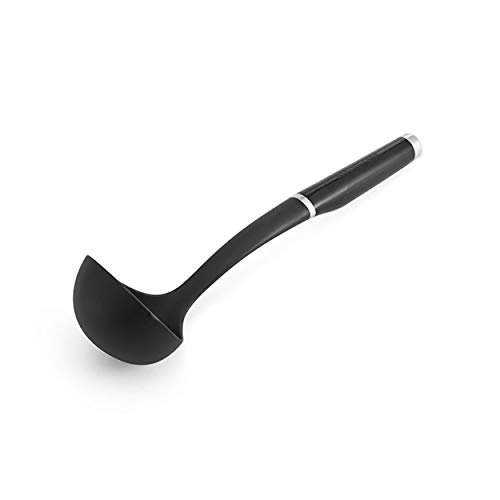
Color: Black 2 Size: One Size Dimensions: 3.54 x 2.95 x 12.2 inches Weight: 0.3 Pounds Product Group: Kitchen Binding: Kitchen
Shop NowZulay Kitchen Stainless Steel Soup Ladle - 13” Large Ladle for Soups, Stews & Sauces - Durable, Heat-Resistant, Rust-Proof & Dishwasher Safe Kitchen Utensil with Ergonomic Handle

Zulay Kitchen
Stainless Steel Soup Ladle - 13” Large Ladle for Soups, Stews & Sauces - Durable, Heat-Resistant, Rust-Proof & Dishwasher Safe Kitchen Utensil with Ergonomic Handle
$12.99 at AmazonColor: Silver Size: Steel Ladle Dimensions: 13 x 3.25 x 0.1 inches Weight: 0.5732 Pounds Product Group: Kitchen Binding: Kitchen
Shop NowNewness Focus on Stainless Steel Newness Soup Ladle, [Rustproof, Heat Resistance, Integral Forming] Resilient 304 Stainless Steel Soup Spoon with Vacuum Ergonomic Round Handle, Cooking Spoon for Kitchen, 13.7 Inches

Newness Focus on Stainless Steel
Newness Soup Ladle, [Rustproof, Heat Resistance, Integral Forming] Resilient 304 Stainless Steel Soup Spoon with Vacuum Ergonomic Round Handle, Cooking Spoon for Kitchen, 13.7 Inches
$16.14 at AmazonColor: Sliver Size: 13.7 Inch Dimensions: 13.7 x 3.66 x 0.1 inches Weight: 0.440924524 Pounds Product Group: Kitchen Binding: Kitchen
Shop Now
Write Your Review
No reviews yet. Be the first to share your experience!