

What a Kitchen Torch Costs, and Where Williams Sonoma Sits
Search results for a Williams Sonoma kitchen torch cluster into a narrow band, roughly thirty to fifty dollars, with the shelves skipping both the twelve-dollar lighter aisle and the two-hundred-dollar restaurant rigs. That band occupies the middle of a market with three distinct floors. At the bottom sit budget butane torches selling for fifteen to twenty-five dollars. The middle belongs to professional-style torches running thirty to fifty. Above sixty dollars begins restaurant-grade territory. Those gaps trace to real mechanical differences — flame stability when the nozzle tilts, how many fills the safety lock survives, the quality of the refill valve, how much usable work each tank of butane delivers — rather than to packaging.
Separating engineering from branding changes what you should buy. All of these torches push butane combustion past 2,500 degrees Fahrenheit at the tip, so the cheapest option appears equivalent on paper. Sugar cares only about steady application, and steadiness is where money buys performance. The walkthrough below uses the Williams Sonoma assortment as a reference point for the middle tier, explains where extra dollars change outcomes and where they buy only a name, and finishes with how to match spending to frequency of use.
Budget Torches at $15–$25: What the Discount Costs You
Inconsistent flame defines the budget tier. Most sub-$25 torches use a bare jet without an anti-flare head, so the flame gutters or extinguishes once the nozzle tips past a modest angle. Sweeping sideways across a horizontal crème brûlée surface works well enough because the torch stays upright. Browning the underside of meringue peaks, or searing a sous-vide ribeye where the head must point up along curved meat, demands a flame that survives awkward positions — and the cheap jet stutters exactly there. The outcome is patchy color: amber streaks beside untouched white, gray bands where fat never rendered.
Safety hardware tells the same story. Thin stamped tabs and soft plastic sliders serve as locks on this tier, and they loosen after a few dozen fills; some stop engaging altogether, leaving a trigger that can fire inside a drawer or a canvas tote. Refill behavior follows suit. Plastic-seated valves often refuse butane unless aligned precisely with the canister nozzle, and a marginal seal lets fuel bleed away overnight. Most budget models ship with a single, barely adjustable setting as well — one aggressive jet sized for sugar, too harsh for anything delicate.
None of this makes the category useless. A twenty-dollar torch that caramelizes custards twice a year does its job, given patience and clean fuel. Fuel choice matters more here than at any other price point. Unrefined butane carries impurities that accumulate in the jet; after four or five fills of cheap gas, a budget torch begins sputtering yellow and eventually refuses to light. Buy triple-refined butane alongside the torch and half the complaints about this tier disappear.
The $30–$50 Middle Tier, Where Williams Sonoma Shops
This is the band Williams Sonoma curates toward, and the reasoning shows in the feature lists. Professional-style torches between thirty and fifty dollars add the pieces that separate dependable tools from frustrating ones: a flame dial that drops output low enough to toast meringue without liquefying it, an anti-flare head whose internal mixing tube keeps the jet burning at any angle including fully inverted, a sight window showing remaining fuel, and metal safety locks built to survive years of drawer duty. Refill quality jumps too. A brass valve accepts butane in a steady three-to-five-second hiss, then rests a minute before ignition while the fresh fuel settles.
Burn duration improves in ways volume cooks notice. A mid-tier tank carries roughly twenty to twenty-five minutes of continuous flame, and caramelizing a batch of six ramekins consumes about eight of them, so one fill spans several dessert nights. The anti-flare head proves its worth outside pastry as well. Under a broiler, poblanos take twenty minutes and fill the kitchen with smoke; a torch pointed straight down chars the skin in ninety seconds. Building a crust on a water-bath short rib works the same way — the flame stays lit while you roll the head along rounded surfaces, rendering fat in a sixty-second pass instead of a five-minute struggle.
Retailer judgment forms part of the value at this price. Williams Sonoma stocks a handful of torch models rather than a hundred, and its buyers have filtered out the leaky-valve and dead-trigger units that crowd marketplace listings. The return policy backs that curation: a torch that sputters in its second month goes back for a refund instead of becoming a lesson. Marketplace sellers charging identical prices rarely extend comparable protection, which quietly raises their real cost relative to the sticker.
Above $60: Precision Hardware, Diminishing Returns
Restaurant-grade torches bring all-metal construction, larger reservoirs, and controls calibrated finely enough for finishing work — melting a dusting of sugar over a tart without coloring it, warming the glaze on a baked Alaska without collapsing the ice cream underneath. Interchangeable heads switch between wide fans and pinpoint jets. Tanks of forty milliliters or more sustain past forty minutes of continuous burn, which matters when two hundred canapés await finishing before service. Brass fittings throughout survive hundreds of refill cycles without stripping or leaking.
For a home kitchen, though, the premium tier mostly answers a question nobody asked. Past fifty dollars you pay partly for capability and largely for the name engraved on the barrel. Nobody tasting the crème brûlée can distinguish a 2,500-degree flame from a 2,600-degree one. Unless you cook professionally, style food for cameras, or host large groups weekly, the middle tier already executes every technique described here.
Matching the Price to Your Kitchen
Begin with honest frequency. Dessert twice a year justifies the twenty-dollar torch, a can of triple-refined butane, and storage with an empty tank; expect replacement in five years and you still come out ahead. Sous-vide on a weekly schedule flips the math. Post-bath proteins require angled, controllable heat to build a crust in about sixty seconds without pushing the interior past medium, which turns the anti-flare head and flame dial from luxuries into equipment. Weekly users also live with refill logistics, and a larger tank that runs twenty-plus minutes beats interrupting dinner to top off a thimble-sized reservoir.
Most cooks land between those poles, and for them the Williams Sonoma position works as a sensible default. Forty dollars spent on a curated, returnable, adjustable torch approaches the lifetime cost of the budget route once you account for the dead-lock unit retired to a drawer after one season. The premium shelf stays a specialist purchase. Choose by how the flame will actually be used rather than by how the box photographs, and whichever tier wins, refined fuel and a functioning child-safety lock stored away from small hands outrank any feature on the list.
Kitchen Torch Questions
How hot does a Williams Sonoma kitchen torch get?
Culinary butane torches, including the models Williams Sonoma sells, reach roughly 2,500 degrees Fahrenheit at the flame tip, which is why they caramelize sugar in seconds where a broiler takes minutes. Raw temperature matters less than command of it. An adjustment dial widens the flame for fast charring across a tray of peppers and narrows it for detail along the edges of a meringue. Distance handles the rest — working four to six inches from the surface browns gradually, while closing in concentrates the heat on stubborn spots like the shoulders of a roasted pepper.
Why does my kitchen torch sputter or refuse to stay lit?
Fuel quality causes nine of every ten cases. Cheap, unrefined butane carries impurities that deposit inside the narrow jet, choking flow until the flame flickers, burns yellow, or quits under pressure. Moving to butane refined at least three times usually ends the trouble with new fills, though a badly clogged jet may need cleaning before it behaves again. Timing contributes as well: fresh butane needs about a minute to settle after a refill, and firing early yields a weak, stuttering start. On older budget torches, a worn seal in the refill valve announces itself as a tank that bleeds empty inside the drawer.
Is a pricier kitchen torch actually safer?
Yes, though not because the flame itself differs — every culinary torch burns the same hazardous jet of ignited butane. The safety margin lives in surrounding hardware. Mid-tier and premium models carry metal locks that keep triggers immobile through years of handling, stable bases that resist tipping while hot, and regulated valves that meter fuel evenly instead of surging. A five-dollar torch whose worn plastic lock lets the trigger fire inside a tote bag poses more danger than any premium model. Whichever tier you buy, make the lock check routine: engage it, squeeze the trigger, and confirm it holds before the torch goes near food or a pocket.
The Best Deals This Week*
-
Sondiko Butane Torch, Refillable Soldering Torch
$18.99
($19.99)Save $1.00 -
TBTEEK Butane Torch Lighter with Fuel Gauge
$13.99
($14.99)Save $1.00
*Deals are selected by our commerce team
Iwatani PRO2 Culinary Professional Kitchen Butane Torch | Adjustable Flame Shape Strength 2700 F | Sous Vide Crème Brulee Pastries | Anti-flare | Incl. Stabilizing Stand | Butane Fuel Not Included
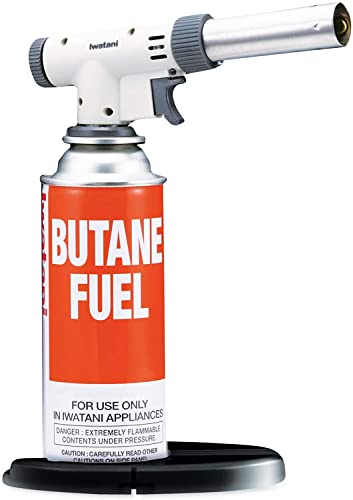
Iwatani
PRO2 Culinary Professional Kitchen Butane Torch | Adjustable Flame Shape Strength 2700 F | Sous Vide Crème Brulee Pastries | Anti-flare | Incl. Stabilizing Stand | Butane Fuel Not Included
$39.99 at AmazonEditors' Favorite
Color: Pro2 Size: 1 Pack Dimensions: 17.78 x 7.62 x 3.81 inches Weight: 0.18 pounds Product Group: Kitchen Binding: Kitchen
Shop NowSondiko Butane Torch, Refillable Soldering Torch with Visible Fuel Window

Great Value
Color: Black Size: 1-Pack Dimensions: 6.1023621985 x 4.5275590505 x 2.3228346433 inches Weight: 0.44202683531 pounds Product Group: Home Binding: Home
Shop NowTBTeek Butane Torch Lighter with Fuel Gauge for Brulee Creme, Soldering | 2500°F Adjustable Continuous Flame Mode,Safety Stopper,One-hand Operation, Easy to Light, Extended Nozzle(Butane Not Included)

TBTeek
Butane Torch Lighter with Fuel Gauge for Brulee Creme, Soldering | 2500°F Adjustable Continuous Flame Mode,Safety Stopper,One-hand Operation, Easy to Light, Extended Nozzle(Butane Not Included)
$13.99 at AmazonColor: Yellow-black Dimensions: 4.72 x 2.63 x 6.3 inches Weight: 0.4960400895 Pounds Product Group: Kitchen
Shop NowJo Chef Kitchen Torch, Refillable Butane Torch for Creme Brulee, Cooking

Color: Silver/Black + 2 Butanes Size: Torch with 3.38 fl oz Butane Dimensions: 1.8 x 5.3 x 7.4 inches Product Group: Kitchen
Shop NowMessermeister Cheflamme Culinary Torch - Up to 2,000 Degrees Fahrenheit & 200 Minute Burn Time - Self-igniting Piezo Ignition - Child-Proof Safety Lock - Fuel Sold Separately

Messermeister
Cheflamme Culinary Torch - Up to 2,000 Degrees Fahrenheit & 200 Minute Burn Time - Self-igniting Piezo Ignition - Child-Proof Safety Lock - Fuel Sold Separately
$89.95 at AmazonColor: Silver Size: 6.5-in. Dimensions: 3 x 6.75 x 10.5 inches Weight: 0.29982867632 pounds Product Group: Kitchen Binding: Kitchen
Shop Now







Write Your Review
No reviews yet. Be the first to share your experience!