

Most cooks learn the limits of a combined roasting-and-grilling setup the same way: a 14-pound turkey goes onto the grate with high hopes and comes off with rubbery, half-detached skin, a breast that never took color, and drippings welded to the metal below. Or the electric roaster hums along all afternoon and produces poultry with the complexion of a boiled dinner. Neither result is bad luck; both trace back to specific gaps between what these appliances do well and what a roast actually demands.
The failures repeat because the physics repeats. Once you see why skin refuses to crisp over guessed-at indirect heat, why rendered fat finds open flame, and why a correctly pulled bird still turns out dry, the fixes stop looking like folklore and start looking like engineering: diagnose each failure first, then build the setup the diagnosis points to.
How Roast-on-the-Grill Attempts Fall Apart
The classic mistake begins with coal geometry. Bank coals to one side of a kettle, park the bird on the other, and you have an indirect zone on paper. Radiant energy from a full chimney of lit coals throws several inches farther than most estimates assume, though. A turkey set too close to that boundary gets hammered from one direction: the fire-side skin renders and darkens quickly while the far side sits in cooler, lazier airflow. By the time you rotate to compensate, the damage exists — skin loosens wherever fat rendered unevenly, and no amount of finishing time reattaches it.
Drip management is the second failure point, and it forgives even less. A roasting bird sheds fat continuously once the skin passes 150°F, and on a gas grill those drips fall straight toward the burner tubes. Vaporized fat ignites somewhere north of 500°F; a single drop hitting a ceramic briquette or burner housing flashes into a tongue of flame that licks exactly the surfaces you wanted gentle. One flare-up scorches the underside. Three flare-ups and the skin structure collapses entirely, sliding off in sheets when the bird moves.
The third failure hides in the lid. Every time a cook lifts it to baste, hot air escapes and cold air replaces it — a drop of 25 to 40°F in seconds on a kettle, followed by ten to fifteen minutes of burner time spent recovering. Baste spray lands cool on the skin and sets the surface back further, so a bird scheduled for two and a half hours that gets checked six times drifts forty minutes behind and sometimes stalls short of a safe temperature right as guests sit down.
Why Electric Roaster Ovens Refuse to Brown
Lift the lid off a roaster oven mid-cook and the explanation appears as fog. These appliances seal tightly, and everything the meat releases — surface moisture, steam from broth in the insert — condenses on the lid and rains back down. Browning reactions need a dry surface held above roughly 300°F; a steamed surface pins at 212°F regardless of what the dial claims. Layer on the fact that most countertop units cycle a modest heating element against a heavy steel insert with serious thermal mass, and the surrounding air rarely climbs far enough past the setpoint to drive color.
That ceiling defines the appliance rather than disqualifying it. A roaster is a moisture-preserving chamber with steady, precise heat: excellent for braising a pork shoulder, warming a spiral ham, or holding a finished bird without drying it. Expecting a crust from one is like expecting a steamer to sear, so split the job instead — sear the meat hard in a skillet or over blazing coals, then let the roaster carry it gently to temperature.
Carryover Heat Is What Dries Out Grill Chicken
Plenty of grill-roasted chickens are cooked correctly and ruined afterward. A bird leaving a 350°F grill stores tremendous heat in its outer layers, and the interior keeps climbing 5 to 10°F through the first ten minutes of rest — sometimes more on a thick-breasted turkey fresh off a hot kettle. Cook to 165°F in the breast on the grate and the resting bird sails to 175°F, wringing out moisture the entire way. Dark meat tells the opposite story: thighs and drumsticks eat best at 175 to 185°F, where collagen has melted, so chasing perfect leg meat with a single pull temperature guarantees a parched breast.
A probe thermometer settles the conflict for about twenty dollars. Reading the thickest part of the breast lets you pull the bird at 157 to 160°F, confident that carryover closes the gap to a safe 165°F during rest. Tent loosely with foil, wait ten to fifteen minutes, carve. Skip the rest and the juices that should have redistributed run straight onto the cutting board.
Building a Setup That Holds 325°F Without Drama
Every dependable roaster grill arrangement rests on four pieces: a true two-zone layout, a drip pan beneath the bird, a water pan near the fire, and a probe you trust instead of testing with lid lifts. On a gas grill, light the outer burners and leave the center off, holding the chamber at 325 to 350°F. On a charcoal kettle, pile coals against one wall — roughly two-thirds of a chimney for a 325°F start — and give the empty zone six inches of clearance from the coals to the bird’s edge. Pellet grills simplify the whole problem by holding any setpoint within about ten degrees on their own, though constant fan-driven airflow dries exposed skin faster than a closed kettle. Gas buys stability with no smoke character; charcoal buys the deepest flavor and demands the most attention.
Treat the drip pan as equipment rather than an afterthought and it earns double duty. An aluminum pan set on the deflector bars directly below the bird intercepts every gram of rendered fat before it reaches flame, and what it collects — skimmed, then deglazed with stock — becomes your gravy base. Pour in a quarter inch of water or broth so early drips do not scorch onto the foil. A separate water pan placed over or beside the heat source steadies the curve further: water absorbs and releases heat slowly, capping the ambient swing whenever the lid opens and adding humidity that slows surface drying on long cooks.
A rotisserie kit attacks the asymmetric-heat problem mechanically. Constant rotation averages out every hot spot in the box, and the self-basting motion — fat migrating over the surface turn after turn — delivers the most even render available. Balance the bird on the spit with its counterweight attached, and a four-pound chicken roasts in about an hour at 350°F with uniformly crackled skin and no mid-cook rotation required from you.
Matching the Machine to the Meal
Owning both appliances pays off twice a year at minimum. On Thanksgiving the kitchen oven fills with dressing, gratins, and pie while the turkey waits for rack space; moving the bird outdoors frees the oven completely and contributes smoke character the indoor version cannot match. A 14-pound turkey at 325°F indirect needs about 12 to 13 minutes per pound unstuffed — call it three hours — with the drip pan assembling pan gravy out where there is room to work. Summer holidays reverse the logic: nobody wants a 350°F oven heating the house in July, so the outdoor rig takes the bird and the kitchen stays livable.
Smaller jobs divide the labor differently. Beer-can chicken stands a bird upright over an open can, halving its footprint on a small grate and letting hot air circulate the whole surface, including the underside that usually stays pale — though the beer itself adds little beyond steam. Pork shoulder belongs to the roaster oven: eight to ten hours at 225 to 250°F overnight, no propane to watch, no coals to replenish, and a sealed chamber that keeps the meat shreddable. Want smoke? Run the shoulder on the grill for the first three hours, then transfer it to the roaster to finish. Each machine handles what it handles well, and neither has to fake the rest.
Frequently Asked Questions
Can you roast a turkey on a gas grill?
Yes, provided the zone is built properly before the bird ever lands. Configure the burners for indirect heat — outer burners on medium-low, center off on a three-burner model — preheat to 325°F, and verify with a grate-level thermometer, since hood gauges read the airspace above the grates and run misleadingly high. Set the turkey over the unlit area with a drip pan underneath and figure roughly 12 to 13 minutes per pound unstuffed. Probe the innermost thigh and the center of the breast; pull at 158 to 160°F in the breast so carryover finishes the job safely.
How do you get crispy skin from an electric roaster oven?
You cannot get it from the roaster alone, because the sealed chamber traps steam against the surface and holds skin below the temperature where browning starts. Work around the physics in either order. Sear the bird over hot coals or in a 450°F oven for fifteen minutes before transferring it to the roaster set at 325°F, or cook it fully in the roaster and finish under a broiler or over glowing coals for the last five to eight minutes. Whichever route you take, patting the skin dry beforehand matters more than most recipes admit.
How long does it take to grill-roast a whole chicken?
Plan on 14 to 16 minutes per pound at an indirect 350°F, which puts a typical four-pound bird just under an hour. Treat time as a guide rather than a promise, because wind, ambient temperature, and every lid lift bend the schedule. A probe in the thickest part of the breast is the trustworthy reference: pull the chicken at 157 to 160°F, rest it ten minutes, and carryover brings it to a safe finished temperature while the juices settle. As confirmation, the leg should twist loosely at the joint, a sign the dark meat has cooked through.
The Best Deals This Week*
-
VEVOR Rotisserie Grill, 52" Electric Rotisserie
$569.90
($609.90)Save $40.00 -
VEVOR Rotisserie Grill, N52" Electric Rotisserie
$95.99
($135.99)Save $40.00
*Deals are selected by our commerce team
VEVOR Rotisserie Grill, 52" Electric Rotisserie Grill Kit

Editors' Favorite
Color: Silver Size: 52" Dimensions: 62.2 x 21.65 x 40.94 Inches Weight: 125.22 pounds Product Group: Lawn & Patio Binding: Lawn & Patio
Shop NowVEVOR Rotisserie Grill, Hood52" Electric Rotisserie Grill Kit
Great Value
Color: Silver Size: 52" Dimensions: 62.2 x 21.65 x 40.94 inches Weight: 125.22 Pounds Product Group: Lawn & Patio Binding: Tools & Home Improvement
Shop NowTITAN GREAT OUTDOORS Ash & Ember 25 Watt Stainless Steel BBQ Rotisserie Grill, Rated 125 LB for Medium Game, Hood with Viewing Window, Portable Electric Outdoor Roaster with Dual Prongs, Single Leg Bracket, and Spine Fork

TITAN GREAT OUTDOORS
Ash & Ember 25 Watt Stainless Steel BBQ Rotisserie Grill, Rated 125 LB for Medium Game, Hood with Viewing Window, Portable Electric Outdoor Roaster with Dual Prongs, Single Leg Bracket, and Spine Fork
$1,174.99 at AmazonColor: With Hood Size: 25W - Holds 125 lb Dimensions: 22.5 x 64 x 44 inches Weight: 130 pounds Product Group: Lawn & Patio Binding: Tools & Home Improvement
Shop NowVEVOR Rotisserie Grill, N52" Electric Rotisserie Grill Kit
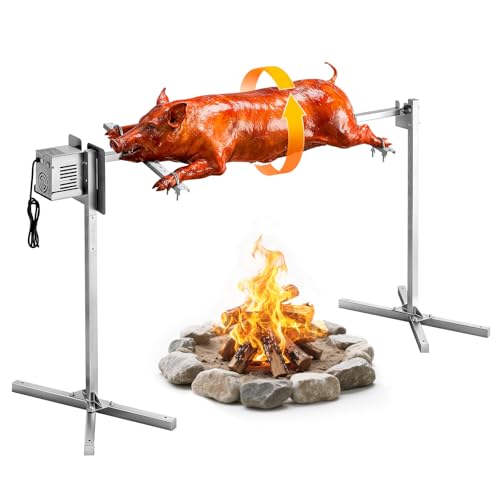
Color: Silver Size: 51.5" Dimensions: 68.503937 x 21.062992 x 33.858268 inches Product Group: Lawn & Patio Binding: Lawn & Patio
Shop NowVEVOR Rotisserie Grill, 46" Electric Rotisserie Grill Kit

Color: Silver Size: 46" Dimensions: 50.79 x 18.9 x 15.35 inches Weight: 97 Pounds Product Group: Lawn & Patio Binding: Tools & Home Improvement
Shop Now






Write Your Review
No reviews yet. Be the first to share your experience!