

A Pyrex lasagna pan hides its engineering behind an ordinary face. To most cooks it is simply the clear 9-by-13-inch dish, roughly three quarts, that has held Sunday lasagnas since the middle of the last century. Almost nobody asks why the material behaves the way it does, right up until the day one shatters.
Knowing the physics changes how you treat the pan. The glass itself comes in two different chemistries depending on where your dish was made, the tempering process that toughens it also stores a hidden liability, and the way the material absorbs heat explains both the gloriously crisp corner pieces and the online horror stories. None of it is complicated, and every piece maps to a kitchen habit worth keeping or dropping.
Two Chemistries Share One Famous Name
Corning introduced Pyrex in 1915 as borosilicate glass, a formulation laced with boron trioxide that barely expands as it warms. What most American shoppers bring home today is a different animal. Over the twentieth century Corning moved its US consumer bakeware to tempered soda-lime glass — the cheaper blend of sand, soda ash, and lime used for windows and jars — while licensees making Pyrex in Europe stayed with true borosilicate. That split survives now: a dish purchased in France and one purchased in Ohio can wear the same red logo and differ fundamentally in chemistry.
The number that matters is the rate of thermal expansion. Soda-lime grows roughly nine micrometers per meter for every degree Celsius, close to three times the 3.3 that borosilicate manages. Expansion rate decides how much internal stress piles up whenever one region of the pan runs hot while another stays cool, which is precisely the situation inside an oven holding a dense four-pound slab of lasagna. Borosilicate absorbs swings that would push soda-lime toward its limits, so the two namesakes behave differently in the same recipe, whatever the shared branding implies.
Tempering Makes It Strong — and Stores the Danger
American Pyrex earns its toughness through tempering. The finished dish is reheated until it nearly slumps, then jets of cold air blast both faces at once. The surfaces chill and lock solid within seconds while the interior is still hot, and as that interior eventually cools and shrinks, it drags the rigid outer skin into permanent compression, leaving the core stretched in tension. A compressed surface resists cracks dramatically better than untreated glass, which is why a tempered dish shakes off impacts that would fell an ordinary pane.
The bargain has a catch: stored energy. The compressed skin is thin, and any chip, deep scratch, or rim nick that punches through it reaches the tension zone below. Once a crack arrives there, the whole pane lets go in milliseconds, breaking into small pebble-like chunks rather than long shards. Failure can also wait. A dish knocked against the faucet on Friday can sail through Saturday’s bake, sit quietly in the cupboard, and burst apart Tuesday afternoon with nobody in the kitchen — the injury happened days earlier, and the release needed only a trigger as gentle as vibration or a shift in room temperature.
Thermal Shock Through the Lens of a Cold Lasagna
Glass moves heat sluggishly compared with any metal — stainless steel conducts it roughly fifteen times faster — so warmth arriving at the outside of a pan takes its time working inward. Everything in the pan also expands as it warms, and soda-lime expands generously. Combine the two facts and you have thermal shock: the outer wall of a refrigerator-cold dish meets 425°F oven air almost instantly and tries to grow, while the center still reads 40°F and refuses to budge. Where the stretching and stationary zones meet, stress spikes, and if a microscopic flaw happens to sit in that band, a crack starts running.
This is why the famous shattering stories all share a plot. A three-quart lasagna assembled the night before and carried straight from fridge to hot oven is the textbook case. A broiler element pours concentrated radiation onto one narrow surface; a stovetop burner heats a ring at the base while everything above stays cold; cold sauce poured into a scorching dish makes one patch contract within seconds; a hot pan set on a wet counter or bare granite surrenders heat unevenly wherever moisture touches. Each scenario abuses the same weakness from a different angle, which is why the standing advice is to park a hot dish on a dry towel or wooden board and nothing else.
Why the Bottom Corners Brown First
An oven cooks with moving hot air and with infrared radiation beamed from the walls and elements. Metal reflects most of that radiation, but dark-tinted glass drinks it in, so a Pyrex base collects radiant heat on top of whatever the circulating air delivers. You see the effect at the bottom corners, where radiant and conducted warmth overlap: mozzarella crisps there sooner, sauce thickens faster, and the corner squares develop the crackly caramelized edge that half the dinner table fights over.
Glass also warms slowly and then clings to its heat long after leaving the oven, so a lasagna keeps bubbling through the rest period while those corners continue darkening. Bakers who know the material compensate by dropping the oven temperature about 25°F, checking ten minutes early, or laying foil across the corners if they color ahead of the center. None of this disqualifies the pan for lasagna — for people who prize browned edges it is a selling point — but it demands slightly more attention than an aluminum pan ever would.
Turning the Physics into Habits
Every failure mode above points to a specific practice. Give a chilled lasagna thirty to forty-five minutes on the counter while the oven preheats, which closes most of the temperature gap before the dish sees any heat; a genuinely frozen assembly belongs in the refrigerator overnight first, and preferably in a disposable foil pan rather than glass. Let the oven finish preheating before anything goes in, and treat the broiler, stovetop burners, and cramped toaster ovens as permanently off limits for this material.
The aftermath matters as much as the entrance. Move a hot dish onto a dry towel, a wooden board, or a room-temperature trivet — never a damp counter, never a sink of cold water, however tempting it feels to soak off baked-on cheese immediately. Keep metal knives and forks out of the dish, because scoring portions by sawing through the crust can gouge deep enough to breach the tempered skin; transfer slices to a cutting board or use wood and silicone tools instead. Respect the rating printed for your line, which lands somewhere between 425°F and 450°F depending on the product family, and remember the plastic lid obeys a much lower ceiling entirely.
Travel raises its own questions. A hot three-quart dish bound for a potluck should ride in a towel-lined carrier, and on arrival it belongs on a trivet rather than the host’s stone countertop or a wet picnic table. Freezer-to-oven shortcuts deserve special suspicion, since a rock-hard glass dish meeting a fully preheated 425°F oven stacks maximum temperature difference on maximum stored stress — the exact recipe every preceding paragraph warns against.
Frequently Asked Questions
Can a Pyrex lasagna pan handle a 425 degree oven?
For most current lines, yes, with conditions attached. Product literature generally rates the glass bakeware for conventional oven use up to about 425°F to 450°F, varying by product family, so it pays to confirm the figure printed for your specific dish. The oven should be fully preheated before the dish enters, the broiler stays out of play, and anything fresh from the refrigerator gets a short rest on the counter while the oven climbs to temperature. Inside those boundaries, a three-quart 9-by-13 dish turns out a standard lasagna reliably.
Why did my Pyrex dish shatter without warning?
Almost always because a chain started long before the collapse. Tempered soda-lime holds mechanical stress beneath its thin compressed skin, and a chip or deep scratch that pierced that skin leaves a loaded crack waiting for release. The final trigger may be obvious — a splash of cold water, a jolt against the sink — or as faint as ordinary household vibration, and the dramatic burst is simply the glass returning energy it banked earlier. Inspect the surviving pieces for a small impact mark near the origin point, because that tiny scar is usually where the story began. Any dish showing visible chips or deep scratches belongs in recycling rather than the oven.
Is European Pyrex genuinely better for lasagna?
It depends on which property you prize. European-made Pyrex is borosilicate, which expands far less with heat and therefore tolerates abrupt temperature changes that would strain American soda-lime glass — a genuine advantage for cooks whose fridge-to-oven habits refuse to die. The American version pushes back with a harder-wearing surface courtesy of heavier tempering, so it shrugs off daily knocks and clatters more willingly. Both bake lasagna well within the rules laid out above, and both fail loudly when those rules are broken. If sloppy temperature transitions are your known weakness, the borosilicate version buys margin; handled sensibly, either dish lasts decades.

Pyrex
Deep Casserole Baking Dish for Lasagna and Leftovers: Pyrex 7x11 Glass Baker with BPA-Free Lid
This 7x11x2.75 inch glass baking dish runs up to 50% deeper than standard Pyrex basics, so layered casseroles and saucy bakes stay in the pan instead of on your oven floor. Buy it if you cook for a crowd and want one dish that bakes, stores in the fridge, and reheats without transferring food to a second container.
Pros and Cons
Pros
- Extra depth adds real capacity for party-sized portions compared to standard shallow bakers.
- The included lid fits tightly enough for fridge and freezer storage, removing the need for foil or wrap.
- Glass construction cleans easily and will not absorb flavors from repeated use with strong seasonings.
- Pyrex glass bakeware is a long-established line with wide availability of matching sizes.
Cons
- The plastic lid is not oven safe, so it must be removed before baking and set aside.
- Glass requires a pre-heated oven and careful handling around temperature swings, unlike metal pans.
M MCIRCO
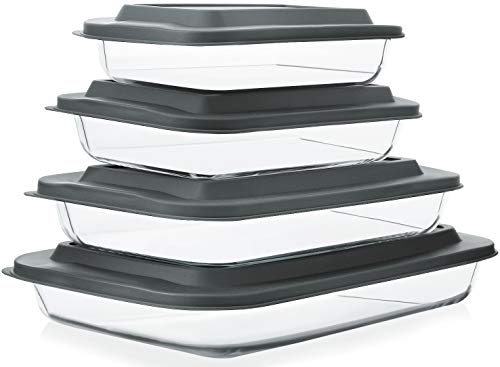
For Baking, Serving, and Storing: M MCIRCO 8-Piece Deep Glass Baking Dish Set with Lids
This four-dish borosilicate glass set handles baking, serving, reheating, freezing, and storage, with tight-fitting lids that help keep food fresh and contained. It suits home cooks who want multiple bakeware sizes and stackable leftovers storage in one set.
Pros and Cons
Pros
- The four-piece size range covers 1-quart through 3.2-quart cooking needs.
- Borosilicate glass works across oven, microwave, freezer, and dishwasher use.
- Included lids make the dishes useful for both baking and storing leftovers.
- Clear sides make serving and checking food easier.
Cons
- The listed dimensions include the handles, so usable interior space may be smaller than the outside measurements suggest.
- The lids are plastic, so they are intended for storage rather than oven baking.

OXO
Everyday 9x13 Baking and Casserole Dish: OXO Good Grips Glass Baking Dish with Lid
The OXO Good Grips Glass Baking Dish handles baking, microwave reheating, freezing, and storage in one borosilicate glass dish, with a slosh-proof lid as its biggest advantage. It suits home cooks who want a durable 3-quart baker that transitions from oven to table or refrigerator with less cleanup.
Pros and Cons
Pros
- The borosilicate glass construction is designed to withstand extreme temperature changes.
- The lid helps contain spills and allows stacking in the refrigerator or freezer.
- Generous handles make the dish easier to carry securely.
- Glass does not stain or absorb odors and is dishwasher-safe.
Cons
- The 3-quart capacity may be limiting for larger family-size casseroles.
- The product data does not list the dish's weight, so buyers cannot assess how heavy it will feel when full.
The Best Deals This Week*
-
Pyrex Deep (9x13") Glass Baking Dish with Lid
$22.88
($24.99)Save $2.11 -
Deep Casserole Baking Dish for Lasagna
$13.97
($14.76)Save $0.79 -
For Baking, Serving, and Storing
$36.99
($44.99)Save $8.00 -
Everyday 9x13 Baking and Casserole Dish
$20.99
($26.99)Save $6.00
*Deals are selected by our commerce team
Pyrex Deep (9x13") Glass Baking Dish with Lid, Deep Casserole Dish

Editors' Favorite
Color: Glass Size: 9x13 (1-Count) Dimensions: 13 x 9 x 3 inches Weight: 5.92 Pounds Product Group: Kitchen Binding: Kitchen
Shop NowPyrex Deep Casserole Baking Dish for Lasagna and Leftovers: Pyrex 7x11 Glass Baker with BPA-Free Lid
Pyrex
Deep Casserole Baking Dish for Lasagna and Leftovers: Pyrex 7x11 Glass Baker with BPA-Free Lid
This 7x11x2.75 inch glass baking dish runs up to 50% deeper than standard Pyrex basics, so layered casseroles and saucy bakes stay in the pan instead of on your oven floor. Buy it if you cook for a crowd and want one dish that bakes, stores in the fridge, and reheats without transferring food to a second container.
$13.97 at AmazonGreat Value
Color: Glass Size: 7x11 (1-Count) Dimensions: 16 x 3.88 x 3.5 inches Weight: 3.88 pounds Product Group: Kitchen Binding: Unknown Binding
Shop NowM MCIRCO For Baking, Serving, and Storing: M MCIRCO 8-Piece Deep Glass Baking Dish Set with Lids
M MCIRCO
For Baking, Serving, and Storing: M MCIRCO 8-Piece Deep Glass Baking Dish Set with Lids
This four-dish borosilicate glass set handles baking, serving, reheating, freezing, and storage, with tight-fitting lids that help keep food fresh and contained. It suits home cooks who want multiple bakeware sizes and stackable leftovers storage in one set.
$36.99 at AmazonColor: Gray Size: 1Quart (10 x 5.9 x 1.8-inch) Dimensions: 5 x 5.8 x 3.7 inches Weight: 11.684499886 pounds Product Group: Kitchen Binding: Unknown Binding
Shop NowPyrex 233-D 5Qt Glass Baking Dish with 233-PC Red Lid - Made in USA

Color: Red Dimensions: 15.75 x 9.5 x 4 inches Weight: 4.7 pounds Product Group: Kitchen Binding: Unknown Binding
Shop NowOXO Everyday 9x13 Baking and Casserole Dish: OXO Good Grips Glass Baking Dish with Lid
OXO
Everyday 9x13 Baking and Casserole Dish: OXO Good Grips Glass Baking Dish with Lid
The OXO Good Grips Glass Baking Dish handles baking, microwave reheating, freezing, and storage in one borosilicate glass dish, with a slosh-proof lid as its biggest advantage. It suits home cooks who want a durable 3-quart baker that transitions from oven to table or refrigerator with less cleanup.
$20.99 at AmazonColor: Glass Size: 3 qt Dimensions: 15.6 x 9.7 x 3 inches Weight: 4.5 Pounds Product Group: Kitchen Binding: Kitchen
Shop Now




Write Your Review
No reviews yet. Be the first to share your experience!