

The pitch sells itself: one appliance, three jobs. Buy a sandwich toaster with removable plates, swap in waffle or grill plates, and the kitchen gains a panini press and a weekend brunch station without surrendering another cupboard shelf. Most of that promise holds. What trips people up is a cluster of quiet assumptions riding along with the word “removable” — assumptions about dishwashers, cross-brand plates, pocket depth, bread choice, and how batter behaves on hardware designed for bread. Whether you are still comparing models or already own one, several of those assumptions fail within the first month of ownership.
Five of the most persistent beliefs are examined below against how these compact machines actually behave, followed by the hardware details that decide whether one earns its shelf or gathers dust behind the kettle.
Removable Does Not Mean Dishwasher-Safe
Manufacturers attach “removable” to plates for two reasons: easier cleaning, and the option to sell extra plate sets later. Only the first gets advertised, and even it arrives with fine print. Dig out the manual from a Hamilton Beach or Proctor Silex compact sandwich maker and plenty of plate assemblies are cleared for hand-washing only, despite lifting straight out of the frame. The dishwasher verdict hides on page nine of the safety leaflet, never on the box.
Even plates explicitly rated for machine washing rarely survive the rating for long. Every cycle exposes nonstick coatings — PTFE and ceramic alike — to alkaline detergent, forced-air drying heat, and knocks against neighboring dishes in the rack. A surface that would last years under a sponge chalks or flakes within months of weekly machine washing, and once the release properties fade, every sandwich welds itself to the plate. Hand-washing takes ninety seconds while the plates are still warm: hot water, a drop of soap, a soft cloth. Baked-on cheese at the crimp responds to a five-minute soak, which is far kinder to the coating than the scrubbing a dried-on mess eventually demands.
Will Plates From One Brand Fit Another Toaster?
Almost never, and the reason is worth knowing before bidding on a spare plate set listed online as “untested.” Each brand engineers its own mounting geometry: post spacing, clip shape, release-button cams, and the way a plate seats against the heating element. A Breville deep-fill plate carries wider pockets and a different frame than the same company’s compact plates, so it will not seat properly even on sibling models, let alone a Cuisinart or Hamilton Beach body. Pastry and dessert plates follow the same logic — the accessory market is organized by model family, not by plate size.
Compatibility lives inside model families, never across brands. Grill, waffle, and sweet-treat plates sold alongside a sandwich maker always name an exact compatible series, because a plate sitting 2 mm proud of the element browns unevenly and can trip the thermal cutoff. Match the full model number printed on the underside of the base — not the marketing name on the lid — before buying any second plate set. If a seller cannot confirm that number, treat the plates as decoration until proven otherwise.
Deeper Pockets Do Not Guarantee a Better Seal
Deep-fill plates advertise pockets around 30 mm deep, roughly half again the 20 mm found on standard plates, and the temptation is to read that headroom as permission. It is nothing of the sort. The crimped edges that fuse a toasted sandwich together need direct bread-to-bread contact, and they only get it when the filling sits below the rim with a clear margin. Load past that line and the lid stops closing flat, the seal parts mid-cook, and the contents escape along the hinge side.
Cheese is the usual offender. Fresh mozzarella and wet grated cheddar shed water and fat as they melt, and a pocket loaded to capacity leaves that liquid nowhere to go but outward. Low-moisture mozzarella behaves far better, which is why pizza-pocket lunch prep suits these machines so well: a tablespoon of thick sauce, a restrained handful of low-moisture cheese, soft white bread, four to five minutes on deep-fill plates. Overfill the same pocket by half and the reward is torn bread along the crimp and a carbonized cheese ledge fused to the element housing by minute three.
Any Standard Loaf Works If You Butter the Outside
Dedicated toasting bread, thick-cut farmhouse loaves, and branded sandwich slabs get marketed as prerequisites. They help, but they are not the mechanism. What seals and crisps a pressed sandwich is heat acting on fat, and that part sits entirely under your control: butter the outside faces of the bread, not the inside. Fat lets the surface climb past the point where moisture evaporates and into the range where the Maillard reaction browns starch and protein — roughly 150°C at the plate. The outer crumb fries crisp while the inner crumb steams soft, and at the crimp the two buttered faces fuse shut.
That is why a plain supermarket loaf performs perfectly well. An after-school grilled cheese built on thin-sliced white bread, buttered externally, seals tighter than a dry artisan sourdough because there is less thickness resisting the press. Mayonnaise plays the same role with a higher smoke point and browns faster — a handy trait in a dorm room where attention splits between the toaster and everything else going on. Hold the rule across all fillings: fat on the exterior, restraint at the rim, and bread choice drops from requirement to preference.
Waffle Plates Follow a Different Browning Curve Than Sandwich Plates
Swapping plates changes the physics, not merely the menu. Bread enters the press already dry-skinned and dense, so cooking is pure conduction: three to four minutes of steady pressure drive internal moisture toward the crimp while the buttered faces brown gradually. Waffle batter is a high-hydration mixture that cooks in a different order — spread, set, rise, then a rush of surface browning once the free water boils off and the sugars begin to caramelize.
That sequence demands more time than a bread-tuned thermostat anticipates. Plan on four to six minutes per batch, accept a pale first waffle while the plates take on fat, and expect lighter color overall than a dedicated iron running hotter plates would deliver. Pour short of the grid edge, because batter expands as it lifts the lid, and treat the opening round as practice — the plates hold heat noticeably better once warm, so the second waffle finishes ahead of the first. None of this makes the conversion a gimmick. It simply means one machine speaks two languages, and waffle night asks for patience the sandwich routine never required.
What Actually Separates a Good Removable-Plate Toaster From a Frustrating One
Four hardware details decide whether a swap-plate sandwich maker earns counter space. Begin with the latch: a metal clip that pulls the lid down under visible tension keeps bread pressed flat as it thins during cooking, while flimsy plastic tabs relax with heat and let the top slice drift off the filling, a fault that shows up later as pale patches dead-center in each triangle. Plate release buttons come next. On better units they sit recessed into the handle arms where a knuckle cannot press them by accident while the plates sit near 180°C, and each plate releases with one firm click rather than a wiggle and a hopeful tug.
Power ratings deserve a glance as well. Compact two-triangle models typically draw 700 to 800 watts, adequate for one pair of sandwiches if a slower reheat between batches is tolerable; four-triangle and deep-fill frames pull 900 to 1,200 watts and recover plate temperature quickly enough to feed a queue. Storage, oddly enough, predicts daily use better than any specification sheet. Look for a cord wrap molded into the base, plates that lock flush for upright storage, and a footprint narrower than about 28 cm so the unit slides into a cupboard instead of colonizing the counter — the difference between a machine that surfaces every week and one that migrates permanently behind the kettle.
Sandwich Toaster With Removable Plates: Common Questions
How long does a toasted sandwich take to cook?
Budget three stages. Preheating runs two to three minutes, announced by the ready light switching off. A standard sealed sandwich then needs three to four minutes of contact; deep-fill pockets carrying heavier fillings stretch closer to five. Judge by feel over the final stretch — when the lid lies flat and the crimp line looks set, the sandwich is done. The ready light will switch back on partway through as the thermostat cycles, which is normal and not a reason to lift the lid early.
Why does cheese leak out of the sides even when the lid closes?
Leaks trace back to filling level or cheese choice far more often than to a defective seal. The crimped edge fuses only where two buttered bread faces meet directly, and filling that reaches the rim breaks that contact, handing molten cheese an exit route. Fresh mozzarella and finely grated wet cheddar release more liquid while melting than a pocket can absorb. Switching to low-moisture cheese, keeping the filling about a centimeter below the rim, and letting the sandwich rest for a minute before opening clears up the majority of leaks.
Should I remove the plates before storing the toaster away?
Detaching them costs ten seconds and prevents two recurring problems. Crumbs and hardened cheese collect in the seam between plate and frame, and whatever survives there carbonizes during the next preheat, tainting the first batch with a burnt smell. Separated plates also dry completely on the rack, which benefits any coating no matter how gently you hand-wash. Store the plates flat beside the body rather than stacked face to face, wind the cord into its wrap, and stand the unit upright if its feet allow. Reattach both plates until they click before the next session, because a half-seated plate browns unevenly.

Cuisinart
Indoor Grill & Panini Press: Cuisinart Griddler 5-in-1 GR-4NNAS Stainless Steel
The Cuisinart Griddler GR-4NNAS works as a contact grill, panini press, full grill, full griddle, and half grill/half griddle in one unit, with dual temperature controls that reach up to 425°F for precise cooking across everything from pancakes to steaks. Home cooks who want one appliance to replace several countertop gadgets will find this earns its counter space.
Pros and Cons
Pros
- Five distinct cooking modes in one footprint covers grilled cheese, hamburgers, panini, sausages, and pancakes without switching appliances.
- Griddle mode temperature range of 200°F to 425°F gives meaningful control for delicate items like eggs alongside high-heat searing.
- Dishwasher-safe removable plates and drip tray make cleanup a practical daily habit rather than a chore.
- PFAS-free nonstick coating addresses a common concern buyers have with older nonstick surfaces.
Cons
- At $115, it costs more than single-function panini presses, so buyers who only make sandwiches may not recoup the versatility.
- No customer reviews are currently available to validate real-world durability claims beyond manufacturer specifications.
The Best Deals This Week*
-
Indoor Grill & Panini Press
$115.65
($129.95)Save $14.30 -
Gotham Steel Breakfast Sandwich Maker & Panini
$17.99
($19.80)Save $1.81 -
3 in 1 Electric Sandwich Maker with Removable
$31.98
($39.99)Save $8.01
*Deals are selected by our commerce team
Cuisinart Indoor Grill & Panini Press: Cuisinart Griddler 5-in-1 GR-4NNAS Stainless Steel
Cuisinart
Indoor Grill & Panini Press: Cuisinart Griddler 5-in-1 GR-4NNAS Stainless Steel
The Cuisinart Griddler GR-4NNAS works as a contact grill, panini press, full grill, full griddle, and half grill/half griddle in one unit, with dual temperature controls that reach up to 425°F for precise cooking across everything from pancakes to steaks. Home cooks who want one appliance to replace several countertop gadgets will find this earns its counter space.
$115.65 at AmazonEditors' Favorite
Color: Brushed Stainless Size: Medium Dimensions: 13.5 x 11.5 x 7.12 Inches Weight: 11.5 Pounds Product Group: Kitchen Binding: Kitchen
Shop NowGOTHAM STEEL Breakfast Sandwich Maker & Panini Press
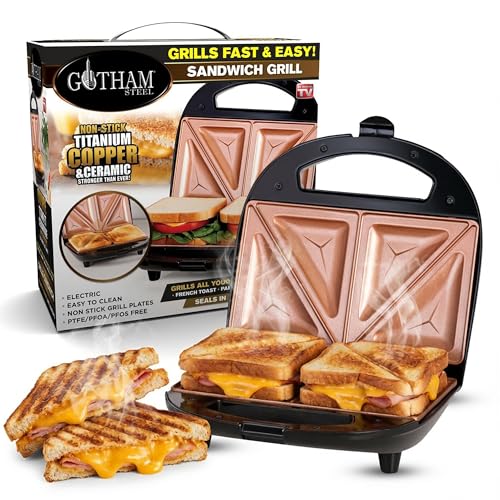
Great Value
Color: Black Size: double sandwich Dimensions: 12 x 6 x 6 Inches Weight: 0.000625 Pounds Product Group: Kitchen Binding: Kitchen
Shop NowSUNVIVI 3 in 1 Electric Sandwich Maker with Removable Nonstick Plates - 750W, Black for Belgian Waffle/Panini/Grill/Pancake Griddle/Breakfast, Dishwasher Safe, Cool Touch Handle, Easy to Clean & Store

SUNVIVI
3 in 1 Electric Sandwich Maker with Removable Nonstick Plates - 750W, Black for Belgian Waffle/Panini/Grill/Pancake Griddle/Breakfast, Dishwasher Safe, Cool Touch Handle, Easy to Clean & Store
$31.98 at AmazonColor: Black Size: Medium Dimensions: 9.3 x 3.75 x 9.01 inches Product Group: Kitchen
Shop NowKEINVE 3-in-1 Sandwich Maker, Waffle Maker and Panini Press Grill, Black

Color: Black Size: 9×5" Plate Dimensions: 9.2 x 9.2 x 3.7 Inches Weight: 4.8 Pounds Product Group: Kitchen
Shop NowKOTEK Panini Press Sandwich Maker, 1200W 4 Slice Sandwich Toaster, Removable Drip Tray & Non-Stick Coated Plates, Open 180°, 3-In-1 Electric Indoor Grill w/5 Auto Modes, Temperature Control & Timer

KOTEK
Panini Press Sandwich Maker, 1200W 4 Slice Sandwich Toaster, Removable Drip Tray & Non-Stick Coated Plates, Open 180°, 3-In-1 Electric Indoor Grill w/5 Auto Modes, Temperature Control & Timer
$89.99 at AmazonColor: Black, Silver Size: 12.5 x 14 x 6"(D x W x H) Dimensions: 12.5 x 14 x 6 inches Weight: 10 Pounds Product Group: Kitchen Binding: Kitchen
Shop Now








Write Your Review
No reviews yet. Be the first to share your experience!