

A small coal grill looks like a shrunken kettle, but it cooks nothing like one. With grates spanning 14 to 18 inches and fireboxes built for 30 to 50 briquettes rather than the 75 to 100 a backyard kettle swallows, these compact machines operate in a different thermal regime: temperatures swing fast in both directions, a load of fuel lasts roughly 45 to 60 minutes, and the vents do far more work than most people credit them for. Grasping that physics first makes every practical decision easier, from how you arrange the fire to what you dare put on the grate.
Everything below concerns charcoal specifically — combustion, airflow, fuel selection, and the reality of cooking for one or two. Pedestal patio grills that run on gas or electricity, and the question of where any grill may legally sit on an apartment balcony, belong to other guides.
Why Less Charcoal Means Faster Temperature Swings
Heat capacity scales with fuel mass. A 22-inch kettle holding 100 lit briquettes behaves like a flywheel: drop ten cold chicken thighs on the grate and the fire barely flinches, recovering within a couple of minutes. Cut the load to 40 briquettes on a 14-inch grate and the same maneuver knocks 50 degrees off the fire, because 40 briquettes simply lack the stored heat to absorb the shock. The flip side is speed. A small coal grill climbs from ignition to 600-degree searing heat in about twenty minutes, and a vent adjustment registers at the grate in three to five minutes rather than fifteen.
The bowl matters nearly as much as the fire inside it. Thin stamped steel, standard on budget tabletop models, sheds heat through its walls almost as fast as the coals generate it, so a gust of wind or a passing cloud translates straight into grate temperature. Thicker porcelain-coated steel, found on better 14-to-18-inch portables, warms slowly and holds a steadier line while resisting the warping that eventually leaves cheap lids sitting crooked and leaking air. If repeatable results matter to you, check wall thickness before you compare grate diameters.
Airflow, Not Fuel Quantity, Decides Your Cooking Temperature
Charcoal has no fixed burn rate; it burns at whatever pace the oxygen supply permits. Every small charcoal grill expresses this through two dampers: a bottom intake that feeds air into the coals and a top exhaust that releases hot gas, together producing the draft that draws fresh air through the fire. A wide-open intake means a roar and 550-to-600-degree grates. Throttle the bottom vent down to a sliver and combustion slows until the fire idles near 300. Extra fuel raises the ceiling of what the fire can achieve, but the vents choose where between idle and ceiling you actually cook.
Small grills magnify the principle because their fuel sits close to the edge of suffocation. Thirty-five briquettes with the intake shut starve within ten minutes, a fate a deep kettle bed rarely suffers. Wind complicates matters further: a stiff breeze across a tabletop model behaves like an uninvited bellows, and cheap sheet-metal flaps rattle out of position mid-cook. Spend one unimportant session practicing quarter-open steps on the bottom vent, timing how long each change takes to register, and you will run rings around cooks who answer every temperature dip by dumping in more charcoal.
The Two-Zone Problem on a 14-Inch Grate
Two-zone cooking — coals banked on one side for direct heat, bare grate beside them for indirect — comes naturally on a large kettle. On a round 14-inch grate it turns into geometry homework. Shove every coal to one half and the surviving calm area is a crescent roughly five by eight inches, space for exactly one burger hiding from the flare-ups. The classic workaround is a ring or crescent fire: spread lit coals around the perimeter and leave the middle vacant, preserving a modest indirect pocket at the center while keeping serious searing heat everywhere else.
Solving it vertically is the other option. A grate riser or stacked upper grate moves food away from the flames without demanding lateral real estate. Whichever route you take, accept the limits. Genuine low-and-slow at 225 to 275 degrees wants a stable fire across four to six hours, and even a carefully damped small grill consumes fresh fuel every 30 to 45 minutes holding that band. Ribs and pork shoulder stay possible in bursts, but they become a refueling vigil rather than a relaxed afternoon.
Lump Charcoal or Briquettes in a Tiny Firebox
Fuel choice reads differently when the firebox is six inches deep. Lump charcoal lights quickly, runs hot, and obeys vent changes within minutes, which suits the fast-sear mission of a small grill. Its vices surface in compact volumes: irregular pieces stack unpredictably, big chunks bridge and strand dead space while dust sifts downward and packs the intake, and a given weight of lump typically burns 20 to 30 percent faster than briquettes. In a machine already short on burn time, that tax stings.
Briquettes surrender some peak temperature for order. Their identical pillows stack into a deliberate layout — two layers of 18 to 20 pieces covers most cooks — and they deliver steadier output hour to hour, which matters when your entire fuel supply weighs two pounds. The price is ash, since binders in briquettes leave considerably more residue and a compact pan fills sooner. Plenty of 14-to-16-inch owners land on briquettes for weeknight burgers and keep lump reserved for steaks, where the extra 50 to 100 degrees of opening punch earns its keep.
Lighting, Chimney Starter Sizing, and Ash Cleanup
A standard chimney starter holds about 100 briquettes and towers over a grill whose whole appetite is 40. The half-size or two-quart version, with capacity near 35 to 45 briquettes, matches small-grill arithmetic: fill it once and you have lit the complete session, no mid-cook additions required. Allow 15 to 20 minutes from ignition to coals dressed in gray ash, then pour them into whichever arrangement your zone plan calls for. Lighter cubes suffice in a pinch, though nothing lights a column as evenly as a chimney does.
Ash management decides whether the last third of your cook proceeds calmly. Briquettes shed generously and the catcher beneath a 14-inch bowl holds perhaps two cups, so one extended session can fill it until the pile blocks the bottom intake — quietly strangling the fire mid-meal through exactly the mechanism described earlier. Tap the pan clean before every cook. Campers and tailgaters should pack a lidded metal can, because spent coals have nowhere to go at a picnic site and must never meet grass, gravel, plastic, or paper bags until fully cold, which takes far longer than intuition suggests.
What a Small Coal Grill Does Well and Where It Fails
Played to its strengths, a small coal grill excels at fast, high-heat cooking for one or two. Steaks, smash burgers, skewers, boneless thighs, and vegetables all finish comfortably inside the window a single fuel load provides, and the concentrated fire lays down a 500-plus-degree crust that larger cookouts struggle to match for speed. Portability completes the case: a 14-inch kettle under 15 pounds rides in any trunk to campsites, tailgate lots, and small-yard cookouts where a full-size kettle will not fit, carrying genuine charcoal flavor with it.
Honesty about weaknesses saves disappointment. Feeding more than three or four people means grilling in shifts against a fading fire, refueling between batches and surrendering heat each time the lid lifts. Brisket, whole birds, and long rib cooks battle the brief burn window and the cramped indirect space. The same light thermal mass that makes the grill responsive also punishes inattention — ninety seconds of an open lid at a windy tailgate and dinner sheds 75 degrees. Buy it for quick meals in confined places, not as a miniature stand-in for a backyard smoker.
Frequently Asked Questions
How many briquettes should I use in a small charcoal grill?
Start with 30 briquettes for direct-heat burgers and steaks on a 14-inch grate, arranged no more than two pieces deep. That load crosses 450 degrees within fifteen minutes of pouring and delivers roughly 40 to 50 minutes of usable cooking heat. For gentler, oven-style cooking, cut the amount roughly in half and bank the coals to one side. Since the firebox carries so little reserve, lean slightly generous rather than precise; surplus fuel costs nothing beyond a few extra minutes of cooldown before you pack up.
Can a small charcoal grill hold 225 degrees for real smoking?
Briefly, though not dependably for true barbecue. The best-damped 18-inch portables can idle near 225 to 250 degrees in stretches of 40 to 60 minutes, but sustaining that band across the three hours ribs require means adding fresh fuel every half hour, and every addition jostles both temperature and clean smoke. Thin-walled models wander worse, drifting between 200 and 300 degrees as breezes shift. Plan smoked food on a compact grill as a series of shorter batches, or embrace the refueling schedule as part of the project.
Is lump charcoal or briquette better for a compact grill?
For routine cooking, briquettes usually win in small fireboxes because their matching shapes stack tightly, feed evenly, and burn predictably across the full 45-to-60-minute session. Lump claims its niche at maximum searing temperature, igniting faster and burning hotter during the first twenty minutes while responding to vent tweaks almost immediately, which rewards attentive hands. Guard against two lump quirks: fine dust settling against the intake vent, and oversized chunks bridging so the fire burns hollow underneath. Either way, one two-quart chimney of fuel lights an entire cook on any grill up to 18 inches.
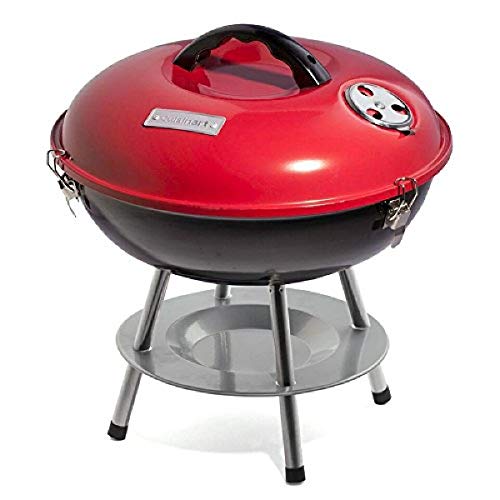
Cuisinart
Portable Tabletop Charcoal Grill for Camping and Tailgating: Cuisinart 14-Inch Grill
The Cuisinart 14-inch charcoal grill provides 196 square inches of cooking space, with adjustable vents as its biggest advantage for managing heat. It suits campers, tailgaters, and small-space grillers who need a lightweight four-pound grill with a locking lid.
Pros and Cons
Pros
- At four pounds, this tabletop charcoal grill is easy to carry for camping and tailgating.
- Adjustable dual vents support more precise temperature management than a grill with fixed airflow.
- Three lid locks make transport more secure and help contain the grill between uses.
- The enamel-coated firebox, ash base, and chrome-plated grate make cleanup more manageable.
Cons
- Its 196-square-inch cooking area is better suited to compact meals than large group cooking.
- Charcoal grilling requires managing fuel, airflow, and ash after use.

Weber Jumbo Joe 18-Inch Portable Charcoal Grill for Tailgating, Camping & Backyard BBQ
The Weber Jumbo Joe delivers 240 square inches of cooking space in a portable kettle design with a locking lid that makes it easy to transport to tailgates and campsites. Buy it if you need a grill that's large enough for family meals but still compact enough to load in your car trunk.
Pros and Cons
Pros
- Large 240 square inch cooking surface handles family-sized meals while remaining portable enough for camping and tailgating.
- Porcelain-enameled construction and rust-resistant components ensure the grill withstands outdoor conditions season after season.
- Secure lid lock system makes transport safe and prevents ash from escaping during movement between locations.
Cons
- Single handle design means you need two hands to lift and carry the grill when loaded with charcoal.
- No built-in thermometer requires you to use a separate temperature gauge to monitor cooking heat.
Cuisinart Portable Tabletop Charcoal Grill for Camping and Tailgating: Cuisinart 14-Inch Grill
Cuisinart
Portable Tabletop Charcoal Grill for Camping and Tailgating: Cuisinart 14-Inch Grill
The Cuisinart 14-inch charcoal grill provides 196 square inches of cooking space, with adjustable vents as its biggest advantage for managing heat. It suits campers, tailgaters, and small-space grillers who need a lightweight four-pound grill with a locking lid.
$39.99 at AmazonEditors' Favorite
Color: Portable Charcoal Grill, 14" (Red) Size: 14.5" x 14.5" x 15" Dimensions: 14.6 x 14 x 15 inches Weight: 2 pounds Product Group: Lawn & Patio Binding: Tools & Home Improvement
Shop NowGas One GasOne 14-inch Portable Charcoal Barbecue Grill with Thermometer – Red

Great Value
Color: Red with Thermometer Dimensions: 14.5 x 14.5 x 15 inches Product Group: Lawn & Patio Binding: Tools & Home Improvement
Shop NowOdoland Camping Campfire Grill, Portable Folding Charcoal Grills for BBQ

Color: black Size: 15.8"x11.8"x8.3" Dimensions: 15.74803148 x 11.417322823 x 8.1496062909 inches Weight: 9.4137385874 Pounds Product Group: Lawn & Patio Binding: Unknown Binding
Shop NowGas One – 14-inch Portable Barbecue Grill with 3-Point Locking Lid for Heat Preservation – Dual Venting System – Small Charcoal Grill for Backyard, Camping, Boat

Gas One
– 14-inch Portable Barbecue Grill with 3-Point Locking Lid for Heat Preservation – Dual Venting System – Small Charcoal Grill for Backyard, Camping, Boat
$25.99 at AmazonColor: Red Size: 14 Inch (Diameter) Dimensions: 14.5 x 14.5 x 15 inches Weight: 4 pounds Product Group: Lawn & Patio Binding: Tools & Home Improvement
Shop NowWeber Jumbo Joe 18-Inch Portable Charcoal Grill for Tailgating, Camping & Backyard BBQ
Weber Jumbo Joe 18-Inch Portable Charcoal Grill for Tailgating, Camping & Backyard BBQ
The Weber Jumbo Joe delivers 240 square inches of cooking space in a portable kettle design with a locking lid that makes it easy to transport to tailgates and campsites. Buy it if you need a grill that's large enough for family meals but still compact enough to load in your car trunk.
$89.99 at AmazonOther Special Features of the Product: Compact, Portable Fuel Type: Charcoal Main Burner Count: 1 Number Of Racks: 1 Grill Configuration: Single Grate Cooking System: Charcoal Item Dimensions D x W x H: 19.75"D x 20.5"W x 19.75"H Item Dimensions: 19.75 x 20.5 x 19.75 inches Item Weight: 18 Pounds Cooking Surface Area: 100.48 Square Inches Finish Types: Painted Material Type: Alloy Steel, Aluminum, Porcelain Handle Material: Metal Frame Material: Aluminum Required Assembly: Yes Installation Type: Free Standing Brand Name: Weber Recommended Uses For Product: Outdoor Included Components: Weber Jumbo Joe 18-Inch Portable Charcoal Grill - 1211001 Model Name: 1211001 Model Number: 1211001 Global Trade Identification Number: 00077924018831 Indoor Outdoor Usage: Outdoor Manufacturer: Weber UPC: 077924018831 Manufacturer Part Number: 1211001 Item Type Name: 18" Jumbo Joe Grill Warranty Description: See Description Best Sellers Rank: #6,434 in Patio, Lawn & Garden (See Top 100 in Patio, Lawn & Garden) #15 in Charcoal Grills ASIN: B0098HR0RC Color: Black Brand: Weber Product Dimensions: 19.75"D x 20.5"W x 19.75"H Special Feature: Compact, Portable
Shop Now







Write Your Review
No reviews yet. Be the first to share your experience!