

Most disappointing mini madeleine pans fail their owners for reasons visible at checkout, not in the oven. Buyers grab the thinnest pan on the shelf, guess at baking times, skip the greasing step because the listing says nonstick, then blame themselves when the shells come out pale, stuck, and flat. Every one of those outcomes traces back to a specific, fixable mistake.
The mistakes below cover metal gauge, bake timing, pan preparation, coating care, batch planning, and how long the shell pattern survives washing. Correct them and modest bakeware performs; ignore them and even pricey pans disappoint.
Buying Thin Stamped Steel That Warps Before the Shells Set
Budget mini madeleine pans are usually stamped from light-gauge tinplated steel, sometimes less than half a millimeter thick. At 375°F that sheet metal expands unevenly, and you can hear it happen: a pop or tick from the oven as the base buckles. A warped pan no longer sits flat on the rack, so batter slides toward the low side and every shell bakes lopsided, thicker on one edge and pale in the deep end of the well, with a hump leaning like a tree in steady wind.
Gauge is the spec to check, though few listings state it plainly. Heft reveals most of it: aluminized steel in the heavier classes feels noticeably denser than a supermarket stamping, resists twisting when you grip opposite ends, and browns whole rows evenly. Corrugated bases, the raised rectangles visible on commercial pans, add stiffness without much weight. Heavy tinplated steel is acceptable, since older French pans were built that way, but thin-plus-tinplated is the combination to walk away from.
Press the center of the pan with your thumb before buying. Any visible flex under light pressure predicts trouble at baking temperature.
Assuming Mini Shells Bake Faster on a Simple Ratio
A common shortcut fails here: divide the standard time by the size ratio and set the timer. Standard madeleines run 11–13 minutes at 375–400°F; minis often finish in 6–8, but that is not a tidy percentage, because it depends on how deeply each well cups the batter and how hot your oven actually runs. Small cakes carry little mass, so the line between golden and dry is measured in seconds. An extra ninety minutes-turned-seconds in the oven dries the crumb, mutes the lemon scent, and collapses the delicate crown that makes a madeleine recognizable in the first place.
Set the first timer for six minutes and check through the oven window rather than trusting any chart. Edges should be golden and the centers should spring back when pressed lightly; a skewer is nearly useless at this size because it passes through so fast. Treat the opening batch as calibration. Once you know your oven’s true number, every round afterward runs on autopilot.
Skipping the Butter-and-Flour Prep Madeleines Specifically Require
Muffin tins forgive paper liners and lazy greasing; madeleine pans do not, because the signature hump is a release-dependent event. Cold batter meets hot metal and hot oven air, and the thermal shock drives a burst of steam up through the center of the shell. That lift only becomes the classic dome if the sides let go cleanly. When batter welds itself to an ungreased well, the crust tears where the pan grips, steam escapes through the split, and the center never rises at all.
Brush softened butter into every flute and ridge, dust with flour, then tap the pan upside down over the sink so only a film remains. Baking spray containing flour works in a pinch, though brushed butter browns the shell edges more attractively. This applies to nonstick coatings too. They help, but the hump rewards a deliberately prepared surface every single time, and chilling the filled pan for ten to fifteen minutes sharpens the cold-batter shock further.
Scratching a Nonstick Coating With Metal Tools
Coated mini pans die young from kitchen habits, not manufacturing defects. Forks prying stubborn shells, knives trimming stray edges, and metal whisks clanking against well corners all carve hairline scratches into the coating within weeks. Those gouges become stick points, stick points mean torn shells, and flaking coating eventually raises the uncomfortable question of what you are eating alongside your tea.
Switch to silicone-tipped tools, wooden picks, and nylon brushes anywhere near the pan. Free fresh shells by rapping the pan’s edge firmly on the counter right out of the oven; they usually jump loose on the second tap, no digging required. Wash by hand with a soft sponge and skip the dishwasher entirely. Or sidestep the problem by choosing bare aluminized steel, which releases beautifully under proper butter-and-flour prep and has no coating to ruin.
Ignoring Capacity Planning Until the Batter Is Already Resting
Minis flip the usual bakeware arithmetic. Where a standard tray holds 12 large shells, a mini madeleine pan carries 20–24 bite-size ones, so a single recipe that fills one standard tray leaves you short of two mini trays. You end up baking sequential rounds whether you planned for them or not.
Sequencing collides with the batter rest. Madeleine batter wants 30–60 minutes chilled before it ever sees the oven; that rest happens once, but the baking happens in waves. Work backwards: mix, start the rest, heat the oven during the last fifteen minutes, then bake round one while the remaining batter stays refrigerated in its bowl. Batter left loitering on the counter between rounds warms up and forfeits exactly the cold-start shock that builds the hump. Owning two pans turns three waves into two and keeps the entire session inside an hour.
Quantity matters for the occasions minis suit best. Figure three to four shells per person at a tea party, stretch one generous bake across a week of lunchbox treats, and remember that holiday cookie boxes reward volume, since twenty-four uniform pieces fill a box far more elegantly than twelve. Count your guests before you buy.
Trusting Shell Definition That Fades After a Dozen Washes
The scalloped pattern on cheap minis starts shallow and wears smoother with every aggressive scrub. Once the ridges soften, shells emerge blobby: fluted edges blur, chocolate drizzle pools instead of tracing the grooves, and powdered sugar has nothing to catch on. Dishwasher detergent speeds the erosion along dramatically, and on exposed aluminum it causes pitting and gray discoloration besides. Hand washing with a soft sponge is non-negotiable in this category.
Judge definition before money changes hands. Ridge lines should meet in crisp creases, flutes should run deep enough to cast small shadows under ordinary kitchen light, and the waist between shell and stem should read clearly at arm’s length. Heavier pans hold their pattern longer, mostly because there is more metal behind each groove to begin with.
Mini Madeleine Pan Questions, Answered
How many mini madeleine pans do I need?
One pan holding 20–24 shells covers family desserts and everyday baking, since a standard recipe portioned into minis yields roughly that many pieces. Entertaining changes the math: a tea party of six at three to four shells apiece empties a single pan twice over, and holiday cookie boxes demand volume that one round cannot supply. A second pan costs little and cuts the session from three oven waves to two, which also keeps later batter from warming while it waits its turn. Bake for crowds seasonally? Buy two. Bake mostly for your own kitchen? One well-built pan beats two cheap ones.
Do nonstick mini madeleine pans still need butter and flour?
Treat the coating as insurance rather than a substitute. The madeleine hump depends on clean release, because batter welded to the well tears as it rises and vents the very steam that should lift the dome. Butter and flour provide a consistent, verifiable barrier even when a coating has picked up invisible scratches from storage or washing, and the flour dusting contributes the faint golden crust that makes shell edges attractive. A flour-containing baking spray is the fastest route; brush-and-dust gives prettier browning. Either way, prepare every well, because one skipped corner will stick every time.
Why did my mini madeleines bake up flat with no hump?
The hump is thermal shock in action: chilled batter strikes hot metal and oven air, steam surges upward through the center, and the final moments of rise pile into that bump. Weaken any link in the chain and the bump disappears. Warm batter is the usual culprit, so rest it the full 30–60 minutes in the refrigerator rather than on the counter, and return unused portions to the fridge between rounds. An oven running cooler than the dial claims softens the shock, which is worth verifying with a separate thermometer set to 375–400°F. Underfilled wells and overbaking contribute too: fill the wells nearly full and pull the pan at six to eight minutes while the crumb is still moist.
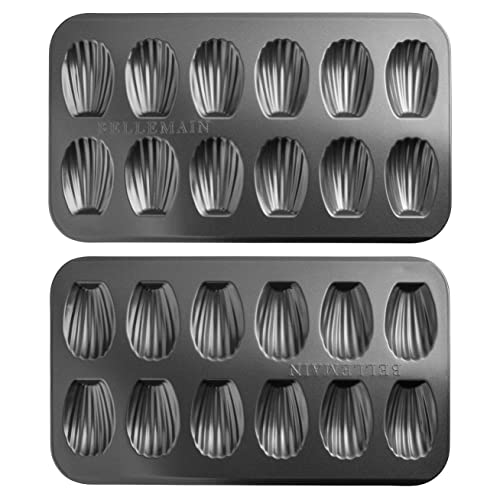
Bellemain
12-Cavity Madeleine Baking Pan Set: Bellemain Nonstick Carbon Steel 2-Pack
The Bellemain two-pack bakes 12 shell-shaped madeleines per pan with even heating and food-safe nonstick release. It suits home bakers who want durable carbon steel pans for producing batches of French tea cakes with less cleanup.
Pros and Cons
Pros
- Each pan has 12 shell-shaped cavities for producing multiple madeleines in one batch.
- Heavy-duty carbon steel offers a sturdier frame than typical non-carbon steel pans.
- The nonstick coating supports easier release and simpler cleanup.
- Both pans are dishwasher safe for convenient maintenance.
Cons
- The product data does not specify the pan dimensions or weight, so storage fit cannot be confirmed.
- The set is designed specifically for madeleines and offers limited versatility for other baked goods.
The Best Deals This Week*
-
Fox Run Mini Madeleine Pan, 20-Cup, Non-Stick
$23.84
($25.98)Save $2.14 -
12-Cavity Madeleine Baking Pan Set
$17.99
($20.99)Save $3.00
*Deals are selected by our commerce team
Fox Run Mini Madeleine Pan, 20-Cup, Non-Stick

Editors' Favorite
Color: Grey Non-Stick Size: Mini, 20 Cups Dimensions: 15.5 x 4.75 x 0.5 inches Weight: 0.4 pounds Product Group: Kitchen Binding: Kitchen
Shop NowNorpro New Non Stick Mini 18 Madeleine Pan Sponge Cake Shells Best For Chocolate

Great Value
Color: As Shown Size: 2.25in/5.5cm x 1.5in/4cm Dimensions: 0.5 x 15 x 0.5 inches Weight: 0.4 pounds Product Group: Kitchen Binding: Kitchen
Shop NowBellemain 12-Cavity Madeleine Baking Pan Set: Bellemain Nonstick Carbon Steel 2-Pack
Bellemain
12-Cavity Madeleine Baking Pan Set: Bellemain Nonstick Carbon Steel 2-Pack
The Bellemain two-pack bakes 12 shell-shaped madeleines per pan with even heating and food-safe nonstick release. It suits home bakers who want durable carbon steel pans for producing batches of French tea cakes with less cleanup.
$17.99 at AmazonColor: Carbon Size: one pack Dimensions: 15.8 x 8.5 x 0.9 inches Weight: 0.9 Pounds Product Group: Kitchen Binding: Kitchen
Shop NowCHEFMADE Mini Madeleine Mold Cake Pan, 16-Cavity Non-Stick Tiny Oval Shell Madeline Bakeware for Oven Baking (Champagne Gold)

CHEFMADE
Mini Madeleine Mold Cake Pan, 16-Cavity Non-Stick Tiny Oval Shell Madeline Bakeware for Oven Baking (Champagne Gold)
$21.99 at AmazonColor: Champagne Gold Size: 04 - Mini Oval Shell 16 Cups Dimensions: 9.9999999898 x 12.90157478999 x 0.49999999949 inches Weight: 1.23 Pounds Product Group: Kitchen Binding: Kitchen
Shop NowGobel Mini Non-Stick Madeleine Pan, 15.5 by 5 Inch, Made in France

Color: Black Size: 15.5" x 5" x .375" Dimensions: 0.375 x 15.5 x 0.375 inches Weight: 0.4 pounds Product Group: Kitchen Binding: Kitchen
Shop Now




Write Your Review
No reviews yet. Be the first to share your experience!