

A kettle sounds like the simplest appliance in the kitchen: water goes in, water gets hot. That was true fifteen years ago, when most models were a chrome jug over a coil and a bimetal strip that clicked off at a rolling boil and did nothing else. Since then nearly every component has been redesigned. The modern kettle is a precision instrument, sensed and throttled and balanced in ways its ancestors never attempted.
None of it arrived as one leap. Sensors got cheaper, control boards shrank, spouts acquired their own research, and manufacturers began hiring industrial designers instead of copying whatever sat on big-box shelves. Since the upgrades hide behind an unchanged silhouette, this guide takes each apart separately: knowing which engineering you are paying for is the difference between a better tool and a badge that says smart.
Closed-Loop Temperature Control Replaced the Boil-Only Switch
Old electric kettles worked like toasters. A bimetal strip, two dissimilar metals bonded together that bend at different rates as they warm, sat in the steam path, and when boiling steam washed over it the strip flexed and killed the power. There was exactly one destination: a full boil, 212°F at sea level and a few degrees shy in Denver. Every drink, every day, same snap, same result.
Temperature-control kettles close the loop. An NTC thermistor, a resistor whose resistance drops predictably as it warms, rides against the water path and reports readings to a small control board several times a second. The board compares each reading to your setpoint and decides whether the element gets full power, a pulse, or a rest. Accuracy is now measured in single degrees: set 175°F and a good unit stays within roughly 2 to 5°F of it for as long as you ask. That holding is also the real meaning of a hold function. Rather than shutting down, the controller dribbles short bursts of energy into the water whenever the sensor detects drift, keeping a green tea at brewing temperature for 30 to 60 minutes without ever reboiling. Repeatedly driving water to a full boil vents dissolved gases and concentrates dissolved solids, either of which flattens a delicate leaf, so heat once and hold steady.
The Gooseneck Spout Is Fluid Engineering, Not Fashion
A gooseneck looks decorative until you see what it does to the stream. The curved neck throttles flow, and inside it a tapered channel narrows toward the tip so water accelerates into a continuous column instead of gulping out in surges; a properly designed spout delivers a repeatable 8 to 12 grams per second across the whole tilt range. That steadiness decides whether extraction comes out even or patchy whenever water hits coffee grounds or a mound of loose leaf directly. Handle geometry carries the other half of the job. Counterweighted handles push empty weight rearward so a filled kettle rotates around the natural pivot of your wrist, and at maximum tilt you are guiding grams rather than fighting a lever arm loaded with a liter of water. Brands lifted these shapes from specialty-coffee competition bars, where pour precision gets scored, and tea drinkers who never compete still notice their hand stops shaking halfway through a slow pour.
Smart Features Worth Having, and Plenty That Aren’t
Connected kettles deserve much of their reputation, yet a few features solve genuine problems. Remote scheduling leads the list: queuing a 195°F hold from bed so water stands ready when your feet hit the kitchen floor is a real improvement for households on tight clocks. Altitude compensation is subtler and arguably cleverer. Above roughly 2,000 feet, water boils several degrees below 212°F, and apps that recalculate targets against local boiling behavior stop instructing mountain residents to chase numbers their water cannot physically reach.
Everything else earns scrutiny. Voice-assistant integration answers a question nobody standing in the kitchen needed asked. Cloud-dependent designs add failure modes plain kettles never had: when the router restarts overnight or a vendor’s server naps, a fully cloud-tied model can ignore a request as simple as start, and breakfast waits on someone else’s infrastructure. Some brands have even floated subscription fees for functions that live entirely in the kettle’s own firmware, which tells you precisely where the value is not. The test before paying for connectivity is blunt. Confirm that temperature selection, hold, and start all work from the physical controls alone; if any of them require the app, you are renting a kettle dressed as a purchase.
Materials Finally Moved Past Chrome
Borosilicate glass bodies changed what you can see, which sounds minor until you have descaled a sealed steel jug by guesswork. Glass exposes the water line, the fill marks, and the first film of chalky scale the moment it forms, turning maintenance from a calendar chore into a glance. The cost is weight and vulnerability; borosilicate shrugs off thermal shock far better than ordinary glass but still loses every argument with a tile floor.
Matte powder-coated 304 stainless travels the opposite direction. The textured finish hides fingerprints and water spots that polished chrome announces from across the room, and many coated shells stay comfortable to grip mid-boil. Interior details matter more than exterior ones: etched minimum-fill lines, visible scale windows, lids wide enough to admit a descaling sponge. None of it changes how quickly water heats. All of it changes whether you enjoy reaching for the machine each morning, which is a fair basis for choosing between silhouettes, though never for tripling the price.
Flat-Based Stovetop Kettles Quietly Returned
While electrics soaked up the attention, stovetop design had its own quiet revision. Flat induction-compatible bases, built as layered plates containing ferromagnetic steel, pulled a category that had drifted into whistling kitsch back toward something minimalists actually want on the range. One good modern stovetop kettle runs on gas, radiant glass, and induction alike, contains no electronics that can fail, and asks nothing of a network. It heats more slowly than a 1500-watt element, and for a certain kind of brewer that latency is the point: making tea becomes a pause instead of a transaction. The handsome versions borrow the gooseneck spouts and matte finishes their electric siblings perfected, so the stovetop ritual finally looks as considered as it feels.
Why New Kettles Whisper Where Old Ones Roared
Boil roar used to be accepted as physics. Exposed open coils superheated water right at the element surface, throwing off large violent bubbles whose collapse was the din itself, around 65 decibels on typical units and loud enough to interrupt a phone call two rooms away. Concealed elements spread the same watts across a broader floor, flattening the temperature gradient, and lower watt density, meaning fewer watts per square centimeter of heated surface, swaps cannon-fire bubbles for a fine gentle simmer. Insulated walls and calmer vent paths do the rest, landing many current kettles near 45 decibels, library territory. Manufacturers rarely headline the number, yet in an apartment with thin walls or a house with a napping toddler, this is the feature you appreciate most often. Decibels are logarithmic too, so twenty points down reads to the ear as roughly a quarter of the original racket.
Where $70, $100, and $160 Actually Go
At seventy dollars, expect genuine closed-loop control, a serviceable hold, and plenty of plastic where water travels. The core technology is cheap now, so this tier buys capability and skips refinement. At one hundred dollars the improvements turn physical: metal interior surfaces, sharper spout geometry, measurably quieter boils, holds that barely drift. Most kitchens should stop here, because everything beyond adds polish rather than new ability.
At one hundred sixty you are buying the whole package: stainless along the entire water path, competition-grade pour control, lid tolerances you can feel, finishes built for years of daily handling. Some of that is real engineering; some of it is jewelry. Marketing, meanwhile, concentrates in predictable places. Connectivity most owners abandon after week two, limited colorways priced like collectibles, and barista-flavored badges stuck onto hardware identical to the base model are all noise. Spend on what touches water and what touches your hand, and discount the rest.
Does precise temperature actually change how tea tastes?
Yes, most dramatically for green and white teas, which turn bitter when scalded anywhere near a full boil. Sencha brewed at 175°F keeps the sweet, grassy character that boiling water cooks out of it, while black and herbal blends tolerate 212°F comfortably. The larger everyday benefit is repeatability: once you find where a particular tea shines, a controlled kettle lands on that number every single morning. Leaf dose and water chemistry still matter more than a degree or two, but control deletes one whole variable from the process.
Is a gooseneck spout pointless if you only drink tea?
Not pointless, but optional depending on method. Tea steeped in a basket infuser or a standard pot pours happily from any clean ordinary spout, and many drinkers will never need more. The neck earns its shelf space when water meets leaves directly, in grandpa-style mugs or small gaiwans or any setup where you aim at the leaves instead of filling a vessel, since a slow directed stream keeps light leaf from churning and helps it bloom evenly. Mug-and-bag routines can spend that budget elsewhere.
Do smart kettles still work when the internet is down?
Nearly always, provided the model has full physical controls, which is exactly why you should verify that before buying. Virtually every connected kettle lets you set temperature, start, and cancel from buttons on the base or handle; the app is a layer on top rather than a gatekeeper. During an outage you lose scheduling and notifications while the heating loop, which lives entirely in the base, keeps working normally. Reviews tend to flag the rare designs that bury basics in software, so read them and favor a kettle that behaves like an appliance first.
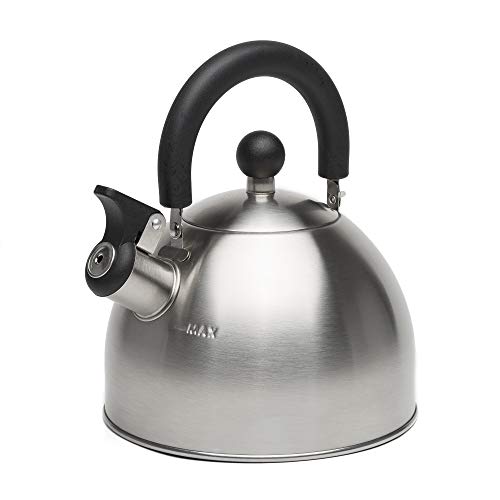
Primula
Fast-Boiling Stovetop Tea Kettle: Primula Stewart 1.5-Quart Stainless Steel Whistling Kettle
The Primula Stewart heats water quickly and whistles when boiling, making tea, coffee, and cocoa preparation easier on the stovetop. It suits compact kitchens and everyday users who want a stainless steel kettle with a folding handle for convenient storage.
Pros and Cons
Pros
- The whistling spout provides a clear boiling alert for easier stovetop monitoring.
- The folding handle helps the kettle fit into compact cabinets, drawers, or pantries.
- The wide opening simplifies cleaning and refilling.
- The 1.5-quart capacity provides several cups of hot water in one batch.
Cons
- The 1.5-quart capacity may require refills when serving a larger group.
- Because it is designed for stovetop use, it does not provide the convenience of an electric kettle.

Cosori
Fast Boil Glass Electric Kettle with No Plastic Contact - Cosori 1.7L Wide Mouth Tea & Coffee Water Heater
This 1.7-liter glass kettle boils water in under 3 minutes with zero plastic contact, using borosilicate glass and stainless steel construction for pure taste. Buy it if you want a fast, safe kettle that's easy to clean and won't leach chemicals into your tea or coffee.
Pros and Cons
Pros
- Borosilicate glass body is heat-resistant and shows exact water level without lifting the lid.
- One-touch lid button opens to a splash-reducing angle for pouring or fully opens for refilling and cleaning.
- Precision spout and cool-touch handle reduce spills and burn risk during pouring.
Cons
- Minor water condensation may drip from the bottom drain port during use, which is normal but can leave small puddles on the counter.
- Hard water leaves visible mineral spots on the stainless steel heating element after first use and requires regular descaling with vinegar.

GGC
Stovetop Whistling Tea Kettle for Family Tea and Pour-Over Coffee: GGC 3.2QT Stainless Steel Kettle
This 3L stainless steel kettle boils about 12 cups at once on gas, electric, or induction burners, with a loud whistle that signals a rolling boil from another room. Buy it if you brew for a household or guests and are tired of refilling a small kettle between rounds.
Pros and Cons
Pros
- Boils enough water for a full table in one go, cutting the wait between refills.
- The whistle is loud enough to hear from other rooms while you handle chores.
- Heat-resistant silicone handle and button-operated spout keep your hands away from steam.
- Diamond-textured black body with wood-pattern handle looks intentional left out on the stove.
Cons
- The whistle only works if you keep the water level below the spout opening, so a full-to-the-brim fill defeats it.
- Gas users are limited to low or medium flame, or the spout can scorch and the body can discolor.

Chefman
Fast Boiling Glass Electric Kettle for Tea & Coffee - Chefman 1.8L 1500W with Auto Shutoff
This 1500W glass kettle boils 1.8 liters in 3 minutes with automatic shutoff and boil-dry protection for safe, hands-off operation. Best for tea and coffee drinkers who want speed and visibility with blue LED indicators showing the heating process.
Pros and Cons
Pros
- Heats water in 3 minutes, significantly faster than stovetop kettles for the same volume.
- Glass construction shows water level and cleanliness at a glance, unlike opaque stainless steel models.
- Drip-free spout and cool-touch handle prevent burns and counter mess during pouring.
Cons
- Glass body shows fingerprints and water spots more visibly than stainless steel alternatives.
- No temperature presets, so it only boils to 100°C without options for delicate teas requiring lower temperatures.
Primula Fast-Boiling Stovetop Tea Kettle: Primula Stewart 1.5-Quart Stainless Steel Whistling Kettle
Primula
Fast-Boiling Stovetop Tea Kettle: Primula Stewart 1.5-Quart Stainless Steel Whistling Kettle
The Primula Stewart heats water quickly and whistles when boiling, making tea, coffee, and cocoa preparation easier on the stovetop. It suits compact kitchens and everyday users who want a stainless steel kettle with a folding handle for convenient storage.
$14.99 at AmazonEditors' Favorite
Color: Brushed with Black Handle Size: 1.5 Quarts Dimensions: 7.44 x 7.44 x 6.85 inches Weight: 1.15301763026 pounds Product Group: Kitchen Binding: Kitchen
Shop NowCosori Fast Boil Glass Electric Kettle with No Plastic Contact - Cosori 1.7L Wide Mouth Tea & Coffee Water Heater
Cosori
Fast Boil Glass Electric Kettle with No Plastic Contact - Cosori 1.7L Wide Mouth Tea & Coffee Water Heater
This 1.7-liter glass kettle boils water in under 3 minutes with zero plastic contact, using borosilicate glass and stainless steel construction for pure taste. Buy it if you want a fast, safe kettle that's easy to clean and won't leach chemicals into your tea or coffee.
$27.99 at AmazonGreat Value
Brand Name: Cosori Included Components: Electric Glass Kettle, Power Base, User Manual Recommended Uses For Product: Brewing tea and coffee, Preparing hot water for instant meals or beverages Model Name: Kettle Teapot Model Number: GK-172-CO UPC: 810043373425 Manufacturer: Cosori Part Number: GK172-01 Item Type Name: Electric Tea Kettle for Boiling Water Unit Count: 1.0 Count Best Sellers Rank: #321 in Home & Kitchen (See Top 100 in Home & Kitchen) #1 in Electric Kettles ASIN: B08PP48979 Customer Reviews: 4.5 4.5 out of 5 stars (48,126) 4.5 out of 5 stars Other Special Features of the Product: Automatic shutoff with accurate monitor(Strix Thermostat), No Plastic Contact with Water, No Plastic Spout, Stainless Steel Filter Container Type: Kettle Voltage: 120.0 Wattage: 1500 watts Capacity: 1.7 Liters Item Dimensions L x W x H: 8.7"L x 5.9"W x 10.3"H Item Weight: 2.7 Pounds Material: BPA-Free, Stainless Steel, Borosilicate Glass Material Features: Non-Toxic, Stainless Steel Filter Product Care Instructions: Hand Wash Color: Black Finish Type: Polished Brand: Cosori Special Feature: Automatic shutoff with accurate monitor(Strix Thermostat), No Plastic Contact with Water, No Plastic Spout, Stainless Steel FilterAutomatic shutoff with accurate monitor(Strix Thermostat), No Plastic Contact with Water, No Plastic Spout, Stainless Steel Filter See more
Shop NowGGC Stovetop Whistling Tea Kettle for Family Tea and Pour-Over Coffee: GGC 3.2QT Stainless Steel Kettle
GGC
Stovetop Whistling Tea Kettle for Family Tea and Pour-Over Coffee: GGC 3.2QT Stainless Steel Kettle
This 3L stainless steel kettle boils about 12 cups at once on gas, electric, or induction burners, with a loud whistle that signals a rolling boil from another room. Buy it if you brew for a household or guests and are tired of refilling a small kettle between rounds.
$36.99 at AmazonColor: Premium Black Size: 3 Quarts Dimensions: 7.7 x 7.7 x 8.8 inches Weight: 1.75928885076 pounds Product Group: Kitchen Binding: Kitchen
Shop NowChefman Fast Boiling Glass Electric Kettle for Tea & Coffee - Chefman 1.8L 1500W with Auto Shutoff
Chefman
Fast Boiling Glass Electric Kettle for Tea & Coffee - Chefman 1.8L 1500W with Auto Shutoff
This 1500W glass kettle boils 1.8 liters in 3 minutes with automatic shutoff and boil-dry protection for safe, hands-off operation. Best for tea and coffee drinkers who want speed and visibility with blue LED indicators showing the heating process.
$25.99 at AmazonBrand Name: Chefman Included Components: User Guide Recommended Uses For Product: Heating water for hot beverages, soup, ramen, and oatmeal Model Name: Fast-Boil Model Number: RJ11-18-PL UPC: 810087846701 Manufacturer: Chefman Global Trade Identification Number: 00810087846701 Part Number: RJ11-18-PL Item Type Name: Kettle Unit Count: 1.0 Count Best Sellers Rank: #406 in Home & Kitchen (See Top 100 in Home & Kitchen) #2 in Electric Kettles ASIN: B0C5Z8VCHX Customer Reviews: 4.5 4.5 out of 5 stars (12,641) 4.5 out of 5 stars Other Special Features of the Product: Anti Scale Mesh Filter, Heat Resistant Handle, Indicator Light, Removable Lid Container Type: Kettle Voltage: 120.0 Wattage: 1500 watts Capacity: 1.8 Liters Item Dimensions L x W x H: 8.75"L x 6.24"W x 9.45"H Item Weight: 2.3 Pounds Material: Borosilicate Glass Material Features: durable, rust-resistant, and cool-touch Product Care Instructions: Hand Wash Color: Black Finish Type: Brushed Brand: Chefman Special Feature: Anti Scale Mesh Filter, Heat Resistant Handle, Indicator Light, Removable Lid
Shop NowSur La Table Kitchen Essentials Large 2 QT Heavy Gauge Stainless Steel Tea Kettle - Matte Black

Sur La Table
Kitchen Essentials Large 2 QT Heavy Gauge Stainless Steel Tea Kettle - Matte Black
$42.99 at AmazonColor: Matte Black Size: 2 Quarts Dimensions: 7 x 9.5 x 9 inches Weight: 2.51106516418 pounds Product Group: Kitchen Binding: Kitchen
Shop Now




Write Your Review
No reviews yet. Be the first to share your experience!