

Lemons and limes sit side by side in the same produce bin and get treated as one shopping category, which is how a kitchen ends up with a squeezer that only half works. They are not the same fruit in any way a tool cares about. A Persian lime runs roughly 1.8 to 2.2 inches across the equator; a supermarket lemon measures 2.2 to 2.8. That half-inch decides whether a rind turns inside out cleanly or folds sideways and dribbles down your wrist.
Almost every complaint about citrus squeezers traces back to a belief about these two fruits that does not survive a ruler. Working through those beliefs one at a time beats another ranked list of models, because once you know what a lime actually is — small, thin-skinned, harvested unripe, seeded with flat little pips — cup size and squeezing force stop being guesswork.
The Single-Cup Assumption
One well-made squeezer is supposed to cover both fruits. It does not, and the reason is geometry rather than quality. A cup built for lemons has an inner diameter near 2.75 to 3 inches. Drop a 1.9-inch lime into it and the fruit has room to move; instead of the peel everting under even pressure from the rim inward, it tips, folds along one side, and sends juice past the edge onto the counter.
Hence the two-piece sets in yellow and green. The green cup usually measures around 2.25 inches inside, the yellow one closer to 2.75, and the pairing is honest engineering rather than a color scheme. A single mid-size cup at roughly 2.5 inches splits the difference and serves neither fruit especially well.
There is a useful asymmetry, though. A cup sized for the lime works better on lemons than a lemon cup works on limes, because a slightly oversized fruit still pinches against the rim and gets compressed, while an undersized one simply tumbles. If you only want to own one, buy the smaller cup.
Limes Are Not the Stingier Fruit
Limes get blamed for being tight-fisted. Per fruit that is fair: a 2-inch Persian lime hands over about 1.5 to 2 tablespoons, while a medium lemon gives 2 to 3.
Per ounce of fruit, the ranking ties or flips. A Persian lime weighs somewhere around 2 to 2.5 ounces against a medium lemon’s 3.5 to 4.5, so run the division and the lime is holding its own, frequently ahead. Size explains the gap you notice in the glass, not generosity.
What genuinely costs you juice is rind thickness. A thick-pithed lemon carries 4 to 5 millimeters of albedo, and that white layer sits between the vesicles and your bowl absorbing liquid on its way out. A Persian lime’s rind runs closer to 2 millimeters, so less of the yield vanishes into the fruit itself. That is why one tool feels generous on one lemon and stingy on the next from the same bag, and why hefting fruit at the store earns its three seconds: a lemon that feels light for its size is mostly pith.
Green Is a Shipping Decision
Deep green reads as ripe. It actually reads as durable. A fully ripe Persian lime turns pale yellow, softens slightly, and carries noticeably more liquid, while the dark fruit stacked in the display was picked early so it could survive weeks of handling without bruising.
So a yellowing lime is not spoiled. It is ready, and it will out-juice its green neighbors by a margin visible in a measuring spoon. That bin of pale, slightly soft limes marked down at the end of the week is often the best juicing fruit in the store.
Ripeness loops back into fit. A softer lime collapses more willingly in a cup that is a shade too big, which partly forgives a mismatch. A rock-hard green one holds its shape, refuses to evert, and skids.
Same Acid, Different Aromatics
Because both juices are fiercely sour, they get swapped for each other without much thought. On acid alone that holds up: both land near pH 2.0 to 2.4, close enough that for keeping cut apples from browning or cutting through fat, either one does the job.
Aroma is another matter. Lime carries terpenes that turn bitter and faintly soapy under sustained heat, which is why a lime-finished curry tastes like two different dishes depending on whether the juice went in at the stove or at the table. Lemon survives cooking better.
That chemistry has one concrete consequence for tool choice. Lime peel oil expressed by a hard squeeze contributes bitterness fast, faster than lemon oil does, and no strainer removes it afterward. A tool that lets the rind dome outward under pressure from the rim keeps most of that oil in the peel; a design that presses the rind flat against a plate grinds the oil straight into the juice, and that costs more on limes than on lemons.
Force Has a Ceiling
Squeezing harder gets more juice only up to the moment the rind turns inside out. Past that point the vesicles have already ruptured and given up what they hold, so the extra force works on peel oil and pith instead, pushing bitter compounds down through the holes with the last few drops.
Two firm pulls with a full release between them beat one crushing pull. The release lets the rind relax and re-seat so a different part of the pulp faces the next squeeze. Limes need less force than lemons for the same result, since there are only about 2 millimeters of rind to work through, and a grip calibrated to a thick lemon will make a lime taste bitter.
Hole Size Beats Hole Count
Any built-in strainer is assumed to keep seeds out, and on limes most of them do not. Lime seeds are small and flat, often under 4 millimeters long and barely a millimeter thick, so a seed can turn edge-on and pass through an opening it has no business fitting. Lemon pips are 8 to 12 millimeters and plump, and a perforation pattern designed around them is effectively an open gate for lime.
If limes are your routine, read hole diameter instead of counting holes. Openings near 2 millimeters, or a mesh in the 1 to 1.5 millimeter range, stop the flat seeds at the cost of slower flow and more pulp left behind. Persian limes are sold as seedless and mostly are, though the occasional pip appears; Key limes, at 1 to 1.5 inches across, carry ten or more each and fit no standard cup at all.
Sizing a Cup to the Fruit You Buy
Skip the label and measure. Put a ruler across three or four fruits from the store you actually shop at, at the widest point, and write down the largest number. Then look for a cup whose inner diameter sits at or just under that figure, because you want the rim to catch the fruit rather than let it drop in. For most shoppers the answer falls between 2.2 and 2.4 inches, which covers Persian limes and small lemons and treats an oversized lemon as a job for a knife.
Bottled lime juice tastes bitter for a processing reason rather than a fruit reason. Pasteurization near 185 degrees drives off the volatile top notes and pushes limonoid precursors toward limonin, the compound behind that flat, medicinal edge, and added preservatives finish the job. The fruit was fine; the heat was not.
Whole limes hold one to two weeks in the refrigerator and about five days on the counter, and the chilled ones stay juicier. Fresh juice is at its best inside 72 hours, after which the aroma flattens even while the acid holds. For cooking, freeze it in tablespoon portions in an ice cube tray: frozen lime juice loses its bright top end but keeps its sourness, which is all a braise or a marinade asks of it.
Can I use a lime squeezer on lemons?
Yes, and it is the better direction to compromise in. A 2.25-inch cup pinches a 2.5-inch lemon against the rim, and that contact is what starts the peel folding outward, so you still get a clean inversion and most of the yield. What you give up is a little completeness, since the rind cannot fully turn inside out in a smaller bowl, and the biggest fruit may need a second pass or a quarter cut instead of a half. Reverse the mismatch and a lime rattles around inside a lemon-sized cup, folds sideways, and sprays. For a single-squeezer kitchen that buys both fruits, the small cup is the safer purchase.
Why do my limes seem drier than the ones behind a bar?
Usually the fruit is different, not the tool. A busy bar turns over limes fast enough to use them ripe, and a lime that has started to pale is carrying more liquid than the dark green one that arrived yesterday. Thick skin compounds it, since an extra millimeter or two of pith absorbs juice before it ever reaches the glass. Weigh two same-size limes in your hands and take the heavy one; the difference between a 1.5-tablespoon lime and a 2-tablespoon lime lives mostly in that heft.
What hole size actually stops lime seeds?
Around 2 millimeters, or a mesh screen in the 1 to 1.5 millimeter range. Lime seeds run under 4 millimeters on the long axis and only about a millimeter thick, so they act like tiny coins and slide edge-on through slots that would never pass a lemon pip. The trade-off is flow, because tighter holes drain slowly and hold back pulp you may have wanted in the glass. If your juicing is split between the two fruits, sizing for lime and accepting the slower drain saves you fishing seeds out of a drink later.
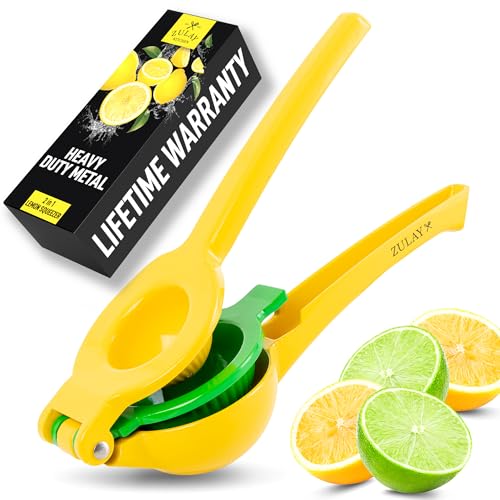
Zulay Kitchen
Manual Lemon and Lime Juicer for Fast Citrus Prep, Zulay Kitchen 2-In-1 Squeezer
The Zulay Kitchen 2-in-1 citrus squeezer extracts juice from lemons, limes, and small oranges while filtering seeds through its base, reducing waste and mess. It suits home cooks and cocktail makers who want quick, battery-free citrus prep in a compact, dishwasher-safe tool.
Pros and Cons
Pros
- The ergonomic handle makes pressing more comfortable, including for smaller hands.
- The 2-in-1 design handles common small citrus fruits with one manual tool.
- The seed-filtering bowl helps keep pulp and seeds out of finished juice.
- A lifetime guarantee provides added support if the tool develops an issue.
Cons
- It requires manual hand pressure, so it is less suitable for high-volume juicing.
- The bowl is intended for lemons, limes, and small oranges rather than larger citrus fruit.
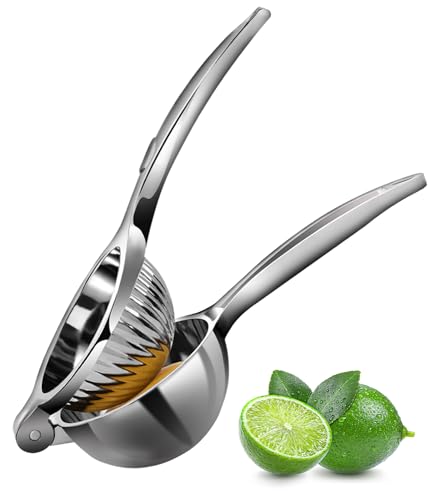
Rekix
Fresh Citrus Juice with Rekix Lemon Squeezer Max Extraction Hand Press Juicer
The Rekix Lemon Squeezer presses lemons, limes, and small oranges while its max-extraction design helps reduce leftover juice. It suits home cooks and bartenders who want a durable manual citrus tool that is easy to use and clean.
Pros and Cons
Pros
- Max-extraction pressing helps get more juice from each lemon or lime.
- Metal construction is designed for durability during regular use.
- The ergonomic handle supports comfortable manual squeezing.
- It can be rinsed under the tap or placed in the dishwasher.
Cons
- As a manual juicer, it still requires hand pressure for every fruit.
- The design is intended for lemons, limes, and small oranges rather than large citrus.

RCMo
Fresh Lemon and Lime Juice for Recipes and Cocktails: RCMo 304 Stainless Steel Manual Squeezer
This handheld RCMo squeezer extracts lemons and limes for recipes and cocktails, with a design claimed to produce 20% more juice than other citrus juicers. It suits home cooks and bartenders who want a durable manual tool that rinses quickly or goes in the dishwasher.
Pros and Cons
Pros
- 304 stainless steel construction supports repeated kitchen and bar use.
- The large bowl handles lemons, limes, and other small citrus fruits.
- Reinforced hinges, thick casting, and strong levers support efficient pressing.
- It can be rinsed under the faucet or placed in the dishwasher.
Cons
- Manual squeezing still requires hand pressure for each piece of fruit.
- Its bowl is intended for lemons, limes, and other small citrus rather than large fruit.
The Best Deals This Week*
-
Manual Lemon and Lime Juicer for Fast Citrus Prep
$14.99
($16.99)Save $2.00 -
Fresh Citrus Juice with Rekix Lemon Squeezer Max
$11.99
($12.99)Save $1.00 -
Lemon Squeezer Stainless Steel with
$22.49
($24.99)Save $2.50 -
Fresh Lemon and Lime Juice for Recipes
$19.99
($24.99)Save $5.00
*Deals are selected by our commerce team
Zulay Kitchen Manual Lemon and Lime Juicer for Fast Citrus Prep, Zulay Kitchen 2-In-1 Squeezer
Zulay Kitchen
Manual Lemon and Lime Juicer for Fast Citrus Prep, Zulay Kitchen 2-In-1 Squeezer
The Zulay Kitchen 2-in-1 citrus squeezer extracts juice from lemons, limes, and small oranges while filtering seeds through its base, reducing waste and mess. It suits home cooks and cocktail makers who want quick, battery-free citrus prep in a compact, dishwasher-safe tool.
$14.99 at AmazonEditors' Favorite
Color: Yellow and Green Size: 2 in 1 Lemon Squeezer Dimensions: 8.7 x 2.9 x 2.1 inches Weight: 0.7 Pounds Product Group: Kitchen Binding: Kitchen
Shop NowRekix Fresh Citrus Juice with Rekix Lemon Squeezer Max Extraction Hand Press Juicer
Rekix
Fresh Citrus Juice with Rekix Lemon Squeezer Max Extraction Hand Press Juicer
The Rekix Lemon Squeezer presses lemons, limes, and small oranges while its max-extraction design helps reduce leftover juice. It suits home cooks and bartenders who want a durable manual citrus tool that is easy to use and clean.
$11.99 at AmazonGreat Value
Color: Silver Size: Large Dimensions: 8.5 x 6.7056 x 2 inches Weight: 0.7605948039 pounds Product Group: Kitchen Binding: Kitchen
Shop NowZulay Kitchen Lemon Squeezer Stainless Steel with Premium Quality Heavy Duty Solid Metal Squeezer Bowl - Large Manual Citrus Press Juicer and Lime Squeezer Stainless Steel - by Zulay Kitchen

Zulay Kitchen
Lemon Squeezer Stainless Steel with Premium Quality Heavy Duty Solid Metal Squeezer Bowl - Large Manual Citrus Press Juicer and Lime Squeezer Stainless Steel - by Zulay Kitchen
$22.49 at AmazonColor: Silver Size: Large Dimensions: 10.236220462 x 5.118110231 x 1.968503935 inches Weight: 1.1464 Pounds Product Group: Kitchen Binding: Kitchen
Shop NowKitchenAid Citrus Juice Press Squeezer for Lemons and Limes with Seed Catcher and Pour Spout, Lemon, 8 Inch
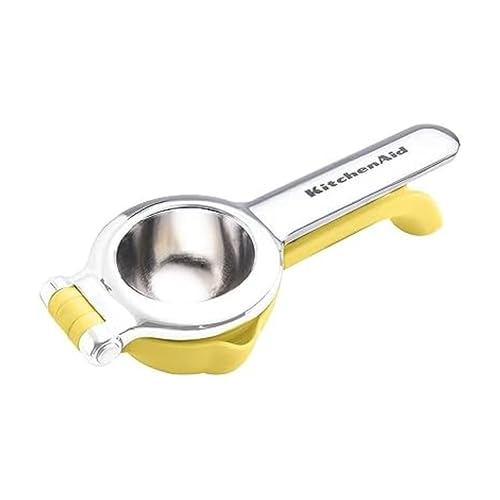
KitchenAid
Citrus Juice Press Squeezer for Lemons and Limes with Seed Catcher and Pour Spout, Lemon, 8 Inch
$19.99 at AmazonColor: Lemon Size: 8 Inch Dimensions: 2.25 x 3.5 x 8.07 inches Product Group: Kitchen Binding: Kitchen
Shop NowRCMo Fresh Lemon and Lime Juice for Recipes and Cocktails: RCMo 304 Stainless Steel Manual Squeezer
RCMo
Fresh Lemon and Lime Juice for Recipes and Cocktails: RCMo 304 Stainless Steel Manual Squeezer
This handheld RCMo squeezer extracts lemons and limes for recipes and cocktails, with a design claimed to produce 20% more juice than other citrus juicers. It suits home cooks and bartenders who want a durable manual tool that rinses quickly or goes in the dishwasher.
$19.99 at AmazonColor: Black Dimensions: 2.19 x 3.34 x 9.05 inches Product Group: Kitchen Binding: Kitchen
Shop Now









Write Your Review
No reviews yet. Be the first to share your experience!