

Most advice about induction compatible pots stops at whether the burner will recognise the metal. That gets you switched on, not cooking well. Once the zone lights, everything after it is geometry: how wide the base is next to the coil under the glass, how flat it sits, how tall the walls climb, and which other zone is drawing power at the same moment. A pot that is perfectly compatible can still boil slowly, brown in a ring, or buzz.
Every Zone Has a Diameter It Refuses to See
An induction zone does not switch on because something metal is nearby. It switches on because a base is loading the coil enough for the detection circuit to register it, and that threshold is a diameter, usually between 4 and 5.5 inches on a standard zone. Manufacturers print the figure in the manual far more often than on the box. A 6-inch saucepan clears it comfortably. A 3.5-inch butter warmer, or the narrow pedestal under a moka pot, does not, and the hob either flashes a pan-detection error or never leaves standby.
The more irritating failure is the intermittent one. A base sitting right at the floor couples well enough to start, then loses the hob as the metal expands, the pot shifts a millimetre, or boiling changes the load. Ten minutes into a reduction the zone drops out and beeps. Small zones on some hobs go down to 3.5 inches, and a ferromagnetic interface disc will bridge the gap, though it adds a layer and gives back much of the speed you bought induction for.
The Coil Is a Ring, Not a Disc
Under the glass sits a flat spiral of wire, and the field is strongest directly over the winding rather than across the whole circle it encloses. Heat therefore enters the base as an annulus: a band of hot metal an inch or two wide, with a cooler middle and nothing at all past the coil’s outer edge. Usually you never notice, because the base spreads that band before the food feels it.
Put a pot much wider than its zone on it and the pattern shows through. A 10-inch pot on a 6-inch zone has an outer two inches heated only by sideways conduction, so butter browns in a circle and the edge of a pancake stays pale. The opposite mismatch is wasteful rather than uneven: a 5-inch base on a 9-inch zone leaves the outer windings coupling to air. Matching base diameter to zone diameter within roughly an inch either way is the single most useful fit rule for induction compatible pots, and it changes everyday results more than anything else here.
Flatness Measured in Millimetres, Not Impressions
Coupling falls off sharply with distance, so the gap between base and glass matters at a scale you would happily ignore on gas. A base bowed 1 to 2 mm across its width, invisible to the eye but obvious against a straightedge, holds the centre far enough from the coil to lose real efficiency while the ring still touching takes the whole load. That varying gap is also where buzzing starts: the base flexes fractionally at the inverter’s switching frequency, and the changing distance becomes noise.
History matters here. A pot that spent five years over a gas ring has been heated from the edges inward hundreds of times, and thin bases take a permanent dish from it. It cooked fine on the flame, which reached up the sides anyway. On induction the same pot climbs slower to a boil and rattles. Many good pots are also ground slightly concave when cold so they flatten as the base expands, so a faint rock on a cold hob is not automatically a defect.
Base Thickness Does the Spreading
Because induction heats the base and nothing else, moving heat sideways is entirely the pot’s job. A flame licks outward and forgives a thin pan; a coil deposits energy in a fixed band and forgives nothing. A sandwich base of 4 to 6 mm carries enough cross-section to redistribute heat faster than the food absorbs it, which is what turns the coil’s ring into an even bottom. At 1 to 2 mm there is not enough metal to move anything, so the pot prints the winding pattern onto whatever touches it: milk scorched in a circle, a roux that browns in an arc while the middle stays blond.
The tradeoff is response time. Six millimetres holds genuine heat, lagging 20 to 30 seconds behind a power change, which suits stock and frustrates a pan sauce you are trying to pull back. Read thickness as a number on the spec sheet, because two pots described in the same words can differ by a factor of three.
Wall Height and Slope Change the Cooking
Heat arriving only at the bottom sets up convection, and the pot’s shape decides what that convection does. A tall narrow stockpot, say 8 inches across and 9 deep, drives a strong vertical circulation and brings 4 litres to the boil quickly because the heated column keeps turning over. Spread the same 4 litres into a wide shallow pan and identical wattage is diluted across far more surface, so it boils later and reduces much faster once there. One is built for stock, the other for sauce.
Slope is the detail people miss. A sauteuse with curved flaring walls and a 10-inch rim may put only 7 inches of flat metal over the coil, so it behaves like a smaller pot than it looks and belongs on a smaller zone than its rim suggests. A straight-sided pan of the same rim diameter delivers nearly its full width to the glass. Measure the flat and treat the rim as a serving figure.
Four Zones, One Power Budget
A hob’s total rating is not the sum of what its zones can each deliver. Most four-zone units pair zones onto shared inverter modules, left front with left rear and right front with right rear, and a hob rated 7200 W cannot hand four zones 3000 W at once. Ask both halves of a pair for everything and the electronics split what the module has, commonly capping each near 1500 to 1800 W. The effect is blunt: a pot that boiled alone in 5 minutes takes 9 with a neighbour drawing beside it, and the boost button will not argue.
Layout becomes a decision rather than a habit. Pasta water and a hard-searing pan belong on opposite sides so they draw from different modules, while a ticking sauce can share with anything. Bridge or flex zones answer the other geometry problem, linking two coils so a long griddle or an oval fish pot spans them as one surface. Without a bridge, an oval pot centred between zones sits over the dead gap and couples poorly to both, heating at its two ends and staying cool in the middle.
A Fitting Routine That Takes Ten Minutes
Turn each pot over and measure the flat contact area rather than the rim. On a disc-bottom pot that means the disc; on a flared pot the flat stops where the curve begins. Then find your zone diameters, either printed as circles on the glass or listed in the manual, and pair each pot with the zone within about an inch of its base. Anything under the detection floor goes to the small zone or onto an interface disc. Check the doubtful pots against a straightedge and retire the ones that are visibly dished.
Finish with the wiring you cannot see. The manual’s zone table shows which pairs share a module, so assign your two highest-power tasks to opposite sides and leave paired zones for simmering. A quick pass with a magnet tells you whether an unlabelled pot is worth measuring at all. Done once, this settles which pot goes where for years, and it cures more slow-boil and uneven-browning complaints than buying new cookware does.
What is the smallest pot that will work on an induction hob?
Most standard zones detect a base of roughly 4 to 5.5 inches, and anything narrower is likely to be ignored or to drop out once it heats. Check the manual rather than guessing, since the figure varies by model and the small zone is often more forgiving than the large one. A 6-inch saucepan is a safe floor for general cooking. If you need a 3-inch moka pot or a tiny butter warmer, an interface disc will run it, at the cost of speed and some responsiveness.
Can a pot be too big for an induction zone?
It can, though the symptom is uneven heating rather than a refusal to start. Heat enters only over the coil, so a base overhanging by more than an inch has an outer band warmed purely by conduction, which thin bases show as a browned circle with a pale edge. A thick 5 to 6 mm base hides a moderate mismatch by spreading heat outward. A 12-inch stockpot on a 6-inch zone also boils slower than its wattage implies. Keep base and zone within an inch and the problem goes away.
Why does my pot boil slower when another zone is running?
Because paired zones share an inverter module and therefore a power ceiling. A hob rated 7200 W may allow 3000 W to one zone but only 1500 to 1800 W each when both halves of a pair are working, which roughly doubles a 5-minute boil. Nothing is broken and the hob is not throttling arbitrarily; it is dividing a fixed budget between two demands. The specification table in the manual shows which zones are linked. Move the pot that needs power to the opposite side and the full wattage returns.

SENSARTE
Nonstick Stock Pot for Soups, Pasta and Stews: SENSARTE Induction-Compatible Multipot with Glass Lid, 2.6 to 11 QT
This die-cast aluminum stock pot handles stewing, boiling, braising, blanching and pasta with a Switzerland ILAG nonstick surface that releases food cleanly and needs very little oil. Choose it if you want one deep pot for batch soups and pasta nights that wipes clean by hand and works on induction as well as gas or electric.
Pros and Cons
Pros
- SGS-approved coating is free of PFOA, PFOS, APEO, lead and cadmium, addressing the main concern buyers have about nonstick cookware.
- Wood-grain bakelite handle is shaped for a secure grip when moving a full pot from burner to counter.
- One pot covers stewing, braising, frying, blanching and pasta, cutting down on how many pieces you need on the stove.
- Thick base resists warping, so the pot stays flat and keeps full contact with induction and flat-top burners.
Cons
- Hand washing is recommended, so it will not fit into a dishwasher-only cleanup routine.
- Bakelite handles and the glass lid limit high-heat oven use compared with all-metal stock pots.

MICHELANGELO
Stainless Steel Saucepan Set for Sauces, Grains and Reheating: MICHELANGELO 6pc Tri-Ply Bottom Sauce Pot Set with Glass Lids
This three-pan set covers 1, 2, and 3 quart cooking with 18/10 stainless steel and a tri-ply base that spreads heat evenly across induction, gas, and electric burners. Buy it if you want one matched set that handles morning oatmeal, weeknight rice, and simmered sauces, then goes into the oven up to 600°F without swapping cookware.
Pros and Cons
Pros
- Food-grade 304 stainless interior will not react with tomato, wine, or citrus, so acidic sauces keep their flavor.
- Magnetic tri-ply base works on induction cooktops as well as gas and electric coil.
- Dishwasher safe stainless construction with no coating to peel or blister over time.
- Riveted handles are anchored through the pan wall rather than spot welded, which holds up under a full 3 quart load.
Cons
- The listing calls the set nonstick while also describing bare 18/10 stainless, so expect eggs and starches to stick unless you preheat and use fat.
- Glass lids top out at 350°F, well below the 600°F pan rating, so the lids have to come off for high-heat oven or broiler work.
EWFEN
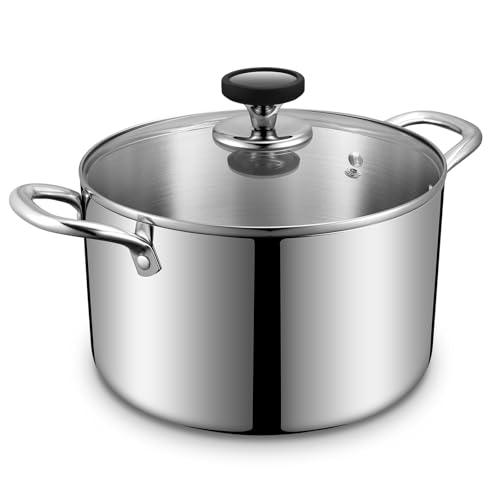
6.5-Quart Tri-Ply Stainless Steel Stock Pot for Pasta, Soup and Induction Cooking
The EWFEN 6.5-quart stock pot handles pasta, soup, steaming, simmering and roasting, while its tri-ply construction promotes even heating across all stovetops. It suits families and batch cooks who want a dishwasher-safe pot with an oven-safe stainless steel body and visible glass lid.
Pros and Cons
Pros
- The 18/8 stainless steel interior and aluminum core provide a food-grade cooking surface with even heat distribution.
- The stainless steel body is oven safe to 500°F, expanding its use beyond stovetop cooking.
- The large capacity and double-handle design support family-size meals and safer handling.
- The seamless, polished construction helps reduce residue buildup and makes maintenance easier.
Cons
- The glass lid is oven safe only to 350°F, lower than the pot body's 500°F limit.
- The product data does not list the pot's weight, so buyers cannot assess how heavy it will feel when full.
The Best Deals This Week*
-
COOKER KING Sauce Pan Set
$42.83
($47.59)Save $4.76 -
Nonstick Stock Pot for Soups, Pasta and Stews
$34.19
($49.99)Save $15.80 -
Stainless Steel Saucepan Set for Sauces
$54.99
($69.99)Save $15.00
*Deals are selected by our commerce team
COOKER KING Sauce Pan Set, 1.5 QT & 2 QT Saucepan with Lid, Hybrid Ceramic Nonstick Saucepan, non stick Sauce pot, Stainless steel Cookware, Induction Compatible (PFAS/PFOA/PTFE Free)

COOKER KING
Sauce Pan Set, 1.5 QT & 2 QT Saucepan with Lid, Hybrid Ceramic Nonstick Saucepan, non stick Sauce pot, Stainless steel Cookware, Induction Compatible (PFAS/PFOA/PTFE Free)
$42.83 at AmazonEditors' Favorite
Color: Silver Size: 1.5 Quarts & 2 Quarts Dimensions: 8.5 x 8 x 6.8 inches Weight: 5.39912079638 pounds Product Group: Kitchen Binding: Kitchen
Shop NowSENSARTE Nonstick Stock Pot for Soups, Pasta and Stews: SENSARTE Induction-Compatible Multipot with Glass Lid, 2.6 to 11 QT
SENSARTE
Nonstick Stock Pot for Soups, Pasta and Stews: SENSARTE Induction-Compatible Multipot with Glass Lid, 2.6 to 11 QT
This die-cast aluminum stock pot handles stewing, boiling, braising, blanching and pasta with a Switzerland ILAG nonstick surface that releases food cleanly and needs very little oil. Choose it if you want one deep pot for batch soups and pasta nights that wipes clean by hand and works on induction as well as gas or electric.
$34.19 at AmazonGreat Value
Color: Classic Black Size: 4.5 Quarts Dimensions: 12.2834645544 x 11.2204724295 x 3.93700787 Inches Weight: 5.180863157 pounds Product Group: Kitchen Binding: Kitchen
Shop NowMICHELANGELO Stainless Steel Saucepan Set for Sauces, Grains and Reheating: MICHELANGELO 6pc Tri-Ply Bottom Sauce Pot Set with Glass Lids
MICHELANGELO
Stainless Steel Saucepan Set for Sauces, Grains and Reheating: MICHELANGELO 6pc Tri-Ply Bottom Sauce Pot Set with Glass Lids
This three-pan set covers 1, 2, and 3 quart cooking with 18/10 stainless steel and a tri-ply base that spreads heat evenly across induction, gas, and electric burners. Buy it if you want one matched set that handles morning oatmeal, weeknight rice, and simmered sauces, then goes into the oven up to 600°F without swapping cookware.
$54.99 at AmazonColor: Tri-Ply Bottom Size: 1+2+3QT Dimensions: 16 x 10 x 6 inches Weight: 4.6 pounds Product Group: Kitchen Binding: Kitchen
Shop NowEWFEN 6.5-Quart Tri-Ply Stainless Steel Stock Pot for Pasta, Soup and Induction Cooking
EWFEN
6.5-Quart Tri-Ply Stainless Steel Stock Pot for Pasta, Soup and Induction Cooking
The EWFEN 6.5-quart stock pot handles pasta, soup, steaming, simmering and roasting, while its tri-ply construction promotes even heating across all stovetops. It suits families and batch cooks who want a dishwasher-safe pot with an oven-safe stainless steel body and visible glass lid.
$23.98 at AmazonColor: Silver Size: 6.5 Quarts Dimensions: 5.59 x 13.94 x 8.11 inches Weight: 5.291094288 pounds Product Group: Kitchen Binding: Kitchen
Shop Now




Write Your Review
No reviews yet. Be the first to share your experience!