

The stamp on the underside of a pan settles an argument it was never having. It reports that a sample went through a run of machine cycles without lifting, bubbling or corroding. That is real information, and narrower than most buyers hear. Almost every complaint about dishwasher safe nonstick cookware starts in the gap between what the mark certifies and what people assume it promises, so the beliefs are worth taking one at a time.
The stamp certifies survival, not slickness
Treat the label as an engineering pass or fail and it clarifies quickly. A sample pan runs a fixed number of cycles, often 500 or more, and an inspector checks for delamination, blistering, pitting and edge corrosion. Find none of those and the pan is dishwasher safe. Nothing in that protocol measures how readily an egg leaves the surface afterwards.
Release is left out because it degrades by degrees rather than failing at a point, and because measuring it repeatably is awkward. A surface can drift from genuinely slick to needing a film of butter without crossing any line the test would catch. So an owner can follow the care card exactly, notice inside a year that eggs grab and omelettes tear, and be told, accurately, that nothing is wrong with the pan.
Heat is the smaller half of the story
Blame usually lands on temperature, which is intuitive and wrong. Wash water in a domestic machine sits between 120 and 150°F. The heated dry stage runs hotter, pushing interior air to roughly 160 or 180°F, warm enough to buckle a thin plastic lid and nowhere near enough to trouble a fluoropolymer. Coatings begin breaking down thermally between 400 and 500°F, which an empty pan on a gas burner reaches in under ten minutes.
The agent doing the work is chemistry. Automatic dishwasher detergent is built to be strongly alkaline, most powders and pods measuring pH 10 to 11.5, because alkalinity is what breaks baked-on fat apart. A typical formula pairs sodium carbonate with proteolytic enzymes and an oxygen bleach, tuned to lift organic residue off glass and glazed stoneware without a brush touching it. Cookware is only in the box while that happens.
Aluminium has no protection there. Anywhere the coating is scratched, thinned by a metal spatula or interrupted by a rivet head, the solution reaches bare metal and etches it, spreading outward from the original flaw. Sol-gel ceramic loses something else: a thin conditioning layer that behaves a little like seasoning, which alkaline detergent removes outright.
Ninety minutes of soaking against sixty seconds of sponge
Then there is the idea that spray must be kinder than hands, since nothing scrubs. Jets in a residential machine push around 15 to 25 PSI, less force than a thumb behind a sponge, so the pressure half of that is true. Duration is where it falls apart. A cycle runs 90 to 150 minutes, most of it warm alkaline mist replenished on the surface every few seconds.
Set the two regimes side by side across a year. Hand washing gives the coating perhaps 60 seconds against dilute, near-neutral dish soap, once a day. Machine washing gives it two hours of concentrated high-pH exposure at 140°F, once a week, fifty-odd times over. The method that looks gentler delivers something like fifteen times the total chemical contact, at a pH two to three points higher.
Rinse aid is the most misdiagnosed part of all this. It is a surfactant that lowers the surface tension of water so droplets sheet off rather than beading and drying into spots. Invisible on glass. On a nonstick interior it leaves a residue that reads as dull and faintly tacky, and owners take that for a coating giving up. A hand wash and a wiped-in drop of oil usually brings the surface back.
Top rack is a rule about geography
Care cards say top rack only, and nearly everyone files that under heat. Position matters for duller reasons. The lower basket sits closest to the heating element in the floor of the tub, and it takes the first and most concentrated pass of the main jet before detergent disperses through the load.
Traffic matters more. Down among plates and bowls a pan gets knocked by a stainless mixing bowl or a pot lid on every fill and drain surge, and a coated interior against a hard steel rim scratches every time. Multiply by 150 cycles and contact abrasion has done more visible harm than the detergent managed. Those scratches then become the entry points alkalinity needs, so the two mechanisms feed each other.
Three coatings, three different ways this goes wrong
Lumping all nonstick together hides the useful part. Hard-anodised aluminium carries a thick, electrochemically grown oxide layer, and repeated alkaline washing dulls it to a chalky, mottled grey. That looks alarming and it is cosmetic. The oxide is still there and still hard; what changed is how light comes off it.
PTFE is the more interesting case, because the coating itself is inert and detergent cannot touch it. What detergent can reach is the primer underneath, the adhesion layer bonding fluoropolymer to metal. Alkaline solution creeping into one nick works sideways beneath that primer and lifts it, which is why flaking starts at a nick or a rivet edge and grows, instead of appearing in the middle of an untouched surface. An unscratched PTFE interior tolerates the machine; a scratched one does not.
Sol-gel ceramic takes the worst of it. Its slickness comes from a silica-based surface whose performance depends on that conditioned top layer, and detergent strips it whether the pan is scratched or flawless. Nothing breaks, nothing flakes, and yet food starts catching after a handful of cycles. Here hand washing is less a recommendation than a condition of the pan working.
Look at the rivets, not the cooking surface
The parts nobody inspects fail first. Phenolic handles are thermoset resin with filler; they take on water each cycle, swell, dry and check into fine cracks, and the bolt seated in that material works loose after a year or two. Silicone sleeves survive the chemistry but trap water underneath, which is how a handle starts smelling of old dishcloth.
Rivets are the honest witness. They pass through the coated interior, so there is bare or thinly covered metal at every head by design, and that is where etching appears first. Set two identical pans side by side after a year, one hand washed and one machine washed, and the rivet heads say which is which before you look anywhere else: dull, faintly pitted, ringed with a white bloom.
The trade, priced honestly
Machine washing a nonstick pan buys minutes now and spends months of release later, and whether that is a good deal depends on what the pan cost and how long it is meant to last. A $25 supermarket skillet replaced every two years belongs in the dishwasher without hesitation; the coating will not outlive the pan either way and the saved time is real. A $120 pan bought to last five years is a different sum, and the machine is a poor bargain.
The workable middle for dishwasher safe nonstick cookware sits between the absolutes. Wash the interior by hand, sixty seconds with a soft sponge and a drop of ordinary dish liquid, and give the machine the lids, the exterior and everything else. Keep anything already scratched out of the dishwasher completely, because a scratch is where the chemistry gets underneath. Leave rinse aid out of loads carrying cookware. And never let a pan sit in a closed, wet machine overnight, which is the cheapest habit here to fix.
Does washing a nonstick pan once in a while really matter?
One cycle will not ruin a sound pan. The harm is cumulative, so the count is what matters: twice a year is noise, once a week for two years is roughly 100 alkaline cycles. On an unscratched interior the occasional pass costs very little. One wash does real damage where there is already a gouge or a worn rivet edge, since that is an open door for the detergent. Judge it by the state of the coating, not the calendar.
Is a shorter or eco cycle better for nonstick pans?
It helps, though not for the reason most people expect. A short or express programme cuts contact time from about 120 minutes to 40 or 50, and contact time is the variable that matters. Eco settings do the reverse: they run cooler but longer, sometimes past three hours, trading a small temperature saving for much more alkaline exposure. If a pan is going in, choose the quickest cycle and switch heated dry off, then open the door as soon as it stops. That removes most of the exposure without changing anything else.
Can a machine-washed pan be brought back to slick?
Partly, and it depends which surface you have. If the dullness is rinse-aid residue, a hand wash with dish soap, then a thin coat of neutral oil wiped in and buffed off, restores most of the release in one go. Sol-gel ceramic answers to the same treatment, since what it lost was a conditioning layer that oil and gentle heat can rebuild. PTFE that has started lifting at a nick is finished, because the bond underneath is gone and nothing you apply reaches it. Grey haze on hard-anodised metal is permanent and harmless, so leave it.
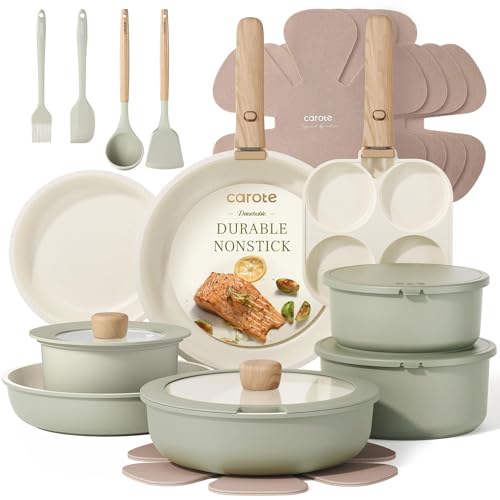
CAROTE
Space-Saving Cookware for Small Kitchens: CAROTE 25pc Detachable Handle Nonstick Pots and Pans Set
This 25-piece nonstick set covers frying, sauteing, and simmering with removable handles that let the pans nest down to save up to 70% of cabinet space. Buy it if you cook in a small kitchen or need pans that move from stovetop to oven to table without a second serving dish.
Pros and Cons
Pros
- Detachable handles cut storage volume dramatically compared to a traditional pan set.
- Oven and grill compatible with the handle removed, expanding what one pan can do.
- Pans double as dinnerware, cutting the number of dishes you wash after a meal.
- Backed by a 12-month manufacturer warranty for quality issues.
Cons
- Detachable handle systems require checking the lock on every pan before lifting hot food.
- Nonstick coatings need low to medium heat and soft utensils, so this is not a high-heat searing set.
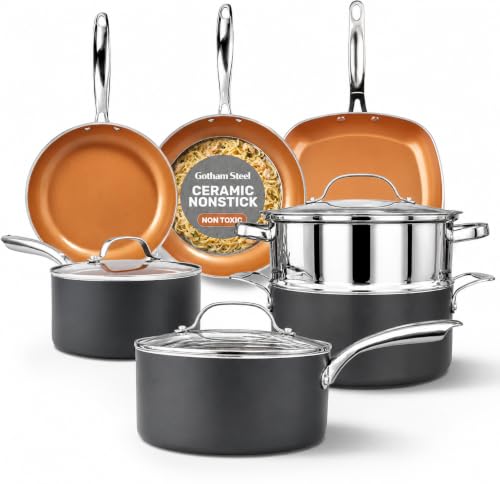
GOTHAM STEEL
Everyday Family Cooking: GOTHAM STEEL 12-Piece Copper Ceramic Cookware Set with Steamer
This 12-piece GOTHAM STEEL ceramic cookware set covers frying, simmering, steaming, and stock-pot cooking, with its biggest advantage being a broad assortment in one purchase. It suits cooks outfitting a kitchen or replacing mismatched pans who want easy food release, dishwasher cleanup, and compatibility with gas, electric, or glass cooktops.
Pros and Cons
Pros
- The set includes a steamer insert, multiple lids, and cookware sizes that cover common daily meals.
- The ceramic surface is free of PFOA, PFOS, lead, and cadmium.
- Stay-cool ergonomic handles provide a more comfortable grip during stovetop cooking.
- Gas, electric, and glass cooktop compatibility supports varied kitchen setups.
Cons
- Induction compatibility is not listed, so induction cooktop owners should choose a confirmed induction-ready set.
- The product data does not specify the cookware's total weight, which may matter to buyers who prefer lightweight pans.

SENSARTE
Everyday Low-Oil Cooking: SENSARTE 20-Piece Black Titanium Nonstick Cookware Set
This 20-piece SENSARTE cookware set handles frying, sautéing, simmering, and crepe making, with easy food release as its biggest advantage. It suits home cooks replacing multiple pans who want induction compatibility, convenient cleanup, and less-oil cooking in one coordinated set.
Pros and Cons
Pros
- The coating contains no intentionally added PFOA, PFOS, lead, or cadmium for buyers prioritizing cookware material disclosures.
- Stay-cool handles provide a more comfortable grip during stovetop cooking.
- Tempered glass lids have silicone edges that seal quietly and help protect against chipping.
- The included six pan protectors reduce scratching when the cookware is stacked for storage.
Cons
- Handles must be removed before oven use, adding an extra step when transferring dishes from stovetop to oven.
- Although dishwasher safe, hand washing is recommended to preserve the finish over time.

T-Fal
Ultimate Hard Anodized 14-Piece Nonstick Cookware Set with Thermo-Spot Heat Indicator
This 14-piece hard anodized set includes everything from an 8-inch fry pan to a 5-quart Dutch oven, with Thermo-Spot technology that shows when pans reach proper cooking temperature. Home cooks who want a complete nonstick collection with visual heat cues should consider this affordable, dishwasher-safe option.
Pros and Cons
Pros
- Complete set eliminates the need to buy individual pans, covering frying, sautéing, steaming, and simmering in one purchase.
- Thermo-Spot technology takes the guesswork out of preheating and helps beginners achieve consistent results.
- Dishwasher-safe nonstick coating speeds up cleanup compared to stainless steel or cast iron.
- Vented glass lids let steam escape while maintaining visibility, preventing boil-overs during unattended cooking.
Cons
- Not compatible with induction cooktops, limiting use for kitchens with induction ranges.
- Nonstick coatings eventually degrade with metal utensils and high heat, requiring replacement after several years of heavy use.
The Best Deals This Week*
-
Space-Saving Cookware for Small Kitchens
$79.99
($139.99)Save $60.00 -
Everyday Low-Oil Cooking
$129.99
($199.99)Save $70.00
*Deals are selected by our commerce team
CAROTE Space-Saving Cookware for Small Kitchens: CAROTE 25pc Detachable Handle Nonstick Pots and Pans Set
CAROTE
Space-Saving Cookware for Small Kitchens: CAROTE 25pc Detachable Handle Nonstick Pots and Pans Set
This 25-piece nonstick set covers frying, sauteing, and simmering with removable handles that let the pans nest down to save up to 70% of cabinet space. Buy it if you cook in a small kitchen or need pans that move from stovetop to oven to table without a second serving dish.
$79.99 at AmazonEditors' Favorite
Color: Green Size: 25 Piece Weight: 13.2497819462 pounds Product Group: Kitchen Binding: Kitchen
Shop NowGOTHAM STEEL Everyday Family Cooking: GOTHAM STEEL 12-Piece Copper Ceramic Cookware Set with Steamer
GOTHAM STEEL
Everyday Family Cooking: GOTHAM STEEL 12-Piece Copper Ceramic Cookware Set with Steamer
This 12-piece GOTHAM STEEL ceramic cookware set covers frying, simmering, steaming, and stock-pot cooking, with its biggest advantage being a broad assortment in one purchase. It suits cooks outfitting a kitchen or replacing mismatched pans who want easy food release, dishwasher cleanup, and compatibility with gas, electric, or glass cooktops.
$90.08 at AmazonGreat Value
Color: Graphite Size: 12 Piece Set Dimensions: 25 x 14 x 10 inches Weight: 14 pounds Product Group: Kitchen Binding: Kitchen
Shop NowSENSARTE Everyday Low-Oil Cooking: SENSARTE 20-Piece Black Titanium Nonstick Cookware Set
SENSARTE
Everyday Low-Oil Cooking: SENSARTE 20-Piece Black Titanium Nonstick Cookware Set
This 20-piece SENSARTE cookware set handles frying, sautéing, simmering, and crepe making, with easy food release as its biggest advantage. It suits home cooks replacing multiple pans who want induction compatibility, convenient cleanup, and less-oil cooking in one coordinated set.
$129.99 at AmazonColor: Midnight Black Size: L Weight: 16 Pounds Product Group: Kitchen
Shop NowT-Fal Ultimate Hard Anodized 14-Piece Nonstick Cookware Set with Thermo-Spot Heat Indicator
T-Fal
Ultimate Hard Anodized 14-Piece Nonstick Cookware Set with Thermo-Spot Heat Indicator
This 14-piece hard anodized set includes everything from an 8-inch fry pan to a 5-quart Dutch oven, with Thermo-Spot technology that shows when pans reach proper cooking temperature. Home cooks who want a complete nonstick collection with visual heat cues should consider this affordable, dishwasher-safe option.
$199.95 at AmazonColor: Onyx Size: 14-Piece Dimensions: 21.84 x 13.845 x 14.235 inches Weight: 25.08 Pounds Product Group: Kitchen Binding: Kitchen
Shop Now



Write Your Review
No reviews yet. Be the first to share your experience!