

A hotpot pan comes down to three decisions that people usually make in the wrong order: how wide the pot is, whether it is divided, and what is heating it from underneath. Get the third one wrong and the first two stop mattering, because a pot that overhangs its burner will never hold a steady simmer no matter how good the steel is. The better way to choose is to picture the evenings you actually plan to cook — who is at the table, what broth is going in, how long everyone will sit there — and work backwards to the vessel. These are the situations that decide the specification.
The table where half the guests cannot eat chilli
The divided pot exists for one reason, and it is a social one. Half the table wants a Sichuan mala broth heavy with chilli and peppercorn, and the other half cannot go near it. A yin-yang pot answers that with a fixed partition, either the S-shaped curve that gives the design its name or a straight wall across the middle. The detail that decides whether it works is not the shape of the divider. It is whether that divider is welded to the base or simply seated into a moulded groove.
A seated divider leaks. Not dramatically, just a slow seep along the bottom seam, but over ninety minutes at a simmer the clear side turns pink, collects a film of chilli oil on the surface and stops being the mild option for the person it was bought for. Welded partitions cost more and earn it. The second thing to understand is arithmetic: a divider halves each side, so a 30 cm divided pot is really two pots of about 2 to 2.5 litres. Ladle out four bowls of soup and the level on one side drops far enough to leave food sitting half exposed.
Six people, one burner, and the width of the base
A 28 to 30 cm pot holds four to five litres and feeds four to six people, provided somebody keeps topping it up between rounds. Move to 32 or 34 cm and you can serve six to eight, but look at what the pot will sit on before you commit. Portable butane burners give you a trivet around 20 to 24 cm across, and portable induction plates concentrate their heat into a coil of roughly 16 to 20 cm.
The rule is easy to apply in a shop: the flat base of the pot should stay within about an inch of the burner’s heating diameter. A 34 cm pot on a 20 cm coil fails that test twice over. It is unstable, since a full pot is four kilos of near-boiling liquid balanced on a narrow footprint, and it heats badly, because the centre rolls while a cool ring forms around the edge where dumplings sit and refuse to cook through. Extra width is not extra capacity if the outer third of the pan does nothing.
The induction plate on the dining table
Cooking at the table usually means a plate rather than a flame, and that narrows the materials sharply. Aluminium and pure copper are invisible to an induction coil unless a magnetic disc has been bonded to the base. Stainless is the safe default, though not every grade is magnetic — the 304 used for pot interiors barely is, which is why induction-ready pots carry a ferritic base layer or a clad sandwich. Put a magnet on the bottom before you pay. A firm grip means the plate will see it.
Thickness matters more than most listings admit. A 0.8 to 1 mm stainless shell reaches the boil quickly and then loses it the moment a plate of cold sliced beef goes in, which is the wrong behaviour for shabu-shabu, where the whole point is a few seconds in liquid that stays hot. A 2 to 3 mm base, or a clad sandwich with aluminium in the middle, absorbs those additions instead. Wattage sets your expectations: a 1500 W plate needs roughly 15 to 20 minutes to bring four litres to a rolling boil, then holds a simmer easily. That is why most people heat the broth on the stove and carry it to the table.
Hour two, when the broth is not what you made
Hot pot is a long meal, and two hours of simmering changes what is in the pan. An open 30 cm pot gives up somewhere around 300 to 500 ml an hour to the air, and the salt, soy and fermented bean paste do not leave with the water. Broth that tasted balanced at seven is noticeably sharp by nine, helped along by every salted meatball and seasoned fish ball dropped into it since.
So a kettle of hot water or a jug of unsalted stock beside the table is standard practice rather than a refinement, and the lid deserves to be used between rounds instead of living on the sideboard. Shape plays a part as well. Wide shallow pots, the shabu-shabu profile that keeps everything within chopstick reach, evaporate faster than a deeper pot with straighter walls holding the same volume. If your meals run long, buy the depth.
Steam in a flat with no extractor fan
Without extraction, the problem is steam rather than smoke. Half a litre of water an hour for two hours has to go somewhere, and it goes onto the windows, into the plaster and into whatever textiles are in the room. A lid on between rounds, a window cracked at the top, and a pot no wider than the evening actually needs will keep that within reason.
A chilli-oil broth adds a second effect. Oil aerosolises along with the water and settles as a thin film on the table, the chair backs and the cabinet fronts nearest the burner, which is worth wiping down the same night rather than the following week.
Living with the pot the rest of the year
An undivided stainless pot is useful well outside hot pot season. It boils pasta, it makes stock, it blanches greens for a crowd. A divided pot with a welded partition does almost nothing else, since anything needing one body of liquid is off the table, and it stores badly too, nesting with nothing and claiming a whole shelf.
Electric models with the element built into the vessel are convenient at the table and poor everywhere else. The pot is tied to its base, most cannot go on a stove at all, and a failed element means replacing the whole unit. A plain pan plus a separate burner keeps both halves useful and independently replaceable.
Cleaning is the other recurring reality. A welded divider creates two inside corners a flat sponge cannot reach, so plan on a brush. Chilli oil stains silicone handle sleeves and plastic rim trim permanently, which is a cosmetic loss rather than a hygiene one, but a loss all the same. Fully stainless construction with rolled rims washes clean and stays looking clean; painted exteriors on cheap pots discolour above the waterline within a few meals.
What to settle before you pay
In the order that things actually go wrong: measure the burner first and keep the pot’s flat base within about an inch of its heating diameter; take 28 to 30 cm unless you regularly feed more than six; insist on a welded divider if you buy divided at all; choose a 2 mm or clad base over thin stainless, because temperature recovery is what you feel at the table; and check induction compatibility with a magnet rather than assuming stainless means yes. None of those five costs much at the point of purchase, and none of them can be fixed afterwards.
Do I need a divided pot if only one person avoids chilli?
Probably not. A divider costs you half the working volume on each side and most of the pan’s usefulness on other nights, which is a great deal to give up for one diner. The usual alternative is a single mild broth with dipping sauces mixed individually, so anyone wanting heat builds it in their own bowl from chilli oil, sesame paste, garlic and coriander. That is how clear-broth Cantonese-style meals are eaten anyway. Buy divided when the split is genuinely half the table, or when someone truly cannot eat chilli rather than choosing not to.
What size pot do I need for four people?
A 28 to 30 cm pot at four to five litres is the sensible answer, and it stretches to six with topping up between rounds. Four can eat from a 26 cm pot, though the surface gets crowded once everybody has meat and vegetables cooking at once, and crowding is how food gets lost and overcooked. Do not size up past 30 cm for headroom alone unless the burner can heat it. Check the flat base against the burner’s heating diameter first, because a 34 cm pot on a 20 cm coil cooks more slowly for four people than a 28 cm pot does.
Will a stainless pot work on my induction plate?
Often, but do not assume it. Induction needs a magnetic base, and the 304 stainless used for most pot bodies is only weakly magnetic, so makers add a ferritic disc or a clad base to qualify a pot as induction-ready. A fridge magnet on the bottom settles the question: a firm grip means it will heat, a weak pull means slow or no response. Check the base is flat rather than slightly domed as well, since a pot that rocks heats unevenly on glass. Then match the coil to the pot, remembering that 1500 W takes 15 to 20 minutes on four litres even with everything correct.

LCJAOF
Two-Flavor Hot Pot for Induction and Gas: LCJAOF 11-Inch Divided Stainless Steel Shabu Pot
This 11-inch divided stainless steel pot lets you simmer two different broths side by side in one vessel, with a spot-welded center divider that keeps spicy and mild soup bases from bleeding into each other. Buy it if you host hot pot nights for a mixed group and need one pot that works on induction, gas, and electric ceramic burners without a separate base unit.
Pros and Cons
Pros
- Weldless-style divided design keeps two broths separated through a full meal thanks to a densely spot-welded seam.
- 304 stainless steel is dishwasher safe for quick post-party cleanup.
- Compatible with nearly every burner type, including induction, which many divided pots are not.
- Handles stay cool enough to grip directly without a towel.
Cons
- This model is listed with no customer reviews, so long-term durability of the divider seam is unproven.
- Hand washing is recommended over the dishwasher to preserve the finish, which adds a step after messy meals.

Food Party
6L Electric Hot Pot with Divider for Shabu Shabu and Dual-Flavor Hotpot - Food Party 1200W
This 6-liter electric hot pot heats to a rolling boil in 8 minutes and uses a fixed S-shaped divider to keep spicy and mild broths separate without leaking. Best for families or small gatherings who want to serve two flavors simultaneously without buying separate appliances.
Pros and Cons
Pros
- Boils a full pot in under 10 minutes thanks to the 1200W high-efficiency element.
- Fixed divider design prevents flavor mixing and eliminates leaks between compartments.
- Non-toxic PFOA-free coating supports low-oil cooking and resists sticking during extended simmering.
Cons
- The integrated heating base cannot be submerged in water, requiring careful manual cleaning with a damp sponge.
- Two sides may boil at different rates depending on broth density, which is a normal physical response but can confuse first-time users.
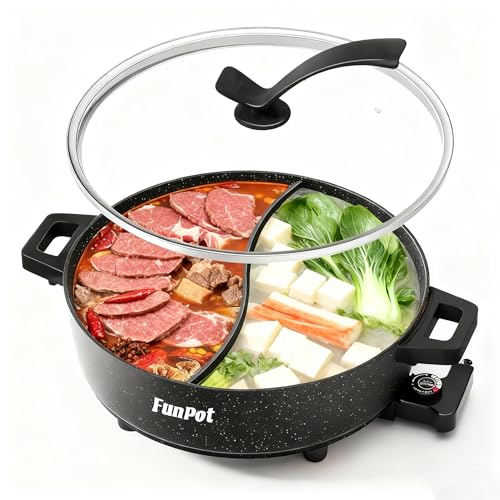
FunPot
Split-Broth Hot Pot for Group Dinners: FunPot 6L Electric Hot Pot with S-Divider and 1350W Butterfly Heating
This 6-liter electric hot pot uses an S-shaped divider to run spicy and mild broths side by side without flavors mixing, and its 1350W butterfly-shaped heating tube brings a full pot to a rolling boil in about six minutes. Buy it if you host hot pot nights for five to twelve people and need one appliance that satisfies both heat-seekers and mild eaters at the same table.
Pros and Cons
Pros
- Dual-broth divider handles conflicting spice preferences without buying a second appliance.
- Fast boil time from the wide butterfly heating tube keeps refills and top-ups moving during a long meal.
- Nonstick diamond-textured interior wipes down quickly after oily or spicy broths.
- Cool-touch hollow handles suit smaller hands and tighter kitchen counters.
Cons
- The product currently has no customer reviews, so long-term nonstick durability and chip reliability are unproven.
- A 6-liter pot filled with broth is heavy and awkward to empty or wash in a shallow sink.
The Best Deals This Week*
-
Two-Flavor Hot Pot for Induction and Gas
$20.59
($22.59)Save $2.00 -
Split-Broth Hot Pot for Group Dinners
$40.49
($53.99)Save $13.50
*Deals are selected by our commerce team
LCJAOF Two-Flavor Hot Pot for Induction and Gas: LCJAOF 11-Inch Divided Stainless Steel Shabu Pot
LCJAOF
Two-Flavor Hot Pot for Induction and Gas: LCJAOF 11-Inch Divided Stainless Steel Shabu Pot
This 11-inch divided stainless steel pot lets you simmer two different broths side by side in one vessel, with a spot-welded center divider that keeps spicy and mild soup bases from bleeding into each other. Buy it if you host hot pot nights for a mixed group and need one pot that works on induction, gas, and electric ceramic burners without a separate base unit.
$20.59 at AmazonEditors' Favorite
Color: Silver Size: 11x7.5x5.5 inches Dimensions: 12.8 x 11.42 x 3.94 inches Product Group: Kitchen
Shop NowFood Party 6L Electric Hot Pot with Divider for Shabu Shabu and Dual-Flavor Hotpot - Food Party 1200W
Food Party
6L Electric Hot Pot with Divider for Shabu Shabu and Dual-Flavor Hotpot - Food Party 1200W
This 6-liter electric hot pot heats to a rolling boil in 8 minutes and uses a fixed S-shaped divider to keep spicy and mild broths separate without leaking. Best for families or small gatherings who want to serve two flavors simultaneously without buying separate appliances.
$55.99 at AmazonGreat Value
Color: Hotpot Dual Sided Dimensions: 12 x 15 x 4 inches Weight: 5.5 pounds Product Group: Kitchen Binding: Kitchen
Shop NowFunPot Split-Broth Hot Pot for Group Dinners: FunPot 6L Electric Hot Pot with S-Divider and 1350W Butterfly Heating
FunPot
Split-Broth Hot Pot for Group Dinners: FunPot 6L Electric Hot Pot with S-Divider and 1350W Butterfly Heating
This 6-liter electric hot pot uses an S-shaped divider to run spicy and mild broths side by side without flavors mixing, and its 1350W butterfly-shaped heating tube brings a full pot to a rolling boil in about six minutes. Buy it if you host hot pot nights for five to twelve people and need one appliance that satisfies both heat-seekers and mild eaters at the same table.
$40.49 at AmazonColor: black Size: 6.3 Quarts Dimensions: 6.8 x 14.76 x 13.2 inches Product Group: Kitchen
Shop Now



Write Your Review
No reviews yet. Be the first to share your experience!