

Almost every complaint about homemade kebabs traces back to one geometric decision made by whoever designed the skewer, and it has nothing to do with steel quality or price. A round shank is functionally a bearing. The food is a loose collar sitting on a smooth cylinder, so when you rotate the skewer the metal spins inside the meat while the meat stays exactly where gravity parked it. Twelve minutes later one side is dark and the opposite side is pale and slack.
Flat Versus Round Shank Is the Whole Ball Game
A flat shank, usually 4 mm to 8 mm across, cannot spin inside the food, because it pierces a slot rather than a hole. The two long edges key into muscle fibre and vegetable flesh, so the piece has no rotational freedom at all. Turn the handle and the whole load indexes with it, every face meeting the fire in sequence. Square shanks do the same job with four corners, and twisted shanks add a helical ridge that bites harder still, holding slippery marinated cubes that a flat bar can let slip.
This deserves top billing because it fixes the problem without asking anything of the cook. There is no technique to learn, no double-skewering with two parallel rods, no pinning pieces with a second rod at right angles. People invent those workarounds precisely because they bought round skewers. If you already own round ones, running two side by side restores rotational control, but you have doubled the punctures and the washing up.
Steel Grade Decides Corrosion, Not Strength
Listings advertise stainless steel as if it were a single specification, and it is closer to a family name. The grade to want is 304, carrying roughly 18 percent chromium and 8 percent nickel. Chromium builds the passive oxide layer that makes steel stainless in the first place; nickel stabilises that layer against the two things a skewer meets constantly, the acids in marinades and the chlorides in salt. Lemon juice, vinegar, yoghurt and soy sauce all attack unprotected steel, and a skewer sits in that liquid for hours before it ever meets fire.
The cheaper alternative is 430, a ferritic grade with chromium but essentially no nickel. It is not weak; for the mechanical job of pushing through raw meat both grades are stronger than they need to be. What 430 does is pit and stain wherever marinade pools, particularly at the joint where shank meets handle, and those pits hold residue permanently. The difference is invisible on day one and obvious after twenty washes: one set still looks like cutlery, the other has grey freckling near the tip.
There is a rough field test. Ferritic 430 is magnetic and austenitic 304 usually is not, so a fridge magnet clings firmly to the cheap grade and slides off the good one. Treat that as an indicator rather than a verdict, since cold working during manufacture can leave genuine 304 faintly magnetic at a drawn tip or a stamped handle. Confident grab along the whole shank means 430.
Thickness Trades Against the Damage It Does
Cross-section is a genuine trade rather than a case of more being better. A 2 mm to 3 mm shank threads through peppers, courgette rounds and onion layers with a small clean wound and leaves the piece intact. Move up to 5 mm or 6 mm and the skewer carries a full load of lamb shoulder without a hint of flex, but it also bursts cherry tomatoes and tears the caps off mushrooms, because those foods are thin walls around a void that a wide blunt bar simply exceeds.
The failure at the thin end is bending. Load 500 grams of chicken thigh onto a 2 mm shank, lift it by one handle, and the middle sags. That is not cosmetic. A bowed skewer will not lie flat on the grate, so the belly of the curve presses into the bars and scorches while the raised ends hover in cooler air, which reintroduces the uneven cooking the flat shank was meant to end. Mostly meat, take the thicker bar and accept the tomato casualties.
Length Is Set by Your Grill, Not by the Food
Metal skewers run roughly 12 to 17 inches overall, and the number that matters is the usable span rather than the total. Take the width of your grate, subtract the handle, then add the two inches of overhang you need to grab it without putting your knuckles over the coals. A 14-inch skewer suits most 22-inch kettle grates, with the handle clear of the hot zone. Seventeen inches belongs on a large rectangular gas grill.
Going longer than the firebox is an error rather than harmless excess. A skewer whose far end extends past the grate has that end suspended over nothing, so the last two or three pieces cook in ambient air and come off raw while the middle is finished.
The Handle Conducts, and Metal Has No Choice About It
Steel moves heat along its own length, so a bare metal loop sitting a few inches from flame reaches a temperature you cannot touch within two to four minutes. That is physics rather than poor design. Wooden and silicone handles interrupt the conduction path and let you turn skewers barehanded all evening, at the cost of an oven restriction: neither survives a 250 degree Celsius broiler element or a long stay in a hot oven. If you finish kebabs indoors, buy all steel with a ring handle you can hook with tongs.
That same conduction becomes a cooking feature once the food is on. A metal shank carries heat into the geometric centre of each piece, which is the clear advantage over bamboo. The interior of a 1.5-inch beef cube is the slowest part to come up to temperature, and a steel rod delivers heat directly there rather than waiting for it to creep in from six faces. Thicker shanks move more of that heat, which is the honest argument for 5 mm over 3 mm on large dense cubes.
Loading, Spacing, and What Actually Undercooks
This outweighs every specification above. Food crammed shoulder to shoulder shields itself: each piece blocks radiant heat from the flat faces of its neighbours, and those touching faces do not sear, they steam in trapped moisture. Leave two or three millimetres of daylight between pieces and heat reaches the sides as well as the top and bottom. It is why a tightly packed skewer looks finished from the outside and turns out pink and wet at every contact point.
Bamboo deserves one honest paragraph. Soaking wooden skewers for thirty minutes delays charring, it does not prevent it, and any length past the food still blackens. Soaked wood also carries water into the cook and lightly steams whatever it touches. Bamboo’s real arguments are that it costs almost nothing and never gets too hot to hold. Metal’s are that it lasts indefinitely and conducts.
Cleaning is where marinade sugars come back. Residue bakes onto the shank into a hard varnish that resists scrubbing, so soak the skewers in hot water for fifteen or twenty minutes and the deposit lifts with a cloth. Twisted shanks are the worst offenders, since the grooves hold residue a flat wipe never reaches. Store them contained rather than loose in a drawer, since sharpened tips puncture bags and fingers with real enthusiasm.
The buying summary is short. Choose a flat or twisted shank, insist on 304 stainless, match the length to your grate rather than your ambition, and pick a handle you can hold where you actually cook. Then keep the proportions straight: shank shape matters more than every other specification combined, and a shaped 430 skewer still produces better kebabs than a round 304 one.
Common Questions About Stainless Steel Skewers
Do I need to oil metal skewers before loading them?
A light film helps, though not for the reason most people assume. It does little to protect 304 stainless, and it will not stop food sticking to the grate. What it does is let cooked pieces slide off cleanly instead of clinging in shreds, which matters most with lean chicken breast and anything carrying a sugary glaze. Wipe the shank with a paper towel dampened in neutral oil before threading, not after. With twisted skewers you can skip it, since the ridge already breaks contact along most of the surface.
Can stainless steel skewers go in the dishwasher?
All-metal 304 skewers are fine in a dishwasher, provided marinade has not already baked into a varnish the machine cannot shift. Wooden handles should be washed by hand, since repeated cycles swell and split the wood and loosen the joint at the shank. Silicone survives the machine but the adhesive under some handles does not. Grade 430 technically survives too, though hot alkaline detergent plus residual chloride accelerates the pitting it is already prone to. Lay them flat in the cutlery basket rather than tip-up.
Why does food still spin on my flat skewers?
Usually the shank is narrower than it looks, because some skewers sold as flat are only 2 mm or 3 mm wide and a slot that shallow gives food almost no purchase. The other common cause is threading pieces along their long axis, so only a short length of slot sits inside each cube. Pierce through the widest part of every piece instead, so the shank passes through as much flesh as possible. Very soft or overmarinated meat can also tear its own slot into a round hole after an hour in acid, and the answer there is a twisted shank.

LANNEY
17-Inch Flat Stainless Steel Kabob Skewers for Grilling - LANNEY 12-Pack Reusable BBQ Skewers with Storage Pouch
These 17-inch flat stainless steel skewers prevent food from spinning during grilling and keep handles cool outside the grill lid. Buy them if you grill kabobs regularly and want reusable skewers that hold chunks securely without bending.
Pros and Cons
Pros
- Food-grade stainless steel resists rust and corrosion for long-term outdoor use.
- Ergonomic handle design works comfortably with tongs during active grilling.
- Comes with two bonus 14-inch skewers for smaller items or tighter grill spaces.
Cons
- No customer reviews yet to verify performance claims about durability and heat resistance.
- Flat blade width may not fit through dense items like whole mushrooms or cherry tomatoes.

MOCUMEI
14-Inch Flat Metal Grilling Skewers for Kabobs - MOCUMEI Stainless Steel BBQ Skewer Set (16-Pack)
These 14-inch stainless steel skewers use a flat blade design that prevents food from spinning when you flip kabobs on the grill. Best for home grillers who want reusable skewers that hold meat and vegetables securely without the hassle of wooden sticks.
Pros and Cons
Pros
- Flat blade prevents the common problem of food rotating when you try to flip skewers, giving you even grill marks.
- Heavy-duty stainless steel construction holds up to repeated high-heat grilling without warping or corroding.
- Reusable design eliminates the need to soak wooden skewers before each use and reduces waste.
Cons
- No customer reviews available yet to verify long-term durability or real-world performance claims.
- Metal conducts heat, so handles may get warm during extended grilling sessions unlike wooden skewers that stay cool.

FLAFSTER KITCHEN
16-Inch Flat Stainless Steel BBQ Skewers with Push Bar - FLAFSTER KITCHEN Set of 6 for Grilling
These 16-inch flat stainless steel skewers grip food securely with an angled tip and include a push bar that slides ingredients off without burning your fingers. Best for grill enthusiasts who want reusable skewers that hold vegetables and meat in place while turning.
Pros and Cons
Pros
- 304 stainless steel resists rust better than cheaper 430-grade alternatives commonly sold as grill skewers.
- Push bar mechanism removes food without direct hand contact near hot grill surfaces.
- Flat blade keeps ingredients stable during flipping, eliminating the spinning problem of round skewers.
Cons
- Set includes 6 skewers, which may require cooking in batches for larger gatherings of 8 or more people.
- Metal construction conducts heat along the entire length, requiring pot holders when handling during active grilling.

OXO
Best Flat Stainless Steel Grilling Skewers for Meat & Veggies – OXO Outdoor Grilling Skewers Review
The OXO Outdoor Grilling Skewers use a flat stainless steel design that prevents food from spinning when you flip, giving you more even cooking with less frustration. Grillers who cook skewered kebabs, veggies, or fruit regularly will benefit from the no-roll stability and the nesting storage design that keeps drawer clutter in check.
Pros and Cons
Pros
- Flat skewer design eliminates the rolling problem that causes uneven cooking on round-rod competitors.
- Dishwasher-safe stainless steel means no hand-washing required after greasy cookouts.
- Nesting storage keeps a full set of skewers organized in a fraction of the space of traditional sets.
- Tong-friendly handles give you a secure grip when pulling skewers off a hot grill.
Cons
- With zero published customer reviews available, long-term durability under heavy seasonal use is unverified.
- The nesting set design may limit how many skewers are included compared to bulk flat-pack alternatives at similar price points.
The Best Deals This Week*
-
16-Inch Flat Stainless Steel BBQ Skewers with Push
$26.97
($29.99)Save $3.02 -
Best Flat Stainless Steel Grilling Skewers
$14.39
($17.99)Save $3.60
*Deals are selected by our commerce team
LANNEY 17-Inch Flat Stainless Steel Kabob Skewers for Grilling - LANNEY 12-Pack Reusable BBQ Skewers with Storage Pouch
LANNEY
17-Inch Flat Stainless Steel Kabob Skewers for Grilling - LANNEY 12-Pack Reusable BBQ Skewers with Storage Pouch
These 17-inch flat stainless steel skewers prevent food from spinning during grilling and keep handles cool outside the grill lid. Buy them if you grill kabobs regularly and want reusable skewers that hold chunks securely without bending.
$12.99 at AmazonEditors' Favorite
Color: Silver Size: 17" skewers(10) + 14" skewers(2) Weight: 1 pounds Product Group: Lawn & Patio Binding: Unknown Binding
Shop NowMOCUMEI 14-Inch Flat Metal Grilling Skewers for Kabobs - MOCUMEI Stainless Steel BBQ Skewer Set (16-Pack)
MOCUMEI
14-Inch Flat Metal Grilling Skewers for Kabobs - MOCUMEI Stainless Steel BBQ Skewer Set (16-Pack)
These 14-inch stainless steel skewers use a flat blade design that prevents food from spinning when you flip kabobs on the grill. Best for home grillers who want reusable skewers that hold meat and vegetables securely without the hassle of wooden sticks.
$7.99 at AmazonGreat Value
Color: Silver Size: 14 inch Weight: 0.440924524 Pounds Product Group: Lawn & Patio Binding: Kitchen
Shop NowFLAFSTER KITCHEN 16-Inch Flat Stainless Steel BBQ Skewers with Push Bar - FLAFSTER KITCHEN Set of 6 for Grilling
FLAFSTER KITCHEN
16-Inch Flat Stainless Steel BBQ Skewers with Push Bar - FLAFSTER KITCHEN Set of 6 for Grilling
These 16-inch flat stainless steel skewers grip food securely with an angled tip and include a push bar that slides ingredients off without burning your fingers. Best for grill enthusiasts who want reusable skewers that hold vegetables and meat in place while turning.
$26.97 at AmazonColor: Stainless Steel Size: 1 Weight: 1.4109584768 pounds Product Group: Lawn & Patio Binding: Kitchen
Shop NowOXO Best Flat Stainless Steel Grilling Skewers for Meat & Veggies – OXO Outdoor Grilling Skewers Review
OXO
Best Flat Stainless Steel Grilling Skewers for Meat & Veggies – OXO Outdoor Grilling Skewers Review
The OXO Outdoor Grilling Skewers use a flat stainless steel design that prevents food from spinning when you flip, giving you more even cooking with less frustration. Grillers who cook skewered kebabs, veggies, or fruit regularly will benefit from the no-roll stability and the nesting storage design that keeps drawer clutter in check.
$14.39 at AmazonColor: Stainless Steel Size: Set of 6 Dimensions: 13.5 x 3 x 1.5 inches Weight: 0.1322773572 pounds Product Group: Kitchen Binding: Kitchen
Shop NowGRILLART Kabob Skewers for Grilling - Metal Skewer for Kabobs with Slider - Flat BBQ Skewer Stainless Steel - 17" Shish Kabob Grill Skewers & Ideal Kabob Sticks for Meat Shrimp Chicken Veggie (10PCS)
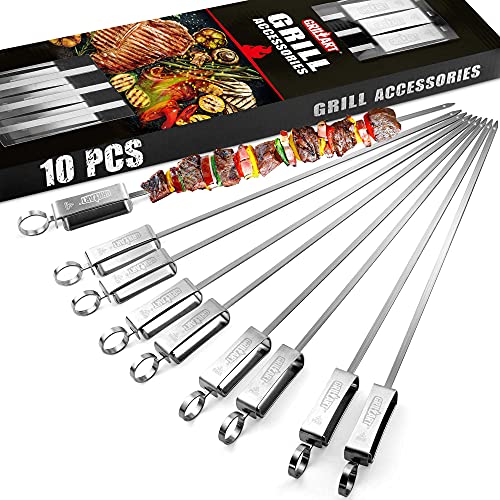
GRILLART
Kabob Skewers for Grilling - Metal Skewer for Kabobs with Slider - Flat BBQ Skewer Stainless Steel - 17" Shish Kabob Grill Skewers & Ideal Kabob Sticks for Meat Shrimp Chicken Veggie (10PCS)
$25.62 at AmazonColor: Silver Weight: 1.56969130544 Pounds Product Group: Lawn & Patio Binding: Kitchen
Shop Now





Write Your Review
No reviews yet. Be the first to share your experience!