

On a gas range the flame is the appliance and the pan is a passenger, carrying borrowed heat to the food. Induction reverses the arrangement. The coil under the glass produces no heat of its own; it makes the base of your pan generate heat inside itself, which means the pan is no longer receiving warmth. It is the burner.
That one change rearranges a surprising number of small habits, and it explains how the same cook can find induction brilliant for steak and maddening for a cream sauce in the same week. Most advice about induction stove compatible cookware stops at whether a given pan will work at all. What follows is organized around kitchens instead: a handful of ordinary situations, and the pan each one quietly demands.
The First Month After a Gas Range
The hard part is not the speed. It is the loss of coasting. A gas flame warms a pan gradually and the metal stores some of that heat, so the pan behaves like a flywheel: drop the flame and it takes twenty or thirty seconds to follow you down. Induction removes the flywheel. Heat appears inside the base, and when the dial moves, generation follows in that instant, so a 2 mm stamped pan runs past your target on the way up and falls off a cliff coming down.
That retires a whole set of moves. Lifting a skillet an inch to stop eggs from setting does nothing, because there is no flame to lift away from; the pan simply stops making heat while the food keeps cooking in cooling metal. Sliding a pot to a warm back corner is not available either, since the glass beside a zone stays barely warm to the hand.
The fix is mass in the pan rather than dexterity at the dial. Four to six millimeters of aluminum sandwiched under the cooking surface hands back roughly the grace period the flame used to supply, in both directions. There is also nothing to look at. No blue cone tells you where you are, so the cues move to the food: the pitch of the sizzle, the second butter stops foaming, how fast a water droplet skitters.
The Week Every Sauce Catches
Induction’s speed is not a brochure claim. An 1800 watt zone with a boost setting takes a dry skillet to smoking in about forty-five seconds, faster than most people can reach the oil bottle. The first casualties are almost always sauces. Milk, cream, sugar and roux scorch at the bottom of a pan, and on induction the bottom is the only place heat enters. The base can sit 60 to 80 °F above the liquid lying on it, and stirring cannot close that gap quickly enough once dairy proteins begin setting around 180 °F.
A heavy sandwich base earns its keep here, since the extra metal averages the heat before the milk ever meets it. Technique carries more of the load, though. The useful instruction is to run sauces two or three settings below whatever the gas equivalent was: a bechamel that lived on a medium flame belongs at three or four out of nine, not six. Stir the flour into the butter low and give the roux four minutes rather than two. Almost nothing in a sauce benefits from being fast.
The Wok Question, Asked Before You Buy the Hob
A round-bottomed carbon steel wok and a flat glass hob are close to incompatible, and the reason is contact. The curve meets the glass over a patch about the size of a coaster, so only that patch makes heat; everything above it warms slowly by conduction through thin steel. You get a scorching center and a tepid remainder, which is the precise inverse of stir-frying. That style of cooking wants a fierce base and hot walls to throw food against, so it keeps cooking while the center recovers.
Flat-bottomed induction woks exist and they do work, but they are a compromise worth seeing as one. The flat section couples properly and gets genuinely hot, while the sides run perhaps 150 to 200 °F cooler because nothing in them is generating anything. Tossing a handful of noodles up the side therefore parks it somewhere cold, and you end up working the base in smaller batches, closer to a wide skillet than a wok. If four nights in five are stir-fries, that is worth knowing before the hob goes in rather than after.
Steak, Deglazing, and What Induction Does Better
Searing is where induction stops apologizing. A flame licks up the sides of a skillet and heats the kitchen; a zone puts its energy into the base, so a heavy pan climbs to around 450 °F and holds there with a steak sitting on it, instead of sagging 50 degrees the moment cold meat lands. Recovery is the part people notice: two thick ribeyes in one pan do not stall the way they do over a flame fighting the metal back up.
The pan sauce is the other win. Deglazing wants a pan hot enough to reduce and cool enough not to scorch the shallots, and on gas that is a thirty-second wait while metal comes down. On induction you go from sear to bare simmer as fast as you can move your hand, so the wine goes in at the right moment rather than the available one. Cast iron and thick clad stainless both suit this work. One caution earns repeating: a bare cast iron base dragged sideways scratches glass permanently, so lift the pan rather than slide it.
Canning Kettles and One-Cup Pans
Scale up and induction shows a seam. In a wide stockpot the liquid over the middle of the zone rolls hard while the liquid out near the pot’s rim lags behind it, so a large pot is worth choosing for how its base is built rather than for two more quarts. Long boils bring a second surprise. Boost settings are usually timed, dropping back a level after five to ten minutes, and some hobs quietly step a zone down during a sustained full-power run. Jam that needs twenty-five minutes at a hard rolling boil does better on the setting below boost, held steady.
Canning day adds a limit that has nothing to do with heat. A loaded 21-quart water-bath canner carries something like 45 pounds of water and jars, and many manufacturers rate their glass for less than that sitting in one place; a cracked cooktop is a bad trade for a batch of pickles. The other extreme goes much better. Melting two tablespoons of butter or heating a cup of water for tea wastes very little, since nothing warms the air around the pan, and the cup is ready in under a minute. The single caveat is that a very small pan may not register at all, so keep one modest saucepan with a base the hob can actually see.
Adapting Comes Down to Four Habits
Little of this is about brands. Buy for base mass, because the thick-bottomed pan is the one that behaves in every situation above, and a famous name stamped on thin metal does not change what happens to your custard. Assume sauce settings drop two or three notches and stop trusting the numbers you knew by feel. Lift pans instead of sliding them, every time, until it stops being a decision.
And treat the wok as a genuine limitation rather than a shopping problem. A flat-bottomed wok is the best answer available, not a repair, and knowing that in advance is worth more than any pan bought afterward. The rest of induction rewards the cook willing to be slower at the dial than the hob wants to be.
Questions Cooks Ask After the Switch
Do I have to relearn the temperatures in my recipes?
Mostly, and it takes less time than it sounds. Timings written for gas assume a pan that keeps heating for a moment after the flame drops, so anything delicate wants a setting two or three steps below the flame the recipe names. Water-based work runs the other way, since a pot of pasta water reaches a boil sooner than the instructions expect. Searing timings survive almost untouched, because a heavy pan on induction actually holds the temperature the recipe imagined. Two weeks of cooking rewrites the numbers for you.
Can I keep using my round-bottomed wok with a support ring?
You can set it up there, but you will not be stir-frying. A ring holds the wok even further from the glass, and since only a sliver of the base was in contact to begin with, less heat gets made rather than more. What you get is a hot coin at the bottom of a cool bowl, so anything added drops the temperature and stews in its own liquid. Two answers work: a flat-bottomed wok indoors cooked in half-size batches, or a portable gas ring outside for the nights that need a roaring one.
How do I hold a truly gentle heat for chocolate or a slow braise?
Two things help, and the dial is only one of them. Near the bottom of its range a zone works in cycles rather than a steady trickle, so a thin pan at setting one still swings while a 5 mm base averages those cycles into something mild. For chocolate, set a bowl over an inch of water and let the water be the buffer; 130 °F is plenty and the metal never has to pass it. For a braise, bring it up on a middle setting, then drop to the lowest number keeping a lazy bubble every few seconds, below where gas would sit. A melt or keep-warm function, if the hob has one, performs that same averaging on your behalf.

SENSARTE
17-Piece Ceramic Nonstick Cookware for Everyday Cooking: SENSARTE Cream White Pots and Pans Set
This 17-piece set covers frying, sauteing, simmering, and stockpot cooking with a PFAS-free ceramic nonstick surface that releases food with just a drizzle of oil. It suits home cooks replacing a mismatched kitchen collection at once, especially those who want non-toxic coatings and compatibility with induction and every other stovetop.
Pros and Cons
Pros
- Non-toxic ceramic coating stays stable even when the pan is accidentally overheated.
- Lightweight cast aluminum construction resists warping while staying easy to lift one-handed.
- Includes lids, two utensils, and pot protectors, so nothing extra is needed on day one.
- Smooth, rivet-free interior makes cleanup a wipe rather than a scrub.
Cons
- Oven safe only to 400 degrees Fahrenheit, and the handle must be removed first, which rules out high-heat roasting and broiling.
- Ceramic nonstick coatings typically lose slickness faster than PTFE, so expect a shorter lifespan than heavier clad cookware.

GreenLife
Complete 16-Piece Kitchen Starter Set: GreenLife Ceramic Nonstick Pots & Pans, PFAS-Free, Induction Ready (Beige Taupe)
This 16-piece GreenLife set covers frying, simmering, sautéing, and stockpot cooking with a PFAS-free ceramic nonstick coating that releases eggs and pancakes without added oil. It suits new households or anyone replacing mismatched cookware who wants induction compatibility and dishwasher-safe cleanup in one purchase.
Pros and Cons
Pros
- Ceramic coating is free of PFAS, a real consideration for cooks avoiding traditional nonstick chemistry.
- Included spoon, slotted spoon, turner, and ladle are safe for the coating, so you are not buying utensils separately.
- Induction base delivers even heating across all common cooktop types.
- Handles stay cool on the stovetop for confident one-handed pan work.
Cons
- Ceramic nonstick coatings typically lose slickness faster than PFAS-based coatings, especially under high heat or dishwasher cycles.
- The set skips a large 12-inch skillet, so cooking for more than four in a single pan means a separate purchase.

ESLITE LIFE
Everyday Induction Cooking: ESLITE LIFE 9-Piece Granite Nonstick Cookware Set
This 9-piece ESLITE LIFE cookware set handles frying, sautéing, simmering, and stock-pot cooking with PFOA-free granite nonstick coating as its biggest advantage. It suits home cooks replacing worn cookware who need one set compatible with gas, electric, ceramic, and induction stovetops.
Pros and Cons
Pros
- PFOA-free granite nonstick coating supports lower-oil cooking and easier cleanup.
- The set works on gas, electric, ceramic, and induction cooktops.
- The die-cast aluminum body heats quickly and evenly.
- Heat-resistant handles and included utensils add practical value for daily stovetop cooking.
Cons
- The listing does not specify oven-safe use or maximum temperatures, so stovetop-to-oven buyers should verify compatibility.
- Cookware weight is not provided, which may matter to shoppers comparing lightweight and heavier pans.

CAROTE
Space-Saving Cookware for Small Kitchens: CAROTE 25pc Detachable Handle Nonstick Pots and Pans Set
This 25-piece nonstick set covers frying, sauteing, and simmering with removable handles that let the pans nest down to save up to 70% of cabinet space. Buy it if you cook in a small kitchen or need pans that move from stovetop to oven to table without a second serving dish.
Pros and Cons
Pros
- Detachable handles cut storage volume dramatically compared to a traditional pan set.
- Oven and grill compatible with the handle removed, expanding what one pan can do.
- Pans double as dinnerware, cutting the number of dishes you wash after a meal.
- Backed by a 12-month manufacturer warranty for quality issues.
Cons
- Detachable handle systems require checking the lock on every pan before lifting hot food.
- Nonstick coatings need low to medium heat and soft utensils, so this is not a high-heat searing set.

Ammeloo
Everyday Stovetop-to-Oven Cooking: Ammeloo Hybrid Stainless Steel 17-Piece Tri-Ply Cookware Set
This 17-piece Ammeloo cookware set handles stovetop cooking, induction heating, and oven finishing, with its tri-ply construction providing fast, even heat as the biggest advantage. It suits home cooks who want one dishwasher-safe set with saucepans, frying pans, a sauté pan, and stockpot for everyday meals.
Pros and Cons
Pros
- The set includes two saucepans, two frying pans, a sauté pan, and a 5.5-quart stockpot for broad meal coverage.
- Its textured cooking surface combines laser etching with a PFAS-free ceramic-enhanced release layer.
- Dishwasher-safe, stain-resistant construction reduces cleanup work after cooking.
- Included utensils, silicone utensil rest, and four pan protectors add practical kitchen convenience.
Cons
- Individual piece weights are not specified, so buyers cannot assess the handling heft before purchase.
- The set includes only 8-inch and 9.5-inch frying pans, which may limit capacity for larger batches.

CAROTE
Space-Saving Cookware for Small Kitchens: CAROTE 19-Piece Detachable-Handle Nonstick Set
The CAROTE 19-piece set combines ultra-nonstick cooking with detachable handles to simplify cleanup and save cabinet space. It suits apartment kitchens, RVs, campers, and home cooks who need versatile cookware for induction, gas, electric, or ceramic stovetops.
Pros and Cons
Pros
- The ultra-nonstick coating supports low-oil cooking and easier hand washing.
- Two removable handles and multiple lids make storage and serving more flexible.
- The set covers everyday tasks with frying pans, saucepans, a sauté pan, utensils, and protectors.
- A 12-month warranty provides coverage for qualifying quality problems.
Cons
- The detachable handles must be removed and reattached when stacking or moving cookware.
- The set includes several compact and medium-sized pieces but does not list a large stockpot.
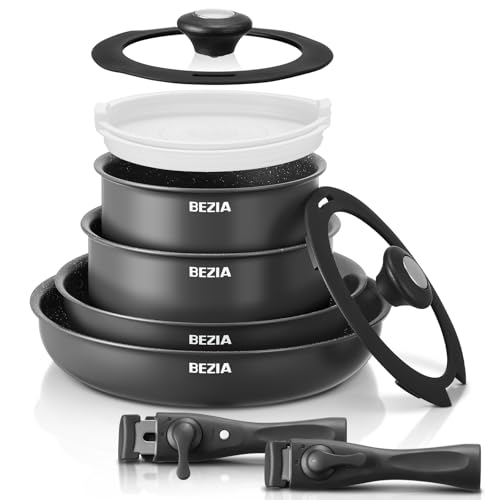
BEZIA
Compact Induction Cookware Set for Small Kitchens: BEZIA 10-Piece Removable-Handle Nonstick Set
The BEZIA 10-piece cookware set handles stovetop cooking, oven finishing, serving, and storage while its removable handles save space. It suits small kitchens, RVs, and campers needing compatible cookware for induction and other stovetops.
Pros and Cons
Pros
- Removable handles provide useful control with a stated support capacity of up to 22 pounds.
- The PFAS-free, PFOA-free, and PFOS-free nonstick materials support lower-stick cooking.
- Two saucepan sizes and two frying pan sizes cover everyday cooking tasks.
- Oven use, stovetop cooking, serving, and refrigerator storage add versatility to the set.
Cons
- The handles must be removed before oven use, adding an extra step during cooking.
- The set includes only two frying pans and two saucepans, so larger households may need additional cookware.

Amazon Basics
Everyday Sautéing and Stovetop Cooking: Amazon Basics Stainless Steel Cookware Set
This five-piece stainless steel set handles frying, simmering, and sautéing across all cooktops, with aluminum core bottoms for even heat distribution. It suits home cooks who need versatile induction-compatible cookware with dishwasher-safe cleanup and oven-safe pans.
Pros and Cons
Pros
- The 18/8 stainless steel and heavy-gauge construction provide a durable cooking surface for regular use.
- The set includes a 10-inch frypan, 3-quart saucepan with lid, and 5-quart sauté pan with lid for common cooking tasks.
- Induction compatibility and 500°F oven-safe pans add useful flexibility.
- Vented tempered glass lids make it easier to check food without fully uncovering the pans.
Cons
- The glass lids are not oven-safe, so they must be removed before transferring covered cookware to the oven.
- Although dishwasher-safe, hand washing with mild soap is recommended for a longer lifespan.
The Best Deals This Week*
-
17-Piece Ceramic Nonstick Cookware for Everyday
$94.99
($149.99)Save $55.00 -
Everyday Induction Cooking
$59.99
($79.99)Save $20.00 -
Space-Saving Cookware for Small Kitchens
$79.99
($139.99)Save $60.00 -
SNOWCLAD Pots and Pans Set Non Stick
$156.99
($179.99)Save $23.00 -
Everyday Stovetop-to-Oven Cooking
$129.99
($159.99)Save $30.00
*Deals are selected by our commerce team
SENSARTE 17-Piece Ceramic Nonstick Cookware for Everyday Cooking: SENSARTE Cream White Pots and Pans Set
SENSARTE
17-Piece Ceramic Nonstick Cookware for Everyday Cooking: SENSARTE Cream White Pots and Pans Set
This 17-piece set covers frying, sauteing, simmering, and stockpot cooking with a PFAS-free ceramic nonstick surface that releases food with just a drizzle of oil. It suits home cooks replacing a mismatched kitchen collection at once, especially those who want non-toxic coatings and compatibility with induction and every other stovetop.
$94.99 at AmazonEditors' Favorite
Color: Creamy White Size: 17pcs Product Group: Kitchen
Shop NowGreenLife Complete 16-Piece Kitchen Starter Set: GreenLife Ceramic Nonstick Pots & Pans, PFAS-Free, Induction Ready (Beige Taupe)
GreenLife
Complete 16-Piece Kitchen Starter Set: GreenLife Ceramic Nonstick Pots & Pans, PFAS-Free, Induction Ready (Beige Taupe)
This 16-piece GreenLife set covers frying, simmering, sautéing, and stockpot cooking with a PFAS-free ceramic nonstick coating that releases eggs and pancakes without added oil. It suits new households or anyone replacing mismatched cookware who wants induction compatibility and dishwasher-safe cleanup in one purchase.
$99.99 at AmazonGreat Value
Color: Taupe Size: 16 Piece Cookware Set Dimensions: 12.5 x 20 x 8 Inches Product Group: Kitchen Binding: Kitchen
Shop NowESLITE LIFE Everyday Induction Cooking: ESLITE LIFE 9-Piece Granite Nonstick Cookware Set
ESLITE LIFE
Everyday Induction Cooking: ESLITE LIFE 9-Piece Granite Nonstick Cookware Set
This 9-piece ESLITE LIFE cookware set handles frying, sautéing, simmering, and stock-pot cooking with PFOA-free granite nonstick coating as its biggest advantage. It suits home cooks replacing worn cookware who need one set compatible with gas, electric, ceramic, and induction stovetops.
$59.99 at AmazonColor: Black-9 Pcs Set Size: 9 Pcs Set Weight: 13.71054807378 pounds Product Group: Kitchen
Shop NowCAROTE Space-Saving Cookware for Small Kitchens: CAROTE 25pc Detachable Handle Nonstick Pots and Pans Set
CAROTE
Space-Saving Cookware for Small Kitchens: CAROTE 25pc Detachable Handle Nonstick Pots and Pans Set
This 25-piece nonstick set covers frying, sauteing, and simmering with removable handles that let the pans nest down to save up to 70% of cabinet space. Buy it if you cook in a small kitchen or need pans that move from stovetop to oven to table without a second serving dish.
$79.99 at AmazonColor: Green Size: 25 Piece Weight: 13.2497819462 pounds Product Group: Kitchen Binding: Kitchen
Shop NowSNOWCLAD Pots and Pans Set Non Stick | Stainless Steel Kitchen Cookware

Color: Stainless Steel Size: 10PCs Product Group: Kitchen
Shop NowYASHE 9Pcs Granite Nonstick Pots and Pans Set, Stackable, Oven Safe

Color: Gray Size: 9Pcs Dimensions: 11.2992125869 x 11.2992125869 x 5.5905511754 Inches Product Group: Kitchen Binding: Kitchen
Shop NowAmmeloo Everyday Stovetop-to-Oven Cooking: Ammeloo Hybrid Stainless Steel 17-Piece Tri-Ply Cookware Set
Ammeloo
Everyday Stovetop-to-Oven Cooking: Ammeloo Hybrid Stainless Steel 17-Piece Tri-Ply Cookware Set
This 17-piece Ammeloo cookware set handles stovetop cooking, induction heating, and oven finishing, with its tri-ply construction providing fast, even heat as the biggest advantage. It suits home cooks who want one dishwasher-safe set with saucepans, frying pans, a sauté pan, and stockpot for everyday meals.
$129.99 at AmazonColor: Stainless Steel & Navy Blue Size: 17 Pcs Nonstick Stainless Steel Cookware Set Product Group: Kitchen
Shop NowCAROTE Space-Saving Cookware for Small Kitchens: CAROTE 19-Piece Detachable-Handle Nonstick Set
CAROTE
Space-Saving Cookware for Small Kitchens: CAROTE 19-Piece Detachable-Handle Nonstick Set
The CAROTE 19-piece set combines ultra-nonstick cooking with detachable handles to simplify cleanup and save cabinet space. It suits apartment kitchens, RVs, campers, and home cooks who need versatile cookware for induction, gas, electric, or ceramic stovetops.
$59.99 at AmazonColor: Taupe Size: 19 PCS Weight: 10.63069027364 pounds Product Group: Kitchen Binding: Kitchen
Shop NowBEZIA Compact Induction Cookware Set for Small Kitchens: BEZIA 10-Piece Removable-Handle Nonstick Set
BEZIA
Compact Induction Cookware Set for Small Kitchens: BEZIA 10-Piece Removable-Handle Nonstick Set
The BEZIA 10-piece cookware set handles stovetop cooking, oven finishing, serving, and storage while its removable handles save space. It suits small kitchens, RVs, and campers needing compatible cookware for induction and other stovetops.
$59.99 at AmazonColor: Black Size: 10 Piece Dimensions: 11.2204724295 x 11.2204724295 x 7.87401574 inches Weight: 4.40924524 Pounds Product Group: Kitchen Binding: Kitchen
Shop NowAmazon Basics Everyday Sautéing and Stovetop Cooking: Amazon Basics Stainless Steel Cookware Set
Amazon Basics
Everyday Sautéing and Stovetop Cooking: Amazon Basics Stainless Steel Cookware Set
This five-piece stainless steel set handles frying, simmering, and sautéing across all cooktops, with aluminum core bottoms for even heat distribution. It suits home cooks who need versatile induction-compatible cookware with dishwasher-safe cleanup and oven-safe pans.
$65.55 at AmazonColor: Silver Size: 5-Piece Set Weight: 10.198254296299 pounds Product Group: Kitchen Binding: Kitchen
Shop Now




Write Your Review
No reviews yet. Be the first to share your experience!