

A stovetop whistling kettle has perhaps six moving or semi-moving parts, and almost every complaint about one traces back to a specific failure in a specific part. The whistle stops sounding. The lid drops into the mug mid-pour. The handle that felt fine in the shop turns out to be untouchable after four minutes on a gas ring. None of this is bad luck, and none of it is mysterious once you know what the part was supposed to be doing. This guide works backwards from the failures, because the failures are what you will actually live with, and because knowing the mechanism tells you both how to fix a kettle you already own and what to look at before buying the next one.
The Whistle Goes Quiet, and It Is Almost Never Broken
The whistle on a stovetop kettle is a small chamber with two offset holes. Steam is forced through the first hole into the cavity and out through the second, and that constricted passage sets up a resonance you hear as a note. The pitch depends on the gap between those two holes, which is why kettles of similar size can sound quite different. It is an entirely mechanical device with nothing to wear out, so when it fades, something has changed the geometry.
That something is nearly always limescale. Mineral deposits build on the inside faces of the whistle chamber and gradually narrow both holes. The note goes thin first, then breathy, then reduces to a hiss you can miss from the next room, and finally stops. Owners at that point conclude the whistle has failed and replace the kettle. It has not failed; it is blocked. On water above roughly 120 ppm hardness the change is audible within a few months of daily use, and on water past 250 ppm it can happen inside a single season.
The fix is a descale. White vinegar or a citric acid solution left to sit in the kettle for twenty to thirty minutes will dissolve the deposit, but the solution has to reach the whistle itself, which means filling high enough to cover the spout opening or removing the whistle cap where the design allows it. A kettle whose whistle unclips for cleaning is meaningfully easier to maintain than one where the whistle is a sealed pressing riveted into the spout. That single detail is worth checking before you buy, and almost nobody does.
When the Whistle Never Worked in the First Place
A separate problem looks identical and has a different cause. Some kettles never whistle properly from new, or go quiet long before scale could plausibly have built up. A whistle needs a certain steam pressure to sound at all, and that pressure only develops if the vessel holds it. Which means the lid has to seal.
A lid that sits loosely in its opening, or one whose rubber or silicone gasket has hardened and shrunk with age, lets steam escape around the rim. The kettle boils enthusiastically, steam leaves by the easiest route, and pressure at the spout never reaches the whistle’s threshold. The tell is easy to spot once you know to look for it: visible steam rising from the lid line while the spout stays silent. If you see that, the whistle is fine and the seal is the problem. A hardened gasket can sometimes be replaced; a lid that was a poor fit from the factory cannot be improved.
This is also why a kettle can whistle well for two years and then stop without any scale in the spout. Gasket material stiffens with repeated heating, and after several hundred cycles it no longer deforms enough to fill the gap it was cut to fill. Checking the seal takes ten seconds and saves people from throwing out a perfectly sound kettle.
Lids That Fall Off and Handles That Cook Your Fingers
Friction-fit lids are held in place by nothing except their own taper pressing against the rim. That works when the parts are new and concentric, and it degrades. Repeated heat cycling expands and contracts both pieces slightly differently, and one firm knock against a tap is enough to distort the lid edge by a fraction of a millimetre. After that it drops out at the worst possible moment, which is mid-pour over a full mug of boiling water. A hinged lid, or a friction lid with a positive catch that clicks, removes the failure mode entirely.
How the lid opens matters just as much as how it stays shut. A lid you open with a thumb lever from the handle can be lifted on a hot kettle without your hand entering the steam. A plain knob on a hot lid means either a cloth, a wait, or a burned knuckle, and that is the difference between refilling casually and putting the job off. If you top up a kettle several times a day, a thumb-lever lid changes the routine more than any other single feature.
Handles fail in two ways, and both are predictable from the geometry. Any handle bolted or welded directly to the kettle body conducts heat straight into your hand, because metal moves heat well and there is nothing in the path to stop it. Separately, a handle that sits fixed above the spout sits directly in the steam plume, so even a cool handle becomes a hazard when you reach for it. Handles that stay usable solve one problem or both: either a low-conductivity insert of wood, phenolic resin or silicone breaks the thermal path, or the handle swings back and away from the rising steam before you grip it. Hollow bare-metal handles are the worst arrangement available, since they conduct freely and can also trap water inside during washing, which then works its way out as rust streaks weeks later.
The Spout That Dribbles Down the Outside
Clean pouring comes from one detail: a defined lip at the spout tip that releases the stream instead of holding on to it. Where the spout edge has been rolled over or rounded for a softer look, surface tension pulls the last of the water back underneath, and it runs down the outside of the kettle onto the counter and sometimes over your hand. No pouring technique corrects this. Tipping more slowly makes it worse, because a slower stream is more easily held by the lip it should be leaving. This is a manufacturing decision made before the kettle reached the shelf, and it is permanent.
The second spout problem is a cap or cover that has to be opened before pouring. On paper it keeps dust out and holds steam in for the whistle. In practice it is one more thing to remember while holding two litres of boiling water, and forgetting it produces either a pour that will not start or a hot spray from an unexpected direction. Some designs link the cap to the handle so it opens as you lift, which is the version worth having. A cap that operates independently is a daily irritation dressed up as a feature.
Bases That Warp, Interiors That Turn
A thin single-layer base heated hard expands unevenly across its diameter and can bow, usually upward in the centre. On a gas ring you may never notice. On a glass-top or induction hob a bowed base rocks, loses contact, and produces a buzzing rattle that gets louder as the water heats. Multi-layer bases, or simply thicker ones in the region of 3 mm or more, spread heat sideways fast enough to stay flat. The check takes a moment in a shop or at home: set the empty kettle on a genuinely flat surface and press down on each side in turn. Any movement now becomes noise later.
Interior discolouration alarms people more than it should. A dull grey or faintly brown film on the walls is scale carrying trace minerals, and it is cosmetic until it is thick enough to flake into your cup. Two things are not cosmetic. A kettle boiled dry reaches temperatures far above anything water allows, which can discolour the metal permanently in a way no descaler removes and can distort or delaminate a multi-layer base. And water left standing inside for several days develops a flat, stale taste that survives a fresh boil, because it has been sitting in contact with residue the whole time. Empty the kettle if you are away, and refill from the tap rather than reboiling yesterday’s water.
Choosing One You Will Not Complain About
Capacity is the one decision people get wrong without ever diagnosing it. A kettle sized well beyond what you pour means every cycle heats water you throw away, adding a minute or two each time and doing it several times a day for years. A full three-litre kettle is also genuinely heavy at the wrist, and that weight lands on the joint at the exact moment you need control over a stream of boiling water. Count the cups you actually make at once, add a little, and buy for that.
Put together, the kettle that stays pleasant has a lid that seals and latches, a whistle you can reach to descale, a spout with a defined pour lip and no cap you have to remember, a handle isolated from both body and steam path, and a base thick enough to stay flat. The maintenance side is one sentence long: on hard water, descale every couple of months, and most of what goes wrong on this list never happens to you.
Common Questions
My kettle whistles faintly now. Do I need a new one?
Almost certainly not. A weak or breathy note usually means scale has narrowed the two small holes inside the whistle chamber, which changes the airflow that produces the sound. Fill the kettle high enough to cover the spout opening with white vinegar or a citric acid solution, leave it twenty to thirty minutes, then rinse thoroughly and boil once with plain water before use. If the note returns, scale was the whole problem. If it stays weak, check for steam escaping at the lid line, because a failed lid seal produces the same symptom for an entirely different reason.
How often should a stovetop kettle be descaled?
It depends almost entirely on your water. Above roughly 120 ppm hardness, every two months keeps the whistle clear and the interior clean, and past 250 ppm you may want to do it monthly. On soft water below about 60 ppm you can stretch to twice a year without much building up. Your water supplier publishes a hardness figure for your area, and it is worth looking up once rather than guessing. The practical signal is the whistle itself, since it blocks before the walls look bad.
Is a whistling kettle safe on a glass or induction hob?
Yes, provided the base is flat and the kettle is compatible with the hob type. The risk on those surfaces is a thin base that has bowed, because it then rocks, loses even contact and rattles as the water heats. Check flatness by setting the empty kettle on a level surface and pressing each side for movement, and favour a thicker or multi-layer base of around 3 mm upward. Lift rather than slide the kettle to avoid scratching a glass top. Never let one boil dry on any hob, since that damages the base and can permanently discolour the interior.
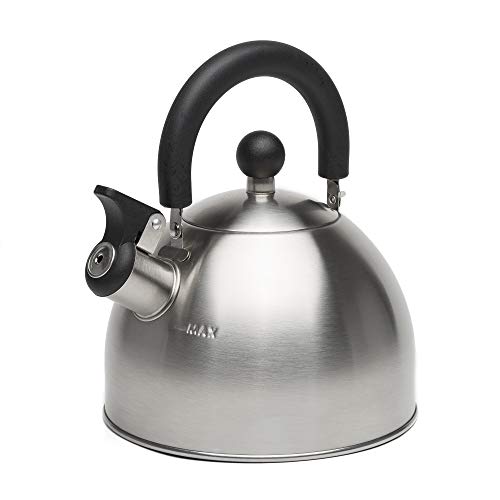
Primula
Fast-Boiling Stovetop Tea Kettle: Primula Stewart 1.5-Quart Stainless Steel Whistling Kettle
The Primula Stewart heats water quickly and whistles when boiling, making tea, coffee, and cocoa preparation easier on the stovetop. It suits compact kitchens and everyday users who want a stainless steel kettle with a folding handle for convenient storage.
Pros and Cons
Pros
- The whistling spout provides a clear boiling alert for easier stovetop monitoring.
- The folding handle helps the kettle fit into compact cabinets, drawers, or pantries.
- The wide opening simplifies cleaning and refilling.
- The 1.5-quart capacity provides several cups of hot water in one batch.
Cons
- The 1.5-quart capacity may require refills when serving a larger group.
- Because it is designed for stovetop use, it does not provide the convenience of an electric kettle.

SUSTEAS
Fast-Boiling Stovetop Tea Kettle for Family Tea and Coffee, SUSTEAS 2.7QT Whistling Kettle
The SUSTEAS whistling tea kettle boils water quickly on any cooktop, with a loud whistle and push-button handle that make pouring safer and easier. It suits households that prepare multiple cups of tea or coffee and want a large stainless steel kettle with an included heat-resistant mitt.
Pros and Cons
Pros
- The large capacity handles several servings of tea or coffee in one heating cycle.
- The thickened stainless steel body is designed for regular stovetop use.
- The included heat-resistant mitt adds protection when handling the kettle.
- The kettle uses Teflon-avoiding and BPA-avoiding materials.
Cons
- High heat can make the body too hot to touch and may cause the paint to peel.
- The manufacturer recommends low to medium heat, which may require more patience than high-heat boiling.
The Best Deals This Week*
-
Fast-Boiling Stovetop Tea Kettle for Family Tea
$35.99
($39.99)Save $4.00 -
WALDWERK Tea Kettle Stovetop (2.4 Quart)
$39.99
($49.99)Save $10.00
*Deals are selected by our commerce team
Primula Fast-Boiling Stovetop Tea Kettle: Primula Stewart 1.5-Quart Stainless Steel Whistling Kettle
Primula
Fast-Boiling Stovetop Tea Kettle: Primula Stewart 1.5-Quart Stainless Steel Whistling Kettle
The Primula Stewart heats water quickly and whistles when boiling, making tea, coffee, and cocoa preparation easier on the stovetop. It suits compact kitchens and everyday users who want a stainless steel kettle with a folding handle for convenient storage.
$14.99 at AmazonEditors' Favorite
Color: Brushed with Black Handle Size: 1.5 Quarts Dimensions: 7.44 x 7.44 x 6.85 inches Weight: 1.15301763026 pounds Product Group: Kitchen Binding: Kitchen
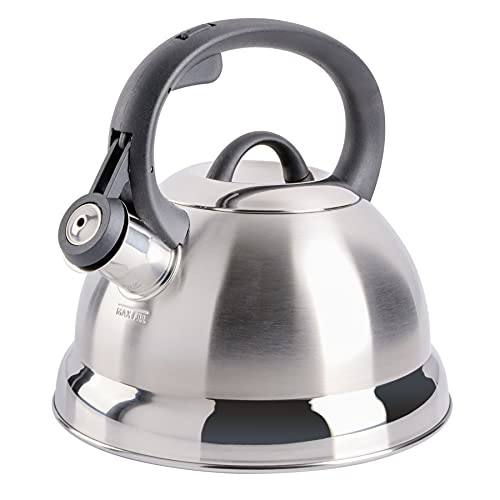
Shop NowMr. Coffee Flintshire 1.75-Quart Stainless Steel Whistling Tea Kettle – Brushed Satin Finish Stove-Top Kettle for Boiling Water
Mr. Coffee
Flintshire 1.75-Quart Stainless Steel Whistling Tea Kettle – Brushed Satin Finish Stove-Top Kettle for Boiling Water
$24.99 at AmazonGreat Value
Color: Brushed Satin Size: 1.8 Quarts Dimensions: 8 x 8 x 8 inches Weight: 1.35 Pounds Product Group: Kitchen Binding: Kitchen
Shop NowSUSTEAS Fast-Boiling Stovetop Tea Kettle for Family Tea and Coffee, SUSTEAS 2.7QT Whistling Kettle
SUSTEAS
Fast-Boiling Stovetop Tea Kettle for Family Tea and Coffee, SUSTEAS 2.7QT Whistling Kettle
The SUSTEAS whistling tea kettle boils water quickly on any cooktop, with a loud whistle and push-button handle that make pouring safer and easier. It suits households that prepare multiple cups of tea or coffee and want a large stainless steel kettle with an included heat-resistant mitt.
$35.99 at AmazonColor: Black Size: 2.6 Quarts Dimensions: 7.16 x 7.16 x 9.25 inches Weight: 2.55956686182 pounds Product Group: Kitchen Binding: Health and Beauty
Shop NowWALDWERK Tea Kettle Stovetop (2.4 Quart) - Teapot for Stovetop - also for Induction and Gas Stoves - Stainless Steel Tea Kettle - Whistling Tea Kettle for Stove Top

WALDWERK
Tea Kettle Stovetop (2.4 Quart) - Teapot for Stovetop - also for Induction and Gas Stoves - Stainless Steel Tea Kettle - Whistling Tea Kettle for Stove Top
$39.99 at AmazonColor: Whistling Kettle 2.4 Quart Size: 2.3 Quarts Dimensions: 9.7 x 8.6 x 9.7 Inches Product Group: Kitchen Binding: Kitchen
Shop NowCuisinart Professional Brushed Stainless Steel 2-QT Teakettle Water Whistling Tea Kettle

Cuisinart
Professional Brushed Stainless Steel 2-QT Teakettle Water Whistling Tea Kettle
$42.95 at AmazonColor: Stainless Steel Size: 2 Quarts Dimensions: 9 x 9 x 7 Inches Weight: 1.9 pounds Product Group: Kitchen Binding: Kitchen
Shop Now







Write Your Review
No reviews yet. Be the first to share your experience!