

Copper is the only kettle material people buy for emotional reasons and then defend with physics. The physics is largely real, which is what makes the subject slippery. Copper genuinely is among the best heat conductors ever used for a cooking vessel, and that fact gets stretched into claims about boiling speed, brewing quality, safety and durability that do not survive contact with a real kettle on a real hob. What follows takes the common beliefs about a copper gooseneck kettle seriously, then measures each against the metal itself.
Copper Does Not Boil Water Meaningfully Faster
Copper conducts heat roughly 1.7 times better than aluminium and around 23 times better than stainless steel. Those ratios are not invention; they are why copper turns up in heat exchangers and the bases of expensive pans. The error is assuming a 23-fold advantage in the wall produces anything like a 23-fold advantage in time to boil. It does not, because the wall is not the bottleneck. What sets how long a litre takes to reach boiling is the burner’s output and the heat capacity of the water itself, which is stubbornly high and wholly indifferent to what the vessel is made of. Steel moves energy across a wall a millimetre or two thick perfectly adequately. Same burner, same volume: copper may arrive first, but by a fraction of a minute rather than the transformation the material invites you to expect.
Where the conductivity is not marketing is evenness. A gas flame is a ring of concentrated hot spots, and thin steel above one runs far hotter over the flame than at the edges of the base. Copper refuses to hold that gradient, smearing heat sideways almost as fast as the flame delivers it. Nothing scorches or builds mineral crust in a concentrated ring, and the base never accumulates the differential thermal stress that eventually warps a thin steel bottom into a rocking disc. That is a genuine advantage of the metal, and it has nothing to do with speed.
Why Careful Brewers Often Choose Steel
The second belief is that copper is the ideal material for a pour-over kettle. Controlled pouring depends on spout geometry, the length and curve of the neck, where the handle sits relative to the centre of mass, and how the kettle balances as it empties. Each of those is a design decision that could be executed identically in copper or in steel, and none is a property of the metal. Then there is the part the marketing omits: high conductivity works in both directions.
A material that moves heat into water quickly moves it out again just as quickly, and copper’s wall does nothing to slow the escape of energy to the room. An uninsulated copper body drops temperature noticeably across a deliberate three-minute pour with pauses for the bed to drain, so the last pour runs cooler than the first. For anyone brewing with precision that is a drawback rather than a feature, and it explains a pattern that otherwise looks like cost-cutting: brewing-focused kettles are usually stainless, often insulated, frequently built to hold a set temperature. Not because the makers could not afford copper, but because holding water steady through a long pour is the opposite of what a bare conductive shell does well.
The Leaching Question, Answered Properly
The safety objection deserves a straight answer, and giving one requires a distinction most product copy skips. Copper in prolonged contact with acidic liquids can dissolve into them at levels that matter, which is why traditional copper cookware, which spends its life holding tomato, wine and vinegar, is lined inside with tin or stainless steel. The lining is not decoration; it is the reason the pan is usable. Water is a different case: close to neutral, nothing like a citrus reduction, and in brief contact because a kettle heats water and then empties.
Beyond that, nearly every copper kettle sold for boiling water is not bare copper on the inside at all. It is lined with tin or nickel, or it is copper-clad over a stainless interior, so the water never touches copper. The practical question is what your particular kettle’s interior actually is. Look before you buy and identify the surface: the dull grey of tin, the harder brightness of nickel or stainless, or the unmistakable pink-orange of bare copper. If it is lined or stainless, boil water in it and stop thinking about the question. If it is genuinely unlined copper, use it for water only and never leave water standing in it.
Patina Is Fine. A Failed Lining Is Not.
New copper is bright pink-orange and it does not stay that way. Within a few weeks of ordinary use the exterior darkens to a warm brown, and over months it deepens toward a mottled green-brown. People read that as damage and start scrubbing. On the outside of a kettle it is nothing of the kind: a thin, chemically stable oxide layer that slows further oxidation rather than accelerating it, and for many buyers the actual reason to own copper. Two things, though, are not cosmetic.
The first is verdigris, the powdery blue-green crust that forms specifically where water sits and lingers: around the base of the spout, in the seam under the handle mount, along the lower rim if the kettle stands somewhere wet. That is corrosion rather than passive oxide, and drying the kettle after use deals with most of it. The second is a tin lining worn through. Tin is soft and applied thin, and over years of thermal cycling it can thin at the base or blister and lift, exposing patches of pink copper. That is the one condition that ends a kettle’s useful life, and retinning is specialist work that routinely costs more than the kettle. Check a lined interior every few months; the lining, not the body, is the part with a finite life.
Bright Copper Is A Chore, Not A Default
The showroom photographs mislead in a specific way. Nobody keeps copper mirror-bright by washing it. Detergent and a cloth clean the surface perfectly well and do nothing whatsoever about oxidation, so a kettle that is only ever washed darkens on exactly the schedule above. Keeping the shine means actively removing the oxide: a paste of salt with lemon juice or vinegar, worked over the surface and rinsed off at once, or a proprietary copper polish used to its instructions. On a kettle in daily use over gas, expect to do that every two to four weeks.
Dishwashers deserve a specific warning, because the damage is not obvious in advance. Machine detergents are strongly alkaline and deliberately aggressive, and on copper they leave a dull, faintly pitted, blotchy surface that polish will not fully bring back. One cycle can change a kettle’s appearance permanently. Abrasive pads cut oxide away quickly but also scratch soft metal, and a steel scourer will damage a tin lining outright. The honest framing is a standing commitment rather than a footnote: buy copper and accept that it will go dark brown, buy copper and polish it monthly, or buy steel.
Check Your Hob Before Anything Else
This is where people actually get caught, and it is the item that can turn a kettle into an ornament. Copper is not ferromagnetic. Induction hobs work by inducing currents in a magnetic base, so a solid copper kettle placed on one does nothing at all: no error, no partial heating, just an unresponsive surface. The only copper kettles that function on induction have a bonded ferromagnetic disc in the base, usually a stainless plate sandwiched into the bottom, and makers who have done that say so explicitly. If a listing is silent on induction, assume it is incompatible. A fridge magnet against the base settles the question in a second.
On gas, copper is in its element, since the flame’s concentrated hot spots are precisely the input its conductivity neutralises. Glass-top and ceramic electric hobs need more thought. Copper is soft, and a soft base dragged across glass can leave metal marks that are genuinely difficult to remove, so lift rather than slide. A base that is not truly flat also makes poor contact and heats slowly, which is reason enough to avoid a hammered or decoratively shaped bottom. Establish what your hob needs first, because no amount of good design elsewhere fixes a base that cannot couple to your heat source.
What The Price Difference Actually Buys
Some of the premium is brand and appearance, and pretending otherwise would be dishonest. A substantial part of it is construction, and the differences are specific enough to check. Wall thickness comes first. A body around 0.5mm is thin decorative stock that dents against a tap and heats unevenly because there is not enough metal to spread heat, while something near 1mm or more holds its shape, resists denting, and delivers the evenness that is copper’s real selling point. A heavier kettle in the hand is not a trick here; the mass is the feature.
How the body is joined matters as much. Hand-hammering works the metal and stiffens it slightly as well as looking the way it looks, and it is hours of skilled labour. Seams are the clearest tell: a soldered or brazed seam is continuous and sealed along its whole length, whereas a row of spot welds leaves the metal between the welds carrying stress alone, and that is where a kettle eventually springs a leak. A thick, even tin lining is skilled work too, and a thin flash of it fails years earlier. Gauge, lining and seams tell you far more than the finish does.
Which leaves a position rather than a recommendation for everyone. Copper is worth buying for genuinely even heating on a gas flame, for the way it looks both new and aged, and for a service life measured in decades when the gauge is adequate, the lining is sound and someone maintains it. It is the wrong choice for induction unless it was specifically built with a magnetic base, the wrong choice for anyone who wants a kettle they can put in a dishwasher and forget, and the wrong choice for anyone whose priority is water sitting at a steady temperature through a slow, deliberate pour. Those are not flaws in the metal. They are the shape of what it is.
Do I need to line or season a copper kettle before first use?
No seasoning is involved, since copper is not cast iron and there is nothing to build up on the surface. Lining is not a home job either: a kettle either arrives with a tin, nickel or stainless interior or it does not, and tinning involves flux and molten metal wiped across the inside by hand. Before the first boil, wash it in warm water with a little detergent to clear manufacturing residue and polish, then boil and discard one full kettle of water. After that it is ready to use, and the only recurring interior task is descaling if you are in a hard-water area.
How do I remove limescale without damaging the interior?
Use dilute acid and heat rather than anything mechanical. Roughly equal parts white vinegar and water, or a proprietary descaler at the stated dilution, brought to a simmer and then left to stand for twenty to thirty minutes, will loosen most scale. Pour it out, rinse two or three times, then boil and discard a full kettle of fresh water before drinking from it again. Never scrape the interior with metal, because a tin lining is soft enough to gouge and a scratched lining fails sooner. In hard water this is worth doing monthly, since a thick scale layer insulates the base and slowly undoes the even heating you paid for.
Will the handle get too hot to hold on a gas hob?
That depends entirely on the handle’s material and how it attaches, and it is worth checking before buying. Solid copper or brass riveted straight to the body conducts heat out of the kettle and will become too hot to grip on gas, which is why kettles built that way are sold on the expectation that you will use a cloth. Handles wrapped in wood, broken by a phenolic resin section, or joined through a stainless stem that interrupts conduction stay manageable. Height matters too, since a handle sitting low over the body catches flame curling up the sides. If a listing does not say what the handle is made of, assume it conducts.

Mixpresso
Pour Over Coffee Kettle for Precision Brewing: Mixpresso Gooseneck Stainless Steel 1.2L Stovetop & Induction Kettle
This 1.2-liter gooseneck kettle gives you barista-level control over water flow when brewing pour over coffee or steeping tea, with a long swan-neck spout that lets you saturate grounds evenly instead of dumping water. Buy it if you brew with a V60, Chemex, or French press at home and want stovetop and induction compatibility without paying for an electric gooseneck setup.
Pros and Cons
Pros
- Long gooseneck spout delivers the slow, targeted stream that pour over and drip brewing require.
- Works across all stovetop types, including induction, thanks to the triple-layer base.
- Food-grade 304 stainless steel is durable and rust-resistant under regular use.
- Backed by a one-year manufacturer warranty from Mixpresso.
Cons
- No built-in thermometer, so you will need a separate probe to hit the 195 to 205 degree range most pour over recipes call for.
- As a stovetop kettle it lacks the temperature holding and preset controls of an electric gooseneck model.
HoJang
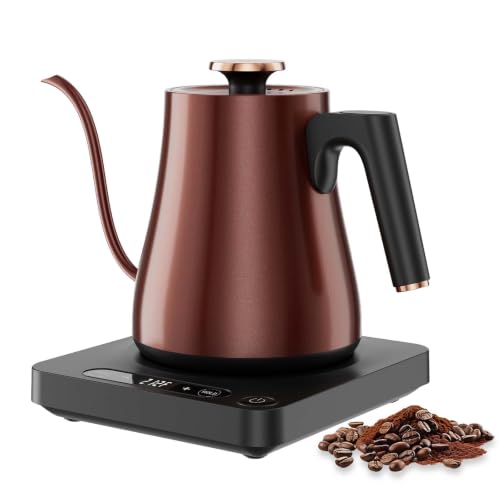
Pour Over Coffee Kettle with Variable Temperature Control: HoJang 1.0L Gooseneck Electric Kettle, 1000W Copper
This 1-liter gooseneck kettle heats water in three to five minutes and holds any temperature from 100°F to 212°F, so pour-over coffee and delicate green teas brew at the exact heat they need. Buy it if you make pour-over or loose-leaf tea daily and want a plastic-free stainless interior plus a slow, controlled pour without switching to a stovetop kettle.
Pros and Cons
Pros
- Celsius and Fahrenheit switching on the LED display suits recipes written in either unit.
- Matte copper finish resists fingerprints and scratches, so it stays presentable on an open counter.
- The 1-liter body has a small footprint that fits cramped apartment and office counters.
- Plastic-free water path means no chemical smell during the first weeks of use.
Cons
- At 1000W it draws less power than 1500W kettles, so boil times lag behind full-size models.
- One liter runs short if you are filling a large French press and several mugs in one go.
Mixpresso Pour Over Coffee Kettle for Precision Brewing: Mixpresso Gooseneck Stainless Steel 1.2L Stovetop & Induction Kettle
Mixpresso
Pour Over Coffee Kettle for Precision Brewing: Mixpresso Gooseneck Stainless Steel 1.2L Stovetop & Induction Kettle
This 1.2-liter gooseneck kettle gives you barista-level control over water flow when brewing pour over coffee or steeping tea, with a long swan-neck spout that lets you saturate grounds evenly instead of dumping water. Buy it if you brew with a V60, Chemex, or French press at home and want stovetop and induction compatibility without paying for an electric gooseneck setup.
$26.99 at AmazonEditors' Favorite
Color: Bronze Size: 1.3 Quarts Dimensions: 11 x 5.5 x 7 Inches Product Group: Kitchen Binding: Kitchen
Shop NowHoJang Pour Over Coffee Kettle with Variable Temperature Control: HoJang 1.0L Gooseneck Electric Kettle, 1000W Copper
HoJang
Pour Over Coffee Kettle with Variable Temperature Control: HoJang 1.0L Gooseneck Electric Kettle, 1000W Copper
This 1-liter gooseneck kettle heats water in three to five minutes and holds any temperature from 100°F to 212°F, so pour-over coffee and delicate green teas brew at the exact heat they need. Buy it if you make pour-over or loose-leaf tea daily and want a plastic-free stainless interior plus a slow, controlled pour without switching to a stovetop kettle.
$59.99 at AmazonGreat Value
Color: Copper Size: 1.1 Quarts Dimensions: 7.4 x 9.8 x 8.18 Inches Product Group: Kitchen
Shop Now



Write Your Review
No reviews yet. Be the first to share your experience!