

A coffee maker with reservoir gets judged on the wrong thing. Shoppers compare tank volume, then live for years with a plastic box they cannot reach inside, water that sits five days at a stretch, and a filter cartridge that expired last spring. The tank touches every single cup, and it is the part nobody maintains.
So this guide runs backwards. Instead of listing features, it starts with the specific ways reservoirs disappoint people after week three, then explains the mechanism behind each. Musty coffee, chalky rings, weeping onto the counter, flat flavor from expensive water — all of it starts in the tank, and all of it has a cause you can name.
Coffee That Suddenly Tastes Musty Is Almost Always Biofilm
The most common complaint about any machine that holds water: it brewed beautifully for a month, then the coffee turned stale and slightly swampy even though the beans never changed. A reservoir is a warm, dark, wet plastic box, which is a close description of a culture vessel. Water standing three or four days develops a slick film across the walls, and you can confirm it in two seconds by running a fingertip along the inside — if it feels faintly soapy rather than squeaky, that is bacterial biofilm.
That film carries a musty taste into every brew after it forms, because water picks up the byproducts on its way to the heater. Brewing does not fix it. Water leaves the tank at roughly 200°F, which kills organisms but does not remove the flavor compounds they already released. The fix is behavioral rather than mechanical: fill only what you will drink in the next day or two, and empty, rinse, and dry the tank once a week. A tank left dry between fills cannot grow anything. One kept two-thirds full for a fortnight will, at any price.
Removable Does Not Mean Cleanable — Check Whether Your Hand Fits
Every product page treats a removable tank as a cleaning feature. On its own it is not. What decides whether you can maintain a reservoir is whether an adult hand fits through the opening, and that number appears on no box anywhere. A tall narrow 60 to 70 oz tank with a 3-inch mouth can be rinsed and refilled, and that is the end of the list. No cloth or brush reaches the inside walls, and rinsing does not remove biofilm, which is adhered and needs mechanical contact.
Rank the designs honestly. Best is a wide-mouth tank that lifts fully off the machine, because you reach every wall and it goes under a faucet properly. Next is a tank that detaches but has a narrow throat, workable if you accept that a bottle brush is now permanent kitchen equipment. Worst is a fixed reservoir opening only through a small hinged lid, common under about 45 oz, where you clean by feel through a slot. Put your hand into the display unit’s tank before buying. If it does not go in, you have learned the most useful thing about that machine.
Scale Appears in the Tank First, Not Inside the Machine
Most people picture limescale as something happening invisibly deep in the heater. It starts in plain sight. Calcium and magnesium precipitate wherever water evaporates, and water evaporates fastest at the waterline in an open tank. So the first visible scale is nearly always a chalky ring inside the reservoir, not something you find by opening the machine. On water above roughly 120 ppm hardness, that ring appears within weeks, which makes it a free hardness test — a heavy ring after two weeks tells you more than any strip.
The ring itself is cosmetic. What matters is that the same deposition is happening on the heating element, where it acts as insulation. A scaled heater delivers cooler water, and water below the 195 to 205°F extraction band under-extracts, tasting thin and sour rather than bitter. That is the real cost of skipping descaling: not a broken machine but a slow slide in cup quality that owners usually blame on the coffee. Descale on a calendar, every 2 to 3 months on hard water and every 6 on soft, and treat a visible ring as proof the process is already underway.
That Charcoal Filter in the Tank Is Almost Certainly Dead
Plenty of machines ship with a small charcoal cartridge clipped inside the reservoir, sold as a chlorine-taste filter. It is rated for roughly 60 tanks or two months, whichever comes first. Ask around and you will struggle to find an owner who has changed one. Many do not know it is there, since it sits low behind the intake and looks like part of the housing. Assume that on any machine more than a few months old, the filter stopped filtering long ago.
An exhausted cartridge is not neutral, which is the part that catches people out. Activated charcoal is deliberately porous, and once its adsorption sites are saturated it becomes an ideal textured, sheltered surface for the biofilm described earlier — a sponge sitting permanently in standing water. An old filter is worse than no filter. Two choices are defensible. Replace the cartridge on schedule and write the date on it in marker, or take it out for good and filter your water in a pitcher before it goes in, which is easier to remember and gives you control over mineral content.
The Cup That Is Not a Cup, and Why Bigger Tanks Get Worse
Reservoir volume gets quoted in the machine’s own cups, and those cups are commonly 5 to 6 fluid ounces. A mug is 8 to 12. Do the arithmetic and a 12-cup machine’s 60 oz tank becomes four or five real mugs, not twelve. This drives more bad purchases than any other number here, because a household drinking three large mugs each morning buys 12-cup capacity, refills constantly, and concludes the machine is undersized when the marketing was simply using a different unit.
The tempting response is to size up hard, to a 90 oz tank or a plumbed line. Understand the trade. A large manual reservoir removes the refilling chore by slowing turnover, which is precisely the condition that grows biofilm — convenience bought with four days of standing water. Plumbed machines escape this because water flows continuously and nothing sits; a big passive tank does not. If you buy the volume, fill it partway on ordinary days and use full capacity only when you are serving eight people.
Your Water Decides the Taste, and Leaks Come From the Valve
Brewed coffee is about 98.5 percent water, so what you pour into the tank is the dominant ingredient by a wide margin. Distilled and zero-TDS water is a mistake made with good intentions: minerals participate in extraction, so mineral-free water pulls poorly and tastes flat. Very hard water goes the other way, scaling fast and muting acidity. Roughly 75 to 150 ppm total dissolved solids is the usable window. Softened water deserves a warning, because ion-exchange softeners trade calcium for sodium — it will not scale your machine, and it will taste faintly salty.
One more failure worth naming, since it gets machines thrown out. When a reservoir machine weeps onto the counter, the tank is rarely cracked. Removable tanks seat onto a spring-loaded outlet valve with a small gasket, and a speck of grit or a flake of scale holds it fractionally open. Lift the tank, wipe the gasket and the seat with a damp cloth, check the seal sits flush in its groove, and reseat firmly. That fixes most counter leaks in under a minute.
The routine is short. Fill for a day or two at a time, not for the week. Empty and dry the tank every weekend. Either replace the charcoal filter on schedule or pull it out and filter upstream in a pitcher. Descale by the calendar, not when the coffee already tastes wrong. If it leaks, check the outlet gasket first.
How often should I empty and refill the water reservoir?
Treat two days as the outer limit for water you intend to drink. Biofilm becomes detectable by touch after roughly three or four days of standing water, and once established every brew carries a musty note. The practical habit is filling only for the mornings immediately ahead — around 20 to 30 oz for a two-mug household — rather than topping up to 60 oz. Once a week, tip out what remains, scrub the walls if the opening lets you, rinse, and leave the tank open to air dry.
Is bottled or filtered water better than tap for a reservoir machine?
It depends on what your tap water measures, not on the label. Aim for 75 to 150 ppm total dissolved solids, which many municipal supplies already sit inside. A carbon pitcher filter is the sensible default because it removes chlorine taste while leaving the minerals extraction needs. Avoid distilled and reverse-osmosis water, which reads near 0 ppm and brews flat. Avoid water from a household ion-exchange softener too, since it has swapped calcium for sodium and tastes salty even though it will not scale. Bottled spring water is fine if you check its mineral figures, and pointless if you do not.
Why does my machine leak water from underneath the tank?
Almost always the outlet valve rather than the reservoir itself. Removable tanks sit on a spring-loaded valve sealed by a small rubber gasket, and a fragment of scale on that gasket keeps it slightly open so water seeps whenever the tank is in place. Lift the tank off, wipe the gasket and the seat it presses against, confirm the seal sits flat in its channel, then set the tank down firmly. If seepage continues, descale the machine, because flakes shedding from the heater will keep re-fouling the valve. Replacement gaskets cost a few dollars.
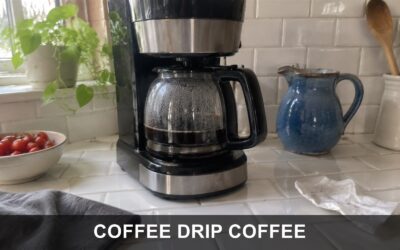
Cuisinart Drip Coffee Maker, Programmable & Self-Cleaning, 12-cup Capacity

Editors' Favorite
Color: Black Size: 12-Cup Dimensions: 11.25 x 8.75 x 14.7 inches Weight: 9 Pounds Product Group: Kitchen Binding: Kitchen
Shop Now






Write Your Review
No reviews yet. Be the first to share your experience!