

TL;DR — The best high-carbon steel for a santoku depends on the trade-off you want between sharpness and upkeep. Japanese carbon steels like Shirogami (White #2) and Aogami (Blue) take the keenest, easiest-to-sharpen edge but rust without care. For most home cooks, high-carbon stainless steels such as VG-10, AUS-8, or the Swedish/German steels used by Mac and Wusthof deliver most of that sharpness with far less maintenance. “High-carbon” simply means enough carbon (roughly 0.5%+) to harden to a keen, lasting edge. For picks, see our best santoku knife guide.
The HomeWhisk editorial team researches kitchen equipment by analyzing manufacturer specifications, knife metallurgy, and aggregated feedback from communities like Reddit r/chefknives and r/Cooking, plus major retailers. This guide untangles what “high-carbon” actually means for a santoku, which steels are considered best, and how to match a steel to your cooking and maintenance habits.
The phrase “best high-carbon for a santoku knife” trips people up because “high-carbon” gets used two ways. Sometimes it means genuine carbon (non-stainless) steel that will patina and rust; other times it means “high-carbon stainless,” a stainless steel with enough carbon to take a great edge. Both are legitimate, and the right one depends on whether you prioritize peak sharpness or low maintenance. Understanding the metallurgy makes the choice clear. For curated recommendations across steels, see our best santoku knife guide.
What a Santoku Is and Why Steel Matters
A santoku (“three virtues,” for slicing, dicing, and mincing) is a Japanese general-purpose knife, typically 5 to 7 inches, with a flatter edge and a sheepsfoot tip that curves down to the spine. Because santokus are used with an up-and-down push cut rather than the rocking motion of a Western chef’s knife, the steel is asked to hold a very clean, thin, keen edge for precise, straight-down cuts through vegetables, fish, and boneless meat.
Japanese knives like the santoku are usually ground thinner and hardened harder than Western knives, which is exactly why steel choice matters so much. Harder, higher-carbon steel takes a sharper edge and holds it longer — but the same hardness makes it more brittle and, in non-stainless form, prone to rust. That fundamental trade-off drives everything below. For how the santoku compares to a chef’s knife, see our best chef knife guide.
What “High-Carbon” Actually Means
Carbon is the element that lets steel harden. When steel is heat-treated, carbon forms hard carbides that let the blade reach a high hardness (measured on the Rockwell C scale, HRC) and take a fine, durable edge.
- Carbon content: Cutlery steels generally run from about 0.5% carbon (basic) up past 1% (high-performance). More carbon (with the right heat treatment) means the blade can be hardened harder, hold an edge longer, and be honed sharper.
- Hardness (HRC): Japanese santokus commonly land around 60 to 63 HRC, versus roughly 56 to 58 for German knives. Higher HRC edges are keener and last longer between sharpenings, but they’re more likely to chip if twisted, dropped, or used on bone.
- “High-carbon stainless”: This adds chromium (13%+) for rust resistance while keeping enough carbon for a good edge. It’s the best-of-both-worlds category most home santokus use.
So “high-carbon” is not one steel — it’s a property. The real question is which specific steel, and whether you want it stainless or not.
The Best Carbon (Non-Stainless) Steels
If you want the sharpest possible santoku and don’t mind maintenance, traditional Japanese carbon steels are the pinnacle:
- Shirogami (White Steel): very pure carbon steel with minimal alloying. It takes an exceptionally keen edge and is the easiest of all to sharpen to scary-sharp, which is why sharpening enthusiasts love it. It dulls a bit faster than alloyed steels and rusts readily. White #1 is harder/more refined; White #2 is slightly more forgiving.
- Aogami (Blue Steel): White steel with added tungsten and chromium for better edge retention and toughness while keeping the fine edge. Aogami holds its edge longer than Shirogami and is a favorite for high-end knives. Aogami Super is the top tier.
- SK / carbon tool steels (used in budget carbon santokus like some Tojiro and traditional makers): affordable, sharpen easily, patina quickly.
All of these will react with food and moisture — they develop a gray-blue patina (which is protective and normal) and will rust if left wet. They demand wiping dry immediately after use and occasional oiling. The reward is an edge and a sharpening experience nothing stainless quite matches. Our best santoku knife guide includes a carbon-steel option for those who want it.
The Best High-Carbon Stainless Steels
For the vast majority of home cooks, high-carbon stainless is the smarter choice — nearly the sharpness, none of the rust anxiety:
- VG-10: a Japanese stainless steel (~1% carbon, 15% chromium, with cobalt and vanadium) that hardens to around 60 to 61 HRC. It takes a very sharp edge, holds it well, and resists rust — extremely common in mid-to-premium santokus, often as the core of a Damascus-clad blade.
- AUS-8 / AUS-10: slightly softer Japanese stainless, easier to sharpen and very tough, common in value knives; AUS-10 edges closer to VG-10 performance.
- Molybdenum-vanadium steels used by Mac (the Mac Professional santoku is a longtime top recommendation) hit an excellent balance of sharpness, edge retention, and easy sharpening at around 59 to 61 HRC.
- German stainless (X50CrMoV15) used by Wusthof and Zwilling: lower carbon (~0.5%) and softer (56 to 58 HRC), so it’s tougher and more forgiving but won’t get quite as keen or hold as long — the most durable, low-fuss option.
- Powder/super steels (SG2/R2, etc.): premium powdered stainless reaching 62 to 64 HRC with outstanding edge retention, at a higher price.
Damascus on a santoku, by the way, is usually just cladding — decorative layered steel wrapped around a functional core like VG-10 or SG2. The pattern is cosmetic; the core steel is what cuts. Don’t pay for the pattern expecting it to sharpen better. For sets that pair a santoku with other blades, see our best knife sets guide.
How to Choose the Right Steel for You
Match the steel to how you actually cook and maintain knives:
- Want the sharpest edge and enjoy sharpening? Go carbon — Aogami for balance, Shirogami for ultimate keenness — and commit to drying and oiling it.
- Want great sharpness with easy upkeep? Choose VG-10 or a moly-vanadium stainless (Mac). This is the sweet spot for most people.
- Want maximum durability and the least fuss? German stainless (Wusthof) tolerates a dishwasher-adjacent lifestyle, occasional bone contact, and less careful honing — at the cost of ultimate sharpness.
- On a budget? AUS-8 or a Tojiro-style knife gives real Japanese performance affordably.
Whatever the steel, technique protects the edge: use a wood or plastic board (never glass or stone), avoid bones and frozen food, hand-wash and dry, and hone/sharpen regularly. A harder high-carbon edge rewards care and punishes abuse. For other blade shapes, see our best bread knife, best boning knife, and best fillet knife guides.
Frequently Asked Questions
Is carbon steel or stainless steel better for a santoku?
It depends on your priorities. Carbon steel (like Shirogami or Aogami) takes a sharper edge and is easier to sharpen to a keen finish, but it rusts and patinas and needs drying and oiling after every use. High-carbon stainless (like VG-10) resists rust and needs far less care while still getting very sharp — the better pick for most home cooks. Choose carbon if you love sharpening and peak performance; choose stainless if you want low-maintenance daily use. See our best santoku knife guide.
What hardness (HRC) should a good santoku be?
Japanese santokus typically fall around 60 to 63 HRC, noticeably harder than German knives at 56 to 58. Higher hardness means a keener edge that lasts longer between sharpenings, which suits the santoku’s precise push-cutting style. The trade-off is brittleness: harder blades chip more easily if you twist them, cut bone, or drop them. If you’re rougher on knives, a slightly softer, tougher steel (German stainless or AUS-8) is more forgiving. Match the hardness to your technique and maintenance habits.
Is a Damascus santoku actually better, or just for looks?
The Damascus pattern itself is mostly cosmetic. On modern kitchen knives, “Damascus” means many layers of softer steel folded and clad around a hard functional core — usually VG-10 or a powdered steel like SG2. It’s the core steel, not the pattern, that determines sharpness and edge retention. A Damascus knife can be excellent because of its core, but the layered look adds cost without cutting performance. Judge it by the core steel and hardness. Our best santoku knife guide notes the core steel of each pick.
What size santoku knife is best?
Most home cooks are best served by a santoku in the 6.5 to 7 inch range, which handles the majority of vegetable, fish, and boneless-meat prep comfortably. A 5 to 5.5 inch santoku is more nimble for smaller hands and detailed work but limits large tasks. Because santokus are pushed straight down rather than rocked, they run a little shorter than a comparable chef’s knife. If you want one all-purpose knife instead, a chef’s knife covers more range — see our best chef knife guide.
How do I care for a high-carbon santoku so it lasts?
Hand-wash and dry it immediately — never the dishwasher, which dulls and corrodes blades. For non-stainless carbon steel, wipe dry after each use and occasionally rub with food-safe oil to prevent rust; the gray patina it develops is normal and protective. Cut only on wood or soft plastic boards, never glass, stone, or metal. Avoid bones and frozen food, which chip hard edges. Hone regularly and sharpen on whetstones as needed. Proper care keeps any good steel performing for decades.
Is a santoku or a chef’s knife more useful?
They overlap heavily, and the choice is about cutting style. A santoku’s flat edge and down-cut excel at precise slicing, dicing, and mincing, especially vegetables and fish, and its lighter, thinner blade feels nimble. A chef’s knife’s curved belly rocks for continuous chopping and handles larger cuts and more varied tasks. Many cooks own both; if buying one, pick the santoku if you prefer push cuts and cleaner precision, the chef’s knife for versatility and rocking. See our best chef knife and best knife sets guides.
The Bottom Line
The “best high-carbon” for a santoku isn’t a single steel — it’s the one that fits your appetite for sharpness versus maintenance. Traditional Japanese carbon steels (Shirogami, Aogami) deliver the keenest edges and the best sharpening feel but demand real care and will rust if neglected. High-carbon stainless steels — VG-10, the moly-vanadium steel in a Mac, or tougher German X50CrMoV15 in a Wusthof — give most of that performance with far less fuss, which is why they suit most home kitchens. Aim for around 60 to 63 HRC for a proper Japanese edge, judge Damascus by its core steel, and protect whatever you buy with a wood board and prompt drying. For curated picks across steels and budgets, see our best santoku knife and best chef knife guides.
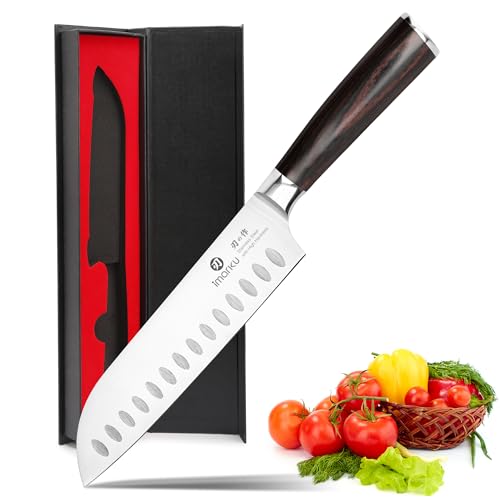
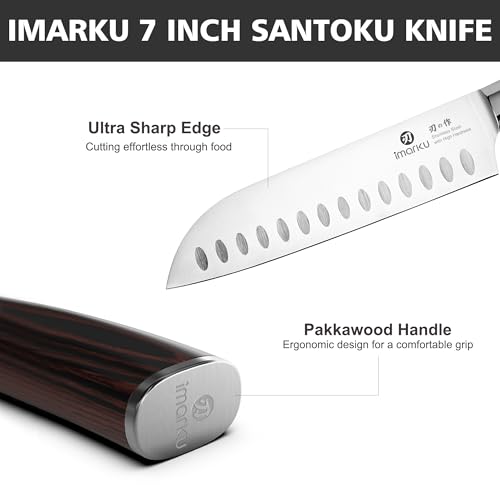
imarku
7-Inch Santoku Knife for Precision Slicing, Dicing & Mincing – High Carbon Japanese Steel with Pakkawood Handle
The imarku 7-inch Santoku knife combines a hollow scalloped edge and 15-18 degree hand-polished bevel to reduce drag and prevent food from sticking during high-volume prep work. Home cooks and apartment dwellers who want a restaurant-capable knife without the steep price will find it covers meat, vegetables, and bread with a single blade.
Pros and Cons
Pros
- The 2.5mm blade thickness paired with the hollow edge design handles both delicate julienne cuts and heavier chopping without flexing or wedging.
- Pakkawood handle construction offers a more sanitary and dimensionally stable grip than standard composite or natural wood handles.
- The 15-18 degree edge angle matches professional Japanese knife geometry, giving it a noticeably sharper out-of-box performance than German-style knives at this price.
- Versatile enough for meat, vegetables, fruit, and bread, making it a practical single-knife solution for small kitchens with limited storage.
Cons
- With zero verified reviews available, long-term edge retention and handle durability under daily use remain unconfirmed by real buyers.
- The 3-month refund window is shorter than the lifetime guarantees offered by competing brands at the same price point.

Zwilling
Henckels Santoku Knife 7-inch Hollow Edge German Stainless Steel
This 7-inch Santoku excels at mincing, slicing, and dicing with its hollow-edge blade that prevents food sticking during prep. Buy it if you want a durable, balanced Japanese-style knife that handles everyday vegetable work without the premium price tag.
Pros and Cons
Pros
- Hollow-edge grantons genuinely prevent cucumber and tomato slices from sticking to the blade mid-cut.
- German stainless steel holds its edge through repeated use on harder vegetables like carrots and beets.
- Fully forged construction creates noticeable weight and balance that makes repetitive dicing feel controlled and effortless.
Cons
- At 7 inches, it's smaller than Western chef's knives, requiring more frequent repositioning on larger vegetables.
- Dishwasher safe, but hand washing extends blade life and prevents potential handle loosening over time.

HOSHANHO
7-Inch Japanese Santoku Chef Knife | HOSHANHO High Carbon Stainless Steel
This 7-inch santoku slices vegetables, meat, and fish with a 15-degree blade angle that delivers thinner, more precise cuts than standard chef knives. Home cooks and professional chefs alike benefit from the triple-layer laminated steel construction that stays sharp longer and resists corrosion.
Pros and Cons
Pros
- The triple-layer laminated steel with 10Cr15CoMoV Japanese steel reaches 62HRC hardness, delivering edge retention that outlasts standard stainless blades.
- Ergonomic pakkawood handle provides secure grip and control without hand fatigue during extended prep sessions.
- 15-degree blade angle and hand-sharpened edge produce cleaner cuts through delicate vegetables and proteins compared to wider blade angles.
Cons
- Hand-washing required; dishwasher use will degrade the blade edge and handle finish over time.
- Requires regular honing to maintain the 15-degree angle; the initial sharpness will gradually diminish with normal kitchen use.

MercerCulinary
Mercer Genesis 7-Inch Santoku Knife: Professional Slicing & Mincing
This fully forged German steel santoku delivers razor-sharp precision for slicing vegetables and mincing herbs with its Granton edge that releases food cleanly. Buy it if you prep vegetables daily and want a professional-grade knife that won't require constant sharpening.
Pros and Cons
Pros
- Granton edge prevents food from sticking to the blade, making thin slicing of cucumbers, tomatoes, and fish noticeably faster than standard chef's knives.
- Ergonomic handle with substantial bolster reduces wrist strain during extended prep sessions and feels secure even when wet.
- Professional-grade construction at under $50 delivers the same German steel and forging process used in culinary schools.
Cons
- Requires hand-washing only; dishwasher use will damage the blade and handle, adding a maintenance step most busy cooks dislike.
- Santoku's shorter blade length and rectangular shape take practice if you're accustomed to Western chef's knives, requiring a learning curve.

Henckels Forged Accent 2-Piece Santoku Knife Set | German Stainless Steel
This 2-piece santoku set delivers razor-sharp German engineering for mincing, slicing, and dicing with effortless precision and lasting edge retention. Buy it if you prep vegetables daily and want knives that stay sharp without constant maintenance.
Pros and Cons
Pros
- Forged bolster transitions seamlessly from blade to handle, eliminating weak points that cause blade wobble during cutting.
- Satin-finished blade holds its edge noticeably longer than stamped knives, reducing the need for frequent sharpening.
- Two-knife set covers both precision work and larger prep tasks without requiring a full block of specialty knives.
Cons
- Santoku blade shape has a steeper learning curve than traditional chef's knives if you're accustomed to rocking motions.
- German stainless steel requires hand-washing to maintain edge longevity, despite being dishwasher-safe.
imarku 7-Inch Santoku Knife for Precision Slicing, Dicing & Mincing – High Carbon Japanese Steel with Pakkawood Handle
imarku
7-Inch Santoku Knife for Precision Slicing, Dicing & Mincing – High Carbon Japanese Steel with Pakkawood Handle
The imarku 7-inch Santoku knife combines a hollow scalloped edge and 15-18 degree hand-polished bevel to reduce drag and prevent food from sticking during high-volume prep work. Home cooks and apartment dwellers who want a restaurant-capable knife without the steep price will find it covers meat, vegetables, and bread with a single blade.
$39.99 at AmazonEditors' Favorite
Color: Brown and Silver Size: 7" Dimensions: 12 x 3 x 1 inches Weight: 0.43 pounds Product Group: Kitchen Binding: Kitchen
Shop NowZwilling Henckels Santoku Knife 7-inch Hollow Edge German Stainless Steel
Zwilling
Henckels Santoku Knife 7-inch Hollow Edge German Stainless Steel
This 7-inch Santoku excels at mincing, slicing, and dicing with its hollow-edge blade that prevents food sticking during prep. Buy it if you want a durable, balanced Japanese-style knife that handles everyday vegetable work without the premium price tag.
$79.95 at AmazonGreat Value
Brand Name: ZWILLING J.A. Henckels Manufacturer: ZWILLING UPC: 035886185930 Global Trade Identification Number: 00035886185930 Model Number: 31170-181 Manufacturer Part Number: 31170-181 -OPEN BOX Manufacturer Warranty Description: Lifetime Warranty Against Manufacturer'S Defects Item Type Name: Hollow Edge Santoku Knife Unit Count: 1.0 Count Included Components: Hollow Edge Santoku Knife Best Sellers Rank: #92,282 in Kitchen & Dining (See Top 100 in Kitchen & Dining) #244 in Bread Knives ASIN: B00068J2A0 Customer Reviews: 4.6 4.6 out of 5 stars (1,418) 4.6 out of 5 stars Blade Material Type: Stainless Steel Handle Material: Stainless Steel,Steel Is the item dishwasher safe?: No Material Type: ZWILLING Carbon No Stain Steel BladeLength: 7 Inches Item Weight: 6.4 ounces Item Length: 16 Inches Size: 7" Color: Stainless Steel Blade Color: Silver Blade Edge: Hollow Ground Construction Type: Forged Blade Material: Stainless Steel Brand: ZWILLING J.A. Henckels
Shop NowHOSHANHO 7-Inch Japanese Santoku Chef Knife | HOSHANHO High Carbon Stainless Steel
HOSHANHO
7-Inch Japanese Santoku Chef Knife | HOSHANHO High Carbon Stainless Steel
This 7-inch santoku slices vegetables, meat, and fish with a 15-degree blade angle that delivers thinner, more precise cuts than standard chef knives. Home cooks and professional chefs alike benefit from the triple-layer laminated steel construction that stays sharp longer and resists corrosion.
$52.99 at AmazonBrand Name: HOSHANHO Manufacturer: HOSHANHO UPC: 714757571477 Model Number: 7 inch Santoku Knife Manufacturer Part Number: HSHES-2022-002 Item Type Name: 7 inch Santoku Chef Knife Unit Count: 1.0 Count Included Components: 7 inch Santoku Knife Best Sellers Rank: #13,746 in Kitchen & Dining (See Top 100 in Kitchen & Dining) #29 in Chef's Knives ASIN: B0C1BQTQKL Customer Reviews: 4.7 4.7 out of 5 stars (1,742) 4.7 out of 5 stars Blade Edge: Plain Construction Type: Forged Blade Material Type: High Carbon Stainless Steel Handle Material: Pakkawood Is the item dishwasher safe?: No Material Type: High Carbon Stainless Steel BladeLength: 7 Inches Item Weight: 11.2 ounces Item Length: 7 Inches Size: 7" Color: Silver Blade Color: Silver Blade Material: High Carbon Stainless Steel Brand: HOSHANHO
Shop NowMercerCulinary Mercer Genesis 7-Inch Santoku Knife: Professional Slicing & Mincing
MercerCulinary
Mercer Genesis 7-Inch Santoku Knife: Professional Slicing & Mincing
This fully forged German steel santoku delivers razor-sharp precision for slicing vegetables and mincing herbs with its Granton edge that releases food cleanly. Buy it if you prep vegetables daily and want a professional-grade knife that won't require constant sharpening.
$39.95 at AmazonBrand Name: Mercer Culinary Manufacturer: Mercer Tool Corp. UPC: 749628445519 765301903244 Global Trade Identification Number: 00765301903244 Model Number: M20707 Manufacturer Part Number: M20707 Manufacturer Warranty Description: Lifetime limited manufacturer's warranty Item Type Name: Genesis Unit Count: 1.0 Count Included Components: Mercer Culinary Genesis 7-Inch Forged Santoku Knife Best Sellers Rank: #3,706 in Kitchen & Dining (See Top 100 in Kitchen & Dining) #15 in Santoku Knives ASIN: B000IBVD4I Customer Reviews: 4.8 4.8 out of 5 stars (1,577) 4.8 out of 5 stars Blade Material Type: High Carbon Steel Handle Material: Santoprene Is the item dishwasher safe?: No Material Type: Stainless steel and manmade BladeLength: 7 Inches Item Weight: 2.99 ounces Item Length: 14.05 Inches Size: 7" Color: Black Blade Color: Silver Blade Edge: Plain Construction Type: Forged Blade Material: High Carbon Steel Brand: Mercer Culinary
Shop NowHenckels Forged Accent 2-Piece Santoku Knife Set | German Stainless Steel
Henckels Forged Accent 2-Piece Santoku Knife Set | German Stainless Steel
This 2-piece santoku set delivers razor-sharp German engineering for mincing, slicing, and dicing with effortless precision and lasting edge retention. Buy it if you prep vegetables daily and want knives that stay sharp without constant maintenance.
$49.95 at AmazonBrand Name: HENCKELS Manufacturer: Henckels UPC: 035886649906 Model Number: 1021241 Manufacturer Part Number: 1021241 Item Type Name: Asian Knife Set Unit Count: 2.0 Count Included Components: 5" HE Santoku, 7" HE Santoku Best Sellers Rank: #41,522 in Kitchen & Dining (See Top 100 in Kitchen & Dining) #14 in Santoku Knives ASIN: B09RTDZ14W Customer Reviews: 4.6 4.6 out of 5 stars (284) 4.6 out of 5 stars Blade Edge: Plain Construction Type: Forged Blade Material Type: Stainless Steel Handle Material: Stainless Steel Is the item dishwasher safe?: Yes Material Type: Stainless Steel BladeLength: 5 Inches Item Weight: 9.07 g Item Length: 5 Inches Size: 2-pc Color: Black Blade Color: Silver Blade Material: Stainless Steel Brand: HENCKELS
Shop Now


Write Your Review
No reviews yet. Be the first to share your experience!