

A grill pizza stone is a thick slab of ceramic, cordierite or similar material that sits on your grill grates, soaks up heat and gives pizza dough a hot, dry surface to bake on. Preheat it with the lid closed for 30 to 45 minutes, slide the pizza on, and you’ll get a crisper crust than a bare grate or a flimsy pan can deliver.
This guide walks through how to pick a stone, how to set up the grill, what goes wrong, and when to replace it. One note up front: the product database for this post holds no actual pizza stones. The items shown below are nearby grill accessories, and we’ve labeled them that way so you know what you’re looking at.
How a pizza stone works on a grill
A stone stores heat and releases it into the bottom of the dough. That’s the whole trick. A thin pan heats fast but loses heat fast, so the crust steams instead of crisping. A thick stone stays hot even after a cold, topped pizza lands on it.
On a gas grill, the stone sits on the grates over indirect or low-medium heat, with the lid down. On a charcoal kettle, bank the coals to the sides and put the stone in the middle. Aim for roughly 500 to 550 degrees Fahrenheit at the stone surface, and use an oven-style thermometer to check, since the dial on the lid often reads high.
Not every grill accessory does this job. A cast iron griddle, for example, is a different tool with its own heat behavior. The Modern Innovations reversible cast iron griddle and grill combo set is a pre-seasoned indoor and outdoor piece that comes with protective mitts, a grill press and a scraper. It isn’t a pizza stone, so treat it as a companion for flatbreads, vegetables and smash-style cooking rather than a swap for one.

Modern Innovations
Reversible Cast Iron Griddle and Grill Set for Stovetop, Camping and BBQ Cooking by Modern Innovations
This reversible cast iron griddle delivers a grill surface for charred steaks, corn and burgers plus a flat side for pancakes, eggs and bacon, while retaining heat effectively. It suits home cooks and campers who want versatile cookware with a press, scraper and protective mitts included.
Pros and Cons
Pros
- Reversible surfaces handle both grilled foods and flat-top breakfast cooking.
- Pre-seasoned cast iron provides a naturally low-stick cooking surface.
- The set includes a press, scraper and protective mitts.
- Cast iron construction is designed for long-term use with proper care.
Cons
- Cast iron requires handwashing, thorough drying and oiling to help prevent rust.
- The product dimensions are not specified in the provided listing data.
Modern Innovations Reversible Cast Iron Griddle and Grill Set for Stovetop, Camping and BBQ Cooking by Modern Innovations
Modern Innovations
Reversible Cast Iron Griddle and Grill Set for Stovetop, Camping and BBQ Cooking by Modern Innovations
This reversible cast iron griddle delivers a grill surface for charred steaks, corn and burgers plus a flat side for pancakes, eggs and bacon, while retaining heat effectively. It suits home cooks and campers who want versatile cookware with a press, scraper and protective mitts included.
Check price on AmazonEditors' Favorite
This reversible cast iron pan solves the need for separate grill and breakfast cookware by offering ridges on one side and a flat cooking surface on the other.
Its heat retention supports charred grill marks for steaks, corn and burgers, while the flat side handles pancakes, eggs and bacon.
Pre-seasoned 100% cast iron provides a naturally low-stick surface, and the included press, scraper and mitts add practical cooking support.
It needs gentle handwashing, complete drying and oiling; soaking and abrasive metal sponges should be avoided.
Best for home cooks and campers who want one versatile stovetop or outdoor cooking pan.
Choosing the right stone
Look at material, thickness and shape before you worry about brand.
Material
Cordierite handles sudden temperature swings better than plain clay, which matters on a grill where flare-ups happen. Standard ceramic works, but it’s more likely to crack if it goes from cold to very hot too fast. Steel plates are another option; they conduct heat quickly, but they’re a different product from a stone.
Size and fit
Measure your cooking grate first. A 14-inch round stone suits many 22-inch kettles and most midsize gas grills, but a stone that overhangs the grates can tip. Leave an inch or so of airflow around the edge so heat can circulate.
Thickness counts too. Thicker stones take longer to preheat and hold heat better. Thin ones heat quickly and cool quickly. Pick based on how many pizzas you plan to make in a row.
Setting up and preheating
Put the stone on the grill while it’s still cold. Dropping a room-temperature stone onto a screaming-hot grate is the fastest way to crack it. Bring the grill up with the stone already in place, lid closed.
Build your pizza on parchment or a floured peel, not directly on the stone. Slide it over with one confident motion. Rotate it halfway through the bake, usually after 4 to 5 minutes, because grills run hotter in the back.
Seasoning matters for the cooking surfaces you use alongside a stone. The Kuche Chef organic BBQ grill seasoning oil is an 8 oz (240 ml) bottle made from flaxseed oil grown and pressed in the USA, and it’s meant for building a non-stick layer on cast iron grills and BBQs. It’s for cast iron, not for ceramic stones. Keep oil off a pizza stone, since it soaks in and can smoke.
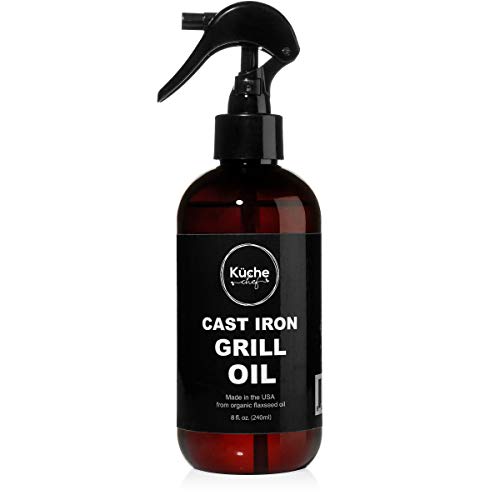
Kuche Chef
Season Cast Iron Grill Grates Without Stickiness: Kuche Chef Organic BBQ Grill Seasoning Oil, USA Flaxseed, 8oz
Kuche Chef's organic flaxseed oil bakes onto cast iron grates and skillets as a hard, non-tacky seasoning layer, and because flaxseed is a drying oil it will not go rancid or leave the sticky film that canola and vegetable oils leave behind. Buy it if you own cast iron grill grates, a griddle, or a Dutch oven and want a single ingredient, edible oil that builds genuine non-stick release instead of a greasy coating.
Pros and Cons
Pros
- Flaxseed is the only edible drying oil, so the bonded layer is food safe as well as durable.
- Single ingredient organic oil grown and pressed in North Dakota, with no additives or thinners.
- Works across cast iron grates, skillets, griddles, and Dutch ovens, not just BBQ hardware.
- High Omega-3 content is what drives the fat polymerization that creates the non-stick bond.
Cons
- Flaxseed builds a hard but brittle finish, so grates under repeated high heat can flake at the edges and need touch-up coats.
- Eight ounces covers only a few full seasoning rounds on a large grill, and the bottle must stay sealed and cool so the oil does not thicken.
Kuche Chef Season Cast Iron Grill Grates Without Stickiness: Kuche Chef Organic BBQ Grill Seasoning Oil, USA Flaxseed, 8oz
Kuche Chef
Season Cast Iron Grill Grates Without Stickiness: Kuche Chef Organic BBQ Grill Seasoning Oil, USA Flaxseed, 8oz
Kuche Chef's organic flaxseed oil bakes onto cast iron grates and skillets as a hard, non-tacky seasoning layer, and because flaxseed is a drying oil it will not go rancid or leave the sticky film that canola and vegetable oils leave behind. Buy it if you own cast iron grill grates, a griddle, or a Dutch oven and want a single ingredient, edible oil that builds genuine non-stick release instead of a greasy coating.
Check price on AmazonEditors' Favorite
An 8oz bottle of organic flaxseed oil made for seasoning cast iron grill grates, griddles, and BBQ surfaces that have gone rusty, sticky, or bare after a season of cooking.
Flaxseed is a drying oil, so it polymerizes into a bonded layer instead of staying tacky the way canola or vegetable oil does on grates left between cookouts.
The oil is 100 percent organic, grown and pressed in North Dakota, and edible, so nothing questionable burns off during the bake cycle. Thin coats go furthest.
The finish is hard but brittle, so grates exposed to repeated high heat can flake at the edges and need a refresh coat each season.
Best for cast iron grill and griddle owners willing to run several thin bake coats for a food safe, non-tacky release surface.
Reviving cast iron grill grates: scrub off rust, wipe on a very thin coat, heat until the surface darkens, then repeat for a slick release layer.
Also suits cast iron skillets, Dutch ovens, flat top griddles, carbon steel woks, and smoker plates that have gone dull or started grabbing food.
For upkeep, wipe a light coat onto warm, dry grates after each cookout to build the seasoning and shorten the next cleanup.
Common mistakes
Most failed grill pizzas come from a handful of repeat errors. Skipping the preheat tops the list. Next comes loading a pizza with wet toppings, which turns the center soggy. Then there’s the lid: leave it open and you’ll lose the top heat that cooks the cheese.
Thermal shock
Never spray water on a hot stone or set it on a cold countertop right off the grill. Let it cool in place with the grill off. Sudden changes are what split stones in half.
Soap and soaking
Skip dish soap. A porous stone absorbs it and your next pizza tastes like it. Scrape off burnt bits with a plastic or metal scraper once it’s cool, then brush it down. Stains are normal. Dark spots don’t hurt anything.
If you want a ridged cast iron pan for grill marks instead, the Semme non stick cast iron grill griddle pan is a pre-seasoned, sided pan with a 10-piece condiment dispenser set included. Again, it’s a different piece of gear. It won’t give you a pizza stone’s dry, even bake.

Semme
Reversible Grill and Griddle Pan for Stovetop Searing and Breakfast: Semme Pre-Seasoned Cast Iron with 10-Piece Condiment Dispenser Set
The Semme cast iron pan gives you a ridged grilling face for steaks and burgers plus a flat face for eggs, pancakes, and pressed sandwiches, so one pan covers both jobs on a single burner. It suits cooks with limited storage who want cast iron heat retention and indoor grill marks without buying and stashing two separate pans.
Pros and Cons
Pros
- One reversible pan does the work of a grill pan and a flat griddle, cutting cabinet space and cost.
- Cast iron construction shrugs off high burner heat and metal spatulas that would strip a coated pan.
- Short integral handles keep the overall footprint to a single burner and standard cabinet depth.
- Factory seasoning means usable food release from the first cook rather than after an oven cure.
Cons
- Cast iron has to be dried immediately and wiped with oil after every wash, or the seasoning degrades and rust forms.
- The listing does not state exact pan dimensions or weight, so confirm it clears your burner grate and range hood before ordering.
Semme Reversible Grill and Griddle Pan for Stovetop Searing and Breakfast: Semme Pre-Seasoned Cast Iron with 10-Piece Condiment Dispenser Set
Semme
Reversible Grill and Griddle Pan for Stovetop Searing and Breakfast: Semme Pre-Seasoned Cast Iron with 10-Piece Condiment Dispenser Set
The Semme cast iron pan gives you a ridged grilling face for steaks and burgers plus a flat face for eggs, pancakes, and pressed sandwiches, so one pan covers both jobs on a single burner. It suits cooks with limited storage who want cast iron heat retention and indoor grill marks without buying and stashing two separate pans.
Check price on AmazonEditors' Favorite
A double sided cast iron pan: ridged on one face for grill marks, flat on the other for breakfast cooking. It replaces a grill pan and a griddle in one burner-sized piece.
The ridges hold steaks and chops above rendered fat, so meat browns instead of steaming. Flip it and the flat face takes pancakes, eggs, and pressed sandwiches at the same heat.
Solid cast iron, pre-seasoned at the factory, with two short integral handles for lifting with mitts. It runs heavier than nonstick aluminum, which is what keeps its temperature stable under cold food.
Factory seasoning is thin. Expect to build it up over several oiled cooks before egg release matches a coated pan, and dry it on the burner after every wash.
Best for the home cook who wants indoor grill marks and a flat-top surface without storing two separate pans.
Dough and topping tips for the grill
Dough behaves differently over live fire. Keep it thin, around a quarter inch, so it cooks through before the bottom scorches. Let it rest at room temperature for 30 minutes before stretching, because cold dough fights you and tears.
Go light on toppings
A grill with the lid down bakes fast, so heavy toppings stay raw. Use a thin layer of sauce, shredded low-moisture mozzarella, and pre-cooked meats. Pile on fresh basil or arugula after the pizza comes off.
Watch the bottom, not the clock
Lift an edge with a spatula after about 3 minutes. If the underside is pale, give it more time. If it’s dark in spots, slide the stone to a cooler zone of the grill. Every grill has hot patches, and a few practice pies teach you where yours are.
Handling the hot stone
Treat it like a hot skillet at all times. Wear long grill gloves, and don’t lift it until it has cooled for at least an hour. Moving a hot stone is how people get burned.
One more thing: a stone takes a long time to cool. Plan your cleanup for later in the evening, or even the next morning, and keep kids and pets away from the grill until then.
Which grill suits a pizza stone
A grill with a tight-fitting lid and even heat does the best job. If you’re still shopping, our guides to the best charcoal grill and the best electric grill cover two very different approaches. Kettle-style charcoal grills reach high temperatures easily; electric models are simpler but may not hit pizza temperatures.
Smaller setups work as well. See the best portable grill list if you’re short on space, and the best smoker grill picks if you want smoke flavor on the crust. Budget buyers can start with best grill under 300 or the best cheap BBQ grill roundup.
Storing and caring for your stone
Once it’s cool and brushed clean, leave the stone somewhere dry. Many people simply keep it in the grill between uses, which works if the grill is covered and the stone stays out of rain. Moisture trapped inside a porous stone turns into steam during the next preheat, and that can crack it.
If it has been sitting in a damp spot, let it dry fully indoors for a day before the next cookout. Patience here costs nothing and saves a stone.
When to replace your stone
A hairline crack isn’t always the end, but a stone that wobbles, flakes or breaks into pieces needs to go. Chipped edges can leave grit in your food. Heavy odor that won’t burn off after a long, empty preheat is another warning sign, since grease has soaked in deep.
If your stone is only stained, keep it. If it’s in pieces, buy a new one before the next cookout.
FAQ
Can you put a pizza stone on a gas grill?
Yes. Place it on the grates before you light the grill, close the lid, and preheat for 30 to 45 minutes. Keep the burners at low to medium so the stone heats gradually.
How hot should a grill pizza stone get?
Most pizzas bake well at about 500 to 550 degrees Fahrenheit. Use a separate thermometer near the stone, because lid gauges can be off by a wide margin.
Do you need to oil a pizza stone?
No. Stones are porous, and oil soaks in, smokes and can turn rancid. Oils like flaxseed are for seasoning cast iron, not ceramic.
Can you wash a pizza stone with soap?
Avoid it. The stone absorbs soap and can pass the taste to your food. Let it cool, scrape off residue, and wipe it with a barely damp cloth.
Is a cast iron griddle the same as a pizza stone?
No. A griddle is metal and conducts heat quickly for searing and flatbreads, while a stone is ceramic and stores heat for baking dough. They suit different jobs, and plenty of cooks own both.









Write Your Review
No reviews yet. Be the first to share your experience!