

TL;DR — A good cookware set matches its materials to how you cook. Stainless steel (ideally tri-ply, aluminum core bonded between steel layers) is the versatile all-rounder for browning and sauces; nonstick is for eggs and delicate foods but wears out in a few years; cast iron and carbon steel deliver unmatched searing heat retention; enameled cast iron excels at braises. Prioritize full tri-ply or thick-gauge construction, riveted stay-cool handles, tight-fitting lids, and induction compatibility if you need it. Skip giant sets padded with lids and utensils; you really only need a couple of pans and a pot or two. For picks, see our best cookware sets guide.
The HomeWhisk editorial team researches kitchen equipment by analyzing manufacturer specifications, material behavior, and aggregated owner reviews from major retailers and cooking communities like Reddit r/cooking and r/castiron. Our guidance reflects how these materials actually perform over years of use, not marketing gloss.
A cookware set is one of the higher-stakes kitchen purchases because you live with it daily for years, and the market is full of large sets that inflate the piece count with lids and gadgets to look like better value. This guide focuses on what actually determines whether cookware performs and lasts: the material, the construction, and the fit between the two and your cooking. Understanding those three things lets you ignore the marketing and buy the set you’ll still reach for a decade from now. For curated picks, see our best cookware sets and best nonstick cookware guides.
Understand the Anatomy of a Good Pan
Before comparing materials, know what you’re looking at. Cookware performance comes down to how a pan conducts and holds heat, and that depends on construction.
Cladding and gauge: Cheap pans are a single thin layer of stamped metal that develops hot spots and warps. Quality stainless cookware is “clad,” meaning a core of highly conductive aluminum or copper is bonded between layers of stainless steel. Tri-ply (three layers) is the practical standard; five-ply and copper-core exist at a premium. “Fully clad” means the layered construction runs up the sides, giving even heat all over, versus “impact-bonded” (or disc-bottom) pans that only have the conductive layer on the base.
Handles and rivets: Handles attached with stainless rivets are the most durable; screwed-on handles loosen over time and fully welded handles can’t be repaired. Riveted handles do leave bumps inside the pan that need cleaning around. Look for handles designed to stay cool on the stovetop and check whether the whole pan is oven-safe (and to what temperature, since some handles cap at 350°F while all-metal ones go to 500°F+).
Lids and edges: Tight-fitting lids retain moisture for simmering and braising; glass lets you watch, metal survives higher oven heat. Flared or rolled pouring rims make transferring sauces cleaner. These small details separate a set you enjoy from one you tolerate.
Stainless Steel: The Versatile All-Rounder
Stainless steel is the default recommendation for a core set because it does almost everything competently and lasts effectively forever. It won’t react with acidic foods (tomatoes, wine, citrus), tolerates metal utensils and high oven heat, and develops the browned bits (fond) that make great pan sauces, something nonstick can’t do.
The catch is that stainless is a poor heat conductor on its own, which is exactly why the aluminum or copper core matters. Buy tri-ply or better; a bare stainless pan is a frustrating, hot-spotting disappointment. Stainless is not naturally nonstick, but proper technique (preheat the pan, then add oil, and let proteins release on their own) makes it manageable. Owners consistently report that a good tri-ply set is the backbone of a kitchen, supplemented by a dedicated nonstick pan and maybe a cast iron. It handles searing, sautéing, braising, boiling, and sauce work.
Nonstick: For Eggs and Delicate Foods (With a Shelf Life)
Nonstick cookware uses a PTFE-based coating (Teflon is one brand) over an aluminum body, giving effortless food release and easy cleanup. It’s ideal for eggs, pancakes, fish, and anything delicate that would tear on stainless. Modern coatings are made without PFOA, which was phased out of manufacturing.
The honest trade-off is lifespan. Nonstick coatings degrade with use and heat, and even careful owners typically replace nonstick pans every 3–5 years, versus decades for stainless or cast iron. To extend their life: never exceed medium-high heat (high heat breaks the coating down and can release fumes), use only wood, silicone, or nylon utensils, avoid aerosol cooking sprays (they leave a gummy residue), and hand-wash rather than putting them in the dishwasher. Because nonstick is a consumable, many cooks buy an inexpensive standalone nonstick skillet rather than a full nonstick set. Ceramic-coated nonstick is a PTFE-free alternative but generally wears out even faster. See our best nonstick cookware guide.
Cast Iron and Carbon Steel: Searing and Heat Retention
Uncoated cast iron is heavy, cheap, and nearly indestructible. Its strength is thermal mass: it holds heat exceptionally well, so it delivers a deep, even sear on steak and holds temperature when cold food hits the pan. Seasoned properly (baked-on layers of polymerized oil), it becomes naturally nonstick-ish and improves with age. The downsides are weight, slow and uneven heat-up (it needs preheating), and the need to keep it seasoned and dry to prevent rust. It’s not ideal for acidic foods in a bare state.
Carbon steel is cast iron’s lighter, more responsive cousin, the metal professional kitchens and woks are made of. It seasons the same way, sears beautifully, but heats faster and is lighter, making it more maneuverable. Enameled cast iron (like a Dutch oven) coats the iron in glass enamel, so it needs no seasoning, resists rust, and handles acidic braises and stews, though it lacks the slick seasoned surface for frying eggs. A carbon steel skillet or an enameled Dutch oven pairs perfectly with a stainless core set, and if you also pressure-cook or slow-cook, a multi-cooker fills that role (see our best instant pot guide).
Copper and Specialty Pieces
Copper is the best heat conductor used in cookware, offering unmatched responsiveness, when you turn the heat down, a copper pan cools almost instantly, which is why it’s prized for delicate sauces and candy work. It’s also expensive, requires polishing to stay bright, and (in unlined form) reacts with food, so it’s lined with stainless or tin. For most home cooks, copper is a specialty indulgence rather than a core buy; see our best copper cookware guide if you’re drawn to it.
Other specialty pieces worth knowing: a wok for high-heat stir-frying (carbon steel is traditional), a moka pot for stovetop espresso-style coffee that pairs with your cookware collection (see our best moka pot guide), and stackable camping cookware if you cook outdoors (our best camping cookware guide covers packable sets). None of these belong in a first set, but they round out a kitchen over time.
Sets vs. Buying Individual Pieces
Here’s the buying-guide truth: large cookware sets are often worse value than they appear. A “12-piece set” usually counts lids and sometimes utensils as pieces, and it forces you to take pans you’ll never use to get the two or three you will. Most cooks genuinely use an 8- and a 10-inch skillet, a 3-quart saucepan, and a larger stockpot or Dutch oven, that’s it.
Buy a set when it’s a well-chosen small set (often 5–8 real pieces) of quality tri-ply, and when the per-piece price genuinely beats buying separately, which it sometimes does. Buy individually when you want the best pan in each category, want to mix materials (stainless core plus a standalone nonstick skillet plus a cast iron), or want to avoid dead-weight pieces. If you cook on induction, verify compatibility: the pan base must be magnetic (a fridge magnet should stick), which rules out plain aluminum and most copper unless they have a magnetic layer. Our best cookware sets guide flags induction-ready options.
Frequently Asked Questions
What is the best cookware material overall?
There’s no single winner because each material trades off differently, which is why most experienced cooks mix them. Tri-ply stainless steel is the best all-rounder and the smartest core: durable, non-reactive, oven- and metal-utensil-safe, and great for browning. Add a nonstick skillet for eggs and delicate foods, and a cast iron or carbon steel pan for high-heat searing. If you had to own one material, stainless is the most versatile. The “best” material is really the one matched to the specific task in front of you.
What cookware is healthiest to use?
The main health considerations are coating integrity and food reactivity. Uncoated stainless steel, cast iron, and carbon steel have no coating to wear off and are widely regarded as safe; cast iron can even add small amounts of dietary iron. Modern PTFE nonstick made without PFOA is considered safe at normal cooking temperatures but should not be overheated past medium-high, where the coating degrades. Avoid using scratched or flaking nonstick pans. If you prefer to avoid PTFE entirely, ceramic-coated, stainless, and cast iron are the go-to choices. See our best nonstick cookware guide for PTFE-free options.
What pieces do I actually need in a cookware set?
Far fewer than most sets include. A practical core is an 8-inch and a 10- or 12-inch skillet (one nonstick, one stainless or cast iron), a 2–3 quart saucepan with a lid, and a large stockpot or Dutch oven. That handful covers frying, sautéing, sauces, boiling pasta, and braising for the vast majority of home cooking. Everything beyond it, sauté pans, extra sizes, specialty pieces, is a refinement you can add as your cooking demands it, not a starting requirement. Don’t pay for a piece count you won’t use.
Is stainless steel or nonstick better for a cookware set?
They solve different problems, so the best answer is usually to own both. Stainless steel is the durable, versatile workhorse for searing, browning, sauces, and high-heat or oven cooking, and it lasts decades. Nonstick is for effortless release with eggs, fish, and delicate foods, and for easy cleanup, but it’s a consumable you’ll replace every few years. If a set is mostly nonstick, you’re buying a lot of pieces with a short lifespan. A stainless core plus one or two nonstick skillets is the more sensible combination.
What should I look for to make sure cookware lasts?
Prioritize construction. For stainless, choose fully clad tri-ply (aluminum or copper core through the sides, not just a disc base) to avoid warping and hot spots. Look for stainless rivets on the handles, a solid feel with some weight, tight-fitting lids, and a clear oven-safe temperature rating. For nonstick, a thicker aluminum body resists warping and a reputable coating lasts longer, though all nonstick is eventually disposable. Avoid thin stamped single-layer pans and welded or screwed-on handles. Good construction is what separates a decade of service from a year.
Does cookware need to be induction-compatible?
Only if you have or plan to get an induction cooktop, but it’s worth checking. Induction works by inducing a current in the pan itself, so the base must be ferromagnetic, if a fridge magnet sticks firmly to the bottom, it will work. Cast iron, carbon steel, and most quality stainless are induction-ready; plain aluminum, copper, and glass are not unless they have a bonded magnetic layer. Since induction is increasingly common, buying induction-compatible cookware future-proofs your purchase even on a gas or electric stove today. Our best cookware sets guide notes which picks work on induction.
The Bottom Line
Choosing a cookware set is really about matching materials to how you cook and insisting on real construction. Tri-ply stainless steel makes the best versatile core, nonstick handles eggs and delicate foods but wears out in a few years, and cast iron or carbon steel deliver searing power that clad pans can’t match. Look past the piece count: full cladding or thick gauge, riveted stay-cool handles, tight lids, and induction compatibility matter far more than whether a box says 10 or 15 pieces. For most people, a small quality set plus a standalone nonstick skillet and a cast iron beats any giant matched set. For picks, see our best cookware sets, best nonstick cookware, and best copper cookware guides.

CAROTE
16-Piece Induction Titanium Nonstick Cookware Set
This 16-piece titanium cookware set delivers effortless food release and even heating across all stovetops, including induction, while the reinforced die-cast aluminum base resists warping. Buy it if you want durable everyday cookware that cuts cleanup time and handles frequent cooking without hot spots.
Pros and Cons
Pros
- Titanium nonstick surface resists peeling and maintains performance through hundreds of cooking cycles.
- Even heat distribution prevents undercooked centers and burnt edges on proteins and vegetables.
- Silicone-edged lids seal tightly, keeping flavors locked in during simmering and braising.
Cons
- Hand-washing required to prevent black residue buildup on the base; dishwasher use voids durability.
- Lid glass can chip if dropped or subjected to thermal shock from extreme temperature changes.
AIVIKI
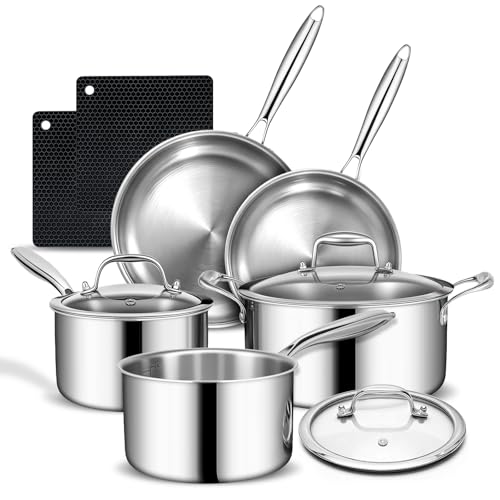
Induction-Ready Tri-Ply Cookware for Everyday Meals, AIVIKI 10-Piece Stainless Steel Set
This AIVIKI cookware set handles frying, simmering, braising, roasting, and broiling while its tri-ply aluminum core promotes faster, more even heating. It suits home cooks who want durable stainless steel cookware compatible with induction and other major cooktops without a nonstick coating.
Pros and Cons
Pros
- Tri-ply construction combines magnetic stainless steel with an aluminum core for responsive, even heating.
- The pots and pans are oven safe up to 500°F, expanding cooking options beyond the stovetop.
- Food-contact surfaces use 304 stainless steel, and the set is free from PFOA, PTFE, and PFAS coatings.
- The set includes two frying pans, two lidded saucepans, a lidded Dutch oven, and two silicone trivets.
Cons
- The tempered-glass lids cannot go in the oven, even though the cookware is oven safe up to 500°F.
- The handles and lid handles require one-time assembly before the set can be used.
The Best Deals This Week*
-
CAROTE 16-Piece Induction Titanium Nonstick
$89.97
($139.99)Save $50.02 -
Induction-Ready Tri-Ply Cookware for Everyday
$65.99
($84.99)Save $19.00 -
M MELENTA Pots and Pans Set Non Stick
$56.98
($59.98)Save $3.00
*Deals are selected by our commerce team
CAROTE 16-Piece Induction Titanium Nonstick Cookware Set
CAROTE
16-Piece Induction Titanium Nonstick Cookware Set
This 16-piece titanium cookware set delivers effortless food release and even heating across all stovetops, including induction, while the reinforced die-cast aluminum base resists warping. Buy it if you want durable everyday cookware that cuts cleanup time and handles frequent cooking without hot spots.
$89.97 at AmazonEditors' Favorite
Brand Name: CAROTE Number of Pieces: 16 Included Components: 8" fry pan, 9.5" fry pan, 2.5-qt saucepan with lid, 5-qt sauté pan with lid, 5-qt stockpot with lid, slotted turner, ladle, 5*pan protectors. With Lid: Yes Manufacturer: CAROTE Set Name: CAROTE Nonstick Pots and Pans Model Number: A09035 Manufacturer Part Number: A09035 Item Type Name: Cookware Set Unit Count: 1.0 Count Best Sellers Rank: #840 in Kitchen & Dining (See Top 100 in Kitchen & Dining) #8 in Kitchen Cookware Sets ASIN: B0DGLVW188 Customer Reviews: 4.6 4.6 out of 5 stars (3,357) 4.6 out of 5 stars Color: Black Material Type: Aluminum, Titanium Handle Material: Bakelite Is the item dishwasher safe?: No Material Type Free: Perfluorooctane Sulfonate (PFOS) Free, Perfluorooctanoic Acid (PFOA) Free Closure Material: Glass with Silicone Cookware Set Is Compatible With: Gas Cooktop, Oven Intended Use: residential, professional Utensil Compatibility: Silicone Is Cookware Induction Compatible: Yes Other Special Features of the Product: Non Stick, Non Toxic Compatibility Options: Electric Stovetop, Gas Stovetop, Induction Stovetop Size: 16 PCS Item Weight: 7.49 Kilograms Is Oven Safe: Yes Material: Aluminum, Titanium Brand: CAROTE
Shop NowAIVIKI Induction-Ready Tri-Ply Cookware for Everyday Meals, AIVIKI 10-Piece Stainless Steel Set
AIVIKI
Induction-Ready Tri-Ply Cookware for Everyday Meals, AIVIKI 10-Piece Stainless Steel Set
This AIVIKI cookware set handles frying, simmering, braising, roasting, and broiling while its tri-ply aluminum core promotes faster, more even heating. It suits home cooks who want durable stainless steel cookware compatible with induction and other major cooktops without a nonstick coating.
$65.99 at AmazonGreat Value
Color: Stainless Steel Size: 10pcs Dimensions: 0.2 x 0.1 x 0.1 inches Weight: 0.220462262 pounds Product Group: Kitchen Binding: Unknown Binding
Shop NowM MELENTA Pots and Pans Set Non Stick, 11-Piece Grey Granite Cookware Set

Color: Dark Gray Size: 11 Piece Cookware Set Product Group: Kitchen
Shop NowAnymark 16PCS Pots and Pans Set Non Stick Cookware (black, 16pieces)

Color: Black Size: 16pieces Product Group: Kitchen
Shop NowMade In Cookware - 3-Piece (Includes 8",10",12") Stainless Frying Pan Set - 5 Ply Stainless Clad - Professional Cookware - Crafted in Italy - Induction Compatible

Made In
Cookware - 3-Piece (Includes 8",10",12") Stainless Frying Pan Set - 5 Ply Stainless Clad - Professional Cookware - Crafted in Italy - Induction Compatible
$299.00 at AmazonColor: Stainless Handle Size: 3-Piece Set (8", 10", 12") Dimensions: 18 x 10.5 x 3.5 inches Weight: 1.75 Pounds Product Group: Kitchen Binding: Kitchen
Shop Now




Write Your Review
No reviews yet. Be the first to share your experience!