

TL;DR — The best dehydrator for the money is the option that balances reliable construction, realistic capacity, easy cleanup, and a price that matches how often you will use it. HomeWhisk prioritizes documented specifications, material choices, and repeated owner-review patterns rather than marketing claims. If you are still comparing nearby categories, start with best 4 qt air fryer and best 6 qt air fryer before narrowing your final pick.
The HomeWhisk editorial team researches kitchen equipment by comparing manufacturer specifications, material details, dimensions, warranty language, retailer listings, and aggregated owner reviews. For best dehydrator for the money, we looked for patterns that matter after the return window closes: repeated complaints, praised design details, compatibility limits, and maintenance habits that determine whether a product stays useful.
This is a commercial buying guide, so the goal is practical selection rather than a broad encyclopedia entry. Use this page alongside best affordable air fryer and best affordable air fryer toaster oven if your purchase overlaps adjacent tools or a larger kitchen setup.
Editor’s Picks
| Category | Pick Type | Why It Makes Sense |
|---|---|---|
| Best Overall | Balanced dehydrator | Strongest mix of construction, usability, cleanup, and owner satisfaction |
| Best Value | Practical dehydrator | Keeps the core performance features while avoiding unnecessary upgrades |
| Best for The Money | Use-case focused option | Prioritizes the size, controls, material, or workflow that matters most for this search |
At a Glance: Comparison Table
| Pick Type | Capacity | Controls | Best For | Trade-Off |
|---|---|---|---|---|
| Best Overall | Balanced build | Everyday size | Most homes | Not the lowest price |
| Best Value | Core materials | Practical capacity | Budget buyers | Fewer premium details |
| Best Upgrade | Heavier construction | Frequent use | Serious cooks | Higher cost |
| Best Compact | Space-saving design | Smaller batches | Small kitchens | Less capacity |
| Best Specialty | Focused feature set | Niche use | Specific needs | Less universal |
How We Evaluated These Products
We evaluated dehydrator options by starting with the product job: what the item must do well for the money, what trade-offs buyers usually accept, and which features are often overstated. From there, we compared visible specifications such as materials, dimensions, capacity, heat or power ratings where relevant, included accessories, warranty terms, and care instructions.
Aggregated owner feedback was used to identify repeated patterns rather than isolated anecdotes. A single dramatic review can be misleading, but repeated comments about weak motors, noisy operation, cracked plastic, confusing controls, awkward cleaning, overheating, or capacity claims that feel inflated are useful signals. We gave more weight to recent reviews because product lines, coatings, accessories, and manufacturing details can change over time.
We also considered how the product fits into a full kitchen workflow. A Dehydrator can look excellent on a spec sheet and still be frustrating if it is too large to store, too slow to clean, incompatible with common accessories, or poorly matched to the buyer’s cooking habits. That is why this guide connects the main recommendation to related guides like best 4 qt air fryer, best 6 qt air fryer, and best affordable air fryer.
What Actually Matters:
Capacity, wattage, and real counter footprint
Usable capacity and footprint rarely match the marketing number, so read the real dimensions. A model rated for a large batch can still cook unevenly if the basket or bowl is cramped, and a “compact” unit can still hog the counter once you account for lid clearance and cord. For the money, compare interior usable space and the space it claims when open, not just the headline quarts or watts. For a related option, compare best 4 qt air fryer before you commit.
Controls, presets, and repeatability
Controls and repeatability separate an appliance you trust from one you fight. Check whether presets map to things you actually cook, whether the dial or panel gives fine control, and whether it remembers or resets between uses. A machine that hits the same result every time is worth more than one with a long feature list you set once and never touch again. For a related option, compare best 6 qt air fryer before you commit.
Cleaning design and removable parts
Cleaning design makes or breaks how often the dehydrator earns its counter space. Look for removable, dishwasher-safe parts, smooth interiors without food traps, and a lid or basket that rinses without disassembly gymnastics. A powerful appliance that is a chore to wash gets used less, so treat easy teardown as a core spec rather than a bonus. For a related option, compare best affordable air fryer before you commit.
Noise, heat, and everyday usability
Noise, heat, and everyday usability are the frictions you only notice after purchase. A loud motor or a unit that vents heat across the counter changes when and where you are willing to run it. Check cord length, how far controls sit from a wall, and whether the exterior stays touch-safe — small ergonomics decide whether a dehydrator lives on the counter or in a cupboard. For a related option, compare best affordable air fryer toaster oven before you commit.
Durability, warranty, and value
Durability and value show up in the parts you cannot see on the box. Weigh the warranty length, the reputation of the motor or heating element, and whether replacement baskets and seals are sold at all. For the money, the better buy is often the model with a proven track record and available parts over a cheaper one that fails just past the return window. For a related option, compare best affordable blender before you commit.

Frequently Asked Questions
What should I look for in the best dehydrator?
Start with fit for your routine: capacity, materials, cleaning, storage, and compatibility. Then compare owner-review patterns for repeated praise or complaints. For best dehydrator for the money, avoid buying only by star rating; the right dehydrator should match the money and the way you actually cook.
Is a more expensive dehydrator worth it?
It can be, but only when the upgrade improves something you will notice often: durability, control, cleaning, capacity, or comfort. If the higher price only adds accessories or cosmetic finish, a value pick may be smarter. Spend more when the category is used weekly or daily.
What size dehydrator is best for the money?
The best size is the one that handles your normal use without making storage and cleanup annoying. Product photos can hide scale, so check exterior dimensions as well as usable capacity. For small kitchens or occasional use, a slightly smaller dehydrator is often the better long-term choice.
How long should a good dehydrator last?
A good dehydrator should last long enough to justify its price when cared for according to the manufacturer instructions. Lifespan depends on materials, heat exposure, cleaning habits, moving parts, coatings, and storage. Repeated owner complaints about early failure are more important than one isolated review.
What mistakes should I avoid when buying dehydrator?
The biggest mistake is buying the most feature-heavy option without checking whether those features solve your actual problem. Also avoid ignoring dimensions, care requirements, replacement parts, and compatibility. If maintenance sounds unrealistic for your household, choose a simpler product.
How does best dehydrator for the money compare with nearby options?
Nearby options can overlap, so use intent to decide. If your need is broad, start with the main dehydrator category. If your need is specific, compare related guides such as best affordable blender for smoothies and best 4 qt air fryer to avoid buying a product that is good generally but wrong for your setup.
Our Top Pick
For most shoppers, the best dehydrator is the balanced option that gets the fundamentals right before adding extras. Prioritize the product with clear specifications, enough capacity for your normal routine, materials that match your maintenance habits, and repeated owner feedback showing reliable everyday use. The shortcode above contains the product set for this page; use the decision tree below to choose the right type within that set.
- Choose the Best Overall type if you want one safe dehydrator for regular use.
- Choose the Best Value type if price matters more than premium finish.
- Choose the Best for The Money type if your use case is specific and frequent.
- Choose an upgrade only if better materials, controls, capacity, or durability will matter every week.
Cosori
Make Beef Jerky and Dried Fruit at Home: Cosori 5-Tray Food Dehydrator with 165°F Max Temp and 48H Timer
The Cosori Food Dehydrator reaches 165°F — higher than most competitors — making it one of the safer options for homemade beef jerky while handling everything from herbs to dog treats across five BPA-free trays. Home cooks who want precise temperature control, quiet overnight runs, and room to expand to seven trays will get the most out of this machine.
Pros and Cons
Pros
- The 165°F maximum temperature meets USDA guidelines for safely drying meat, which most entry-level dehydrators cannot match.
- Fine-grained 1°F temperature increments give you precise control over delicate ingredients like herbs and thin fruit slices.
- Solid housing construction resists cracking and warping better than clear-shell models that can become brittle over time.
- The sub-47 dB operation makes it practical to run extended cycles in a home kitchen without noise disruption.
Cons
- Five trays may feel limiting for large households or bulk batches until the optional expansion trays are purchased separately.
- No digital display or app connectivity means monitoring requires manual checks rather than remote oversight.

Reemix
Compact 5-Tier Food Dehydrator for Fruit, Herbs and Jerky: Reemix BPA-Free Tray Model
The Reemix 5-Tier Food Dehydrator dries fruit, vegetables, herbs and jerky while its circular airflow system promotes even moisture removal across trays. It suits home cooks who want compact countertop food preservation with adjustable temperature and timer controls.
Pros and Cons
Pros
- The compact five-tier layout provides useful drying space for small kitchens.
- Touch controls and a bright LCD display make settings easy to adjust and monitor.
- BPA-free trays and a food-grade design support routine snack and meal preparation.
- Quiet, low-power operation is more convenient for frequent use than running a conventional oven.
Cons
- The product data does not specify the dehydrator's exact dimensions or weight.
- The compact design may offer less room for large batches than a full-size dehydrator.
vassillias
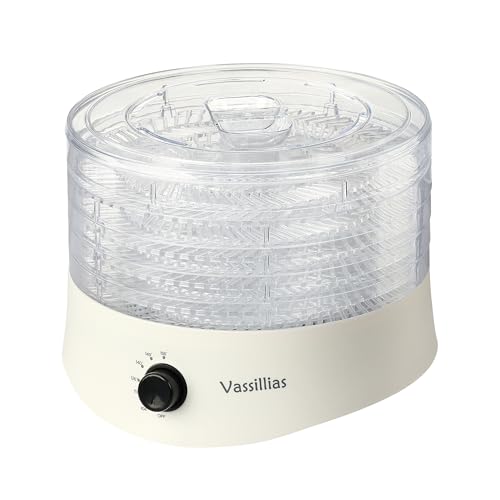
5-Tray Food Dehydrator for Jerky, Fruit and Herbs, vassillias Model 740MJY
The vassillias Model 740MJY dehydrates meat, jerky, fruit, vegetables, mushrooms and herbs with adjustable heat and a fan for consistent drying. It suits small kitchens and home snack makers who need five removable trays without taking up much countertop space.
Pros and Cons
Pros
- BPA-free, food-grade materials provide a suitable food-contact surface for everyday dehydrating.
- Five trays and a 0.79-inch gap provide useful capacity for home snack preparation.
- Adjustable temperature control accommodates both low-temperature herbs and higher-temperature jerky preparation.
- The automatic shutdown feature adds protection against overheating or short-circuit-related temperature problems.
Cons
- The product weight is not provided, so buyers cannot assess how easily it can be moved or stored.
- The 0.79-inch tray gap may limit use with thicker food pieces unless they are sliced thinner.
Cosori Make Beef Jerky and Dried Fruit at Home: Cosori 5-Tray Food Dehydrator with 165°F Max Temp and 48H Timer
Cosori
Make Beef Jerky and Dried Fruit at Home: Cosori 5-Tray Food Dehydrator with 165°F Max Temp and 48H Timer
The Cosori Food Dehydrator reaches 165°F — higher than most competitors — making it one of the safer options for homemade beef jerky while handling everything from herbs to dog treats across five BPA-free trays. Home cooks who want precise temperature control, quiet overnight runs, and room to expand to seven trays will get the most out of this machine.
$49.99 at AmazonEditors' Favorite
Color: White Size: 5 Trays Dimensions: 11.62 x 11.62 x 8.74 Inches Weight: 4.85 pounds Product Group: Kitchen Binding: Kitchen
Shop NowReemix Compact 5-Tier Food Dehydrator for Fruit, Herbs and Jerky: Reemix BPA-Free Tray Model
Reemix
Compact 5-Tier Food Dehydrator for Fruit, Herbs and Jerky: Reemix BPA-Free Tray Model
The Reemix 5-Tier Food Dehydrator dries fruit, vegetables, herbs and jerky while its circular airflow system promotes even moisture removal across trays. It suits home cooks who want compact countertop food preservation with adjustable temperature and timer controls.
$39.99 at AmazonGreat Value
Color: Black, Sliver Size: Compact Dimensions: 16.8503936836 x 6.2204724346 x 13.1889763645 inches Product Group: Kitchen Binding: Kitchen
Shop Nowvassillias 5-Tray Food Dehydrator for Jerky, Fruit and Herbs, vassillias Model 740MJY
vassillias
5-Tray Food Dehydrator for Jerky, Fruit and Herbs, vassillias Model 740MJY
The vassillias Model 740MJY dehydrates meat, jerky, fruit, vegetables, mushrooms and herbs with adjustable heat and a fan for consistent drying. It suits small kitchens and home snack makers who need five removable trays without taking up much countertop space.
$35.99 at AmazonColor: White Size: 5 Trays Product Group: Kitchen
Shop Now







Write Your Review
No reviews yet. Be the first to share your experience!