

TL;DR — The best sharpening stone for knives is the option that balances reliable construction, realistic capacity, easy cleanup, and a price that matches how often you will use it. HomeWhisk prioritizes documented specifications, material choices, and repeated owner-review patterns rather than marketing claims. If you are still comparing nearby categories, start with best affordable bread knife and best affordable chef knife before narrowing your final pick.
The HomeWhisk editorial team researches kitchen equipment by comparing manufacturer specifications, material details, dimensions, warranty language, retailer listings, and aggregated owner reviews. For sharpening stone for knives, we looked for patterns that matter after the return window closes: repeated complaints, praised design details, compatibility limits, and maintenance habits that determine whether a product stays useful.
This is a commercial buying guide, so the goal is practical selection rather than a broad encyclopedia entry. Use this page alongside best affordable chef knife set and best affordable kitchen knife set if your purchase overlaps adjacent tools or a larger kitchen setup.
Editor’s Picks
| Category | Pick Type | Why It Makes Sense |
|---|---|---|
| Best Overall | Balanced sharpening stone | Strongest mix of construction, usability, cleanup, and owner satisfaction |
| Best Value | Practical sharpening stone | Keeps the core performance features while avoiding unnecessary upgrades |
| Best for Knives | Use-case focused option | Prioritizes the size, controls, material, or workflow that matters most for this search |
At a Glance: Comparison Table
| Pick Type | Steel / Edge | Handle Feel | Best For | Trade-Off |
|---|---|---|---|---|
| Best Overall | Forgiving stainless or semi-stainless | Neutral balance | Daily prep | Not the cheapest |
| Best Value | Durable stamped or simpler forged steel | Practical grip | Newer cooks | Less refined finish |
| Best Upgrade | Harder steel with cleaner edge retention | More precise balance | Frequent prep | Needs better care |
| Best Small Kitchen | Versatile mid-length profile | Easy control | Tight counters | Less reach |
| Best Specialty | Task-specific blade geometry | Purpose-built | Specific foods | Less universal |
How We Evaluated These Products
We evaluated sharpening stone options by starting with the product job: what the item must do well for knives, what trade-offs buyers usually accept, and which features are often overstated. From there, we compared visible specifications such as materials, dimensions, capacity, heat or power ratings where relevant, included accessories, warranty terms, and care instructions.
Aggregated owner feedback was used to identify repeated patterns rather than isolated anecdotes. A single dramatic review can be misleading, but repeated comments about dull factory edges, slippery handles, chipping, rust spots, awkward balance, unsafe storage, or difficult sharpening are useful signals. We gave more weight to recent reviews because product lines, coatings, accessories, and manufacturing details can change over time.
We also considered how the product fits into a full kitchen workflow. A Sharpening Stone can look excellent on a spec sheet and still be frustrating if it is too large to store, too slow to clean, incompatible with common accessories, or poorly matched to the buyer’s cooking habits. That is why this guide connects the main recommendation to related guides like best affordable bread knife, best affordable chef knife, and best affordable chef knife set.

What Actually Matters:
Steel, hardness, and edge geometry
The steel and its heat treatment decide almost everything about how a sharpening stone performs over years of use. Softer stainless in the mid-50s HRC range is forgiving and quick to touch up, while harder Japanese-style steel holds a keener edge but chips more easily and wants careful boards. Look at the grind and blade profile too — a thin, well-tapered edge slices cleanly, whereas a thick shoulder wedges through food. For a related option, compare best affordable bread knife before you commit.
Handle comfort and balance
Handle comfort is where a knife either disappears in your hand or fights you. Check how the handle fills a pinch grip, whether the spine and choil are eased instead of squared, and where the balance point sits relative to the bolster. A blade that balances near the finger guard feels nimble for detail work; a handle-heavy one feels planted for power cuts. Grip material matters for wet hands, so weigh textured composite against smooth polished wood. For a related option, compare best affordable chef knife before you commit.
Blade length and task fit
Blade length should follow the tasks you actually repeat, not the biggest option on the shelf. A longer blade covers more food per stroke and suits big-board prep, but it turns clumsy in a small kitchen or on a crowded counter. For knives, a mid-length profile usually handles the widest range of jobs before you reach for a specialist shape. For a related option, compare best affordable chef knife set before you commit.
Sharpening, storage, and upkeep
Upkeep is the hidden cost of any blade, so judge storage and sharpening before you buy. A knife stored loose in a drawer dulls and chips faster than one on a magnetic strip, in a block, or in an edge guard. Ask whether you will realistically hone it, send it out, or run it on a pull-through — the honest answer should steer you toward steel that matches your habits. For a related option, compare best affordable kitchen knife set before you commit.
Price tiers and long-term value
Price tiers for a sharpening stone rise fast, and past a point you pay for finish rather than cutting. The jump from a basic to a mid-tier blade usually buys better steel and fit; the jump to premium often buys hand-finishing and brand. For knives, spend where it changes daily use — edge retention and comfort — and skip cosmetic upgrades that never touch the food. For a related option, compare best affordable kitchen knives before you commit.
Frequently Asked Questions
What should I look for in the best sharpening stone?
Start with fit for your routine: capacity, materials, cleaning, storage, and compatibility. Then compare owner-review patterns for repeated praise or complaints. For sharpening stone for knives, avoid buying only by star rating; the right sharpening stone should match knives and the way you actually cook.
Is a more expensive sharpening stone worth it?
It can be, but only when the upgrade improves something you will notice often: durability, control, cleaning, capacity, or comfort. If the higher price only adds accessories or cosmetic finish, a value pick may be smarter. Spend more when the category is used weekly or daily.
What size sharpening stone is best for knives?
The best size is the one that handles your normal use without making storage and cleanup annoying. Product photos can hide scale, so check exterior dimensions as well as usable capacity. For small kitchens or occasional use, a slightly smaller sharpening stone is often the better long-term choice.
How long should a good sharpening stone last?
A good sharpening stone should last long enough to justify its price when cared for according to the manufacturer instructions. Lifespan depends on materials, heat exposure, cleaning habits, moving parts, coatings, and storage. Repeated owner complaints about early failure are more important than one isolated review.
What mistakes should I avoid when buying sharpening stone?
The biggest mistake is buying the most feature-heavy option without checking whether those features solve your actual problem. Also avoid ignoring dimensions, care requirements, replacement parts, and compatibility. If maintenance sounds unrealistic for your household, choose a simpler product.
How does sharpening stone for knives compare with nearby options?
Nearby options can overlap, so use intent to decide. If your need is broad, start with the main sharpening stone category. If your need is specific, compare related guides such as best affordable knife block set and best affordable bread knife to avoid buying a product that is good generally but wrong for your setup.
Our Top Pick
For most shoppers, the best sharpening stone is the balanced option that gets the fundamentals right before adding extras. Prioritize the product with clear specifications, enough capacity for your normal routine, materials that match your maintenance habits, and repeated owner feedback showing reliable everyday use. The shortcode above contains the product set for this page; use the decision tree below to choose the right type within that set.
- Choose the Best Overall type if you want one safe sharpening stone for regular use.
- Choose the Best Value type if price matters more than premium finish.
- Choose the Best for Knives type if your use case is specific and frequent.
- Choose an upgrade only if better materials, controls, capacity, or durability will matter every week.
HMPLL
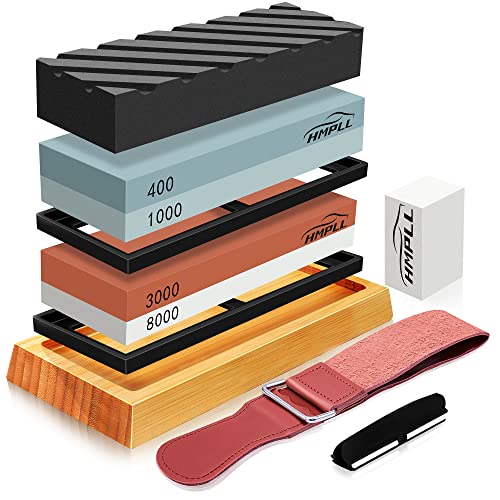
Restore and Polish Kitchen Knives with the HMPLL 400/1000 and 3000/8000 Grit Whetstone Set
The HMPLL whetstone set repairs dull or chipped kitchen knives and delivers a polished edge through its four progressive grit levels. It suits home cooks who want a complete water-based sharpening kit with an angle guide, stable base, flattening stone, and leather strop.
Pros and Cons
Pros
- Four grit levels cover edge repair, routine sharpening, refinement, and final polishing.
- White corundum construction is designed for hardness, density, heat resistance, and consistent abrasion.
- Water lubrication eliminates the need to purchase or clean up sharpening oil.
- The set works with kitchen knives, scissors, razors, shears, axes, sickles, and chisels.
Cons
- The whetstones require a 10 to 15-minute soak before use, making them less convenient for quick touch-ups.
- Manual sharpening still requires controlled strokes and practice, even with the included angle guide.

MIDOProfesssioalAbrasive
Kitchen Knife Sharpening Stone 400/1000 Grit Whetstone with Non-Slip Base by MIDO Professional Abrasive
This dual-grit whetstone restores dull kitchen knives using water instead of expensive honing oil, with a 400-grit side for reshaping edges and 1000-grit for polishing. Home cooks who want professional sharpening results without the cost of oil-based systems should consider this silicon carbide stone with its non-slip rubber base.
Pros and Cons
Pros
- Dual grit system handles both edge restoration and fine polishing in one tool without switching stones.
- Water-only operation saves money compared to oil-based sharpening systems.
- Non-slip base provides stability during the grinding process for safer and more consistent results.
Cons
- Requires 5-10 minute soaking before each use, which adds prep time compared to instant-use sharpening rods.
- Only 1000 grit on the fine side may not achieve mirror polish finishes that higher-grit stones provide.

KATISUN
All-in-One Meal Prep: KATISUN 15-Piece White Knife Set with Built-In Sharpening Stone
The KATISUN 15-piece set handles chopping, slicing, bread cutting, paring, steak service, and scissor tasks, with a built-in sharpening stone as its biggest convenience. It suits home cooks who want a coordinated white knife block with multiple blade types, ergonomic triple-rivet handles, and dishwasher-safe cleanup.
Pros and Cons
Pros
- The 15-piece assortment covers chef, bread, Santoku, slicing, hobby, paring, steak knife, and scissor tasks.
- A sharpening stone is integrated into the storage block for convenient edge maintenance.
- Triple-rivet fixed handles add stability while the curved shape supports a comfortable grip.
- The matching white handles and block create a coordinated countertop appearance.
Cons
- The product information does not identify the stainless steel grade, making direct blade-quality comparisons difficult.
- Although the knives are listed as dishwasher safe, hand washing is generally gentler on blade edges and handles.

Intelitopia
Complete Knife Sharpening Stone Kit with Dual Grit Whetstones – Intelitopia 400/1000 3000/8000 Set for Kitchen Knives
This whetstone kit brings professional knife sharpening to your kitchen with four grit levels (400/1000/3000/8000) that restore any blade from badly damaged to razor-sharp, plus all the accessories needed for beginners. Home cooks tired of dull knives should buy this because it replaces expensive sharpening services and works on every knife type from chef knives to cleavers.
Pros and Cons
Pros
- Four progressive grit levels in two double-sided stones cover the complete sharpening spectrum from repair to mirror polish.
- Angle guide and non-slip bamboo base make it accessible for first-time sharpeners who lack experience.
- Leather strop and flattening stone included mean you have everything needed for long-term maintenance in one purchase.
Cons
- Requires 10-15 minute soaking before each use and the full sharpening process takes 50+ minutes for one knife when using all grit levels.
- Bamboo base may crack or warp if left wet, requiring careful drying after each sharpening session.
Atis Meiers
Whetstone Knife Sharpening Guide for Beginners – Atis Meiers Step-by-Step Booklet for 1000/6000 Grit Stones
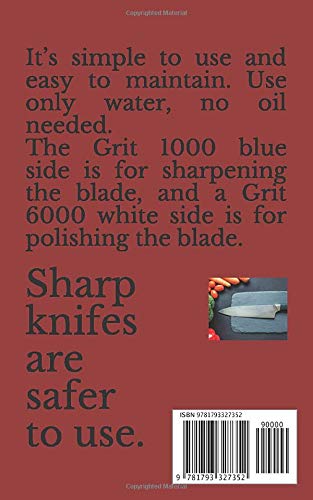
This 9-page booklet walks you through sharpening kitchen and utility knives on a dual-grit whetstone, covering angle technique, grit selection, and polishing finish. Home cooks who just bought a whetstone kit and want clear, no-guesswork instructions will get the most value from it.
Pros and Cons
Pros
- Directly paired with the Amstorm 1000/6000 dual-grit stone setup, so instructions match the actual tools most buyers already own.
- Covers angle guide usage explicitly, which is the step most beginners skip and the main reason edges come out uneven.
- Applies to multiple blade types beyond kitchen knives, including scissors and chisels, adding practical range.
Cons
- At only 9 pages, experienced sharpeners will find the depth too thin for advanced techniques like reprofiling or convex edges.
- Content is tightly tied to the Amstorm kit, so buyers using other whetstone brands may find some references mismatched.
The Best Deals This Week*
-
Restore and Polish Kitchen Knives with the HMPLL
$25.99
($29.99)Save $4.00 -
Kitchen Knife Sharpening Stone 400/1000 Grit
$9.99
($15.99)Save $6.00 -
Complete Knife Sharpening Stone Kit with Dual Grit
$29.99
($35.99)Save $6.00
*Deals are selected by our commerce team
HMPLL Restore and Polish Kitchen Knives with the HMPLL 400/1000 and 3000/8000 Grit Whetstone Set
HMPLL
Restore and Polish Kitchen Knives with the HMPLL 400/1000 and 3000/8000 Grit Whetstone Set
The HMPLL whetstone set repairs dull or chipped kitchen knives and delivers a polished edge through its four progressive grit levels. It suits home cooks who want a complete water-based sharpening kit with an angle guide, stable base, flattening stone, and leather strop.
Check price on AmazonThis HMPLL set restores dull or chipped kitchen knives, helping blades cut food cleanly instead of crushing, tearing, or slipping.
The 400/1000 stone handles repair and routine sharpening, while the 3000/8000 stone refines and polishes the edge for smoother kitchen prep.
Dense white corundum stones pair with a bamboo base, silicone holder, and rubber support for durability and a more stable sharpening platform.
Each stone must soak for 10 to 15 minutes, and achieving an even edge still depends on careful manual technique.
Best for home cooks who want one water-stone kit for repairing, sharpening, refining, and stropping multiple blade types.
MIDOProfesssioalAbrasive Kitchen Knife Sharpening Stone 400/1000 Grit Whetstone with Non-Slip Base by MIDO Professional Abrasive
MIDOProfesssioalAbrasive
Kitchen Knife Sharpening Stone 400/1000 Grit Whetstone with Non-Slip Base by MIDO Professional Abrasive
This dual-grit whetstone restores dull kitchen knives using water instead of expensive honing oil, with a 400-grit side for reshaping edges and 1000-grit for polishing. Home cooks who want professional sharpening results without the cost of oil-based systems should consider this silicon carbide stone with its non-slip rubber base.
Check price on AmazonThis is a dual-sided silicon carbide whetstone that solves the problem of dull kitchen knives without requiring expensive electric sharpeners or professional services.
The 400-grit coarse side reshapes damaged or very dull edges in about 15 minutes, while the 1000-grit fine side smooths and polishes the edge in 10 minutes for a sharp, usable cutting surface.
Made from green silicon carbide with clear edge demarcation between grits. Measures 7 inches long by 2.25 inches wide by 1.125 inches high. The silicone rubber base grips countertops to prevent movement during sharpening.
The 1000-grit fine side will not produce ultra-polished edges that 3000+ grit stones achieve, so this works best for functional sharpness rather than razor finishes.
Best for home cooks who sharpen their own knives regularly and want a budget-friendly water stone that covers basic restoration and honing.
KATISUN All-in-One Meal Prep: KATISUN 15-Piece White Knife Set with Built-In Sharpening Stone
KATISUN
All-in-One Meal Prep: KATISUN 15-Piece White Knife Set with Built-In Sharpening Stone
The KATISUN 15-piece set handles chopping, slicing, bread cutting, paring, steak service, and scissor tasks, with a built-in sharpening stone as its biggest convenience. It suits home cooks who want a coordinated white knife block with multiple blade types, ergonomic triple-rivet handles, and dishwasher-safe cleanup.
Check price on AmazonThis 15-piece block set consolidates everyday food preparation, bread cutting, carving, paring, steak service, and kitchen scissor tasks into one coordinated countertop system.
Its broad blade selection reduces the need to use one knife for every task, while the built-in sharpening stone makes routine edge maintenance more accessible.
The knives use anti-rust-treated stainless steel blades and curved triple-rivet handles. The complete set weighs about 5.71 pounds, and the listed dimensions are 22.2 by 16 by 36.7 inches.
The listing does not specify the steel grade, so buyers cannot easily compare edge retention or hardness with other knife sets.
Best for home cooks seeking a complete white knife set with organized storage and convenient sharpening.
Intelitopia Complete Knife Sharpening Stone Kit with Dual Grit Whetstones – Intelitopia 400/1000 3000/8000 Set for Kitchen Knives
Intelitopia
Complete Knife Sharpening Stone Kit with Dual Grit Whetstones – Intelitopia 400/1000 3000/8000 Set for Kitchen Knives
This whetstone kit brings professional knife sharpening to your kitchen with four grit levels (400/1000/3000/8000) that restore any blade from badly damaged to razor-sharp, plus all the accessories needed for beginners. Home cooks tired of dull knives should buy this because it replaces expensive sharpening services and works on every knife type from chef knives to cleavers.
Check price on AmazonThis is a four-stone knife sharpening system designed to restore kitchen knives from damaged to razor-sharp. It solves the problem of dull blades without paying for professional sharpening services or replacing knives prematurely.
The dual-sided whetstones provide 400/1000 grit for repair and primary sharpening, plus 3000/8000 grit for fine finishing and polishing. The included angle guide clips onto your blade to maintain the correct 10-30 degree angle, making the technique accessible even if you have never sharpened a knife before.
Stones are made from aluminum oxide corundum for durability. The kit includes a bamboo base with three rubber holders for stability, a coarse flattening stone to maintain whetstone flatness, and genuine cowhide leather strop for final burr removal. Total weight is manageable for countertop storage.
The water-soaking requirement adds 10-15 minutes before you can start, and a full four-grit sharpening session takes nearly an hour per knife. The bamboo base needs thorough drying to prevent warping.
Best for home cooks who want to maintain their own knives and are willing to invest the time to learn proper sharpening technique.
Atis Meiers Whetstone Knife Sharpening Guide for Beginners – Atis Meiers Step-by-Step Booklet for 1000/6000 Grit Stones
Atis Meiers
Whetstone Knife Sharpening Guide for Beginners – Atis Meiers Step-by-Step Booklet for 1000/6000 Grit Stones
This 9-page booklet walks you through sharpening kitchen and utility knives on a dual-grit whetstone, covering angle technique, grit selection, and polishing finish. Home cooks who just bought a whetstone kit and want clear, no-guesswork instructions will get the most value from it.
Check price on AmazonThis is a 9-page printed booklet that teaches knife sharpening on a dual-grit whetstone — solving the core problem of inconsistent angles and wasted stone use.
The guide walks through both grits in sequence: 1000-grit blue side for edge repair and sharpening, 6000-grit white side for finishing and polishing.
It covers angle guide usage directly, which is the most critical variable for beginners getting a repeatable, sharp edge.
At 9 pages, the guide is entry-level — buyers seeking freehand sharpening techniques or advanced edge geometry will need additional resources.
Best for first-time whetstone users who bought an Amstorm kit and want a structured, step-by-step reference to build consistent sharpening habits.




Write Your Review
No reviews yet. Be the first to share your experience!