

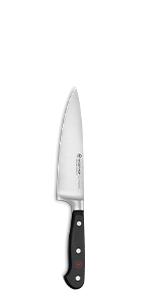
If you’re asking what size chef knife do I need, the short answer for most home cooks is 8 inches. An 8-inch blade is long enough to slice through a large onion or a head of cabbage in one stroke, yet short enough to control on a standard 12 x 18 inch cutting board. A 6-inch knife suits small hands, tight counters and lighter prep. A 10-inch knife pays off when you cook big batches, break down watermelons or do a lot of rock-chopping.
This guide walks through how blade length changes the way a knife handles, how to match a size to your hands, your board and your cooking, and which mistakes lead people to buy the wrong length. By the end you’ll know which size to reach for and why.
Why 8 inches is the default answer
Blade length is measured from the tip to the heel, where the edge meets the bolster or handle. Chef knives are commonly sold in 6, 7, 8, 9, 10 and 12 inch lengths, but 8 inches is the size that most knife makers, culinary schools and cookbook authors point beginners toward. There’s a practical reason. Most produce you’ll cut at home, from bell peppers to sweet potatoes, is under 5 inches wide. An 8-inch blade covers that width with a few inches to spare, so you can slice with a smooth forward-and-back motion instead of sawing.
The 8-inch length also balances reach and control. Shorter blades feel nimble but run out of edge on bigger jobs. Longer blades glide through roasts and squash but take up more board space and need more wrist confidence. Eight inches sits in the middle. That’s why it’s the size you’ll see most often in our best chef knife roundups and in nearly every starter set.
If you want a proven 8-inch knife without a big spend, the Victorinox Wood 8 Inch Chef’s Knife is a common pick. It pairs a stainless steel blade with a wood handle, and it carries a 4.9-star rating from buyers. It’s a reasonable way to find out whether 8 inches feels right before you invest more.

Victorinox
Meat Slicing and Everyday Prep: Victorinox Wood 8-Inch Chef's Knife
This Victorinox chef's knife handles meat and everyday cutting with a sharp stainless steel blade designed for precise, efficient prep. It suits home cooks and professionals who want an ergonomic rosewood handle, balanced handling, and Swiss-made construction.
Pros and Cons
Pros
- Sharp stainless steel blade is designed for precise cutting and efficient food preparation.
- Rosewood handle combines ergonomic handling with artisan craftsmanship.
- 8-inch chef's knife format works well for cutting all kinds of meat.
- Victorinox has crafted kitchen utensils since 1884.
Cons
- The wood handle may require more careful cleaning than a fully synthetic handle.
- Its meat-focused description may not appeal to buyers seeking a specialized vegetable or bread knife.
Victorinox Meat Slicing and Everyday Prep: Victorinox Wood 8-Inch Chef's Knife
Victorinox
Meat Slicing and Everyday Prep: Victorinox Wood 8-Inch Chef's Knife
This Victorinox chef's knife handles meat and everyday cutting with a sharp stainless steel blade designed for precise, efficient prep. It suits home cooks and professionals who want an ergonomic rosewood handle, balanced handling, and Swiss-made construction.
$70.12 at AmazonEditors' Favorite
Color: Brown Size: 8" Dimensions: 11.81 x 0.39 x 0.79 inches Weight: 0.220462262 pounds Product Group: Kitchen Binding: Kitchen
Shop NowHow to match blade length to your kitchen
Size isn’t only about the knife. It’s about the person holding it and the space they work in. Three factors matter most: your hands, your cutting board and the food you prep most often.
Your hand size and grip
Most cooks use a pinch grip, with the thumb and index finger gripping the blade just ahead of the handle. With that grip, the knife’s balance point should sit near your fingers. People with smaller hands often find a 10-inch blade tip-heavy, which makes it tire the wrist during long prep sessions. If you wear a small glove size, a 6 or 7 inch knife may feel more natural. Larger hands usually handle 8 to 10 inches without strain. A quick rule: if the handle feels cramped or your knuckles hit the board when you chop, consider a taller or longer blade.
Your cutting board and counter space
A good guideline is that your board should be at least a few inches longer than your blade on the diagonal. A 10-inch knife on a small 8 x 10 inch board is awkward. The tip hangs off the edge, and you lose the rocking motion. If your board is compact or your counter is narrow, an 8-inch knife, or even a 6-inch, will be easier to use safely. Apartment kitchens fall into this category more often than not.
What you cook most
Think about your weekly prep. Mostly garlic, herbs, shallots and chicken breasts? A 6 to 8 inch blade handles that comfortably. Regularly cutting whole pumpkins, big cabbages, brisket or batches of soup vegetables for a family of six? A 10-inch blade starts to make sense, because the extra length lets you finish each cut in a single pass.
6-inch vs 8-inch vs 10-inch: what each size does well
Each common size has a clear job. A 6-inch chef knife is light and quick, and it’s handy for small tasks like mincing garlic or trimming a single chicken thigh. It’s also a good fit for kids learning to cook or anyone with limited grip strength. The downside is reach. It struggles with anything wider than a large onion.
An 8-inch chef knife is the all-rounder. It slices, dices, minces and rock-chops with equal ease, and it fits most boards. If you only own one knife, this is the one. A 10-inch chef knife is the long-reach option. It’s favored in restaurant kitchens where cooks process large volumes, and it excels at long, clean slices through melons and roasts. At home it can feel like a lot of knife.
Blade style also affects how a given length feels. Japanese-style gyuto knives tend to be thinner and lighter than German-style blades of the same length, so an 8-inch gyuto can feel more agile than an 8-inch German knife. If you’re drawn to that lighter feel, the Atumuryou JPCK Japanese Chef Knife is an 8-inch option with a hand-forged, 67-layer Damascus blade over a VG10 core. It ships with a leather sheath and a gift box, which helps if you store knives loose in a drawer. You can compare more options in our best Japanese chef knife guide.
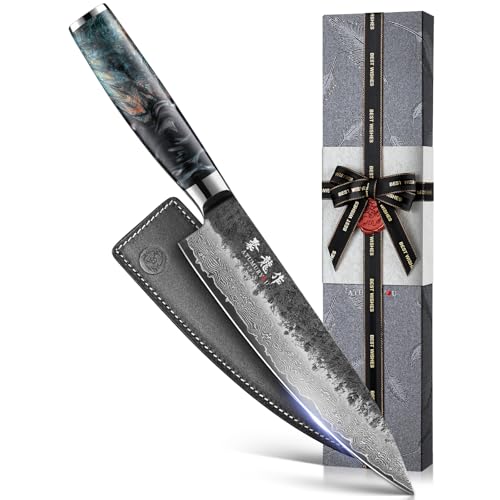
Atumuryou JPCK
Precision Slicing and Chopping: Atumuryou JPCK 8-Inch VG10 67-Layer Damascus Chef Knife
The Atumuryou JPCK 8-inch chef knife handles slicing, chopping, and dicing with a razor-sharp VG10 core hardened to 62 HRC for precise cuts. It suits home cooks and professional chefs seeking a balanced full-tang knife with protective storage and gift-ready presentation.
Pros and Cons
Pros
- The premium Japanese VG10 steel core is hardened to 62 HRC for strong edge performance and precision.
- Its 67-layer Damascus blade combines corrosion resistance, toughness, and a distinctive forged appearance.
- The full-tang ergonomic handle offers a secure grip and balanced handling for prolonged kitchen work.
- A genuine leather sheath and premium gift box are included for protected storage and polished presentation.
Cons
- The listing does not specify the knife's weight, so buyers cannot confirm whether its balance matches their preferred handling style before purchase.
- A 62 HRC edge requires careful handling and proper cutting surfaces to reduce the risk of chipping.
Atumuryou JPCK Precision Slicing and Chopping: Atumuryou JPCK 8-Inch VG10 67-Layer Damascus Chef Knife
Atumuryou JPCK
Precision Slicing and Chopping: Atumuryou JPCK 8-Inch VG10 67-Layer Damascus Chef Knife
The Atumuryou JPCK 8-inch chef knife handles slicing, chopping, and dicing with a razor-sharp VG10 core hardened to 62 HRC for precise cuts. It suits home cooks and professional chefs seeking a balanced full-tang knife with protective storage and gift-ready presentation.
$109.99 at AmazonEditors' Favorite
Color: 67-Layer Damascus Steel Size: 8" Dimensions: 13.3 x 1.77 x 0.12 Inches Weight: 0.46 pounds Product Group: Kitchen Binding: Kitchen
Shop NowCommon mistakes when choosing a size
The most frequent mistake is buying a longer knife because it looks more professional. A 10-inch blade in hands that aren’t comfortable with it leads to slower, less precise cuts, and that’s how slips happen. Bigger isn’t automatically better. Comfort and control count for more.
Another mistake is ignoring blade height. Two 8-inch knives can feel very different if one is 2 inches tall at the heel and the other is 1.6 inches. A taller blade gives knuckle clearance and makes it easier to scoop chopped food off the board. A shorter, slimmer blade feels quicker. Check the profile, not just the length.
People also forget about weight. Heavier forged knives carry more momentum, which helps with dense squash, but they can wear you out over 30 minutes of prep. Lighter stamped knives are easier to swing all day. Neither is wrong. It depends on what you prefer.
Finally, don’t buy a full set just to get the right chef knife. Many sets include sizes you won’t use. If you do want several knives at once, our best chef knife set picks focus on sets where the core knives are worth having. On a tight budget? Start with our best chef knife under $50 list, and add a paring knife later.
Do you need more than one chef knife size?
For most home cooks, no. One good 8-inch chef knife plus a 3 to 4 inch paring knife covers almost every task in a home kitchen. The paring knife handles peeling, hulling strawberries and other in-hand work that a chef knife isn’t built for. A serrated bread knife is a useful third blade if you bake or buy crusty loaves.
A second chef knife makes sense in a few cases. Households with two regular cooks often keep one 6-inch and one 8-inch so each person has a comfortable option. Serious batch cooks sometimes add a 10-inch for big jobs and keep the 8-inch for everyday work. If you’re just starting out, our best beginner chef knife guide covers knives that forgive a learning curve.
When to upgrade your chef knife
It’s time to upgrade when your current knife won’t hold an edge for more than a week or two, when the handle is cracked or loose, or when you’ve realized the size is wrong for you. If your 6-inch keeps running out of edge on onions, or your 10-inch feels clumsy every time, that’s your cue to move to an 8-inch.
When you’re ready to spend more for a knife meant to last decades, a German-style forged blade is a common choice. The WÜSTHOF Classic 8 Inch Chef’s Knife, in black, is one of the best-known examples of that style and holds a 4.9-star rating. It’s a heavier, sturdier feel compared with thinner Japanese blades, and it’s built for cooks who want one knife to do nearly everything. See how it stacks up in our best Wusthof chef knife roundup.

WÜSTHOF Classic 8-Inch Chef's Knife - Precision Forged German Steel for Professional Home Cooking
This precision-forged German chef's knife delivers 20% sharper cuts and twice the edge retention of previous models, making it ideal for daily chopping, mincing, and slicing tasks. Home cooks and professional chefs who want a reliable, balanced workhorse knife that holds its edge through heavy use should invest in this Classic series blade.
Pros and Cons
Pros
- German precision forging creates superior edge retention that stays sharp through months of regular kitchen use.
- The 8.5-ounce weight and ergonomic handle design reduce hand fatigue during extended meal prep.
- Backed by over 200 years of Solingen craftsmanship and strict German quality standards.
Cons
- The full bolster prevents sharpening the entire blade length on a standard whetstone without professional thinning.
- At 8.5 ounces, some cooks with smaller hands may find it heavier than Japanese-style chef's knives.
WÜSTHOF Classic 8-Inch Chef's Knife - Precision Forged German Steel for Professional Home Cooking
WÜSTHOF Classic 8-Inch Chef's Knife - Precision Forged German Steel for Professional Home Cooking
This precision-forged German chef's knife delivers 20% sharper cuts and twice the edge retention of previous models, making it ideal for daily chopping, mincing, and slicing tasks. Home cooks and professional chefs who want a reliable, balanced workhorse knife that holds its edge through heavy use should invest in this Classic series blade.
$170.00 at AmazonEditors' Favorite
Brand Name: Wüsthof Set Name: Classic Manufacturer: Wüsthof UPC: 769194038526 670023145356 022934582438 Global Trade Identification Number: 00022934582438, 04002293158242, 40022931582422 Model Number: 4582-7/20 Manufacturer Part Number: 4582/20 Manufacturer Warranty Description: Lifetime warranty Item Type Name: Chef's Knives Unit Count: 16.0 Ounce Included Components: Cook's Knife Best Sellers Rank: #35,094 in Kitchen & Dining (See Top 100 in Kitchen & Dining) #103 in Chef's Knives ASIN: B00009ZK08 Blade Material Type: Stainless Steel Handle Material: Composite Is the item dishwasher safe?: No Material Type: Stainless Steel BladeLength: 8 Inches Item Weight: 0.24 Kilograms Item Length: 14 Inches Size: 8" Color: Black Blade Color: Silver Blade Edge: Chef's Knife Construction Type: Forged Blade Material: Stainless Steel Brand: Wüsthof
Shop NowFAQ
Is an 8-inch chef knife too big for a beginner?
No. An 8-inch chef knife is the length most often recommended for beginners because it handles nearly every prep job without feeling unwieldy. If it feels large at first, practice the pinch grip and slow down. Most people adjust within a few weeks.
Should a woman or someone with small hands use a 6-inch chef knife?
Hand size matters more than anything else. Many people with small hands do well with an 8-inch knife, especially a lighter Japanese-style blade. If an 8-inch knife feels tip-heavy or tiring after a short session, a 6 or 7 inch blade is a sensible alternative.
What size chef knife do professional chefs use?
Many restaurant cooks use 9 or 10 inch chef knives because they process large volumes of food on big boards. That said, plenty of professionals still prefer 8 inches for control. Professional habits don’t automatically translate to a home kitchen with a smaller board.
Is a 10-inch chef knife worth it for home cooking?
It’s worth it if you regularly cut large produce, cook for big groups or have a large cutting board. For everyday dinners for two to four people, a 10-inch knife usually adds bulk without much benefit. An 8-inch knife will be easier to store and use.
Does blade length affect how often I need to sharpen?
Not directly. Sharpening frequency depends on the steel, the edge angle, your cutting board and how often you cook. A longer blade does take a little more time per sharpening session because there’s more edge to work on.





Write Your Review
No reviews yet. Be the first to share your experience!