

If you’re asking why is my chef knife warping, the short answer is heat and leverage. Most bent or bowed blades come from a dishwasher cycle, a blade left resting on a hot pan or burner, careless sharpening that overheats the edge, or prying and twisting the knife through hard food. Less often, the steel was unevenly heat treated at the factory, and the bend shows up after a few months of normal use.
This guide walks you through how to confirm the blade is actually warped, what caused it, whether it can be straightened, and how to store and use a knife so it stays true. You’ll also see when it makes more sense to stop fixing and start shopping.
First, confirm the blade is really warped
A lot of “warped” knives aren’t warped at all. A rolled edge, a chipped section or an uneven bevel can make a knife cut crooked and feel bent. So check before you blame the steel. Hold the knife at eye level with the edge pointing away from you and sight down the spine from the handle to the tip. A true blade looks like a straight line. A warped one shows a gentle curve to the left or right, or a slight wave along its length.
Next, lay the flat of the blade on a countertop or a sheet of glass. If one side rocks or the tip lifts while the heel sits flat, the blade has a bow. Flip it over and repeat. A bend usually shows on one face and disappears on the other. If the blade lies flat both ways but still steers off course when you slice, the problem is more likely the edge geometry than a warp, and a careful resharpening will fix it.
Bends near the tip are the most common, since the tip is the thinnest part of the blade and takes the most abuse during prying. Bends near the heel are rarer and usually point to heat damage or a manufacturing issue. Damage also happens in storage. A loose knife tossed in a drawer gets pressed and knocked by other tools every time the drawer opens, and that’s how plenty of edges get bent and chipped. A simple blade guard keeps the edge covered and protected from that kind of pressure.
The Morodo 8″ Chef Knife Scabbard Sheath is a black nylon sleeve sized for 8-inch chef knives. It’s an inexpensive way to protect a blade that lives in a drawer, a knife roll or a camping kit, and at around $11 it costs far less than replacing a damaged knife.

Morodo
8-Inch Chef Knife Sheath: Black Nylon Blade Protector for Safer Kitchen Storage
The Morodo 8-Inch Chef Knife Sheath covers chef knife blades up to 8 inches long and 1.8 inches wide, with nylon protection that helps prevent blade and household contact damage. It suits cooks who need safer storage or portable carrying for a compatible chef knife.
Pros and Cons
Pros
- Durable nylon construction provides a lightweight protective cover for daily kitchen storage.
- The sheath protects both the blade and people nearby from unwanted contact.
- Belt and hook hanging options make carrying and accessible storage more convenient.
Cons
- It only fits chef knife blades no longer than 8 inches and no wider than 1.8 inches.
- The product data does not specify a rigid insert or additional padding beyond the nylon construction.
Morodo 8-Inch Chef Knife Sheath: Black Nylon Blade Protector for Safer Kitchen Storage
Morodo
8-Inch Chef Knife Sheath: Black Nylon Blade Protector for Safer Kitchen Storage
The Morodo 8-Inch Chef Knife Sheath covers chef knife blades up to 8 inches long and 1.8 inches wide, with nylon protection that helps prevent blade and household contact damage. It suits cooks who need safer storage or portable carrying for a compatible chef knife.
$10.99 at AmazonEditors' Favorite
Color: Black Size: 8" Dimensions: 13.1889763645 x 3.0708661386 x 0.393700787 inches Weight: 0.1322773572 pounds Product Group: Kitchen Binding: Electronics
Shop NowThe most common reasons chef knives warp
Steel is springy, but only up to a point. Push past that point, or change the steel’s structure with heat, and the blade won’t spring back. Nearly every warped knife traces back to one of the causes below.
Heat from the dishwasher, stove or sink
Dishwashers are the top offender. The cycle exposes the blade to hot water, harsh detergent and a long heated drying phase, and thin blades can bow from the uneven heating and cooling, especially when they’re wedged against a rack tine. Leaving a knife on a hot stovetop, resting it across a pan, or pouring boiling water over it to sanitize it does the same thing faster. Handles suffer too. Wood and some composite handles swell and shrink, which can loosen the tang and make the whole knife feel off.
Sharpening that overheats the edge
Powered grinders and belt sanders can get the thin edge hot enough to lose its temper in seconds. You’ll sometimes see a straw or blue tint near the edge when that happens. Once the steel overheats, it softens and can distort, and the edge won’t hold as well afterward. Hand stones and pull-through sharpeners rarely cause this, though heavy pressure on a coarse pull-through can still chew up an edge unevenly.
Prying, twisting and chopping bone
A chef knife is built to slice and rock, not to pry. Twisting it to pop open a squash, levering out an avocado pit, or splitting frozen food applies sideways force the thin blade can’t handle. Chopping through bone does the same. Softer steels bend under that load. Harder steels tend to chip or snap instead, which is a different kind of damage but comes from the same habit.
Factory heat treatment issues
Occasionally the steel wasn’t heat treated evenly during manufacturing. Internal stress gets locked into the blade, and it shows up as a slow bow after the first few sharpenings remove material and release that stress. If a new knife develops a bend without any of the abuse above, contact the maker. Many brands treat this as a warranty problem.
Can you straighten a warped chef knife?
Sometimes. It depends on the steel and how bad the bend is. Softer stainless blades, like most German-style chef knives, have enough flex that a mild bow can often be coaxed back. Very hard, thin Japanese blades are a different story. They’re more likely to crack than bend back, so they’re best left to a professional sharpener.
For a mild bend in a softer blade, the gentlest approach is slow, even pressure. Place the blade on a wooden cutting board with the bowed side facing up, put a folded towel over it, and press down on the high spot with the heel of your hand, a little at a time. Check by sighting down the spine after each press. Don’t hammer it. Don’t heat it with a torch, since that ruins the temper. And stop if you hear or feel anything crack. If the bend doesn’t move with moderate pressure, the steel is telling you something.
A sharpener with a straightening press can usually handle what you can’t do safely at home, and the fee is often lower than the cost of a new knife. If the knife was expensive or has sentimental value, that’s the smart route. If it was a cheap knife and the bend is severe, replacement is usually the better use of your money. Our guide to the best cheap chef knife is a good starting point for budget options.
If you’re replacing a warped blade with a straightforward German-style knife, the HENCKELS Statement Razor-Sharp 8-inch Chef Knife is one to consider. It’s an 8-inch blade with the classic German profile, and the brand bills it as German engineered and informed by more than 100 years of knifemaking. At about $27, it’s a sensible pick for a home cook who wants a dependable everyday blade without a premium price. It isn’t a delicate, ultra-thin Japanese knife, which also means it’s more forgiving of the occasional mistake.
HENCKELS Statement Razor-Sharp 8-inch Chef Knife, German Engineered Informed by 100+ Years of Mastery

HENCKELS
Statement Razor-Sharp 8-inch Chef Knife, German Engineered Informed by 100+ Years of Mastery
$26.99 at AmazonEditors' Favorite
Color: Black/Stainless Steel Size: 8" Dimensions: 15.63 x 3.5 x 1 Inches Weight: 0.44 Pounds Product Group: Kitchen Binding: Kitchen
Shop NowCommon mistakes that bend good knives
Most warping is preventable. These habits cause the bulk of the damage we see described in reader questions and manufacturer care guides.
Running knives through the dishwasher “just this once.” It’s never once. Hand washing with warm, soapy water and drying right away takes about 30 seconds and protects both the blade and the handle.
Storing knives loose in a drawer. Blades get knocked into each other and wedged under heavier tools. Use a block, a magnetic strip, a drawer insert or a sheath. If you’re building out a full kitchen setup, a matched chef knife set with a block solves storage at the same time.
Using the chef knife for every job. Frozen food, bones and hard rinds need a different tool. A cleaver, a boning knife or kitchen shears will spare your chef knife from the prying and twisting that bends thin steel.
Sharpening on a powered grinder without cooling the blade. If you use a powered sharpener, go slow and keep the steel cool. Better yet, learn a whetstone or have a pro do it once or twice a year.
Cutting on glass, stone or ceramic boards. They don’t bend knives directly, but they roll and chip the edge, and a damaged edge makes you push harder, which raises the odds of a twist or a slip. Stick with wood or plastic.
When to replace or upgrade your knife
Replace the knife if the blade has a visible crack, if a bend comes back after straightening, if the tang has worked loose from the handle, or if the steel shows heat discoloration along the edge. Those signs mean the steel itself is compromised. A knife in that state won’t hold an edge and can fail without warning.
Upgrading is also worth thinking about if you keep reaching for your chef knife to do heavy work. That’s often a sign your kitchen is missing a tool. For readers who chop a lot of dense vegetables, a vegetable cleaver takes some of that load off the chef knife. If you’d rather stay with a single all-purpose blade, our roundups of the best chef knife and the best German chef knife cover sturdier options, and the best Japanese chef knife guide covers thinner, harder blades for people who’ll baby them.
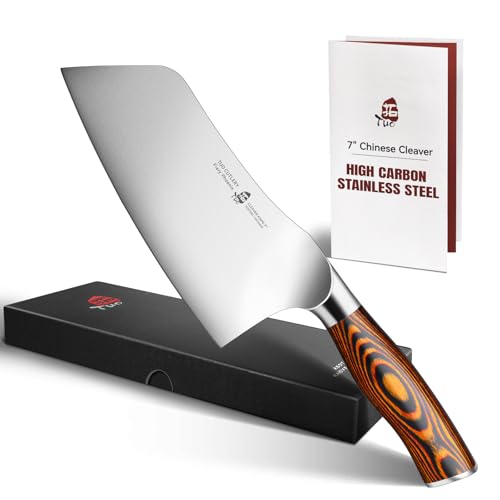
As an alternative to a second chef knife, the TUO Vegetable Cleaver Knife is a 7-inch Chinese chef knife with a Pakkawood handle and a stainless steel blade, from TUO’s Fiery Phoenix Series. The wide, tall blade is suited to chopping vegetables and scooping prepped food off the board. It’s still a kitchen knife, not a bone splitter, so the same no-prying rules apply. At about $32, it’s a reasonable add-on for cooks who want to protect their main knife from heavy chopping.
TUO
Fast Vegetable Chopping with TUO Fiery Phoenix 7-Inch Chinese Chef Cleaver
The TUO Fiery Phoenix 7-inch cleaver handles chopping, mincing, garlic smashing, and meat preparation, with its curved profile providing versatile control. Home cooks and beginner chefs should buy it for the full-tang pakkawood handle, sharp 18-degree-per-side edge, and durable stainless steel construction.
Pros and Cons
Pros
- The 7-inch curved blade supports several common kitchen tasks instead of limiting the knife to vegetable chopping.
- The 18-degree-per-side edge arrives designed for precise cutting performance.
- The pakkawood handle offers an ergonomic grip and resistance to warping and splitting.
- The full-tang design adds stability, while the manufacturer backs the knife against defects with a lifetime guarantee.
Cons
- The product data does not specify the knife's weight, so buyers who prefer a lightweight or heavy cleaver cannot compare that factor in advance.
- The 7-inch blade may provide less cutting surface than a larger cleaver for oversized ingredients.
TUO Fast Vegetable Chopping with TUO Fiery Phoenix 7-Inch Chinese Chef Cleaver
TUO
Fast Vegetable Chopping with TUO Fiery Phoenix 7-Inch Chinese Chef Cleaver
The TUO Fiery Phoenix 7-inch cleaver handles chopping, mincing, garlic smashing, and meat preparation, with its curved profile providing versatile control. Home cooks and beginner chefs should buy it for the full-tang pakkawood handle, sharp 18-degree-per-side edge, and durable stainless steel construction.
$31.75 at AmazonEditors' Favorite
Color: High Carbon Steel Size: 7" Dimensions: 1 x 1 x 1 inches Weight: 0.65 pounds Product Group: Kitchen Binding: Kitchen
Shop NowFAQ
Why does my knife bend after going in the dishwasher?
The long hot wash and heated dry cycle heat and cool the blade unevenly, and a thin blade pressed against a rack can bow while it’s warm. Harsh detergent and banging against other utensils add to the damage. Hand wash your knives and dry them right away to avoid it.
Is a warped chef knife still safe to use?
A very slight bow is usually safe, though the knife will steer off line and make uneven cuts. A noticeable bend, a crack or a loose handle isn’t safe. The blade can catch, twist or snap mid-cut. Straighten it, have it serviced, or replace it.
Can a warped knife be fixed by sharpening?
No. Sharpening fixes the edge, not the spine. It can hide a mild problem for a while, but the blade will still be bent. Straighten the blade first, then sharpen it so the bevel is even along the full length.
Do Japanese knives warp more than German knives?
They tend to fail differently. Harder, thinner Japanese blades usually chip or crack under sideways force rather than bending. Softer German-style blades are more likely to bend, but they’re also easier to straighten. Both can warp from heat damage.
How should I store a chef knife to keep it straight?
Keep it in a knife block, on a magnetic strip, in a drawer insert, or covered with a sheath. The goal is to keep the blade from being pressed or knocked by other tools. Never store it loose in a drawer with heavy utensils on top.




Write Your Review
No reviews yet. Be the first to share your experience!