

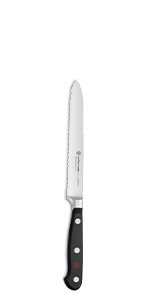
If you’re asking “why is my chef knife not working,” the answer is almost always a dull or rolled edge, not a broken knife. A blade that slides off tomato skin, crushes herbs instead of slicing them, or needs real pressure to get through an onion has lost its edge geometry. Sometimes the cause is a bent tip, a loose handle, a bad cutting board, or simply the wrong knife for the job. Most of these problems can be fixed at home in under 20 minutes.
This guide walks through each cause in the order you should check it, explains how to tell a dull edge from a rolled one, and covers the habits that quietly ruin a good blade. You’ll also find out when a fix stops being worth it and a new knife makes more sense.
Check the edge first: dull vs. rolled
Start with the edge, because that’s where nine out of ten “my knife stopped working” complaints come from. Hold the knife edge-up under a bright light and tilt it slowly. A sharp edge is so thin it doesn’t reflect light. If you see a thin, shiny line running along the edge, or bright spots in certain sections, those are flattened or rounded areas. That shine is the dullness you’re feeling on the cutting board.
Next, try the paper check. Hold a sheet of printer paper by one corner and draw the blade down through it, heel to tip. A sharp knife glides through with a clean, quiet slice. A dull one snags, tears, or folds the paper. Note exactly where it catches. Catching only near the tip or only at the heel tells you the damage is local, which matters when you sharpen.
A rolled edge is different from a dull one. The steel at the very edge has bent over to one side, usually from hitting a hard board, a bone, or the side of a pot. Run your thumbnail gently across (never along) the edge from spine to edge. If it catches more on one side than the other, the edge has rolled. The good news? A rolled edge often comes back with a few strokes on a honing rod, no stone needed.
If your current knife is a no-frills model that’s simply worn out, a budget replacement is a reasonable stopgap while you learn to sharpen. The Mossy Oak Chef Knife is built as a general kitchen knife for boning, cutting, and chopping, so it covers the daily prep jobs most home cooks need.

Mossy Oak
Boning, Cutting & Chopping: Mossy Oak 6-Inch Hand-Forged Chef Knife
This 6-inch Mossy Oak chef knife handles boning, slicing, chopping, peeling, and food preparation, while its textured hand-forged blade helps reduce sticking. It suits home cooks and outdoor users who want one full-tang knife with a leather sheath for kitchen and camping use.
Pros and Cons
Pros
- The hand-forged 6-inch blade combines a distinctive texture with reduced food sticking.
- Full-tang construction, three rivets, and a contoured wood handle support stable handling.
- The genuine leather sheath adds blade protection and convenient outdoor portability.
- Its multi-function design covers common kitchen preparation tasks plus camping and BBQ use.
Cons
- The product data does not specify the knife's weight, so buyers cannot assess its heft before purchase.
- Natural wood variation means the handle may arrive dark brown or nearly black, which can differ from product images.
Mossy Oak Boning, Cutting & Chopping: Mossy Oak 6-Inch Hand-Forged Chef Knife
Mossy Oak
Boning, Cutting & Chopping: Mossy Oak 6-Inch Hand-Forged Chef Knife
This 6-inch Mossy Oak chef knife handles boning, slicing, chopping, peeling, and food preparation, while its textured hand-forged blade helps reduce sticking. It suits home cooks and outdoor users who want one full-tang knife with a leather sheath for kitchen and camping use.
$19.99 at AmazonEditors' Favorite
Color: Silver/Black Size: 6 inches Weight: 1.08 pounds Product Group: Kitchen
Shop NowFix it: honing vs. sharpening
People use “honing” and “sharpening” as if they’re the same thing. They aren’t, and mixing them up is a big reason knives seem to stop working even after “sharpening.”
Honing realigns the edge
A honing rod (often called a sharpening steel, which adds to the confusion) doesn’t remove much metal. It pushes a rolled or wavy edge back into line. Hold the rod vertically with the tip on a towel, place the heel of the knife against the top of the rod at roughly 15 to 20 degrees, and draw the blade down and across so the whole edge touches the rod. Alternate sides. Six to eight light strokes per side is plenty. Heavy pressure does more harm than good. If the knife cuts well again afterward, the edge was rolled, not worn out.
Sharpening rebuilds the edge
When honing doesn’t help, the edge is truly worn and you need to remove steel to form a new one. A whetstone gives you the most control. A coarse stone around 1000 grit restores a dull edge, and a finer stone in the 3000 to 6000 range polishes it. Keep a steady angle, work one side until you can feel a tiny burr along the opposite edge, then switch sides. Pull-through sharpeners are faster and easier, though they take off more metal and can leave a rougher edge. Not ideal for harder Japanese steels.
Angle matters too. Many Western-style knives are ground somewhere near 20 degrees per side, while many Japanese-style knives are thinner, closer to 15 degrees. Sharpening a thin Japanese blade at a steep Western angle makes it feel blunt even when it’s technically sharp. If you don’t know your knife’s angle, check the maker’s care guidance before you start.
Look beyond the edge: tip, handle, and board
If the edge passes the paper check and the knife still feels wrong, look at the rest of the tool and your setup.
Bent or chipped tip
A tip that’s bent or snapped off changes how the knife rocks and how cleanly it starts a cut. Small chips can be ground out on a coarse stone by reshaping the tip, but that takes patience. Big chips along the main edge usually mean a professional sharpening service or a replacement.
Loose handle or bolster
A handle that wiggles makes every cut feel imprecise and is a safety problem. On riveted handles, a gap between the scales and the tang often comes from dishwasher heat and soaking. Full-tang knives, where the steel runs the full length of the handle, tend to stay solid longer than partial-tang designs. If the handle moves, stop using the knife until it’s repaired or replaced.
Your cutting board
Glass, marble, ceramic, and slate boards look nice and wreck edges fast. So does cutting directly on a plate. Use wood or a softer plastic board. A board that slides around also makes a good knife feel bad, so put a damp towel under it.
Match the knife to the task
Sometimes the knife isn’t failing at all. It’s just being asked to do the wrong job. A thin, hard Japanese-style blade is made for clean slicing of vegetables, fish, and boneless meat. Twisting it through chicken joints or frozen food can chip the edge, and then it really does stop working. On the other hand, a heavy blade can feel clumsy when you’re mincing shallots.
If you mostly want precise slicing and you’re willing to hone often and hand wash, a thin Damascus-style gyuto is worth a look. The Sunnecko 8 Inch Japanese Damascus Chef Knife uses VG10 steel, a hard stainless steel common in Japanese kitchen knives that holds a fine edge well. The trade-off is that harder steel is less forgiving of bones and twisting cuts. That’s typical of the category, not a flaw of one brand.

Sunnecko
Everyday Slicing, Dicing and Chopping: Sunnecko 8-Inch Japanese Damascus VG10 Chef Knife
The Sunnecko 8-inch chef knife handles slicing, dicing, chopping and meat carving with a hand-honed 10-12-degree VG10 edge for smooth, low-resistance prep. It suits home cooks and professional chefs who want balanced full-tang control, durable Damascus construction and one versatile kitchen knife.
Pros and Cons
Pros
- A hand-honed 10-12-degree edge delivers precise cutting performance for everyday ingredients and meat carving.
- The 67-layer Damascus construction combines a distinctive ripple pattern with high-carbon stainless steel durability.
- Full-tang balance and the ergonomic ABS handle support controlled cutting during longer preparation sessions.
- The 8-inch blade covers common kitchen tasks while remaining suitable for delicate seafood and thicker proteins.
Cons
- The listing does not specify the knife's weight, so buyers who prefer a particular heft should verify it before purchase.
- Dishwasher compatibility is not stated, so buyers should confirm cleaning requirements before using a dishwasher.
Sunnecko Everyday Slicing, Dicing and Chopping: Sunnecko 8-Inch Japanese Damascus VG10 Chef Knife
Sunnecko
Everyday Slicing, Dicing and Chopping: Sunnecko 8-Inch Japanese Damascus VG10 Chef Knife
The Sunnecko 8-inch chef knife handles slicing, dicing, chopping and meat carving with a hand-honed 10-12-degree VG10 edge for smooth, low-resistance prep. It suits home cooks and professional chefs who want balanced full-tang control, durable Damascus construction and one versatile kitchen knife.
$49.99 at AmazonEditors' Favorite
Color: Silver Size: 8" Dimensions: 14.2 x 3.4 x 1.2 inches Weight: 0.89948602896 pounds Product Group: Kitchen Binding: Kitchen
Shop NowFor more side-by-side options in this style, our guide to the best Japanese chef knife breaks down the main choices, and if you prefer a heavier, more forgiving profile, see our picks for the best German chef knife.
Common mistakes that make a chef knife stop working
Most edge damage comes from a few everyday habits. Fix these and you’ll sharpen far less often.
The dishwasher is the biggest one. Hot water, harsh detergent, and other utensils knocking against the blade dull the edge and loosen handles. Hand wash, dry right away, and put it away. That’s it.
Scraping food off the board with the edge is another. It feels natural, but dragging the sharp side sideways across the board rolls the edge every single time. Flip the knife and use the spine instead.
Loose storage in a drawer is a quiet killer too. When knives knock against other tools, the edges chip and dull. Use a block, a magnetic strip, or an edge guard or sheath. Leaving a wet knife in the sink doesn’t help either, since it invites rust spots and accidental bumps.
Finally, people wait too long. A few strokes on a honing rod every couple of uses keeps the edge aligned. Waiting until the knife is crushing tomatoes means you’ll need a full sharpening, and you’ll remove more steel than necessary.
When to replace or upgrade your chef knife
Sharpening fixes most problems, but not all of them. It’s time to replace the knife if the blade is cracked, the tip has snapped off in a way you can’t reshape, the handle is loose or cracked, or the edge won’t hold for more than a day or two even after proper sharpening. That last one usually points to soft, low-grade steel. And if years of sharpening have narrowed the blade so much that the heel no longer reaches the board, the knife has done its job.
When you replace it, think about how you cook. A light, thin blade suits vegetable-heavy prep. A heavier blade makes sense if you break down whole chickens, chop through squash, or work with bone-in cuts. Our roundups of the best chef knife and the best chef knife under $50 cover a wide spread of styles and budgets. Newer cooks may also want to read our list of the best beginner chef knife options.
If your old knife kept failing on heavy chopping, a cleaver-style chef knife is a sturdier choice. The SYOKAMI Meat Cleaver Chef Knife has a 7.7 inch blade, a full-tang build with a wood handle, a Damascus pattern finish, and an herb stripper. It also comes with a sheath, which protects the edge in a drawer. Keep in mind a cleaver is heavier and less nimble for fine slicing, so it works best as a partner to a thinner knife rather than a total replacement for everyone.
SYOKAMI Meat Cleaver Chef Knife with Sheath, 7.7 Inch Butcher Knife with Herb Stripper, Chopping Knife Heavy Duty Bone Cutting, Damascus Pattern Full Tang Wood Handle, Birthday Gift for Men

SYOKAMI
Meat Cleaver Chef Knife with Sheath, 7.7 Inch Butcher Knife with Herb Stripper, Chopping Knife Heavy Duty Bone Cutting, Damascus Pattern Full Tang Wood Handle, Birthday Gift for Men
$32.19 at AmazonEditors' Favorite
Color: Silver Size: 7.7 Inch Dimensions: 6.5354330642 x 7.3228346382 x 11.9685039248 inches Weight: 1.06 pounds Product Group: Kitchen Binding: Kitchen
Shop NowFAQ
Why is my chef knife not cutting even after sharpening?
The most common reasons are the wrong angle, not raising a burr, or a rolled edge that wasn’t finished. If you never felt a small burr along the opposite side, the edge wasn’t fully formed. Sharpening a thin Japanese blade at a steep Western angle can also leave it feeling blunt. Try honing lightly and repeat the paper check.
How often should I hone a chef knife?
For regular home cooking, a few light strokes every one to three uses keeps the edge aligned. Honing doesn’t remove much metal, so frequent use is fine. Just keep the pressure light and the angle consistent.
How often should I sharpen a chef knife?
Most home cooks need a full sharpening every few months, depending on how often they cook and what board they use. If honing no longer brings the edge back, it’s time. Knives used on hard boards or in a dishwasher will need it much sooner.
Can a dishwasher really ruin a chef knife?
Yes. Heat, detergent, and contact with other utensils dull the edge and can loosen or crack handles, especially wood ones. Hand washing with mild soap and drying right away is the simplest way to make a knife last longer.
Is it worth fixing a cheap chef knife?
Often it is, since a basic edge can be restored in a few minutes on a stone or pull-through sharpener. But if the steel won’t hold an edge for more than a day or the handle is loose, replacing it is the better use of your time. Learning to sharpen on an inexpensive knife is also a low-risk way to build the skill.



Write Your Review
No reviews yet. Be the first to share your experience!