

HomeWhisk earns commission from qualifying purchases made through links on this page. We research picks from specifications and owner reviews; we do not test products ourselves.
TL;DR — Ceramic cookware is the non-toxic choice (no PTFE/PFAS, handles a bit more heat) but wears out faster; traditional (PTFE/Teflon) nonstick lasts longer and releases food better over time but uses fluoropolymer coatings some prefer to avoid. Choose ceramic to avoid “forever chemicals,” traditional nonstick for durability and food release. Both are coated nonstick pans that eventually wear out. The HomeWhisk team compared the two against aggregated feedback. For picks, see our best ceramic cookware set non toxic guide.
The HomeWhisk editorial team researches kitchen equipment by analyzing manufacturer specifications, coating types, and aggregated user reviews from major retailers and cooking communities. Our recommendations are based on what the products actually deliver, not what brands promise.

Ceramic and traditional nonstick pans both promise easy food release, but they use different coatings with different trade-offs. Here’s how they compare and which fits you. For picks, see our best ceramic cookware set non toxic and best nonstick cookware set guides.
The Best Deals This Week*
-
Complete Kitchen Cookware Set
$149.97
($249.99)Save $100.02 -
GreenPan Rio Healthy Ceramic Nonstick 16 Piece
$137.07
($199.99)Save $62.92
*Deals are selected by our commerce team
Deeper Dive: Our Top Picks
Our Top Picks

Bazova
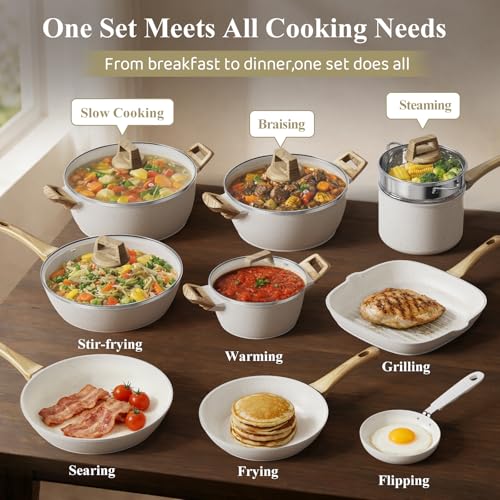
Complete Kitchen Cookware Set: Bazova 25-Piece Titanium-Reinforced Ceramic Pots and Pans
The Bazova 25-piece cookware set handles frying, simmering, steaming, grilling, and casseroles, with a ceramic nonstick surface that simplifies food release and cleanup. It suits households replacing mismatched cookware with an induction-ready, PFAS-free collection for everyday meals and meal prep.
Pros and Cons
Pros
- The ceramic coating is made without PFAS, PTFE, PFOA, lead, or cadmium.
- Three casserole pots and multiple pan styles provide useful flexibility for family meals and batch cooking.
- Included utensils, a steamer, and pan protectors add practical value beyond the core pots and pans.
- Balanced, ergonomic construction is designed to make lifting, pouring, flipping, and stacking more comfortable.
Cons
- The product data does not specify oven-safe temperature limits or dishwasher compatibility.
- Exact pan dimensions and cookware weights are not provided, making cabinet-fit and handling comparisons harder.

T-Fal
Ceramic Nonstick Cookware for Everyday Stovetop Cooking: T-Fal Inspire 10-Piece Set, Oven Safe to 500F, Mint Green
This 10-piece T-Fal Inspire set covers frying, simmering, and braising with a ceramic nonstick interior that lasts four times longer than T-fal's basic ceramic coating. It suits home cooks on gas, electric, or ceramic cooktops who want a full kitchen outfitted at once and don't need induction compatibility.
Pros and Cons
Pros
- Even heat base works across gas, electric, and ceramic cooktops without hot spots that scorch sauces.
- 100% recycled aluminum body cuts the environmental cost of a full cookware set.
- Limited lifetime warranty backs the set against manufacturing defects.
- Horizontal textured exterior and mint green finish look presentable enough to bring straight to the table.
Cons
- Not compatible with induction cooktops, which rules out a growing share of kitchens.
- Handwashing is recommended, and the lids drop to a 350F oven limit while the pans handle 500F.

Ninja
Best Ceramic Nonstick Fry Pan for Searing: Ninja Ceramic Pro 10.25" Review
The Ninja Ceramic Pro uses a titanium-infused ceramic coating that's PTFE-free and rated oven-safe to 550°F, delivering searing performance comparable to hybrid pans at a lower price point. Home cooks who want a nontoxic, metal-utensil-safe skillet with long-term durability will find the 10-year nonstick guarantee and scratch-resistant surface hard to match in this category.
Pros and Cons
Pros
- The PTFE-free ceramic coating is free of PFAS chemicals, lead, and cadmium, addressing the top safety concern for health-conscious cooks.
- Metal utensil safety and a claimed 5x scratch resistance over Caraway ceramic cookware make this more forgiving in daily use than most ceramic pans.
- 550°F oven and broiler compatibility is unusually high for a ceramic-coated pan and opens up sear-then-roast cooking techniques.
- Universal stovetop compatibility, including induction, means no compatibility guesswork when buying or upgrading.
Cons
- With zero published customer reviews at launch, long-term real-world durability of the ceramic coating remains unverified despite the 10-year guarantee claim.
- At 10.25 inches, the cooking surface is on the smaller side for households regularly cooking proteins for more than two people.
Editors' Picks
Bazova Complete Kitchen Cookware Set: Bazova 25-Piece Titanium-Reinforced Ceramic Pots and Pans
Bazova
Complete Kitchen Cookware Set: Bazova 25-Piece Titanium-Reinforced Ceramic Pots and Pans
The Bazova 25-piece cookware set handles frying, simmering, steaming, grilling, and casseroles, with a ceramic nonstick surface that simplifies food release and cleanup. It suits households replacing mismatched cookware with an induction-ready, PFAS-free collection for everyday meals and meal prep.
$149.97 at AmazonEditors' Favorite
Color: Cream White-25Pcs Set Size: Large Set Product Group: Kitchen
Shop NowT-Fal Ceramic Nonstick Cookware for Everyday Stovetop Cooking: T-Fal Inspire 10-Piece Set, Oven Safe to 500F, Mint Green
T-Fal
Ceramic Nonstick Cookware for Everyday Stovetop Cooking: T-Fal Inspire 10-Piece Set, Oven Safe to 500F, Mint Green
This 10-piece T-Fal Inspire set covers frying, simmering, and braising with a ceramic nonstick interior that lasts four times longer than T-fal's basic ceramic coating. It suits home cooks on gas, electric, or ceramic cooktops who want a full kitchen outfitted at once and don't need induction compatibility.
$169.95 at AmazonGreat Value
Color: Mint Green Size: 10-Piece Weight: 15.87 pounds Product Group: Kitchen Binding: Kitchen
Shop NowNinja Best Ceramic Nonstick Fry Pan for Searing: Ninja Ceramic Pro 10.25" Review
Ninja
Best Ceramic Nonstick Fry Pan for Searing: Ninja Ceramic Pro 10.25" Review
The Ninja Ceramic Pro uses a titanium-infused ceramic coating that's PTFE-free and rated oven-safe to 550°F, delivering searing performance comparable to hybrid pans at a lower price point. Home cooks who want a nontoxic, metal-utensil-safe skillet with long-term durability will find the 10-year nonstick guarantee and scratch-resistant surface hard to match in this category.
$59.99 at AmazonColor: Midnight Blue Size: 10.25-Inch Fry Pan Dimensions: 13 x 10.25 x 2 inches Weight: 2.2 pounds Product Group: Kitchen Binding: Kitchen
Shop NowGreenPan Rio Healthy Ceramic Nonstick 16 Piece Cookware Pots and Pans Set
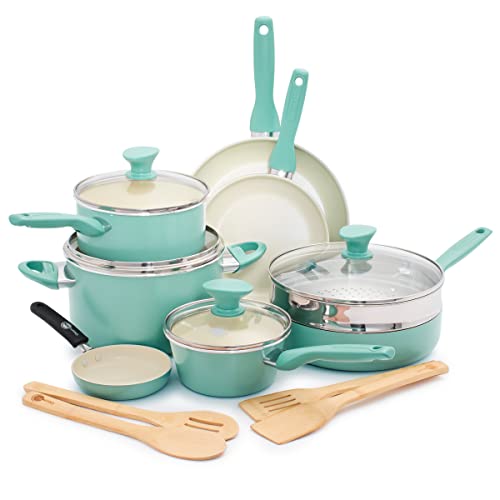
Color: Turquoise Size: 16 Piece Cookware Set Dimensions: 9.055118101 x 21.653543285 x 12.7952755775 inches Weight: 19.5990950918 pounds Product Group: Kitchen Binding: Kitchen
Shop NowThe Core Difference: Coating Type
Both are nonstick pans, but they achieve nonstick with different materials — and that’s the whole distinction.
Traditional nonstick uses a PTFE-based coating (polytetrafluoroethylene, the family that includes Teflon). PTFE is a fluoropolymer that provides excellent, slick food release. Modern PTFE nonstick is PFOA-free (PFOA, a processing chemical of concern, was phased out years ago), and intact PTFE nonstick is considered safe for normal cooking. See our are-nonstick-pans-safe guide.
Ceramic nonstick uses a ceramic (sol-gel, sand-derived) coating instead of PTFE. It’s free of PTFE, PFOA, and PFAS (“forever chemicals”), which is the basis of its “non-toxic” marketing. It provides good food release through a different chemistry. See our is-ceramic-cookware-non-toxic guide.
The fundamental difference: traditional nonstick = PTFE/fluoropolymer coating (durable, slick, PFAS-based); ceramic = sand-derived coating (PFAS-free, “non-toxic,” but less durable). Both are coatings over metal (usually aluminum) that provide nonstick release and both eventually wear out — the difference is the coating chemistry and its trade-offs. This single distinction drives the whole comparison. Our guides cover both types.
How They Compare
Here’s how ceramic and traditional nonstick stack up on the factors that matter.
Safety / chemicals:
- Ceramic: free of PTFE, PFOA, PFAS — the “non-toxic” appeal for those avoiding fluoropolymers. Doesn’t release fumes at high heat.
- Traditional nonstick: PTFE-based (PFOA-free in modern versions); considered safe when intact and used properly, but can release fumes if severely overheated (~500°F+), and some people prefer to avoid PTFE/PFAS on principle.
- Verdict: ceramic wins if avoiding “forever chemicals” is your priority; traditional nonstick is still considered safe within normal use.
Durability / lifespan:
- Traditional nonstick: the coating generally lasts longer and maintains food release better over time (often several years with care).
- Ceramic: the coating wears out faster (often 1-3 years), losing its nonstick sooner — the main ceramic complaint.
- Verdict: traditional nonstick wins on durability and lasting food release.
Food release / nonstick performance:
- Traditional nonstick: excellent, very slick release that holds up well over its life.
- Ceramic: good release when new, but degrades faster.
- Verdict: traditional nonstick has the edge, especially over time.
Heat tolerance:
- Ceramic: more heat-stable, handles somewhat higher temperatures without off-gassing.
- Traditional nonstick: should stay below ~500°F to avoid coating degradation and fumes.
- Verdict: ceramic tolerates heat a bit better.
Cooking spray: both should avoid aerosol cooking sprays (buildup damages the coating), but ceramic is especially sensitive.
Both share: coatings that eventually wear out (neither is permanent — see our how-often-to-replace-nonstick guide), needing gentle care (no metal utensils, low-medium heat, hand-washing preferred), and neither takes high-heat searing like stainless or cast iron. Our best ceramic cookware set non toxic and best nonstick cookware set guides cover options.
Which Should You Buy?
Match the coating to your priorities — chemical avoidance versus durability.
Choose ceramic cookware if you:
- Want to avoid PTFE, PFOA, and PFAS (“forever chemicals”) — the top reason to choose ceramic.
- Prioritize a “non-toxic” coating for peace of mind.
- Are okay replacing pans more often (1-3 years) in exchange for the PFAS-free surface.
- Want a coating that tolerates a bit more heat without off-gassing.
- Buy from reputable brands that disclose being free of harmful substances. See our best ceramic cookware set non toxic guide.
Choose traditional nonstick if you:
- Prioritize durability and lasting food release (it holds up longer than ceramic).
- Are comfortable with modern PFOA-free PTFE nonstick (considered safe when intact and used properly).
- Want the best, slickest release over the pan’s life.
- Want better value per year (longer lifespan). See our best nonstick cookware set guide.
Consider neither (go coating-free) if you:
- Want cookware that lasts indefinitely with no coating to wear out → stainless steel or cast iron (no coating, extremely durable, but need technique/seasoning and aren’t as effortlessly nonstick). See our best stainless steel cookware guide.
The honest framing: this is largely a chemical-avoidance vs durability trade. If avoiding fluoropolymers/PFAS matters to you, ceramic is the choice despite its shorter life. If you want the most durable, best-releasing nonstick and are fine with modern PTFE, traditional nonstick wins. And if you want a permanent solution, skip both for stainless or cast iron. Many kitchens keep one nonstick pan (ceramic or traditional) for eggs and delicate foods plus stainless/cast iron for everything else. Our guides cover all these options.
Frequently Asked Questions
What’s the difference between ceramic and nonstick cookware?
Both are nonstick pans, but they use different coatings. Traditional nonstick uses a PTFE-based (Teflon-family) fluoropolymer coating that’s durable and very slick. Ceramic nonstick uses a sand-derived (sol-gel) coating that’s free of PTFE, PFOA, and PFAS (“forever chemicals”), which is its “non-toxic” appeal. The trade-off: traditional nonstick lasts longer and releases food better over time, while ceramic avoids the fluoropolymer chemicals but wears out faster (often 1-3 years). Both eventually wear out and need gentle care.
Is ceramic cookware better than nonstick?
Neither is universally better — it depends on your priority. Ceramic is better if you want to avoid PTFE/PFAS “forever chemicals” and prefer a “non-toxic” coating that tolerates a bit more heat. Traditional nonstick is better if you prioritize durability and lasting food release, since it holds up longer (ceramic wears out faster, often in 1-3 years). It’s essentially a chemical-avoidance vs durability trade-off. Choose ceramic to avoid fluoropolymers, traditional nonstick for longevity and best release. Both are coated pans that eventually wear out.
Which lasts longer, ceramic or traditional nonstick?
Traditional (PTFE) nonstick generally lasts longer and maintains its food release better over time — often several years with proper care. Ceramic nonstick tends to wear out faster, frequently losing its nonstick performance within 1-3 years, which is the most common complaint about ceramic cookware. So if durability and long-lasting nonstick are your priority, traditional nonstick has the edge. Ceramic trades some of that longevity for being free of PTFE and PFAS. Both benefit from gentle care (low-medium heat, no metal utensils) to maximize lifespan.
Is traditional nonstick (Teflon) safe?
Modern traditional nonstick is considered safe when used properly and kept intact. It’s PFOA-free (PFOA, a processing chemical of concern, was phased out years ago), and intact PTFE coatings don’t release harmful amounts of anything at normal cooking temperatures. The main precautions are avoiding severe overheating (above ~500°F, where the coating can degrade and release fumes) and replacing pans when the coating is badly worn or flaking. Some people prefer to avoid PTFE/PFAS on principle, which is why ceramic exists as an alternative, but modern nonstick is regarded as safe in normal use.
Should I avoid nonstick cookware entirely?
Not necessarily — both ceramic and modern traditional nonstick are considered safe in normal use, so it comes down to preference. If you want to avoid PTFE/PFAS, choose ceramic; if you’re comfortable with modern PFOA-free PTFE, traditional nonstick is durable and safe. If you’d rather have no coating at all (nothing to wear out or worry about), use stainless steel or cast iron, which are coating-free and last indefinitely but require more technique or seasoning. Many people keep one nonstick pan for eggs plus stainless/cast iron for everything else.
Can I use metal utensils on ceramic or nonstick pans?
No, avoid metal utensils on both ceramic and traditional nonstick cookware — metal scratches and damages the coating, shortening its life and potentially causing it to flake. Use silicone, wood, or nylon utensils instead. Ceramic is especially sensitive to scratching. Also avoid abrasive scrubbers, aerosol cooking sprays (which build up and damage coatings), and high heat, and hand-wash rather than using the dishwasher. These gentle-care habits maximize the lifespan of either coating. If you want to use metal utensils freely, stainless steel or cast iron are better choices.
Related buying guides: best stainless steel cookware set and best cookware sets.
The Bottom Line
Ceramic and traditional nonstick cookware are both coated nonstick pans, differing in coating chemistry. Traditional nonstick uses a PTFE (Teflon-family) coating that’s durable, very slick, and modern versions are PFOA-free and safe when intact — but it’s fluoropolymer-based. Ceramic uses a sand-derived coating free of PTFE, PFOA, and PFAS (“forever chemicals”), the “non-toxic” appeal, but it wears out faster (1-3 years). Choose ceramic to avoid fluoropolymers, traditional nonstick for durability and lasting food release, or skip both for coating-free stainless steel or cast iron if you want a permanent solution. See our best ceramic cookware set non toxic and best nonstick cookware set guides.



Write Your Review
No reviews yet. Be the first to share your experience!