

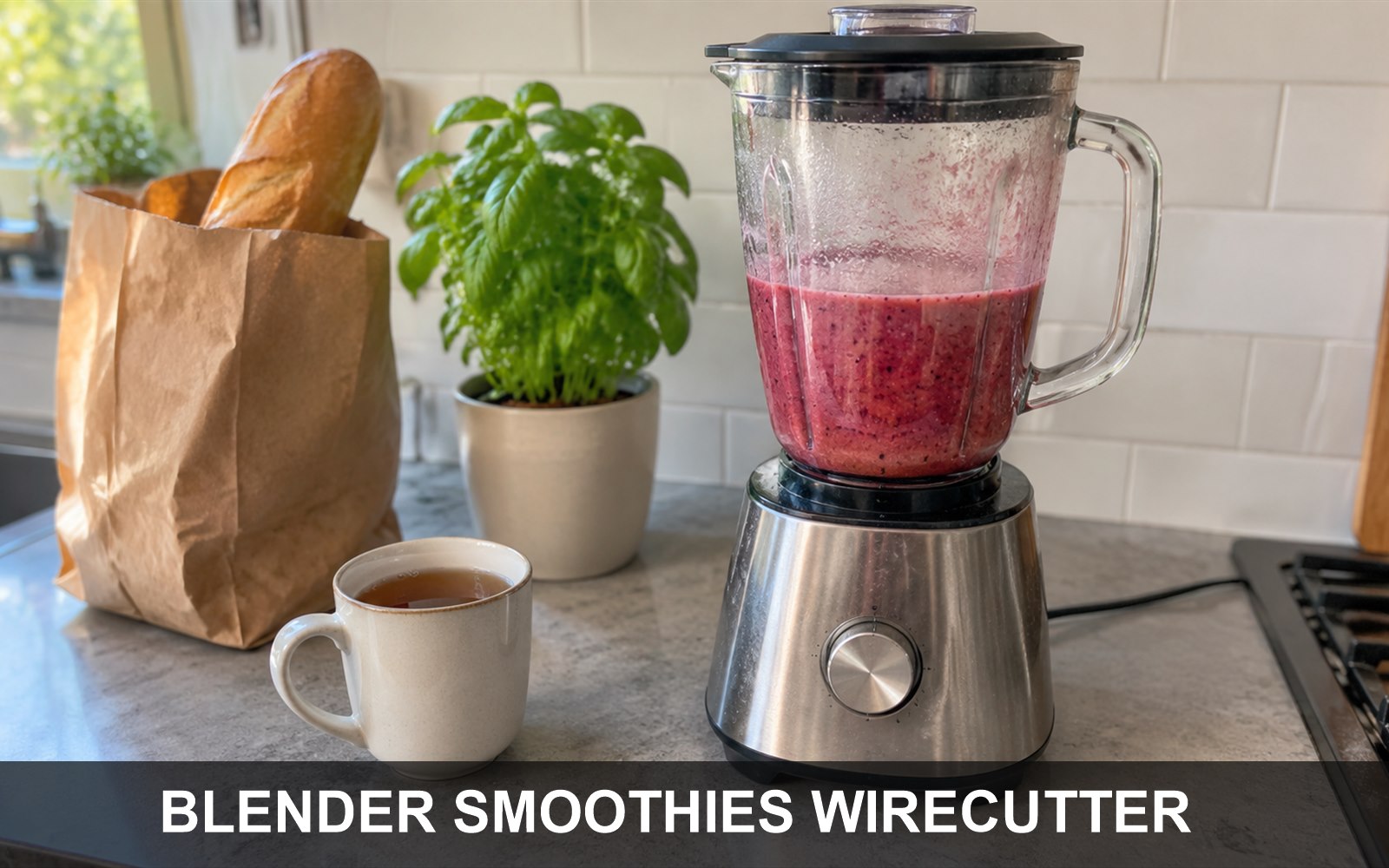
Most people buy a blender for smoothies because they picture thirty seconds of noise followed by a clean jar and a drinkable breakfast. The gap between that expectation and morning reality is where blade design, jar geometry, and motor wattage matter more than any marketing promise. If you make a protein shake with frozen banana chunks at 6:30 AM three days a week, you need different engineering than someone blending room-temperature spinach and almond milk twice a month. The best blender for smoothies wirecutter depends entirely on what you actually put in the jar, how often you clean it, and whether you can tolerate spending two minutes scraping kale fragments off the lid gasket.
This guide walks through three common blender scenarios—thick breakfast smoothies with frozen fruit, high-protein shakes with powder and ice, and leafy-green blends for meal prep—and identifies which specifications solve the friction points that turn a fifteen-second task into a ten-minute cleanup problem. We skip the vague language about “powerful motors” and focus on the documented wattage, blade angles, and jar materials that change how smoothly each scenario plays out in a real kitchen.
Frozen Fruit and Breakfast Timing
Frozen strawberries, mango chunks, and banana slices create the texture most people associate with a satisfying smoothie, but they also expose the weakest link in cheaper blender designs: blade assemblies that flex under load. A stainless steel blade mounted to a plastic coupler will spin freely around soft ingredients but stall or chatter when it hits a frozen mass. You hear the motor speed drop, the jar vibrates against the base, and the fruit rides up the sides instead of moving down toward the blades. This is not a technique problem or a liquid-ratio issue—it is a torque and bearing problem that shows up within the first twenty seconds of blending.
Blenders built for frozen ingredients use motors rated at 1000 watts or higher and pair them with metal drive couplings that do not deform under side load. The blade assembly sits in a jar with steeply angled sides—usually 30 degrees or more from vertical—so frozen chunks slide toward the blades instead of forming a stable ring around the perimeter. These jars also have narrow bases, which concentrates the vortex and keeps ingredients moving through the cutting zone. If your morning routine depends on blending straight from the freezer, look for a jar volume between 48 and 64 ounces (enough to make two servings without overfilling) and a lid design that lets you add liquid through a center plug without removing the entire top. That last feature cuts cleanup time in half when you need to adjust consistency mid-blend.
The other variable that matters for frozen-fruit smoothies is blade count and pitch. Four-blade assemblies with asymmetric angles—two blades angled at 20 degrees, two at 40 degrees—create turbulence that pulls frozen pieces down into the cutting zone faster than symmetrical designs. If you make smoothies three or more times per week, the difference in blend time adds up to several minutes per month, and the reduction in unblended chunks means less time spent shaking the jar or stopping to scrape the sides.
Protein Powder, Ice, and Clumping
Protein shakes introduce a different problem: powder that clumps when it contacts liquid too quickly, forming sticky pockets that either float on top or coat the jar walls. Ice cubes make this worse by creating cold spots that solidify the clumps before the blades can break them apart. The typical response is to blend longer, but extended run times heat the motor and thin out the shake, leaving you with a warm, foamy drink that separates within ten minutes. The best blender for smoothies wirecutter in this scenario is one that minimizes contact time through higher blade speed and better vortex design.
Blade tip speed matters more than raw wattage for protein drinks. A blade rotating at 25,000 RPM creates enough shear force to break apart clumps in the first five seconds, before they have time to stick to the jar or float out of reach. Cheaper blenders top out around 18,000 RPM, which leaves visible powder streaks even after thirty seconds of blending. Look for models that list actual RPM figures in the specifications rather than vague “high speed” claims. Jar shape also plays a role: tall, narrow jars keep the vortex tight and force powder through the blade zone repeatedly, while wide, shallow jars spread the mixture out and let clumps hide near the walls.
Ice-crushing capability is listed on almost every blender box, but the meaningful specification is blade thickness. Blades thinner than 2mm bend or chip when they hit hard ice, and the resulting rough edges make protein residue stick to the blade assembly. Stainless steel blades stamped from 2.5mm or thicker stock hold an edge longer and rinse clean under running water without needing a brush. If you add ice to every shake, pay attention to whether the lid has a removable center cap—blenders without this feature force you to remove the entire lid to add ice mid-blend, which lets powder escape and coats the rim with sticky residue.
Leafy Greens and Meal Prep Volume
Blending kale, spinach, or Swiss chard for green smoothies creates two immediate problems: the leaves compress into a mat that blocks the blades, and fibrous stems leave stringy bits that get stuck in your teeth. People who make green smoothies in large batches—four or more servings at once—also run into capacity issues, where adding enough liquid to blend properly means the jar is too full to achieve a smooth vortex. The result is a gritty, layered drink with foam on top and unblended chunks at the bottom.
Solving the leafy-green problem requires a jar design that pulls material down into the blade path continuously. Some blenders accomplish this with ribs molded into the inside of the jar, which disrupt the vortex just enough to knock leaves off the walls without stopping the overall flow. Other designs use wider blade assemblies—spanning 70% or more of the jar diameter—so greens cannot ride up the sides and avoid the cutting zone. Both approaches work, but ribbed jars are harder to clean because smoothie residue collects in the grooves, while wide blades make the jar heavier and harder to pour from.
For meal prep batches, jar volume becomes the limiting factor. A 64-ounce jar can hold four 12-ounce servings with enough headspace to prevent overflow, but only if you add ingredients in the correct order: liquid first, then greens, then frozen fruit or ice on top. Adding greens first creates an air pocket that prevents the blades from pulling liquid up, so the motor runs at full speed without actually blending anything. Look for blenders with measurement markings molded into the jar rather than printed on the outside—printed markings wear off after a few months of washing, and eyeballing proportions leads to overfilling.
The other variable that matters for green smoothies is whether the blade assembly removes from the bottom of the jar for cleaning. Fixed blades trap fibrous material underneath the gasket, and that residue turns into a bacterial growth site within 24 hours if you do not disassemble and scrub the seal. Removable blade designs let you rinse both sides of the gasket under running water and confirm that no organic material is left behind. If you make green smoothies more than twice a week, this cleaning step shifts from optional to mandatory, and blenders without removable blades require a small brush and extra time to stay sanitary.
Motor Heat and Duty Cycle
Most blender motors are rated for intermittent use, which means they overheat if you run them continuously for more than 60 seconds. Manufacturers bury this limitation in the fine print as a “duty cycle”—typically one minute on, two minutes off. If you ignore that guideline and blend multiple smoothies back-to-back, the motor winding temperature climbs past the thermal cutoff point and the blender shuts down mid-blend. Cheaper models use a manual-reset thermal breaker that requires you to wait 15 minutes before the blender will start again, while better designs use an automatic breaker that resets in three to five minutes.
Heavy-duty blenders solve the heat problem with larger motors that dissipate heat faster, or with brushless DC motors that generate less waste heat in the first place. These models typically cost twice as much as basic blenders, but the trade-off is a duty cycle that allows two or three minutes of continuous blending without triggering a thermal shutdown. If your morning routine involves making smoothies for multiple people in sequence, a longer duty cycle is worth the price difference because it eliminates the waiting time between batches.
Another heat-related issue is jar material. Polycarbonate jars insulate the contents and trap motor heat, which raises the temperature of the smoothie itself. Glass jars conduct heat away from the blending zone and keep drinks colder, but they add weight and create a higher center of gravity that makes the blender tip more easily if you bump it while the motor is running. Tritan copolyester jars split the difference—they stay cooler than polycarbonate without the fragility risk of glass, and they do not absorb odors or stain from berry pigments the way softer plastics do.
Frequently Asked Questions
Does wattage directly predict blending performance for frozen ingredients?
Wattage measures input power, not the mechanical force delivered to the blades. A 1200-watt motor paired with a poorly designed gearbox or a flexible blade assembly will underperform a 900-watt motor with a rigid coupling and optimized blade geometry. The correlation between wattage and frozen-ingredient performance holds only when comparing blenders with similar drive-train designs. Look for motors rated at 1000 watts or higher as a baseline, but verify that the blade assembly uses metal couplings and that owner reviews confirm the blender handles frozen fruit without stalling or chattering.
How often should you replace blender blades to maintain smoothie consistency?
Stainless steel blades dull gradually rather than failing suddenly, so the decline in performance is hard to notice until you compare a fresh blade to one that has been in service for a year. If you blend frozen fruit or ice daily, expect blade sharpness to drop noticeably after six months, at which point blending time increases by 20 to 30 percent and you see more unblended chunks. Replacement blade assemblies cost between twelve and thirty dollars depending on the model, and swapping them takes less than five minutes. Some manufacturers sell blade assemblies with upgraded materials—hardened steel or titanium-coated edges—that last twice as long as the original blades.
Can you fix a blender that leaves chunks at the bottom without buying a new jar?
Chunks at the bottom usually mean the blade assembly is not creating enough downward flow to pull ingredients through the cutting zone. Adding more liquid helps temporarily, but it also dilutes the smoothie and changes the texture. A more effective fix is to add ingredients in stages—blend the frozen or fibrous items first with just enough liquid to get the vortex started, then add the remaining liquid and softer ingredients once the hard materials are broken down. If that still leaves chunks, check whether the blade assembly is loose or damaged; a worn gasket or bent blade will disrupt flow patterns even if the motor runs normally. Replacing the blade assembly costs less than replacing the entire blender and often solves the problem completely.

Quik
Cordless 24oz Smoothie Blender for Ice-Crush Shakes, QUIK Portable Blender
The QUIK Portable Blender makes smoothies, juices, and protein shakes while crushing ice with one-button operation, and its cordless design supports blending away from an outlet. It suits travelers, gym users, and busy kitchens that need a 24-ounce personal blender with portable drinking and cleaning features.
Pros and Cons
Pros
- Cordless operation makes it practical for travel, outdoor use, and locations without a nearby outlet.
- Ice-crush capability expands its use beyond basic shakes and soft ingredients.
- Dishwasher-safe Tritan parts and a self-cleaning cycle simplify maintenance.
- The safety switch prevents operation until the blender is properly engaged.
Cons
- The 24-ounce capacity may require multiple batches when preparing drinks for several people.
- The listing does not provide the blender's weight, making carry comfort harder to evaluate.
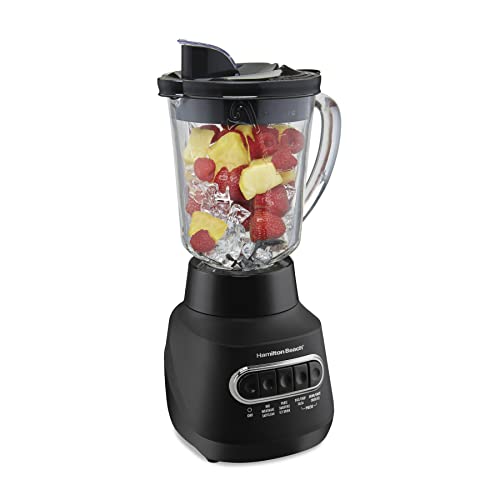
Hamilton Beach
Smoothie Blender for Quieter Ice Crushing: Hamilton Beach Quiet Blender With Wave Action System
This Hamilton Beach blender makes smoothies, frozen drinks, and blended recipes with quieter operation as its biggest advantage. It suits households that want easier smoothie prep and cleanup with a dishwasher-safe glass jar, blades, and lid.
Pros and Cons
Pros
- The patented base design minimizes motor and airflow noise during operation.
- The Wave Action system helps pull difficult ingredients into the blades for thorough blending.
- The dishwasher-safe removable parts make cleanup easier after smoothie preparation.
- The stainless steel blades are built for repeated ice-crushing tasks.
Cons
- The glass jar may feel heavier and is less forgiving of drops than a plastic jar.
- The 800-watt peak rating is suited to everyday smoothies and frozen drinks, not necessarily the most demanding blending workloads.

MUELLER HOME
Smoothie and Shake Blender: MUELLER HOME Heavy-Duty Personal Blender with 15 Oz Travel Cup
The MUELLER HOME personal blender makes shakes, smoothies, juices, dressings, and baby food with one-touch blending, while its travel cup reduces cleanup. It suits individuals who want compact, portable drink preparation without investing in a larger countertop blender.
Pros and Cons
Pros
- Four stainless steel blades provide strong chopping and blending performance in a compact appliance.
- The one-touch control keeps operation simple for quick single-serving recipes.
- The included travel cup and lid combine blending and drinking in one container.
- Its compact format handles smoothies, juices, dressings, and baby food without taking up the space of a full-size blender.
Cons
- The 15-ounce cup is better suited to individual portions than large family-size batches.
- Its compact single-cup design may require multiple blending cycles when preparing drinks for several people.

Abuler
Smoothie Blender for Fast Frozen Fruit Drinks, Abuler PB2105 1200W Personal Blender with Two 20oz Cups
The Abuler PB2105 blends smoothies, sauces, jams, baby food, and protein shakes with a peak 1200W motor and six-leaf stainless-steel blade. It suits busy households, fitness users, and small kitchens because two 20oz cups support blend-and-go convenience without taking much counter space.
Pros and Cons
Pros
- The 1200W motor and six-leaf blade are designed for demanding ingredients such as ice and frozen fruit.
- Two 20oz cups make it easier to prepare separate servings or keep one drink ready to go.
- The compact design fits apartments, dorm rooms, and kitchens with limited counter space.
- The cups, lids, and included brush support convenient everyday use and cleanup.
Cons
- The blender requires water or milk for proper operation and even mixing, especially with fruit and other solid ingredients.
- Blending should be limited to 20 seconds at a time, and the motor base cannot go in the dishwasher.
The Best Deals This Week*
-
Smoothie Blender for Quieter Ice Crushing
$49.39
($52.45)Save $3.06 -
Smoothie and Shake Blender
$21.87
($29.99)Save $8.12 -
Smoothie Blender for Fast Frozen Fruit Drinks
$34.98
($49.99)Save $15.01
*Deals are selected by our commerce team
Quik Cordless 24oz Smoothie Blender for Ice-Crush Shakes, QUIK Portable Blender
Quik
Cordless 24oz Smoothie Blender for Ice-Crush Shakes, QUIK Portable Blender
The QUIK Portable Blender makes smoothies, juices, and protein shakes while crushing ice with one-button operation, and its cordless design supports blending away from an outlet. It suits travelers, gym users, and busy kitchens that need a 24-ounce personal blender with portable drinking and cleaning features.
Check price on AmazonThe QUIK Portable Blender is a cordless personal blender for smoothies, juices, and protein shakes. It solves the need for single-serve blending without keeping the appliance beside a kitchen outlet.
Its one-button ice-crush function and 20-second timer support quick smoothie preparation, while the 24-ounce cup handles a substantial individual serving.
The cup uses durable Tritan and has dishwasher-safe parts. A waterproof seal, sip lid, and extra leak-proof cap support easier cleaning, carrying, and drinking.
The 24-ounce size is useful for one serving but may be limiting for multiple people. The listing does not state the blender's weight.
Verdict: best for individuals who want cordless smoothies, shakes, or juices at home, work, the gym, or outdoors.
Hamilton Beach Smoothie Blender for Quieter Ice Crushing: Hamilton Beach Quiet Blender With Wave Action System
Hamilton Beach
Smoothie Blender for Quieter Ice Crushing: Hamilton Beach Quiet Blender With Wave Action System
This Hamilton Beach blender makes smoothies, frozen drinks, and blended recipes with quieter operation as its biggest advantage. It suits households that want easier smoothie prep and cleanup with a dishwasher-safe glass jar, blades, and lid.
Check price on AmazonThis countertop blender solves the nuisance of noisy smoothie preparation while handling smoothies, frozen drinks, ice, greens, and frozen ingredients.
Its Wave Action system circulates ingredients toward the blades, while 800 watts of peak power and stainless steel blades support thorough ice and frozen-food blending.
The glass jar, removable blades, and lid are dishwasher safe, which helps reduce cleanup effort after daily use. The glass construction may add weight compared with plastic.
Its five labeled buttons simplify operation, but the 800-watt peak rating is aimed at everyday blending rather than the most demanding workloads.
Best for households wanting quieter smoothie preparation with straightforward controls and dishwasher-safe parts.
MUELLER HOME Smoothie and Shake Blender: MUELLER HOME Heavy-Duty Personal Blender with 15 Oz Travel Cup
MUELLER HOME
Smoothie and Shake Blender: MUELLER HOME Heavy-Duty Personal Blender with 15 Oz Travel Cup
The MUELLER HOME personal blender makes shakes, smoothies, juices, dressings, and baby food with one-touch blending, while its travel cup reduces cleanup. It suits individuals who want compact, portable drink preparation without investing in a larger countertop blender.
Check price on AmazonThe MUELLER HOME personal blender solves the need for quick individual smoothies, shakes, juices, dressings, and baby food without a bulky countertop setup.
One-touch pulse blending and four stainless steel blades help combine fresh or frozen ingredients quickly for everyday recipes.
The food-grade, non-toxic ABS blending jar holds 15 ounces and includes a drinking lid, making blend-to-go preparation simpler.
Its small capacity limits it to personal portions, and the available specifications do not state its weight.
Verdict: best for individuals who want portable single-serving blending with minimal cleanup.
Abuler Smoothie Blender for Fast Frozen Fruit Drinks, Abuler PB2105 1200W Personal Blender with Two 20oz Cups
Abuler
Smoothie Blender for Fast Frozen Fruit Drinks, Abuler PB2105 1200W Personal Blender with Two 20oz Cups
The Abuler PB2105 blends smoothies, sauces, jams, baby food, and protein shakes with a peak 1200W motor and six-leaf stainless-steel blade. It suits busy households, fitness users, and small kitchens because two 20oz cups support blend-and-go convenience without taking much counter space.
Check price on AmazonThe Abuler PB2105 is a compact personal blender for smoothies, sauces, jams, baby food, and protein shakes. It addresses quick single-serve preparation without demanding much counter space.
Its peak 1200W motor and six-leaf 304 stainless-steel blade are built to process ice, frozen fruit, and hard nuts for smoother results.
The BPA-free, shatter-resistant 20oz cups double as blending and drinking vessels. Two cups, to-go lids, and a cleaning brush support daily use.
Add water or milk, avoid overfilling, and blend for no more than 20 seconds at a time. The motor base is not dishwasher-safe.
Best for busy users, fitness routines, and compact kitchens needing quick personal servings.
Write Your Review
No reviews yet. Be the first to share your experience!